
Here’s the thing about creating content that actually gets noticed: you have to know your audience. I mean, really know them. Better than they know themselves.
This isn't about making educated guesses. It’s about digging deep to understand their real-world frustrations, their secret ambitions, and the exact words they use when they’re venting to a colleague. If you can tap into that, you've found the foundation for content that truly connects.
Your Audience Is the Foundation of Everything

Before a single word gets written or one graphic is designed, you have to look outward. So many marketers and creators fall into the trap of starting with their own ideas or what they assume the audience needs. That inside-out approach is precisely why most content lands with a thud.
Think of it like this: engaging content is a two-way conversation. And you can’t have a good conversation if you don’t know who you're talking to. This means going way beyond the basics like age and location. Sure, that stuff is useful, but it doesn't tell you why someone should care about what you have to say. You need to get into their heads—their values, their pain points, and what actually motivates them to act.
Moving Beyond Basic Demographics
To get this right, you almost have to become a digital anthropologist. Your job is to find the human story buried in the data. Where do these people spend their time online? What’s keeping them up at night? What are the biggest hurdles standing in their way, professionally or personally?
Here are a few practical ways I’ve found to get these answers:
- Listen on Social Media: Don't just broadcast—listen. Spend time in Reddit threads, niche Facebook groups, and the comment sections on LinkedIn posts in your industry. The questions people ask and the problems they complain about are pure gold. It’s unfiltered, raw insight.
- Talk to Your Frontline Teams: Your sales and customer support colleagues are sitting on a treasure trove of information. They talk to your customers all day, every day. Ask them about the most common objections, the questions that come up constantly, and the "aha" moments that finally get someone to sign on or solve a problem.
- Run Simple Surveys: Use a tool like Google Forms to ask your current audience a few direct questions. Keep it short and sweet. Ask about their single biggest challenge or what topic they wish someone in your industry would finally explain properly.
A critical first step in creating engaging content is understanding how to identify your target audience. This process sets the stage for everything that follows, ensuring your efforts are focused and effective from the start.
From Insights to Actionable Personas
Once you’ve gathered all this intel, you can start building an audience persona that feels like a real person. This isn't just a document you create and file away—it should become your north star for every content decision you make.
To give you a real-world example, I once worked with a B2B SaaS company that was convinced its audience of project managers desperately wanted a new time-tracking feature.
But after we dug into LinkedIn group discussions, we found their actual pain point wasn't tracking time. It was having to communicate project delays to stakeholders without looking incompetent. That one insight changed their entire content strategy. Instead of writing a blog post about a new feature, they created a guide on "How to Communicate Project Delays with Confidence."
The result? The guide's engagement rate was double that of their previous content. It worked because it solved a real, emotional problem. If you want to go deeper on this, we've got a whole guide on the process: https://www.reachlabs.ai/how-to-identify-target-audience/
This kind of deep understanding is what builds authenticity, and that’s what people connect with. The numbers back this up: 54% of consumers are more likely to buy from creators they find relatable, and a whopping 87% say that personally relevant topics are key. This is exactly why generic, one-size-fits-all content fails, and audience-first content always wins. You can find more data on this from Social Native’s look at creator marketing.
Creating a persona from this research ensures your insights don't get lost. A simple checklist can keep you focused on what truly matters.
Audience Persona Development Checklist
This table is a quick guide to help you translate your research into a tangible persona you can use every day.
| Attribute Category | Key Questions to Answer | Example (for a B2B SaaS Marketer) |
|---|---|---|
| Demographics | What is their age, role, industry, and company size? | "Maria, 32, Marketing Manager at a mid-size tech company (100-500 employees)." |
| Goals | What are they trying to achieve professionally? What does success look like for them? | "Wants to prove marketing ROI to get a bigger budget and a promotion to Director." |
| Challenges | What are their biggest frustrations or obstacles? What keeps them up at night? | "Struggles to unify data from different platforms (Google Analytics, CRM, social) to create one report." |
| Watering Holes | Where do they go for information? Which blogs, influencers, or communities do they trust? | "Listens to the Marketing Over Coffee podcast, follows Ann Handley on LinkedIn, active in r/marketing." |
| Motivations | What drives their decisions? Are they motivated by efficiency, innovation, or career growth? | "Driven by data and efficiency; wants tools that save time and provide clear, actionable insights." |
| Communication | What is their preferred communication style? Do they prefer quick bullet points or deep dives? | "Prefers scannable, data-backed blog posts and short-form video tutorials. Hates marketing fluff." |
By filling this out, you create a clear picture of a real person, making it infinitely easier to create content that speaks directly to their needs.
Weaving Your Story with Hooks and Structure

Okay, you’ve done your homework and you know who you’re talking to. Now for the fun part: giving them something they actually want to consume. Just throwing facts at people doesn’t work. We're all wired for stories. It’s stories that create the emotional connection that turns a casual browser into a loyal follower.
This is where you move from being an information provider to a storyteller. You’re taking raw data and ideas and shaping them into a journey with a clear beginning, middle, and end. The whole point is to make your audience feel something, learn something, and remember you long after they’ve moved on.
You Have Three Seconds. Make Them Count.
In the world of the infinite scroll, you don’t get a few minutes to make your case. You get seconds. The very first sentence of your post or the first three seconds of your video has to give someone an undeniable reason to stop scrolling. That’s your hook.
A great hook creates an instant hit of curiosity, empathy, or even urgency. It often works by poking at a common belief, asking a question they can't ignore, or hitting on a problem they're desperate to fix.
Here are a few hook archetypes I’ve seen work time and time again:
- The "You're Doing It Wrong" Hook: This one challenges a piece of conventional wisdom. For example: "Everyone tells you to post on social media every single day. What if that’s the worst advice for growing your brand?"
- The Shocking Statistic Hook: A surprising number can jolt people to attention. Picture a video opening with: "Did you know that half of all marketing budgets are wasted on content nobody ever sees?"
- The Relatable Problem Hook: This speaks directly to a shared frustration. An article could kick off with: "You know that feeling of staring at a blank page, knowing you need a killer content idea right now? It’s the worst."
The goal is to send an immediate signal: "This is for you, and it's worth your time." Without a solid hook, even the most brilliant content just becomes more noise.
Structuring Your Content So People Actually Read It
Once you’ve got their attention, the next challenge is holding it. Structure is your best friend here. A well-organized piece of content doesn't just present information; it guides the reader effortlessly from one point to the next, making even complex topics feel easy to digest.
Long, intimidating blocks of text are the absolute enemy of engagement. People scan online. You have to make your content easy on the eyes. That means short paragraphs, clear subheadings, and plenty of white space to let the words breathe.
Your content's structure isn't just about organizing ideas; it's about respecting your reader's time and cognitive load. An easy-to-scan format shows you understand how people consume information online and makes your message more likely to stick.
This is absolutely critical for video. Short-form videos, in particular, need a breakneck pace to keep people from swiping away. It's no surprise that videos under one minute have an average retention rate of 66%. That stat really drives home the need for tight storytelling right from the jump. You can find more data about social media video performance here. Your structure has to deliver value fast and keep it coming.
Borrowing from Proven Storytelling Frameworks
You don't need to reinvent the wheel every single time. There are proven storytelling frameworks that give you a reliable skeleton for your narrative, making sure it has a logical flow and an emotional punch. One of the most effective I've ever used is the Problem-Agitate-Solve (PAS) model.
The PAS framework is beautifully simple:
- Problem: Kick things off by clearly stating a pain point your audience knows all too well. This ties right back to the relatable problem hook.
- Agitate: Now, don’t just leave the problem there—poke it. Dig into the frustrations, the consequences, and the emotional toll it takes. This is where you build real empathy.
- Solve: Finally, you ride in with the solution. This could be your product, a new strategy, a piece of advice, or anything that resolves the agitated problem.
For example, a blog post for a project management tool could use PAS like this:
- (Problem) Managing a dozen different projects feels like juggling chainsaws.
- (Agitate) Deadlines are always slipping, communication is a mess, and you spend more time chasing people for updates than actually working.
- (Solve) Our tool puts everything in one place, giving you a crystal-clear view of everyone's progress and bringing some sanity back to your workflow.
This simple structure works for almost anything—blog posts, video scripts, social captions, you name it. It turns dry information into a compelling story of relief. To dig deeper, check out our guide on building a powerful brand storytelling framework.
When you combine a killer hook with a structure that resonates, you create content that doesn’t just inform—it connects.
Choosing the Right Format for Maximum Engagement
You could have the most brilliant idea in the world, but if you package it wrong, it’ll fall flat. Think about it: serving a gourmet meal on a flimsy paper plate just doesn't work. Picking the right content format is a strategic move that determines whether your audience stops to listen or just keeps scrolling.
This isn't about chasing the latest trend. It’s about creating a perfect match between your message, your audience's habits, and the platform you're on. A deep, analytical topic that shines as a 2,000-word blog post will almost certainly fail as a 30-second TikTok. On the flip side, a quick visual tip that's perfect for an Instagram Reel would feel painfully stretched out in a long-form article.
Aligning Format with Your Message and Audience
Before you automatically start writing another blog post, hit pause. What is the core purpose of this specific piece of content? Is it meant to educate, entertain, inspire, or persuade? Your answer is a compass pointing you toward the right format.
- For in-depth education: Go with long-form articles, webinars, or detailed YouTube tutorials. These give you the space to build a solid case, back it up with data, and walk people through complex steps.
- For quick entertainment or a dose of inspiration: Short-form video (think Reels and TikToks), image carousels, and even simple GIFs are your best friends. They're designed for quick hits and easy sharing.
- For bringing data to life: Nothing beats an infographic. The human brain processes visuals a staggering 60,000 times faster than text, so a sharp infographic can make complicated data not just understandable, but memorable.
- For building a genuine connection: Podcasts and live streams are fantastic for this. They create a feeling of intimacy, making your audience feel like they're part of a real conversation, which is gold for building trust.
This is a real pain point for a lot of marketers. The pressure is on, with 38% struggling to create content faster and 35% finding it tough to come up with compelling ideas in the first place. You can dive deeper into these content marketing trends on Blogging Wizard. Nailing the format from the get-go makes the entire creation process smoother and far more effective.
Making Smart, Platform-Specific Choices
Every social platform has its own vibe, its own unwritten rules. Great content respects that. Something that gets tons of engagement on LinkedIn will likely die a silent death on TikTok simply because people are in a completely different headspace.
Someone scrolling LinkedIn is probably looking for career advice or industry news, so professional articles, data-driven posts, and polished videos work well. That same person, five hours later on TikTok, is in full-on entertainment mode, looking for a laugh, a life hack, or a surprising fact.
The real secret to multi-platform success isn't just blasting the same content everywhere. It's about translating your core idea into the native language of each platform.
Take one piece of original research. You could spin it into a whole ecosystem of content:
- The Pillar Post: Start with a comprehensive blog article that covers everything. This is your foundation.
- The Visual Summary: Create a sharp infographic with the key stats to share on LinkedIn and Pinterest.
- The Quick Tip Video: Film a 60-second Reel for Instagram that breaks down one actionable insight from the research.
- The Discussion Starter: Head over to X (formerly Twitter) and pose a provocative question related to your findings to get a conversation going.
This approach isn't just about saving time; it's about maximizing your impact by meeting people where they are, with a format they actually want to see. This kind of smart adaptation is a huge part of successful content repurposing strategies.
Don't Forget to Make It Interactive
Sometimes, the best way to engage your audience is to make them part of the story. Interactive content like quizzes, polls, calculators, and assessments can be incredibly powerful because they shift people from passive consumers to active participants.
Imagine a financial services company. Instead of writing another article titled "How to Prepare for Retirement," they could create a "What's Your Retirement Readiness Score?" quiz. It’s instantly more compelling because it gives the user personalized, immediate value. It directly answers their silent question: "What does this mean for me?"
You should lean on interactive formats when your goal is to:
- Generate high-quality leads.
- Segment your audience based on their needs.
- Make a complex topic feel personal and relevant.
- Boost social shares and keep people on your page longer.
In the end, the right format is the vehicle that delivers your message. By making a thoughtful choice based on your topic, audience, and platform, you give your hard work the best possible chance to not just be seen, but to be felt, remembered, and acted upon.
Optimizing and Distributing Content for Greater Reach
You’ve poured hours, maybe even days, into creating a brilliant piece of content. That’s a huge win, but it’s only half the journey. The other, equally critical half is making sure it actually reaches the people you made it for. This is where a smart optimization and distribution plan turns your hard work from a quiet asset into a powerful engine for growth.
Think of it this way: your content is a product. Optimization is the packaging that makes it irresistible to search engines and users. Distribution is the logistics network that gets it in front of the right eyeballs. Without both, even the best content just sits on a digital shelf, collecting dust.
Fine-Tuning Your Content for Discovery
Before you even think about hitting “publish,” a few small tweaks can make a world of difference in how easily your content gets found. This isn't about gaming the system or stuffing keywords where they don't belong. It’s about making your content clear, helpful, and accessible—for both search engines and the humans using them.
For written content like a blog post, this means weaving your primary keyword naturally into your title, your intro, and a few key subheadings. It’s also about building a web of relevance through internal linking. Guiding readers to other useful articles on your site is a simple act that keeps them engaged longer and shows search engines how your content connects, boosting your entire site's authority.
When it comes to video, optimization starts before you even upload. On crowded platforms like YouTube, your title and thumbnail are the one-two punch that wins the click. The title needs to be rich with relevant terms but also spark genuine curiosity. Your thumbnail should be clean, emotionally resonant, and pop visually against the competition.
The goal of on-page optimization isn't just to rank higher. It's to create a better, more coherent user experience. When you make your content easy for search engines to understand, you're also making it easier for people to find and consume.
Once your content is polished, it’s time to lean into effective content distribution strategies to get it in front of your target audience. This is how you move beyond just hoping people find you.
Work Smarter with Content Repurposing
Distribution doesn't have to mean reinventing the wheel for every single platform. Honestly, the most efficient and effective approach is to treat one major piece of content as a "pillar" and then splinter it into dozens of smaller "micro-assets." This lets you maximize your reach with minimal extra effort.
The process is all about looking at your core message through the lens of different platforms and formats to see how it can be reimagined.
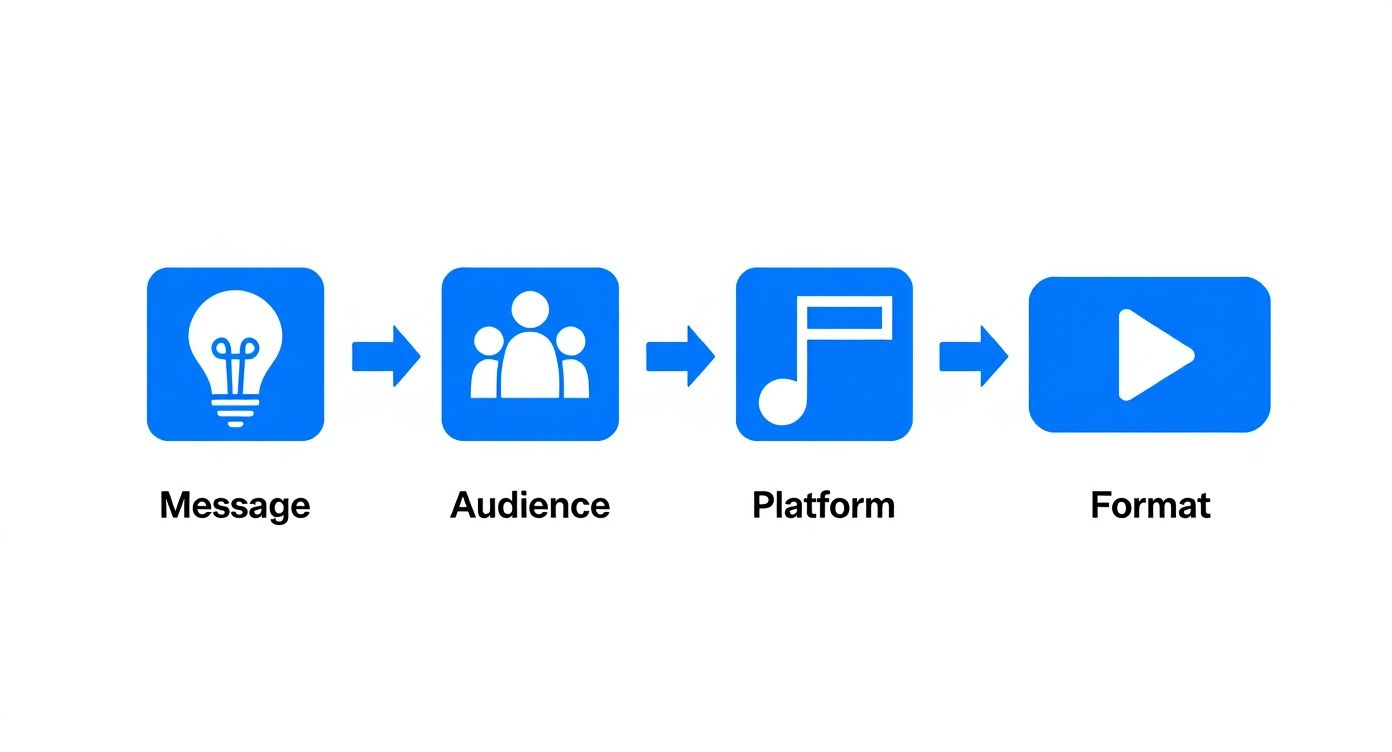
As you can see, the core idea has to be adapted for a specific audience and platform before you can pick the most engaging format.
Let's walk through a real-world scenario. Imagine a B2B software company just published a massive 3,000-word guide on "Improving Team Productivity." Instead of just tweeting the link and calling it a day, they transformed that one guide into a full week of promotional content.
Here’s how they broke it down:
- LinkedIn: They created a five-slide carousel post highlighting the top 5 productivity myths busted in the guide. Each slide featured a key takeaway and a compelling visual.
- X (formerly Twitter): They scheduled a thread of eight tweets. The first tweet hooked readers with a startling statistic from the guide. Each one that followed shared a single, actionable tip, with the final tweet linking back to the full article.
- Instagram: They shot a quick, 45-second Reel where a team member acted out a common productivity mistake from the guide, with the solution appearing as on-screen text.
- Email Newsletter: They didn’t just send a link. They dropped the introduction and the first major section of the guide directly into the email, with a clear call-to-action to "Read the final 4 tips on our blog."
By repurposing their pillar content, they met their audience on five different platforms with native, engaging formats that felt right for each channel. This multi-pronged approach amplified their reach and drove sustained traffic to the original guide long after it was published. Now that's how you make content work for you.
Measuring Success and Refining Your Strategy
So you've created and published your content. Job done, right? Not even close.
If you’re not measuring its impact, you're essentially shouting into the void. You have no idea if anyone heard you, what they thought, or what you should say next. We have to kill the "create and hope" mindset and replace it with a disciplined "measure and refine" cycle. This is what separates the pros from the amateurs.
This isn't about getting a dopamine hit from vanity metrics like raw page views or a ballooning follower count. Those numbers look nice on a report, but they don't tell you if your content actually connected with anyone. The real magic happens when you turn raw data into actionable insights that fuel your next great idea.
Focusing on Metrics That Matter
What you measure depends entirely on what you’re trying to achieve. You wouldn't use the same yardstick for a piece meant to build brand awareness as one designed to get sign-ups for a webinar. Before you look at a single dashboard, get crystal clear on your objective.
Let's break it down with some real-world examples:
- Goal: Brand Awareness. Don't just look at reach. Go deeper. I'm talking about Average Watch Time on your videos, Scroll Depth on your articles, and social media Brand Mentions. These tell you if people are actually paying attention.
- Goal: Audience Engagement. This is where the real connection happens. Look for Comments, Shares, and especially Saves. These actions take effort and signal that your content was so valuable, someone wanted to return to it later. That's gold.
- Goal: Lead Generation. Now we’re talking business. The metrics here need to be sharp: Click-Through Rate (CTR) on your calls-to-action, Conversion Rate on your landing pages, and the number of qualified leads—like MQLs—it actually produced.
True engagement isn't just about eyeballs; it's about action. If your content doesn't inspire your audience to think, feel, or do something different, it hasn't done its job.
When you tie your metrics directly to your goals, you stop collecting data and start understanding performance. That clarity is what lets you make smart, strategic decisions instead of just guessing what might work next.
Tracking the right metrics is crucial for understanding what truly resonates with your audience. To help you align your measurement strategy with your content objectives, here's a breakdown of which KPIs to focus on for different goals.
Key Engagement Metrics by Content Goal
| Content Goal | Primary Metrics to Track | Secondary Metrics | Tools for Measurement |
|---|---|---|---|
| Brand Awareness | Impressions, Reach, Video Views (first 3s), Brand Mentions | Social Media Follower Growth, Website Traffic | Google Analytics, Native Social Media Analytics |
| Audience Engagement | Likes, Comments, Shares, Saves, Average Session Duration | Click-Through Rate (CTR), Scroll Depth | Sprout Social, Hootsuite, Hotjar |
| Lead Generation | Conversion Rate, Form Submissions, Downloads, MQLs | Cost Per Lead (CPL), CTR on CTAs | HubSpot, Marketo, Google Analytics Goals |
| Sales/Revenue | Sales Attributed to Content, Customer Lifetime Value (CLV) | Return on Investment (ROI), Conversion Funnel Drop-off | CRM Platforms (Salesforce), E-commerce Analytics |
Ultimately, this table serves as a starting point. Your specific toolkit and metrics might vary, but the principle remains the same: measure what's directly tied to the outcome you want to create.
Time for a Content Audit
Every so often, you need to get out of the weeds and look at the big picture. This is where a content audit comes in. It’s a systematic review of all your published assets to see what’s working, what’s flopping, and where your biggest opportunities are hiding.
Start by grouping your content. You can categorize it by topic ("beginner guides" vs. "expert interviews"), format (blog posts, videos, podcasts), or the campaign it was part of. Then, pull the key performance data for each category based on the goals we just discussed.
Almost immediately, patterns will jump out at you. You might find that your "how-to" videos consistently crush your expert interviews, or that listicles drive 3x more traffic than your thought leadership essays.
Think of this not as finding failures, but as discovering your strengths. Once you know your top performers—your "winners"—the path forward is clear: double down. For the "losers" that fell flat, you have two choices. You can try to update and optimize them with what you've learned, or you can just archive them and stop wasting resources on a dead end.
This cycle of measuring, auditing, and refining is the engine of any great content strategy. It’s how you guarantee you're not just creating more content, but more of what actually works.
Common Questions About Creating Engaging Content
Even with the best plan in the world, you're going to hit a few snags. It happens to everyone. Let's walk through some of the most common questions that pop up when you're in the trenches, creating content day in and day out.
How Long Should My Content Be?
Honestly, there's no single magic number. The right length is whatever it takes to deliver value on that specific topic, for that specific audience, on that specific platform.
For a comprehensive blog post trying to rank for a competitive term, you might see top performers clocking in at over 1,400 words. But don't mistake length for quality. A punchy, 500-word article that solves a niche problem in two minutes can be way more valuable (and engaging) than a bloated 3,000-word piece that hides the answer.
It's all about the format, too. A TikTok or Instagram Reel needs to grab attention and deliver its message in under 60 seconds. Meanwhile, a dedicated YouTube audience is often happy to settle in for a detailed 10-20 minute video.
The real secret? Let the topic dictate the length. Your job is to answer the user's question completely and satisfyingly. Don't add fluff, and don't cut corners.
What Is the Best Way to Find New Content Ideas?
Waiting for a lightning bolt of inspiration is a surefire way to fall behind. The best creators don't wait for ideas; they build systems to find them consistently.
Instead of one single source, think of it as an "idea engine" fed by multiple streams:
- Eavesdrop on your audience. Seriously. The best ideas come straight from their mouths (or keyboards). Dive into your social media comments, comb through customer support emails, and send out a quick survey. What are their biggest headaches? What questions keep coming up?
- Dig into keyword research. Tools like Ahrefs or Semrush aren't just for SEOs. They show you exactly what your audience is typing into Google. That’s pure, unfiltered demand you can build content around.
- Do some competitor recon. See what’s working for others in your space. Find their most popular articles or videos and ask yourself: "How can I do this better? Can I offer a fresh perspective? Is there an angle they completely missed?"
- Talk to your internal experts. Your sales and customer service teams are goldmines. They hear the real-world objections, questions, and goals of your customers every single day. A 15-minute chat with them can spark a dozen content ideas.
How Can a Small Team Produce High-Quality Content Consistently?
When you're a small team (or a team of one), the game is about strategy, not brute force. Forget trying to out-produce the big guys. Your mantra should be consistency over frequency.
One amazing, high-impact piece of content is infinitely better than five mediocre ones. Quality is your competitive advantage.
First up, you need a killer repurposing strategy. Go all-in on creating one "pillar" piece of content—think a comprehensive guide, an original research report, or a webinar. Then, slice and dice it into dozens of "micro" assets. That one pillar can fuel your social media for weeks with quote graphics, short video clips, key takeaways, and discussion prompts. You're maximizing every ounce of effort.
Next, templatize everything. Create simple, reusable outlines for your blog posts, video scripts, and social media updates. Templates remove the "blank page" problem, speed up your workflow, and help maintain a consistent level of quality without reinventing the wheel every time.
Finally, you can't be everywhere. Don't even try. Pick one or two channels where your audience actually lives and commit to dominating them. It’s far more powerful to be a recognized voice on a single platform than a faint whisper on ten.
Ready to stop guessing and start creating content that drives real results? The expert team at ReachLabs.ai combines data-driven strategy with creative execution to build a content engine that elevates your brand and achieves your business goals. Learn more about how we can help you connect with your audience.