
For any small business, lead generation is how you find and attract people who might buy from you. It’s the process of sparking their interest and getting their information so you can, hopefully, turn them into a customer. Think of it as the first, most crucial step in moving from random, one-off sales to building a real, sustainable system for growth.
Why Lead Generation Is the Fuel for Small Business Growth

Lead generation isn't just another marketing task—it's the engine that powers everything else you do. It’s the difference between crossing your fingers and hoping for customers, and actually having a reliable stream of them coming in the door. Without a steady flow of new prospects, a business can easily stall out, relying solely on past customers or unpredictable word-of-mouth.
Imagine it as the foundation of your sales and marketing house. Every single lead is an opportunity, a person who has essentially raised their hand and said, "I'm interested in what you have." This creates a predictable pipeline, which lets you forecast revenue more accurately and make smarter decisions about your budget and resources.
Building a Foundation for Predictable Revenue
When you get proactive about generating leads, you introduce a powerful element of stability into your business. You can finally step off the exhausting feast-or-famine rollercoaster and create a system that consistently brings new opportunities your way. This is absolutely critical for surviving slow seasons and staying a step ahead of the competition.
A healthy flow of leads puts you in the driver's seat. It gives you the power to:
- Forecast sales with confidence: You'll have a much better idea of where your next customers are coming from.
- Navigate slow periods: A full pipeline can carry you through seasonal dips without causing a panic.
- Scale your business smartly: It’s much easier to hire a new team member or invest in equipment when you know you have a predictable influx of work.
For small businesses, lead generation isn’t a one-and-done task. It's the core activity that transforms marketing spend into real, measurable revenue and ensures your business is built to last.
The Numbers Tell the Story
The data backs this up. Across the board, a staggering 91% of marketers say lead generation is their single most important goal. But it's not always easy. The average lead-to-customer conversion rate hovers at just 2.9%, which means you need a lot of quality leads coming in to make a meaningful impact on your bottom line.
To really scale your efforts without burning out, it's worth diving into a complete guide to automated lead generation. This is where you shift from constant manual effort to building systems that bring in leads for you around the clock.
Turning Your Website Into a Lead Capture Machine
Think of your website as your best salesperson—one that never sleeps. Too many small business sites just sit there, like a digital brochure, waiting for someone to pick them up. To really generate leads, you need to transform your site from a passive placeholder into an active, engaging tool that guides visitors right where you want them to go.
This isn't just a nice idea; it's becoming essential. More and more small businesses are waking up to this reality. In fact, 73% of small businesses in the U.S. now have a website, which is a huge leap from just 64% back in 2020. This investment is clearly paying off, with businesses reporting revenue bumps between 15-50% after launching a modern site. You can dig into the numbers yourself with these small business website statistics here.
Crafting High-Converting Landing Pages
The first real step is to get serious about your landing pages. A landing page isn't just any page on your site; it’s a standalone page built with one single, focused goal: to get that lead. Your homepage has to juggle a dozen different tasks, but a landing page is a specialist.
To get these pages working for you, nail these three things:
- A Crystal-Clear Offer: Be incredibly direct about what someone gets for filling out your form. Is it a free audit? A downloadable checklist? A discount code? Make the offer so good and so obvious that they can't help but want it.
- Compelling Copy: You need to speak directly to your visitor's problems. Use a headline that grabs them by the collar and bullet points that quickly lay out the benefits of your offer.
- Minimal Distractions: This is huge. Rip out the main navigation menu, social media links, and anything else that could pull them away. The only thing they should be able to do is fill out that form.
A well-designed page is the foundation of this whole process. If you need some real-world inspiration, our guide on creating a high-converting landing page is packed with actionable examples and layouts you can put to use right away.
Designing Lead Magnets That Solve Problems
A lead magnet is that valuable freebie you dangle in exchange for an email address. The trick is to offer a quick win. The best lead magnets solve a very specific, nagging problem for your ideal customer. They don't have to be a 100-page epic.
Some of the most effective ones are surprisingly simple:
| Lead Magnet Type | Why It Works | Example Scenario |
|---|---|---|
| Checklist | It's easy to digest and gives a clear, step-by-step path to getting something done. | A local catering company offers a "10-Point Event Planning Checklist." |
| Short Guide/eBook | It positions you as an expert and provides real value on a niche topic. | A financial advisor creates a guide called "5 Common Retirement Mistakes to Avoid." |
| Template | It saves your audience a ton of time by giving them a resource they can use immediately. | A marketing agency provides a "Monthly Social Media Content Calendar Template." |
The point of a lead magnet isn’t to show off everything you know. It’s to prove you can solve one small problem really well. That builds the trust you need for them to hire you to solve the bigger ones.
Optimizing Your Forms for Frictionless Capture
Your form is the final hurdle between a curious visitor and a new lead. You can have the world's best landing page and an irresistible offer, but a clunky form will kill your conversions dead.
The golden rule? Only ask for what you absolutely need right now.
Put yourself in their shoes. Every single field you add is another bit of friction, another reason for them to click away. For that first interaction, like downloading a guide, a name and an email address are usually plenty. You can always gather more details later as you build the relationship.
And please, make your call-to-action (CTA) button specific. Ditch the boring "Submit." Instead, use phrases that reinforce the value, like "Get My Free Guide" or "Book My Consultation." This simple tweak turns a chore into a rewarding exchange and can make a massive difference in how many leads you actually capture.
Using Content to Attract Your Ideal Customers
Let's get one thing straight: content isn't just about churning out blog posts. It’s about solving your customers' problems, over and over again, until they see you as the only solution. When you consistently offer up valuable information, you stop chasing leads and start attracting them. This whole idea, content marketing, is what turns your small business into a trusted authority and creates a reliable stream of inbound interest.
The concept is beautifully simple. Figure out what keeps your ideal customers awake at night, then create content that solves that exact problem. This completely changes the dynamic. You're no longer making a sales pitch; you're starting a helpful conversation, which is a much better foundation for a real business relationship.
This infographic paints a clear picture of where most small businesses stand online.
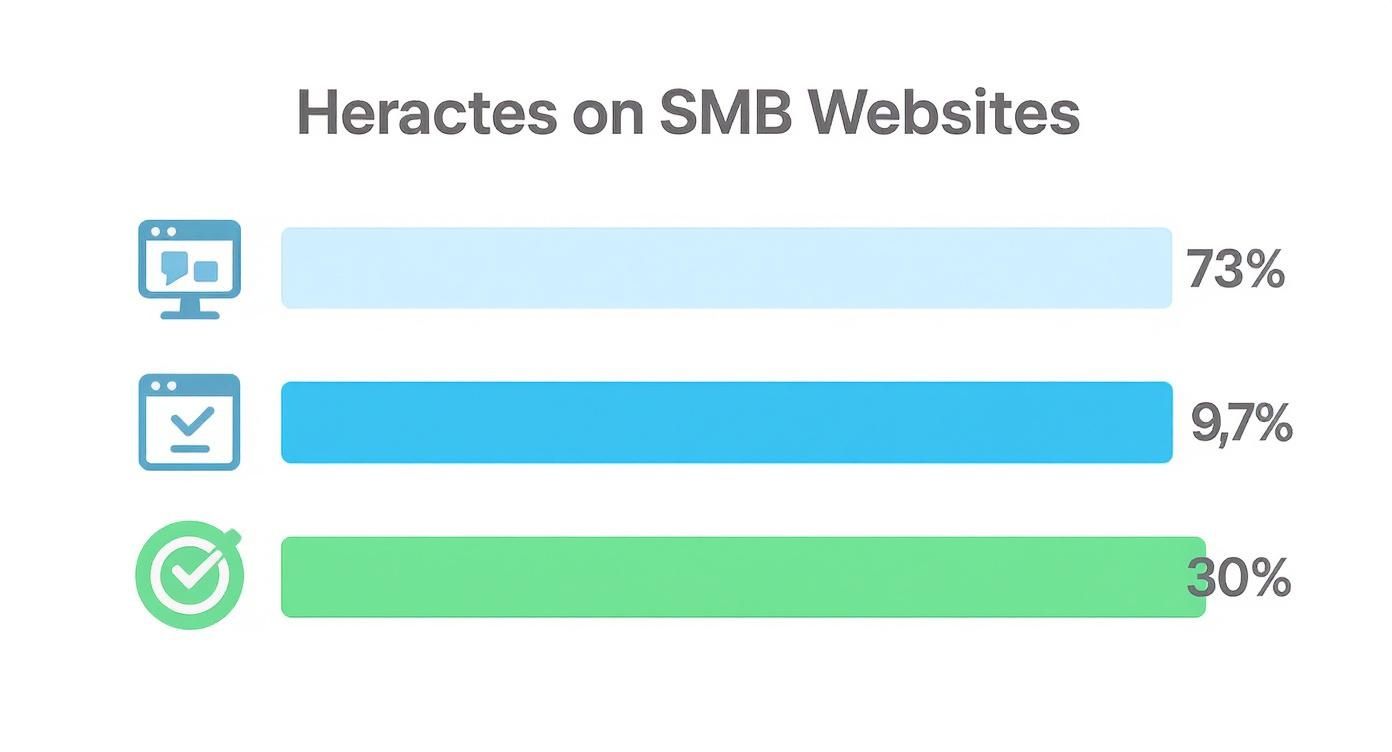
As you can see, most small businesses have a website, but the conversion rates tell the real story. There’s a huge opportunity to do better—to turn all that website traffic into actual, tangible leads.
Uncovering Your Customers' Biggest Pain Points
The best content ideas won’t come from a fancy brainstorming session in a boardroom. They come directly from your audience. Your job is to become an expert listener and dig into the real, nitty-gritty challenges they’re dealing with every day. This is the bedrock of any content strategy that actually generates leads.
Here are a few practical places to start your detective work:
- Scour Online Forums: Dive into places like Reddit, Quora, or industry-specific groups. Pay close attention to the exact words people use when they ask for help. That’s the language you need to be using in your own content.
- Talk to Your Sales Team (or Yourself): What are the top five questions you get on every single sales call? I guarantee each one of those is a fantastic idea for a blog post, a short video, or a downloadable guide.
- Read Customer Reviews: Don't just look at your own reviews—check out your competitors' too. What are the common complaints and frustrations you see popping up again and again? These are absolute goldmines for content ideas.
Once you have a solid list of problems, you can start reframing them as compelling content topics. For instance, if you're a local accountant and you constantly hear, "I am so lost when it comes to quarterly taxes," you've got your next title: "A Simple Guide to Quarterly Taxes for Freelancers."
Turning Problems Into Compelling Content
Armed with a list of genuine pain points, you can start creating content that doesn't just attract people but truly connects with them. The goal is to provide such undeniable value that they think, "Wow, this business really gets me." That's the moment trust is built—the kind of trust that makes someone happy to give you their contact information.
To make your content really hit home, focus on these three things:
- Actionable Advice: Don't just talk about the problem. Give people clear, concrete steps to solve it. A simple checklist, a ready-to-use template, or a step-by-step tutorial is infinitely more valuable than a vague, high-level overview.
- Relatable Scenarios: Use real-world examples that your customers can see themselves in. Instead of offering generic advice, tell a quick story about how another small business owner tackled the same challenge.
- Basic SEO Integration: You don't have to be an SEO wizard. Just make sure the keywords and phrases your customers are actually searching for appear naturally in your titles, headings, and throughout your text.
The most powerful lead generation content never feels like marketing. It feels like a helping hand, guiding a potential customer toward a solution—with your business perfectly positioned as the expert they need.
If you're looking to go deeper on this, our guide on content marketing for small businesses is packed with more advanced strategies.
Leveraging LinkedIn for B2B Lead Generation
For any business selling to other businesses, LinkedIn is an absolute powerhouse. It's not just another social network; it’s a dedicated platform for professional conversations. Forget about broadcasting generic company updates. The real magic happens when you use it to engage directly with potential clients by sharing genuinely insightful content.
Think of it this way: you’re not making a cold call, you’re joining a relevant conversation that’s already happening. Share short, punchy posts that tackle a specific industry problem, leave thoughtful comments on other people’s content, and get active in group discussions. This is how you build visibility and credibility over time.
To see how different channels stack up for small businesses, it's helpful to compare them directly.
Lead Generation Channel Effectiveness
This table breaks down the effectiveness of various channels to help you decide where to focus your time and budget for the best return.
| Channel | Effectiveness Score (Out of 100) | Best For | Key Metric |
|---|---|---|---|
| Content & SEO | 92 | B2B & B2C, long-term growth | Organic Traffic, Keyword Rankings |
| 89 | B2B, professional services | Engagement Rate, Lead Gen Forms | |
| Email Marketing | 85 | Nurturing existing leads | Open Rate, Click-Through Rate |
| PPC/Google Ads | 78 | Quick wins, targeted campaigns | Cost Per Lead (CPL), Conversion Rate |
| Social Media Ads | 75 | B2C, e-commerce, brand awareness | Cost Per Acquisition (CPA), Reach |
The data shows that for sustainable, long-term growth, nothing beats a solid content and SEO strategy. However, for direct B2B engagement, LinkedIn is hard to top.
In fact, content marketing is now responsible for over 51.5% of all lead acquisition, and LinkedIn is a dominant force in the B2B world. A staggering 89% of B2B marketers use the platform specifically for lead generation. Why? Partly because its native Lead Gen Forms can hit a 13% conversion rate—which blows the average landing page out of the water.
By consistently showing up with helpful, relevant content, you cement yourself as a trusted resource. When a prospect in your network finally needs the service you offer, your name will be the first one that comes to mind. This organic, relationship-first approach is one of the most sustainable ways to generate leads for your small business today.
Nurturing Leads with Smart Email Marketing
Getting an email address isn't the finish line—it's the starting pistol. The real race to win a customer happens in their inbox. This is your chance to turn someone who was just browsing into a paying customer, but it requires a smart approach, not just a constant barrage of sales pitches.
This is where thoughtful email marketing comes in. It’s all about guiding leads toward a decision without being pushy. You do this by delivering real value, building trust, and simply staying on their radar. That way, when they’re finally ready to pull the trigger, your business is the first one they think of.
Setting Up a Simple Welcome Sequence
That first email you send is your single best shot at making a great impression. Seriously. Welcome emails can see open rates as high as 82%, so you absolutely cannot afford to mess this up.
An automated welcome sequence is the perfect tool for the job. It's a short series of emails that automatically goes out to new subscribers, introducing them to your brand and warming them up.
Think of it as a friendly handshake and a quick tour. A simple but highly effective sequence could look like this:
- Email 1 (Immediately): A warm welcome that delivers whatever they signed up for (the checklist, the guide, the discount code). Keep it short, sweet, and focused on that initial promise.
- Email 2 (2 Days Later): Share one of your most popular articles or a quick, helpful tip related to their interest. This positions you as an expert without asking for a single thing in return.
- Email 3 (4 Days Later): Tell a short story. It could be about why you started your business or a quick case study of how you helped a customer. This builds a human connection and shows the real-world results you deliver.
This hands-off approach ensures every single new lead gets a consistent, positive first impression, even when you're busy running your business.
Using Segmentation for Personalized Messaging
You wouldn't have the exact same conversation with every person at a networking event, right? Your email list should be no different. Segmentation is just a fancy word for splitting your list into smaller, more focused groups based on their interests or actions.
Doing this lets you send messages that are far more relevant, which in turn gets you way better engagement.
For a small business, this doesn't need to be some complex data science project. You can start with simple, powerful segments:
- How they signed up: If someone downloaded your "Event Planning Checklist," they're probably interested in event services. Someone who grabbed the "Corporate Catering Menu" has a completely different need. Talk to them accordingly.
- What they've looked at: Many modern email platforms can see which pages on your website a contact has visited. If they spent time on your "Web Design Services" page, you can follow up with a relevant case study.
- If they've bought before: Keep your existing customers separate from your prospects. You can send customers special offers or loyalty rewards, while prospects get more educational content.
A personalized email always beats a generic blast. When you send the right message to the right person, you're showing them you actually understand their problems. That's a huge step toward earning their trust—and their business.
Crafting Content That Keeps You Top-of-Mind
After your welcome sequence wraps up, the goal is to stay in touch without being annoying. The secret? Provide relentless value. Your emails should feel less like advertisements and more like helpful notes from a trusted expert in your field. If you want to dive deeper, you can explore our guide on lead nurturing automation to see how to put this on autopilot.
Here are a few content ideas that consistently work well for nurturing leads:
| Content Type | Why It Works | Example Scenario |
|---|---|---|
| Weekly Tips | Gives subscribers quick, actionable advice that's easy to digest and reinforces your expertise. | A local gym sends a "Workout Wednesday" email with a new exercise or a simple nutrition tip. |
| Case Studies | Shows potential customers how you've solved the exact problems they're facing right now. | A web design agency tells the story of how they helped a client increase online sales by 40%. |
| Behind-the-Scenes | Humanizes your brand and builds a much stronger, more personal connection with your audience. | A coffee shop owner shares a quick video of their team taste-testing new seasonal drinks. |
To really make this work, you need the right tools in your corner. Checking out some of the Top Email Outreach Tools can give you the power to manage your campaigns, track engagement, and make sure your messages are actually resonating. By combining great content with the right tech, you build a powerful system for turning interested leads into loyal customers.
Measuring What Matters for Lead Generation
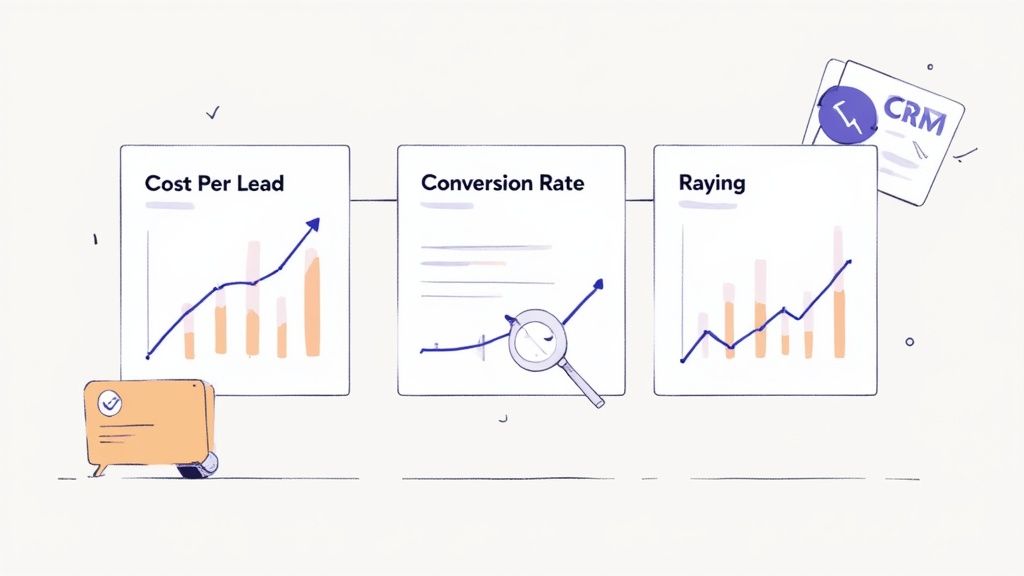
Running a lead generation campaign without tracking your results is like driving blind. Sure, you're moving, but you have no clue if you're even on the right road, let alone heading toward your destination. To stop guessing—and start investing your money where it counts—you have to measure what actually matters.
This isn’t about drowning in a spreadsheet full of confusing data. It’s about zeroing in on a handful of key numbers that tell you the real story behind your marketing. When you understand these core metrics, you can make sharp, data-backed decisions that grow your business.
Identifying Your Most Important Metrics
As a small business owner, your time and budget are your most valuable assets. You can't afford to get distracted by "vanity metrics" that look nice but don't move the needle. Your focus should be on the numbers that reveal the health of your entire lead-gen funnel, from that first click to the final handshake.
Here are the heavy hitters you should be watching like a hawk:
- Conversion Rate: This is your bread and butter—the percentage of people who take the action you want them to. If they land on a page, do they fill out the form? A low conversion rate is a red flag, pointing to a potential issue with your landing page, your offer, or your message.
- Cost Per Lead (CPL): Simply put, how much does it cost you to get one new lead? You calculate this by dividing your total campaign spend by the number of leads generated. Knowing your CPL for each channel (say, Google Ads versus LinkedIn) is mission-critical for smart budget allocation.
- Lead Quality Score: Let's be honest, not all leads are created equal. A simple scoring system, even a 1-to-5 scale, helps you distinguish the hot prospects from the tire-kickers. This tells you which channels are bringing in people who are actually likely to buy.
- Customer Lifetime Value (CLV): This is the big-picture number. It represents the total revenue you can reasonably expect from a single customer over the entire course of your business relationship. When you compare CLV to your CPL, you finally see your true return on investment.
The real goal is to get past just counting leads and start understanding their actual value. A channel might bring in fewer, more expensive leads, but it could be your most profitable one if those leads become high-value, long-term customers.
Essential Tools for Tracking and Analysis
You don't need a team of data scientists or a Fortune 500 budget to track your campaigns effectively. There are plenty of powerful, affordable (and even free) tools that can give you all the insights you need to make better decisions.
Getting the right tech in place is the first step. It puts data collection on autopilot so you can spend less time crunching numbers and more time acting on what they tell you.
For small businesses, trying to track everything manually is a recipe for disaster. I've seen it happen—spreadsheets get messy, data gets lost, and opportunities are missed. A few key tools can make all the difference.
To help you get started, here's a quick-reference guide to the most important metrics you should be tracking.
Key Lead Generation Metrics and Their Meaning
| Metric | What It Measures | Why It Matters | Good Benchmark |
|---|---|---|---|
| Conversion Rate | The % of visitors who complete a desired action (e.g., form fill). | Indicates the effectiveness of your landing page and offer. | 2-5% is average; 10%+ is excellent. |
| Cost Per Lead (CPL) | Total campaign cost / Number of leads generated. | Determines the cost-effectiveness of your marketing channels. | Varies widely by industry, but aim to keep it well below your average sale value. |
| Lead Quality | The likelihood of a lead converting into a paying customer. | Helps you focus sales efforts on the most promising prospects. | Aim for >75% of leads to be qualified (MQLs). |
| Customer Lifetime Value (CLV) | Total net profit a customer brings to your business over time. | Puts your acquisition costs into perspective and reveals long-term profitability. | Should be at least 3x your Customer Acquisition Cost (CAC). |
These benchmarks can vary, but they give you a solid starting point for evaluating your own performance.
Putting the Data to Work
Once the numbers are rolling in, the real work begins. Data tells a story, and your job is to interpret it and make adjustments.
Let's say you're looking at your CPL and notice your Facebook ads are costing you $50 per lead, while your SEO and blog content are bringing them in for just $15 per lead. The knee-jerk reaction might be to kill the Facebook campaign.
Not so fast. Before you pull the plug, you need to ask some deeper questions:
- Are the more expensive leads from Facebook higher quality? Do they close faster or have a higher CLV?
- Can we tweak the ad creative, audience targeting, or landing page on Facebook to bring that CPL down?
- How can we double down on our blog content strategy to get even more of those $15 leads?
This cycle of analyzing, questioning, and testing is the heart of optimization. It's how you turn lead generation from a guessing game into a predictable, scalable engine for growth. By consistently measuring what truly matters, you ensure every dollar you spend is pushing your business forward.
Your Top Lead Generation Questions, Answered
Jumping into lead generation can feel like you're trying to crack a code. There's a ton of jargon, conflicting advice, and it’s tough to know where to start. It makes sense that you've got questions.
Let's cut through the noise. Here are some straightforward, practical answers to the most common questions I hear from small business owners.
How Much Should We Actually Budget for Lead Generation?
There’s no one-size-fits-all number, unfortunately. Your ideal budget really depends on your industry, how much revenue you're bringing in, and your growth goals. But if you're looking for a solid starting point, a common benchmark for small businesses is to put 7-12% of total revenue toward marketing as a whole.
The real key isn't the initial number, but how you think about it. It’s about return on investment, not just spending. The best way to figure this out is to track your Cost Per Lead (CPL) for every channel you try.
For instance, you might find that your blog posts and SEO efforts are bringing in leads for about $20 each, while a paid ad campaign on LinkedIn is costing you $60 per lead. That data doesn't automatically mean LinkedIn ads are a waste of money. It just gives you the power to shift more of your budget toward what’s working best for you.
My advice? Start small. Pick two or three channels, track your CPL and conversion rates like a hawk, and then go all-in on the winners. Let real data—not some arbitrary percentage—drive your spending decisions.
What's the Real Difference Between an MQL and an SQL?
Getting this right is a game-changer. It’s what stops your sales team from chasing dead-end leads and wasting their time. The terms might sound like corporate buzzwords, but the concept is simple and incredibly powerful.
-
MQL (Marketing Qualified Lead): Think of this as someone who is "kicking the tires." They've shown some interest in what you do—maybe they downloaded an ebook, signed up for your newsletter, or watched a webinar. They're curious, but they haven't raised their hand to say, "I'm ready to buy."
-
SQL (Sales Qualified Lead): This is where it gets serious. An SQL is a lead who has been vetted and is showing clear buying signals. They've moved past simple curiosity and have taken an action like requesting a demo, asking for a price sheet, or filling out your "Contact Sales" form. They're ready for a conversation.
When you create clear definitions for MQLs and SQLs, you build a solid bridge between your marketing and sales departments. It makes the handoff seamless and ensures your sales team spends its valuable energy on the hottest prospects, which is a direct line to better efficiency and more closed deals.
Seriously, How Long Does This Stuff Take to Work?
The honest answer is: it depends entirely on your strategy. It’s helpful to split your efforts into two buckets: short-term wins and long-term assets.
Paid advertising, like Google Ads or social media campaigns, can start pulling in leads almost instantly. You could literally launch a campaign in the morning and have new leads in your inbox by the afternoon. The catch? The second you stop paying, the leads dry up. It’s like a faucet—on when you pay, off when you don’t.
On the other hand, organic strategies like content marketing and SEO are the long game. You're building an asset. It can easily take 3-6 months of consistent effort—publishing great content, earning backlinks, and optimizing your website—before you see a meaningful, steady flow of leads.
The payoff for that patience is massive, though. The leads you get from organic channels are often higher quality and much cheaper in the long run. The best approach is usually a mix of both: use paid ads for some quick wins while you patiently build your organic engine for sustainable, long-term growth.
Should I Just Buy a List of Leads to Get Started?
I know it sounds like a tempting shortcut to fill your pipeline fast, but buying lead lists is almost always a catastrophic mistake. Here's why.
First off, those people never gave you permission to contact them. That makes your outreach unsolicited spam, which could land you in hot water with regulations like GDPR or the CAN-SPAM Act. The fines are no joke.
Even worse, the quality of these lists is notoriously bad. You'll be dealing with terrible conversion rates and a sky-high email bounce rate. All that negative activity can get your domain blacklisted by email providers, which cripples your ability to reach the real leads you generate later on. It’s just not worth the risk.
Invest that money and energy into building your own list of people who have actually expressed interest in what you have to offer. It's the only sustainable way to grow.
At ReachLabs.ai, our focus is on building sustainable growth engines for businesses like yours. We blend data-backed strategy with world-class creative to generate high-quality leads that become loyal customers. See how our team can help elevate your brand.