
Attribution modeling is all about figuring out which of your marketing efforts actually deserve credit when a customer makes a purchase. Instead of just giving 100% of the credit to the very last thing they clicked, this process looks at the entire customer journey—from that first social media ad they saw weeks ago to the final email that sealed the deal.
What Is Attribution Modeling in Marketing
Think about a game-winning touchdown. The wide receiver who catches the ball gets the glory, but what about the quarterback's perfect throw? Or the offensive line that gave him time to make it? If you only credited the receiver, you’d have a seriously skewed view of how the team actually won.
Marketing works the same way. Without a proper system to assign credit, we tend to give it all to the final touchpoint. Attribution modeling is the framework that helps you see the whole field, evaluating how all your channels work together to score that "win"—whether it's a sale, a new lead, or a sign-up.
By mapping out the entire customer journey, you can finally answer those nagging questions:
- Which channels are actually introducing new people to our brand?
- What touchpoints are most effective at keeping prospects engaged and moving them along?
- What's the final push that convinces someone to buy?
"Attribution modeling assigns proportional credit to each brand interaction a prospect has before converting, giving marketers a data-driven attribution map of the customer journey."
Before we go further, let's nail down the basic ideas.
Attribution Modeling Core Concepts at a Glance
This table breaks down the fundamental concepts you'll need to understand as we dive deeper.
| Concept | Brief Explanation |
|---|---|
| Touchpoint | Any interaction a customer has with your brand (e.g., seeing an ad, reading a blog, opening an email). |
| Conversion | The desired action you want a customer to take (e.g., a purchase, a form submission, a download). |
| Customer Journey | The complete sequence of touchpoints a customer experiences on their path to conversion. |
| Attribution Model | A set of rules that determines how credit for a conversion is distributed among the various touchpoints. |
Understanding these terms is the first step to moving beyond simplistic measurement and getting real insights.
Moving Beyond Last-Click Wins
For a long time, the go-to method was last-click attribution. It's simple: whatever the customer clicked right before converting gets 100% of the credit. But simple doesn't mean accurate. It's like only crediting the final pass in a basketball game and ignoring the dribbling, defense, and teamwork that got the ball down the court.
This outdated model often tricks marketers into pouring money into bottom-of-funnel channels (like branded search ads) because they look like superstars. Meanwhile, it completely undervalues the top-of-funnel workhorses—like blog posts, social media, and video ads—that introduced the customer to your brand in the first place. For a deeper look into this, you can explore this guide on What is Attribution Modeling? and see how a fuller picture can dramatically improve your ROI.
At the end of the day, solid attribution modeling helps you understand the real impact of every dollar you spend, leading to smarter budget decisions and a much more effective marketing strategy.
The Journey From Simple Metrics to Smart Models
To really get a handle on attribution modeling, it helps to look back at how we got here. Marketing measurement didn't just appear out of thin air with fancy algorithms. It started with the basics. Think of the old-school direct mail days, where a marketer could track how many people brought a specific coupon into their store. That was attribution at its core—a clean, straight line from A to B.
But as marketing got more complicated, those simple methods couldn't keep up. Even early digital analytics weren't much better. We were counting clicks, sure, but we were missing the story behind them. This blind spot led to a huge problem: multiple campaigns were getting credit for the same sale, which meant a lot of wasted budget.
The change has been pretty dramatic. In the early days, we just lumped our efforts into big buckets. A classic example comes from a regional bank back in the 1990s. They discovered that, on average, a single dollar of revenue was being attributed to seven different campaigns. It was a glaring sign of just how messy and inefficient their measurement was. To see how the industry tackled these problems, you can explore the history of attribution.
The Rise of High-Level Views
To get a better grip on things, marketers came up with approaches like Marketing Mix Modeling (MMM). This was a huge leap forward, giving us a panoramic, top-down view of performance. MMM looks at massive amounts of data over long periods to see how big channels—TV ads, print, digital campaigns—all work together to drive sales.
The problem? MMM was like looking at a map of a city from a helicopter. You can see the major highways and neighborhoods, but you have no idea what's happening on the individual streets. It gave great strategic direction, but it was too broad to help you tweak a specific digital ad or email.
MMM gave marketers the "what"—which general channels were working—but it couldn't explain the "why" or "how" of a single conversion. It just wasn't built to follow one customer's unique path from a blog post to a social ad and finally to a purchase.
This limitation became a much bigger deal as customer journeys moved online and got way more tangled. A potential customer might see a Facebook ad, read a review on a third-party site, click a Google ad, and open a promotional email—all before they ever decide to buy. MMM simply couldn't untangle that web.
The Need for Granular Insights
This growing complexity created a serious need for a better way to measure success. Marketers needed something that could zoom in from that helicopter view right down to the street level, tracking every single touchpoint and giving credit where it was due.
This is exactly where modern attribution modeling fits in. It was born out of the need for the kind of user-level detail that the old methods just couldn't provide. It represents the shift from asking, "Did our overall TV budget pay off?" to "Did that specific Instagram ad campaign lead to this particular sale?" This move from broad strokes to fine detail is what makes the models we use today so powerful.
Exploring the Most Common Attribution Models
So, you get it—different touchpoints lead to a sale. The big question now is, how much credit does each one really deserve? This is where attribution models come in. Think of them as different rulebooks for assigning value to each step a customer takes on their path to purchase.
There’s no magic bullet here. The "best" model for you depends entirely on your business—your sales cycle, your goals, and what you’re trying to learn from your data. Let's walk through the most common ones.
Single-Touch Attribution Models
The simplest approaches are called single-touch models. As the name implies, they give 100% of the credit to just one interaction. They're straightforward to set up, but they often give you a very narrow, and sometimes misleading, picture of what's working.
-
First-Touch Attribution: This model gives all the glory to the very first interaction a customer had with your brand. It's great for figuring out which channels are your top performers for generating initial awareness and pulling new people into your orbit.
-
Last-Touch Attribution: By far the most common model, this one gives all the credit to the final click before the sale. It tells you what closed the deal, but it completely ignores everything that led up to that moment. It's like only giving credit to the person who scores a goal, ignoring the rest of the team who passed the ball down the field.
These single-touch models are a decent starting point, but they don't tell the whole story. With over 50% of customer journeys now involving two or more touchpoints before a conversion, you can see why marketers needed something more sophisticated. This complexity is exactly why we have multi-touch approaches.
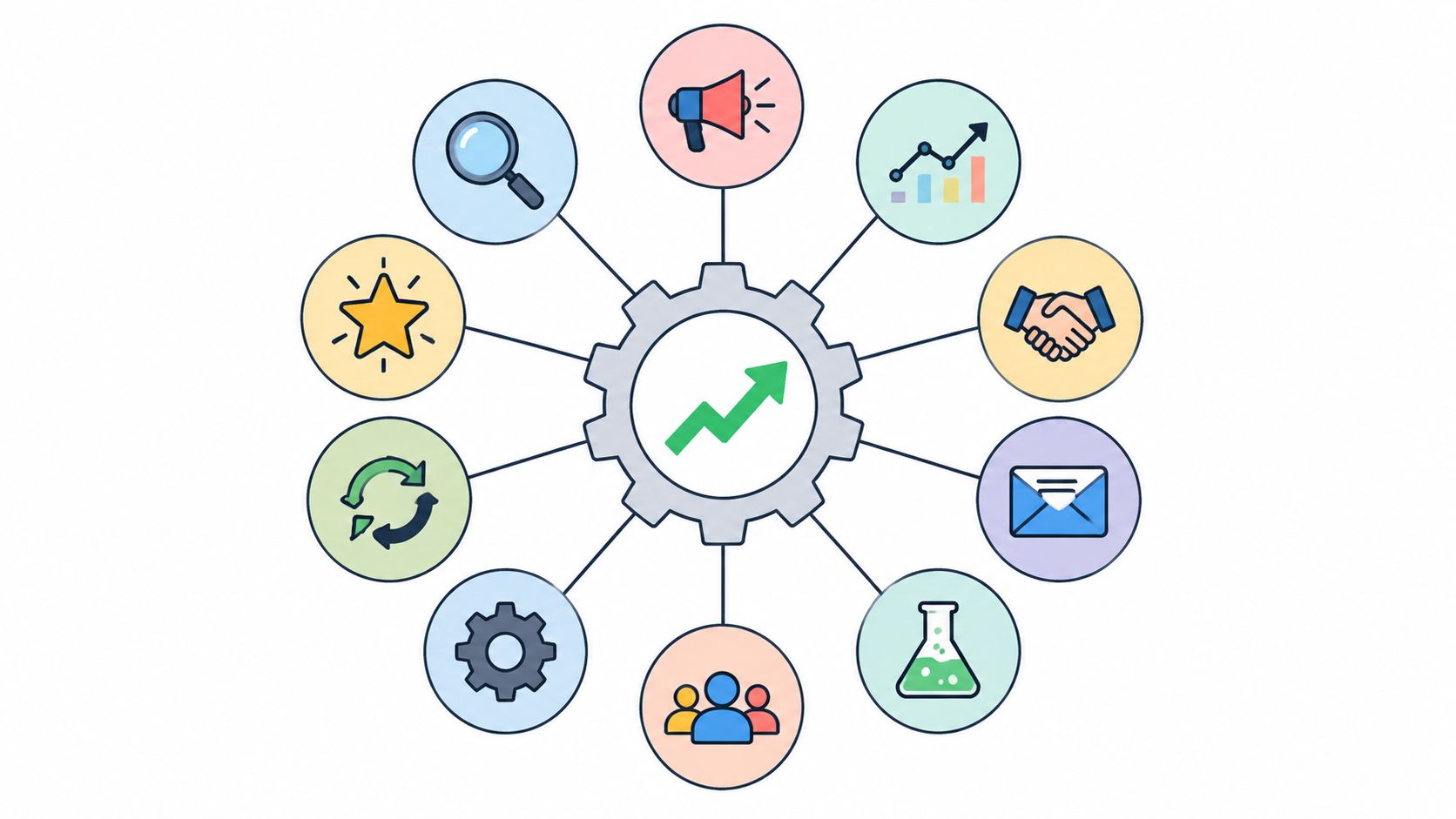
This image really drives home how different channels work together to guide a customer toward that final purchase.
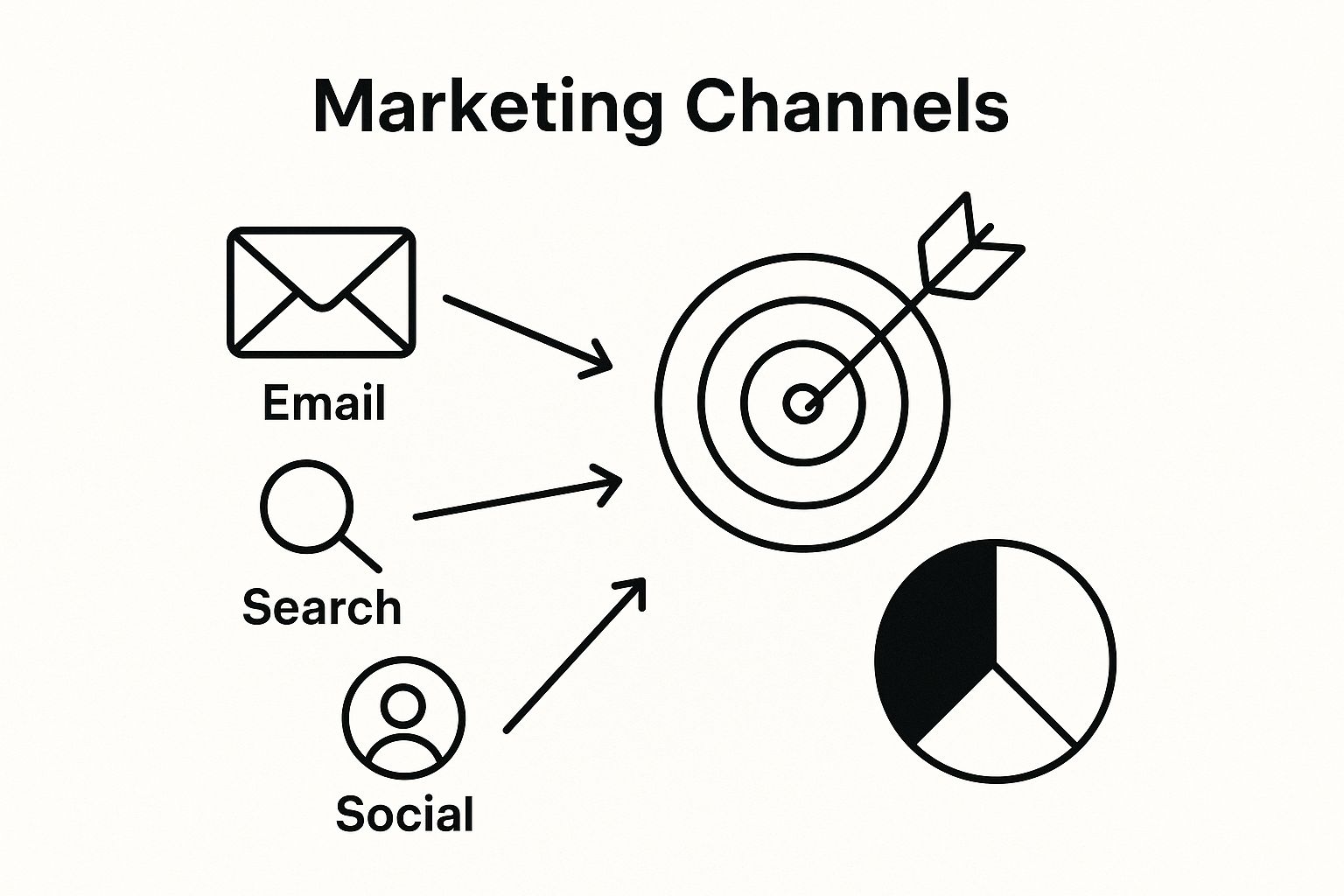
As you can see, a conversion is rarely a solo act. It's usually a team effort between search, social, email, and other marketing channels.
Multi-Touch Attribution Models
This is where things get more interesting. Multi-touch attribution models spread the credit across multiple touchpoints, giving you a much more balanced and realistic view of your marketing performance.
Comparison of Common Attribution Models
Choosing the right model can feel overwhelming, so let's break them down side-by-side. This table gives you a quick snapshot of how each one works and where it shines.
| Model Type | How It Works | Best For |
|---|---|---|
| First-Touch | 100% credit to the first interaction. | Understanding top-of-funnel channels that drive initial awareness. |
| Last-Touch | 100% credit to the final interaction before conversion. | Identifying which channels are most effective at closing deals. |
| Linear | Credit is split equally among all touchpoints. | Getting a simple, baseline view of the entire customer journey. |
| Time-Decay | More credit goes to touchpoints closer to the conversion. | Businesses with longer sales cycles where recent interactions matter more. |
| U-Shaped | 40% credit to the first touch, 40% to the last, and 20% to the middle. | Valuing both the channel that started the journey and the one that closed it. |
| W-Shaped | 30% each to the first, lead-creation, and final touchpoints. | Highlighting key milestones (awareness, consideration, decision). |
Each of these models offers a unique lens through which to view your data. The key is to pick the one that aligns most closely with your customer's typical buying behavior.
A Closer Look at Multi-Touch Models
Let's dive a bit deeper into how these work in practice.
-
Linear: This is the most democratic model. It splits the credit evenly across every single touchpoint. If a customer interacted with five channels, each one gets 20% of the credit. It’s fair, but it treats a quick glance at a social media ad the same as an in-depth demo request.
-
Time Decay: This model assumes that the closer an interaction is to the sale, the more important it was. The final touchpoint gets the most credit, and the value "decays" the further back in time you go. This makes a lot of sense for businesses with long consideration phases, like B2B sales.
-
Position-Based (U-Shaped & W-Shaped): These models are all about giving extra weight to the moments that matter most.
- The U-Shaped model is a popular choice. It gives 40% of the credit to the first touch (the introduction) and 40% to the last touch (the closer), then sprinkles the remaining 20% across everything in between.
- The W-Shaped model takes this a step further. It assigns 30% of the credit to the first touch, 30% to the touchpoint that created a lead (like a form submission), and 30% to the final touch. The last 10% is divided among the other interactions.
Getting a handle on these different rulebooks is the first step toward building a truly accurate picture of your marketing performance. A solid understanding of cross-channel attribution will empower you to choose the model that truly reflects how your customers interact with your brand across all their devices and platforms.
The Next Leap: Data-Driven Algorithmic Attribution
While rule-based models give us a clear, structured way to assign credit, they're ultimately just educated guesses. They follow a fixed rulebook, no matter what. The real evolution in attribution modeling moves beyond these static rules into a far more dynamic and intelligent space: data-driven algorithmic attribution.
Think of it like this: rule-based models are the team's playbook, outlining set plays. Algorithmic attribution is the AI coach that has watched every game tape, analyzed every single move, and can tell you the precise, nuanced impact of each player in every situation.
This advanced approach uses machine learning to sift through enormous amounts of data, looking at the paths of customers who convert and those who don't. Instead of just following a preset rule, the algorithm finds the real patterns and correlations on its own. The result is a level of precision that rule-based models just can’t touch.
How Does Algorithmic Attribution Actually Work?
This is where marketing analytics really gets interesting. These models don't just follow a script; they learn. By analyzing metrics like click-through rates, engagement levels, and historical conversion data, they statistically figure out how much each touchpoint truly contributed to a sale.
The model is always learning from new data, constantly tweaking its own understanding to more accurately assign credit. This creates a custom attribution model that is tailored specifically to your business and your customers' unique behaviors. It's an absolutely essential part of building a modern https://www.reachlabs.ai/data-driven-marketing-strategy/ that can adapt on the fly.
Algorithmic attribution doesn't just follow the rules; it discovers them. By comparing converting paths to non-converting ones, it learns which touchpoints are genuine difference-makers and which are just background noise.
The Good and The Bad
The benefits here are huge. Algorithmic models deliver far greater accuracy, adapt to shifting customer habits, and can even uncover surprising influencers in the buyer journey that you'd never have guessed. But this power doesn't come without a few hurdles.
Here’s a realistic look at the challenges:
- It Needs a Ton of Data: These models are data-hungry. To learn effectively, they need a significant volume of both touchpoint and conversion data, which can be a steep hill to climb for smaller businesses.
- You'll Need Tech Skills: Getting these models up and running isn't a simple "plug-and-play" affair. It often requires someone with data science expertise to implement, manage, and interpret the results.
- The "Black Box" Problem: Because the algorithms are so complex, it can sometimes be tough to understand exactly why credit was assigned in a particular way. This can feel a bit opaque compared to the straightforward logic of rule-based models.
Still, as marketing continues to evolve, the move toward sophisticated approaches like AI-powered advertising is becoming the norm. These models are the future, and they're even adapting to privacy changes by learning from aggregated and anonymized data, ensuring they remain a powerful, and responsible, tool for any serious marketer.
How to Choose and Implement the Right Attribution Model
Knowing the theory behind attribution models is one thing, but actually putting one to work is a whole different ballgame. It's not about picking the trendiest model; it's about finding the one that truly mirrors your unique customer journey and business reality.
The whole process starts with a good, hard look at your business goals. What are you actually trying to achieve? If your main focus is on generating brand awareness and filling the top of your funnel, a First-Touch model makes a lot of sense. It’ll show you which channels are best at introducing new people to your brand. On the flip side, if you're laser-focused on what pushes prospects over the finish line to become customers, a Last-Touch model will give you a clearer picture of your most effective closing channels.
Next, you have to consider your sales cycle. A direct-to-consumer brand selling t-shirts online has a super short journey, so a Time-Decay model works well because it emphasizes the most recent touchpoints. But what about a B2B SaaS company with a six-month sales cycle? For them, a position-based model like the U-Shaped or W-Shaped is far more insightful, as it gives credit to the key moments in that long, complex process.
Starting Your Implementation
Once you’ve got a model in mind that fits your goals and sales cycle, it's time to get your hands dirty. Implementing an attribution model isn't as simple as flipping a switch; you need to lay the proper groundwork to make sure the data you're collecting is clean, consistent, and actually useful.
-
Define Your Key Touchpoints: First, map out every single way a potential customer can interact with your brand. Think big here—ad clicks, social media engagement, email opens, webinar sign-ups, demo requests, content downloads. Every single touchpoint matters.
-
Establish Consistent Tracking: This is the non-negotiable step. You have to be diligent about using UTM parameters for all of your campaigns. Consistent marketing campaign tracking is the bedrock of attribution; without it, you're just guessing. This data is the raw material for everything else.
-
Choose Your Analytics Platform: You don't have to build a custom solution from day one. Tools like Google Analytics or HubSpot have built-in attribution reporting that lets you compare different models. This is a great place to start experimenting and see how each model tells a slightly different story about your marketing performance.
Remember, your first choice of an attribution model is a starting line, not a finish line. The best marketers are constantly testing, learning, and refining their approach.
Testing and Refining Your Model
The real magic happens when you treat attribution as an ongoing process. Once your chosen model is up and running, don't just set it and forget it. You should regularly compare its results against other models to spot hidden insights.
For example, you might rely on a Last-Touch model for your weekly channel performance meetings because it’s simple and clear. But for your quarterly strategic reviews, you might switch to a Linear or U-Shaped model to get that bigger-picture view of how all your channels work together.
This cycle of selecting, implementing, and refining is what separates companies that just report on marketing from those that use data to drive real growth. When you’re constantly challenging your own assumptions, you turn attribution from a simple dashboard into a powerful engine for making smarter decisions.
Frequently Asked Questions About Attribution Modeling
Alright, you've got the basics of the models down. But when the rubber meets the road, a whole new set of questions always seems to pop up. Let's walk through some of the most common things marketers ask when they're actually trying to put attribution into practice.
Think of this as your field guide to clearing up the confusion. We'll tackle the hurdles people run into most often so you can move forward with a clear, effective strategy.
What Is the Difference Between Attribution Modeling and MMM?
This is a classic one. It's easy to get attribution modeling and Marketing Mix Modeling (MMM) mixed up since they both help you figure out what's working in your marketing. The real difference comes down to the lens you're looking through. Think of attribution as a magnifying glass and MMM as a telescope.
Attribution modeling gets right down into the weeds. It looks at the specific digital touchpoints—the clicks, the email opens, the form fills—that an individual customer interacts with on their path to a single conversion. It's built for real-time, tactical tweaks to your digital campaigns.
Marketing Mix Modeling (MMM), on the other hand, pulls way back for the big picture. It uses high-level, aggregate data over longer timeframes (think quarters or years) to see how broad channels, including offline efforts like TV and print, and even external factors like the economy, affect your overall sales.
So, to put it simply: use attribution for fine-tuning your digital channels day-to-day. Use MMM for making those big, long-term strategic decisions about your budget.
How Often Should I Re-evaluate My Attribution Model?
Please don't treat your attribution model as a "set it and forget it" tool. Your business changes, and your model needs to change with it. A good starting point is to give it a thorough review quarterly, or whenever you make a major pivot in your marketing strategy.
It's definitely time for a check-up if you find yourself:
- Launching a new marketing channel: When you add a new channel, you're introducing a whole new set of touchpoints. Your old model won't know how to value them properly.
- Shifting your budget around: If you're moving significant money from one channel to another, the typical customer journey is going to change. You need to re-evaluate how credit gets assigned.
- Seeing major changes in customer behavior: Has your sales cycle suddenly gotten shorter or longer? Are conversion rates dropping on a channel that used to be a winner? Your model might be out of sync with reality.
Staying on top of this ensures your insights are actually useful and not leading you down the wrong path.
Can Small Businesses Use Attribution Modeling?
One hundred percent, yes. It's a common misconception that attribution is only for massive companies with dedicated data science teams. While the really advanced, custom-built models can be complex, the simpler, rules-based models are incredibly valuable and easy to get started with.
Most of the analytics platforms you're already using, like Google Analytics, have built-in tools that let you toggle between models like First-Touch, Last-Touch, and Linear with just a few clicks. For a small business, just moving from the default last-click view to any multi-touch model is a game-changer.
This shift gives you a much clearer picture of how to spend a limited budget. You'll finally see which channels are your workhorses for bringing in new leads versus which ones are the all-stars at closing the deal. That's how you make every dollar count.
Ready to stop guessing and start knowing what drives your marketing success? The team at ReachLabs.ai uses data-driven insights to build strategies that deliver real results. Learn how our experts can help you implement the right approach for your brand at https://www.reachlabs.ai.