
At their heart, data-driven marketing solutions are simply strategies and tools that use customer data to build smarter, more effective marketing campaigns. Instead of relying on guesswork, these solutions tap into real-time information—things like website clicks, past purchases, and social media interactions—to make precise decisions that boost your ROI.
The Shift From Guesswork to GPS Navigation

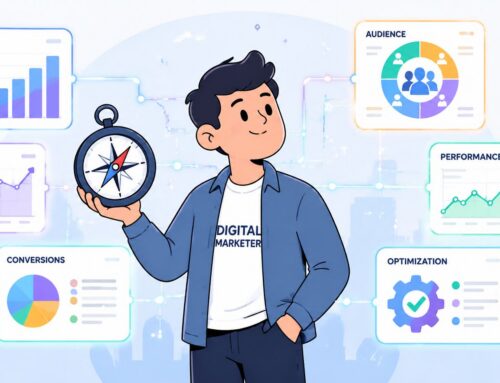
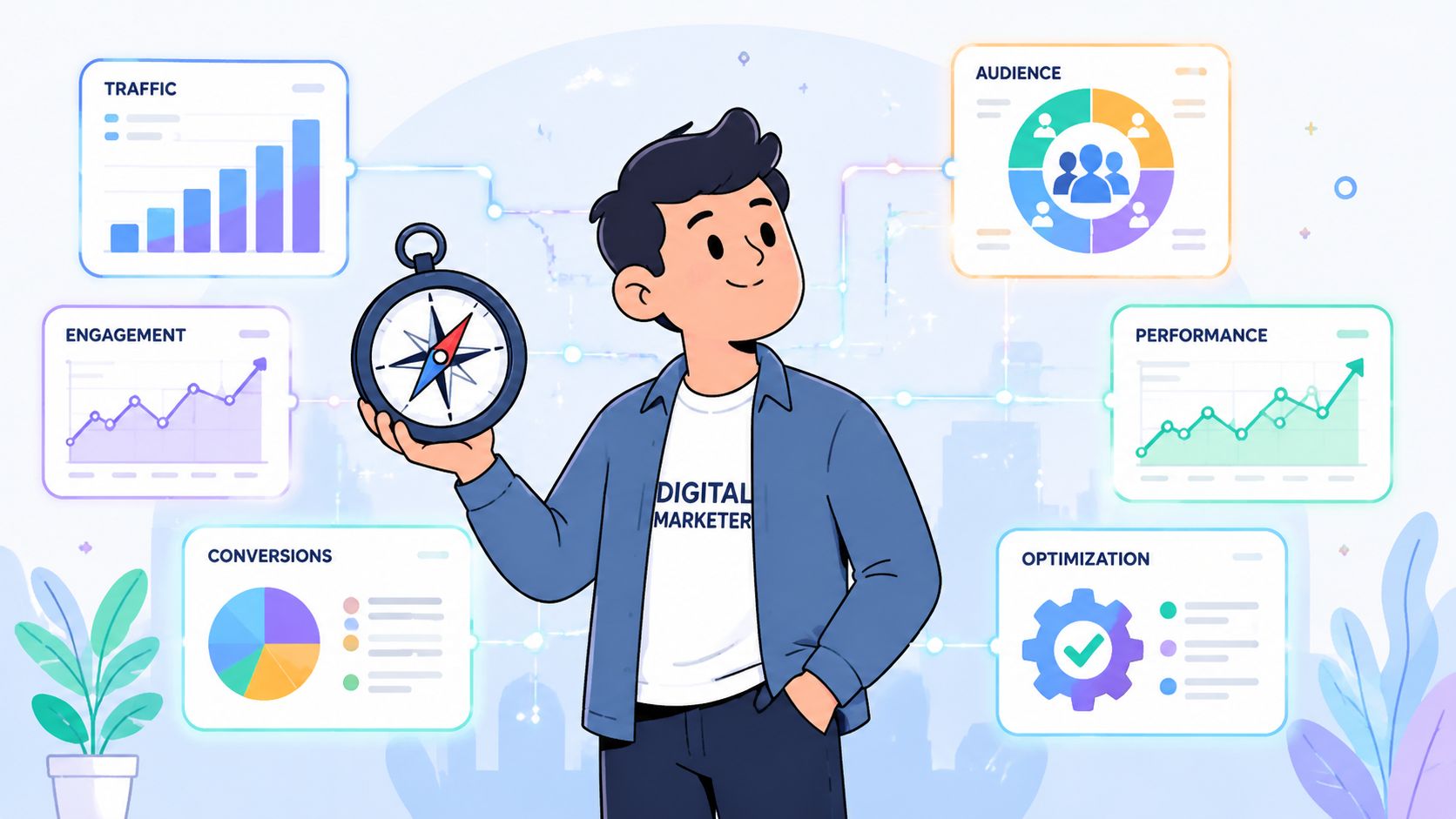
Think of traditional marketing like trying to navigate a vast ocean with only a basic compass. Sure, you're pointed in a general direction, but you don't have the detail needed to dodge storms or find the fastest route. It relies heavily on intuition and broad assumptions.
Data-driven marketing, on the other hand, is your state-of-the-art GPS system. It doesn't just point you toward your goal; it uses a constant stream of data to map out the most accurate and efficient course. This is a fundamental change, moving from decisions based on what you think might work to what you know will work based on solid evidence.
Turning Information Into Actionable Insights
At its core, this approach is all about creating a strategic feedback loop. Every single customer interaction generates a piece of data. That data can then be analyzed to fine-tune your next marketing move.
This process transforms raw business data into a clear roadmap for action, making your campaigns more predictable and powerful. For instance, by analyzing how people behave on your website, you can pinpoint which content truly connects with specific audience segments and then create more of what works. If you'd like to learn more, you can explore a complete overview of what data-driven marketing entails.
This constant cycle of learning and improving ensures your marketing gets smarter over time. The key benefits of making this strategic shift are pretty clear:
- Increased Personalization: You can deliver messages and offers that are directly relevant to what individual customers actually want and do.
- Improved Efficiency: Data helps you stop wasting money by focusing your resources on the channels and tactics that deliver the best results.
- Enhanced Decision-Making: Gut feelings are replaced by data-backed confidence, which leads to much more predictable outcomes.
The goal of data-driven marketing isn't just to collect massive amounts of information. The true value lies in turning that information into your most valuable business asset—a deep, actionable understanding of your customers.
Ultimately, these solutions give you the power to move beyond one-size-fits-all campaigns. They let you build real relationships with your audience by understanding their journey and anticipating their needs, which is the cornerstone of sustainable growth in any competitive market.
The Core Components of a Data-Driven Strategy
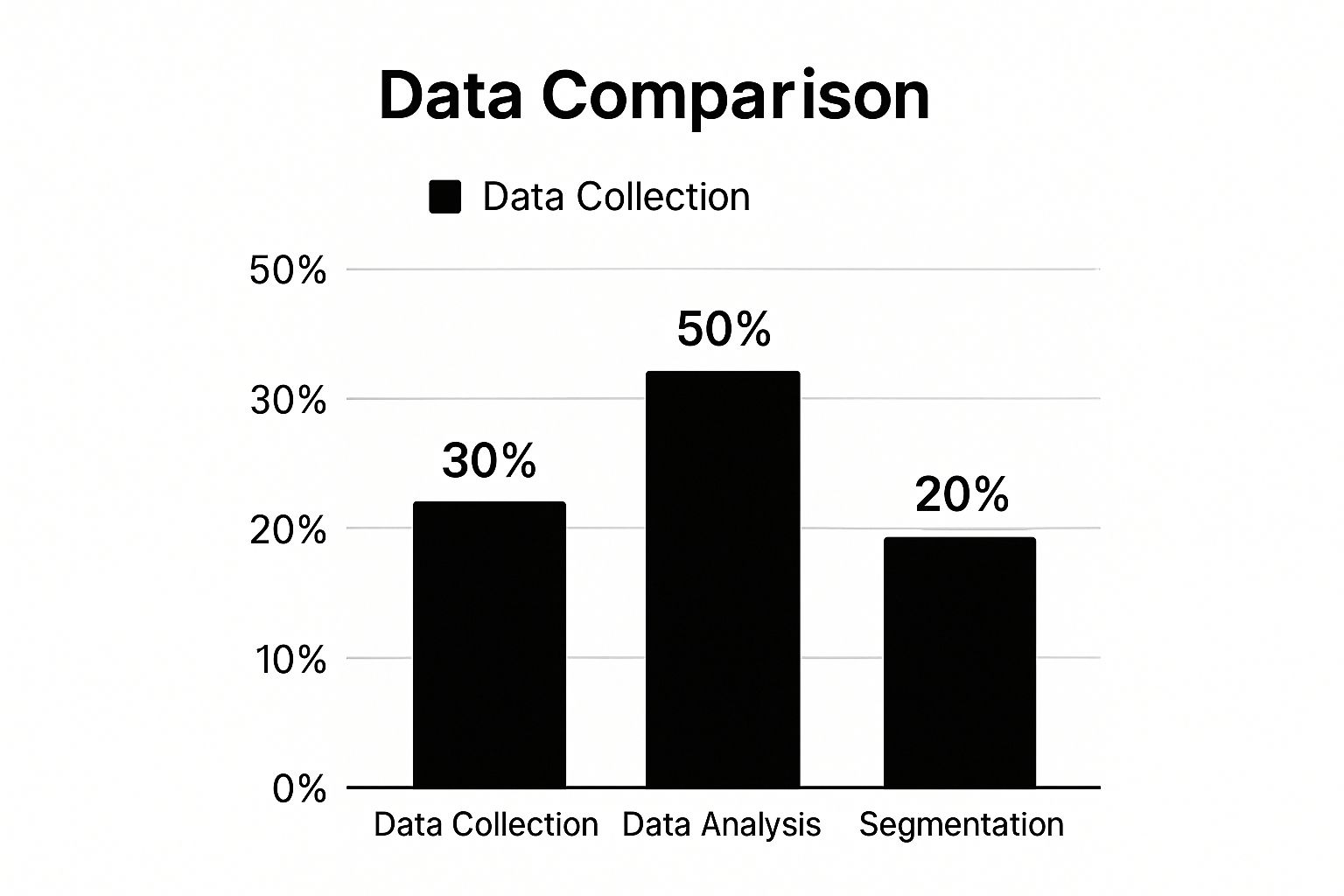
A truly effective data-driven marketing strategy isn't just one thing; it's a living system with three core parts that have to work together perfectly. Think of it like a three-stage rocket—each section has to fire at the right time to get you where you're going. If one part misfires, the whole mission stalls.
These three pillars—data collection, analysis, and action—are designed to feed into each other, creating a continuous improvement loop. You gather data, pull insights from it, take action, and the results of that action create new data. The cycle repeats, making your marketing smarter and more effective over time.
The Foundation: Data Collection and Management
First things first, you need solid ground to build on. That’s Data Collection and Management. This is the bedrock of your entire strategy. Trying to build anything on bad data is like trying to construct a skyscraper on quicksand; it doesn't matter how great your plans are, the whole thing is coming down.
This first step is all about pulling together information from every single place a customer interacts with you. We’re talking about unifying data from a bunch of different places into one reliable spot.
Key sources often include:
- CRM Systems: Your treasure trove of customer interaction histories, purchase details, and support logs.
- Web Analytics: The story of how people behave on your site—what pages they visit, how long they stay, and where they convert.
- Social Media: What people are saying, how they’re engaging, and the overall sentiment around your brand.
- Transactional Data: The hard facts about what people buy, how much they spend, and what they like.
The whole point is to create a single source of truth. If your data is messy or siloed, the insights you pull will be skewed, and you'll end up making decisions based on a distorted picture of reality.
The Brain: Data Analysis and Insights
Once your data is clean and in one place, it's time for the "brain" of the operation: Data Analysis and Insights. This is where raw numbers and figures get transformed into actual strategic intelligence. It’s one thing to have data; it's another thing entirely to understand what it’s trying to tell you.
This stage involves digging deep to find the hidden patterns and trends. For example, customer segmentation lets you group your audience by shared traits or behaviors, which is the key to sending messages that actually resonate instead of just shouting into the void.
You can also get into predictive modeling, which uses your past data to make educated guesses about the future—like which of your leads are most likely to become paying customers. This is where you shift from reacting to what’s already happened to proactively anticipating what your customers will need next. Getting a clear picture is crucial, and looking at different marketing dashboard examples can give you great ideas for how to visualize your findings.
The Hands: Action and Automation
Finally, we get to the "hands" of your strategy: Action and Automation. This is where your brilliant insights turn into tangible results. After all, an amazing insight that just sits in a report is completely useless.
This is where marketing automation tools really come into their own, letting you deliver highly personalized experiences without having to do everything manually. Let's say your analysis flags a group of customers who keep looking at a specific product but never buy. You can set up an automated workflow to send them a targeted email with a special discount on that exact item.
This seamless jump from insight to action is what separates the marketing teams that truly succeed with data from those that just collect it. The system doesn't just learn; it does.
Focusing on the data you collect yourself (first-party data) is more important than ever. By 2025, a whopping 64% of marketing executives expect to be leaning heavily on data-driven strategies. With privacy regulations like GDPR getting stricter and browsers phasing out third-party cookies, relying on data you own isn't just a good idea—it's a necessity.
Exploring Key Types Of Marketing Solutions
Diving into the world of marketing technology can feel like stepping into a massive toolbox. Every solution promises to solve your toughest challenges, but the most impactful data driven marketing solutions fall into a handful of core categories.
Imagine building a high-performance car: you need an engine, a dashboard, GPS, and a driver who knows the route. In marketing, different solutions serve as the engine, dashboard, and navigator—working in concert to collect, analyze, and act on customer data. Let’s break down these essential components.
Customer Data Platforms The Central Hub
A Customer Data Platform (CDP) acts as the heart of your tech stack. Solutions like Segment gather data from every customer touchpoint—your website clicks, mobile app sessions, CRM entries, and even offline events.
By stitching these touchpoints into a single profile, a CDP delivers a 360-degree view of each person’s journey. Suddenly, fragmented data becomes a clear narrative that powers your campaigns with consistent, accurate insights.
- Unified customer profiles
- Cross-channel data collection
- Real-time identity resolution
Marketing Automation Platforms The Execution Engine
Think of a Marketing Automation Platform as the hands and feet of your strategy. Platforms such as HubSpot use CDP data to fire off targeted campaigns automatically.
Picture a shopper abandoning their cart. An automation platform springs into action—sending a reminder email with the exact items left behind, maybe even tossing in a discount code. For deeper tips on getting the most from your setup, explore these marketing automation best practices.
Key Capabilities:
- Trigger-based email workflows
- Social media scheduling
- Lead scoring and nurturing
Business Intelligence And Analytics Tools The Navigator
When you need to understand the “what” and “why,” Business Intelligence (BI) tools like Tableau step in. They pull data from your CDP and marketing automation platform, transforming raw numbers into visual stories.
A BI dashboard might reveal that your cost per acquisition jumped by 15% last quarter—and pinpoint the underperforming ad. With those insights, you can reallocate your budget and sharpen your messaging.
Core Functions:
- Custom dashboards and reports
- Trend analysis and forecasting
- Ad-hoc data exploration
AI-Powered Personalization Engines The Co-Pilot
AI-Powered Personalization Engines act as an intelligent co-pilot, delivering one-to-one experiences at scale. Tools like Dynamic Yield analyze behavior in real time, then tailor content, product recommendations, and message timing for each individual.
This goes beyond inserting a first name—it’s about swapping out homepage banners or email layouts based on a user’s past purchases, browsing history, or even the weather in their city.
Highlights:
- Dynamic content rendering
- Predictive product recommendations
- Real-time message optimization
Below is a comparison to help you choose the right mix of solutions for your business.
Comparison of Key Data Driven Marketing Solutions
| Solution Type | Primary Function | Example Key Features | Ideal Business Use Case |
|---|---|---|---|
| Customer Data Platform | Unify customer data from multiple sources | Real-time identity resolution, unified profiles, data governance | Brands needing a 360° view of every customer |
| Marketing Automation Platform | Automate and scale campaign execution | Trigger workflows, lead scoring, A/B testing | E-commerce sites with high cart abandonment rates |
| Business Intelligence & Analytics Tools | Visualize and analyze campaign performance | Custom dashboards, trend forecasting, ad-hoc reporting | Marketing teams making data-driven budget decisions |
| AI-Powered Personalization Engine | Deliver individualized experiences in real time | Dynamic content, predictive analytics, personalized journeys | Retailers aiming for high conversion and loyalty |
Use this table as a starting point to map out your marketing stack. By combining the right solutions—your engine, dashboard, navigator, and co-pilot—you’ll turn raw data into meaningful customer experiences and stronger ROI.
The Real-World Impact on Your Business
Putting data at the core of your marketing isn't just a technical upgrade; it's how you drive real growth and earn customer loyalty. Let's break down four of the most significant ways this approach gives you a competitive edge.
Personalize Every Interaction, Automatically
The first major win is Enhanced Personalization at Scale. This means you can finally stop blasting generic messages and start tailoring every touchpoint to individual customers.
Think about dynamic email campaigns that automatically segment your audience based on their purchase history or what they've been browsing on your site. This isn't just a nice-to-have. It’s about creating offers that feel genuinely relevant, right when people are most likely to act.
- Consistent, personalized messaging builds a foundation of trust that encourages repeat business.
- Getting this right can lift revenue by a staggering 5% to 15%.
- The best part? Scalable segmentation lets you create thousands of unique customer experiences without needing to hire an army of marketers.
A major streaming platform saw this firsthand when they used AI-powered recommendations to boost click-through rates by 20%. On top of that, personalized push notifications helped them cut subscriber churn by 12%.
Get More Bang for Your Marketing Buck
Data-driven strategies are fantastic for maximizing your Improved ROI and Efficiency. Too often, marketing budgets get wasted on guesswork—targeting broad segments or pouring money into channels that just don't perform.
By digging into actual campaign data, you can spot the money pits and shift your funds to the channels that are actually delivering results. No more guessing games.
- Detailed cost-per-acquisition metrics immediately shine a light on what’s not working.
- Automated bidding strategies can adjust your ad spend in real-time, cutting waste before it adds up.
One e-commerce brand took this to heart, reallocating 25% of its ad budget based on performance data. The result? Their return on ad spend (ROAS) shot up by 30%. This trend is only growing; the global big data analytics market is on track to hit $924.39 billion by 2025, up from $32.3 billion in 2021. That's a 13% compound annual growth rate.
Personalization through analytics can boost revenues by 5% to 15% and efficiency by 10% to 30%. Learn more about these findings on designveloper.com.
Truly Understand Your Customers
Data also gives you a much Deeper Customer Understanding. By analyzing all the different ways customers interact with your brand, you can start to uncover powerful behavioral patterns.
This kind of insight lets your team get ahead of customer needs and prioritize the product features people actually want. For example, you could segment customers by how often they use your product to spot opportunities for an upsell or a retention campaign.
- Rich customer profiles can guide your product development, making sure you're building things people will love.
One software company did exactly this. They grouped users based on feature adoption and managed to improve their onboarding completion rates by 18%.
Make Decisions with Confidence
Finally, this approach enables Proactive Decision-Making. Instead of just reacting to last month's numbers, predictive models let you forecast future trends and customer behavior.
You're no longer just putting out fires. You're planning ahead. Imagine having a churn prediction model that flags at-risk customers, allowing you to send them a targeted offer before they decide to leave.
- You can run "what-if" scenarios to test how different campaign budgets or channel mixes might play out, all without risking a single dollar.
This is common practice in financial services, where teams run simulations on discount offers to accurately predict the impact on revenue.
Tying It All Together
So, what's the bottom line?
- Enhanced Personalization: Boosts relevance and keeps customers coming back.
- Improved ROI: Eliminates waste and makes every dollar in your budget work harder.
- Deeper Customer Understanding: Aligns your products and campaigns with what people actually want.
- Proactive Decision-Making: Gives you the foresight and agility to stay ahead.
The models and strategies you build aren't static, either. They learn continuously, adapting week by week to make your campaigns smarter and more effective over time.
A client working with ReachLabs.ai saw their ROI jump by 40% in just six months.
To make this work, it’s all about monitoring your key metrics, constantly feeding your models with fresh data, and having a mindset of testing and learning.
When you combine these benefits, the case for investing in data-driven marketing is undeniable. By embracing personalization at scale, budget efficiency, deep customer insight, and predictive planning, you set your organization up to outperform the competition.
Partnering with an expert like ReachLabs.ai can provide the support you need at every stage, from seamless integration to ongoing optimization. When you're ready to make the leap, they can help you get there.
How to Choose the Right Solution for Your Needs
Picking the right data-driven marketing solution from a sea of options feels a lot like buying a car. You wouldn't buy a two-seater sports car for a family of five, right? It might be fast and flashy, but it's completely impractical for your actual needs. The same logic applies here—the "best" tool isn't the one with the most features, it's the one that's a perfect fit for your specific journey, your team, and what you’re trying to accomplish.
This all starts with an honest look in the mirror. Before you get dazzled by a single product demo, you need to get crystal clear on what you’re trying to fix. Are you drowning in customer data scattered across a dozen different systems? Or is your biggest hurdle personalizing your campaigns at scale? Pinpoint the pain before you go shopping for the cure.
Start with Your Core Requirements
A brilliant solution on paper can become a nightmare in practice if it doesn't mesh with the tools you already use every day. So, start your search by focusing on the absolute must-haves. These are the dealbreakers.
- Integration Capabilities: How well will this new platform talk to your existing tech stack? Think about your CRM, analytics tools, and e-commerce platform. If a new tool creates more data silos instead of breaking them down, you're moving backward.
- Scalability: Think about where you want to be in three to five years. The right solution should handle your needs today and have the horsepower to keep up as your business grows. You don't want to have to do this all over again in 18 months.
- User-Friendliness: A tool is only as good as your team's ability to use it. If it's too complicated, it’ll just gather digital dust. Look for an intuitive interface and make sure the vendor provides real, hands-on training and support to get your team up and running.
Asking the Right Questions
Once you’ve nailed down your foundational needs, it’s time to get into the details. A good evaluation process helps you compare different data-driven marketing solutions side-by-side, without getting swayed by a slick sales pitch. This means asking tough questions—both to the vendors and to your own team.
You're not just buying a piece of software; you're looking for a strategic partner. The right platform should give your team the power to turn data into action, paving a clear path to better ROI and happier customers.
Use this checklist to steer your conversations and make a smarter decision.
Questions for Your Internal Team:
- What's the single biggest data challenge holding us back right now?
- Who is actually going to be using this day-to-day, and what's their comfort level with new technology?
- What specific result are we trying to achieve? (e.g., boost lead conversion by 15%, cut down customer churn, etc.)
- What's our real budget, factoring in implementation, training, and the subscription itself?
Questions for Potential Vendors:
- Can you show me a case study from a company in our industry and of a similar size?
- Walk me through your onboarding and customer support process. What happens when we run into a problem?
- How do you handle data privacy and ensure compliance with regulations like GDPR?
- What new features or improvements are on your product roadmap for the next 12 months?
Following a simple framework like this takes the guesswork out of the buying process. You stop focusing on shiny features and start zeroing in on strategic fit, ensuring the platform you choose actually helps you grow the business.
The Future of Marketing is Fueled by AI
Artificial intelligence isn't some far-off concept anymore; it's the engine powering the next wave of data-driven marketing solutions. AI takes everything we've been doing with data and puts it on steroids. We're moving away from just analyzing what happened in the past and are now starting to accurately predict what's coming next. It’s a massive leap forward.
Think of it like this: traditional data analysis is like a coach reviewing game footage to figure out why the team won or lost. AI, on the other hand, is like having a super-advanced simulator that runs thousands of game scenarios before you even hit the field. It doesn’t just review—it anticipates, optimizes, and gets you ready for what’s ahead with incredible speed and precision.
Predictive Analytics: A Glimpse into the Future
One of the most powerful ways AI is making an impact is through predictive analytics. By sifting through massive datasets of past customer interactions, machine learning models can spot tiny patterns that a human analyst would never catch. These models can then forecast future customer behavior with surprising accuracy.
This means you can see which customers are about to churn and step in with the right retention offer before they leave. It helps you predict which leads are most likely to convert, so your sales team can stop wasting time and focus their energy where it counts. AI essentially gives you a crystal ball—one that’s built on hard data, not guesswork.
By forecasting demand and spotting high-value audience segments before a campaign even kicks off, AI turns marketing from a reactive, backward-looking function into a proactive driver of growth. This is the new reality for data-driven marketing solutions.
Hyper-Personalization That Actually Scales
AI is also the key to unlocking true hyper-personalization, making it possible to deliver unique one-to-one experiences to millions of customers at the same time. While marketing automation was great for segmenting audiences, AI can tailor the content for each individual within those segments, and it can do it on the fly.
For example, an e-commerce site can use AI to instantly change its homepage, product recommendations, and even special offers based on a visitor's real-time browsing, past purchases, and demographic profile. This creates an experience that feels incredibly relevant, which is a surefire way to boost engagement and sales.
- Dynamic Content: AI can pick the perfect hero image or call-to-action for every single person who visits your site.
- Predictive Recommendations: It suggests products a customer is highly likely to buy next, even if they've never looked at them before.
- Optimized Timing: AI figures out the absolute best time to send an email or a push notification to each user to get them to open it.
The investment in this technology is exploding. The global AI marketing market was valued at $12.05 billion back in 2020, but it's expected to rocket past $107.5 billion by 2028. You can learn more about the rapid growth of AI marketing statistics and see just how fast companies are adopting these tools.
At the end of the day, AI is the ultimate force multiplier for your data. It finally unlocks the true potential hidden in all that information, allowing businesses to build smarter, more predictive, and deeply personal marketing strategies that create a real, lasting competitive advantage.
Still Have Questions? Let's Clear Things Up.
Thinking about making the switch to data-driven marketing brings up a lot of questions. It's totally normal. Whether you're a small shop just getting started or a bigger company looking to sharpen your edge, getting the practical side of things straight is what matters most.
Here are some of the most common questions we hear, answered in plain English.
Where Does a Small Business Even Begin?
The best advice? Start small and stay focused. Don't try to boil the ocean. Begin by getting a handle on the basics with a powerful (and free) tool like Google Analytics. Your first goal is simple: understand who is visiting your website and what they do when they get there. This gives you a performance baseline.
Once you have that foundation, you can start layering in other tools as you grow. Maybe an email marketing platform or a simple Customer Relationship Management (CRM) system is next. The key is to make steady, manageable progress, not to achieve perfection overnight.
How Do Data Privacy Rules like GDPR Fit into All of This?
This might sound counterintuitive, but privacy regulations like GDPR actually make your marketing stronger. They force you to focus on first-party data—the information you collect directly from your audience with their permission.
Good data-driven marketing solutions are built for this. They have compliance baked right in, making it easier to manage user consent and respect their privacy choices. This isn't just about following the rules; it’s about building trust. When customers trust you with their data, the quality of that data is infinitely higher.
Think of it this way: privacy regulations shift the game from a numbers game (quantity) to a relationship game (quality). And better relationships always lead to better business.
Do I Really Need a Data Scientist on Staff?
Absolutely not. That’s a common misconception that holds a lot of businesses back. The idea that you need someone with a PhD in statistics to read a report is a thing of the past.
Modern marketing platforms are designed for marketers, not data scientists. They’re packed with user-friendly dashboards, visual reports, and automated insights that do the complex number-crunching for you. You get the valuable takeaways without needing to write a single line of code.
Sure, a dedicated data scientist can uncover some incredibly deep insights. But your team can get tremendous value and make smarter decisions right now with the tools available today. They’re built to empower you, not intimidate you.
At ReachLabs.ai, we help businesses turn their data into their biggest growth asset. Our team brings together strategic know-how and creative muscle to launch campaigns that produce real, measurable results. See how we can build a strategy for your brand at https://www.reachlabs.ai.