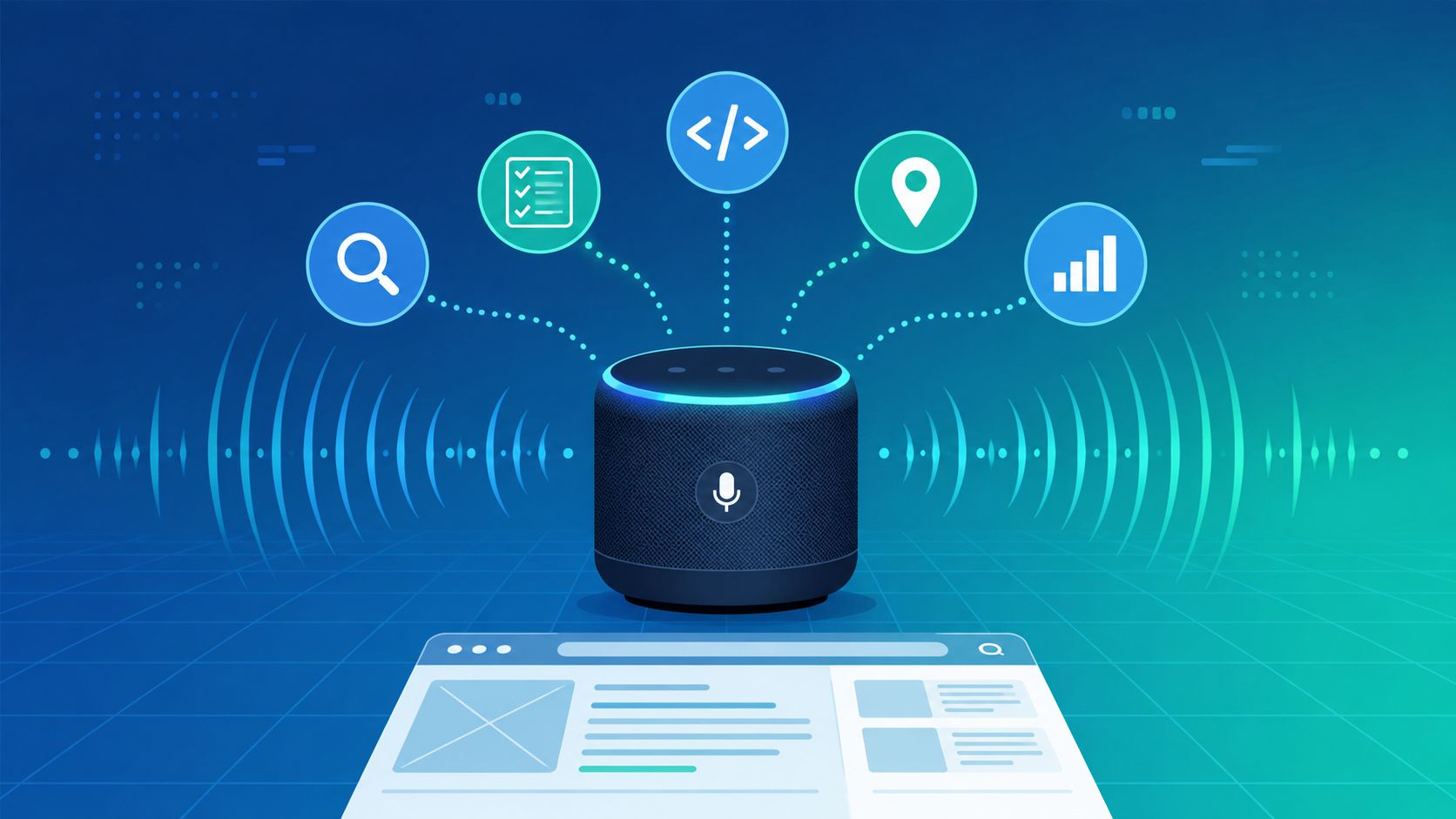
Most voice search advice is stuck in 2019. It still tells teams to collect conversational keywords, add an FAQ page, and wait for traffic to show up. That approach misses what changed: assistants and AI systems now pull extractable answer blocks, not just pages that happen to rank for a spoken phrase.
The job in voice search optimization is to make your content easy to retrieve, easy to trust, and easy to speak aloud. That means writing short answers, structuring pages for snippets and AI citations, and treating local intent, schema, and performance as part of the same system. The brands that win are the ones that stop optimizing for the query alone and start optimizing for the answer.
Why Voice Search Optimization Has Changed in 2026
Voice search has moved from a novelty layer to a real discovery channel. By 2026, one independent roundup reported 8.4 billion active voice assistants worldwide, 4.2 billion monthly active voice search users, and more than 10 billion voice queries per day. It also said voice accounts for 31% of all search queries and is growing 18% year over year. Those numbers make one thing clear, voice search optimization is no longer a side project, it sits inside mainstream search behavior in major markets. voice search in the AI era

The old keyword playbook is too small
The mistake most guides still make is treating voice as a copywriting problem. They focus on conversational phrases, then bolt on a few FAQ questions and call it done. That was never enough, and it's even weaker now because assistants increasingly need a clean answer block they can extract, not just a page that uses the right wording.
A better mental model is AI answer retrieval. Search systems want concise, entity-clear content that they can cite, summarize, or read aloud without guessing. That's why snippets, direct answers, and structured page sections matter more than broad keyword repetition.
A useful way to think about the shift is this. A person speaks a question, but the system does not reward the question itself, it rewards the page fragment that can answer it fastest and with the least ambiguity. If your page buries the answer under marketing language, the machine has to work harder to trust it.
What the research pattern keeps showing
A major SEO study found that the average voice search result page loads in 4.6 seconds, which is 52% faster than the average webpage, and that the typical answer is only 29 words long. It also found that about 75% of voice search results rank in the top 3 for the query, while 40.7% come from a Featured Snippet and 70.4% of Google Home result pages use HTTPS. Later summaries kept pointing in the same direction, with 41% of voice results including Featured Snippets and 93.7% of voice assistant answers reported as accurate. Backlinko's voice search SEO study
Practical rule: if a page can't be summarized cleanly in one short block, it's probably not ready for voice or AI retrieval.
That pattern explains why older FAQ-only guidance falls short. The winning unit isn't just the page, it's the extractable answer block inside the page. Brands that write sourceable, entity-specific answers give assistants less reason to go elsewhere.
For a broader framing of how assistants, AI Overviews, and citation monitoring are changing search, recent 2026 guidance on voice search optimization in the AI era captures the strategic shift well. The important takeaway is simple. Voice search optimization now sits at the intersection of technical SEO, content structure, and AI visibility, not just conversational keyword research.
Researching Conversational Queries and Question-Based Intents
Voice queries are rarely clean keyword phrases. People ask complete questions, add context, and expect a fast answer. That changes how you do research, because you're not only collecting terms, you're mapping the questions people ask before they decide, call, book, or buy.
Start with the questions people already use
Google Search Console is still the most practical starting point because it shows real query language from your own site. Filter for question words, look for pages that already attract conversational impressions, and separate the queries that imply action from the ones that only signal curiosity. If a query suggests timing, availability, pricing, location, or a comparison, it usually deserves more attention than a broad awareness phrase.
People Also Ask boxes are useful because they expose adjacent questions that often cluster around the same intent. Tools such as AnswerThePublic and AlsoAsked help you turn one seed topic into a question map, which makes it much easier to decide whether a query belongs in a section, an FAQ entry, or a standalone page. The goal isn't volume. It's finding the questions that match how people speak.
For a deeper keyword workflow, this internal guide on how to find the best keywords pairs well with conversational research because it forces a clearer distinction between topic discovery and intent selection.
Sort queries by intent, not by wording
A single spoken phrase can hide different motives. A navigational query asks for a specific brand or place. An informational query wants an explanation. A transactional query suggests a purchase or booking. A local query usually wants nearby availability, directions, or same-day service.
One practical filter is to ask whether the user needs an answer, an option, or an action. If they need an answer, the content can stay compact. If they need options, the page should compare choices. If they need action, the page has to make contact, location, hours, and next steps obvious.
That's especially important for local businesses. Many of the strongest voice queries are not generic “near me” searches. They're more specific, like checking whether a business is open now, whether a service is available in a neighborhood, or whether someone can handle a job today.
Practical rule: if the query includes timing, location, or urgency, treat it as decision intent, not just keyword research.
A simple workflow helps. Build a list of question-based queries, tag each one by intent, then assign the highest-value queries to a specific page section or content asset. If a question can be answered in 40 to 60 words without losing accuracy, it usually belongs inside an existing page. If it needs comparison, proof, or step-by-step detail, it probably deserves its own page.
For local keyword discovery, this resource on keywords for attracting local customers is useful because it pushes research toward service language instead of generic traffic terms.

Writing Extractable Answer Blocks for Voice Assistants
The best voice-friendly copy doesn't sound clever. It sounds clear. Assistants and AI systems are much more likely to lift a short, direct passage than a polished paragraph that circles the point three times before landing the answer.
Lead with the answer, then add just enough context
The cleanest format is simple. Start with the direct answer in the first sentence, keep the full block to roughly 40 to 60 words, then add one sentence of support or qualification. That gives the machine a concise unit to extract and gives the reader enough context to trust the claim.
A weak version hides the answer. A strong version puts the answer first. For example, if someone asks whether a service is available the same day, the page shouldn't open with a brand story. It should answer the question immediately, then clarify the conditions under which the service applies.
That same rule applies to definitions, comparisons, and how-to prompts. Keep the first line explicit, avoid vague transitions, and write with concrete nouns. If the answer depends on a location, product type, or service tier, name that entity clearly so the system doesn't have to infer it.
Shape the page so extraction is obvious
Headings matter because they signal where one answer starts and another ends. Use H2 and H3 labels that match question language, then keep the answer block directly under the heading. If the answer is buried under a long opener, the section stops looking extractable.
Schema helps reinforce the structure, but it shouldn't replace the writing itself. FAQPage works when the page is a set of question-and-answer pairs. HowTo fits step-based content. LocalBusiness matters when the page needs to surface location, hours, and service coverage. The markup confirms the structure, but the content still has to read naturally.
For implementation guidance on clear page structure, this internal resource on how to write web content for a website aligns well with answer-block writing because it keeps the copy readable while still making it machine-friendly.
If the first 2 lines can stand on their own, the rest of the paragraph becomes support instead of filler.
Write for attribution, not just inclusion
Generative systems increasingly cite sources directly, which means your answer blocks need to sound like something a system can trust and attribute. That doesn't mean stuffing in your brand name every two lines. It means writing with entity clarity, so the page unmistakably explains who the service is for, what it does, and where it applies.
A clean answer block often beats a long article section because it reduces ambiguity. Keep numbers, qualifiers, and exceptions close to the answer. If the answer depends on inventory, geography, or timing, say so immediately. The more the block behaves like a self-contained fact unit, the easier it is to reuse in voice and AI results.
Technical Performance and Schema Markup Requirements
Speed still matters, but not in a vague “make the site faster” way. Voice results reward pages that load quickly, render cleanly on mobile, and make the answer easy to identify without delay. That's where performance and structure stop being separate disciplines.

The thresholds that actually matter
Independent 2026 guidance consistently points to LCP under 2.5 seconds, CLS below 0.1, and INP below 200 ms as the mobile performance targets worth protecting for voice and featured-snippet readiness. Those thresholds aren't random. They're the kind of user-experience signals that reduce friction before the page ever gets a chance to answer the query. Moonrank's 2026 voice search optimization guide
HTTPS is still essential, and the earlier study's 70.4% HTTPS figure shows how often secure pages show up in voice results. That doesn't mean HTTPS alone wins anything. It means insecure pages add unnecessary doubt, and doubt is expensive when assistants are deciding what to read aloud.
The practical audit order is straightforward:
- Check mobile load behavior first. If the answer block appears late, the page is harder to select.
- Validate Core Web Vitals on the pages that matter most. Don't start with low-value content.
- Compress anything that delays rendering. Large assets often do more damage than the copy itself.
- Keep the answer above the fold where possible. The system should not have to hunt for it.
Schema should match the content, not decorate it
Schema markup is most useful when it mirrors real page structure. FAQPage helps when the page is built as a question list. HowTo is better for ordered instructions. LocalBusiness matters on service and location pages because it gives search systems a cleaner way to read the business entity, coverage, and contact details.
Many teams waste time. They add schema, then leave the page copy vague or repetitive. That doesn't help much. The markup works best when the answer is already concise, the heading hierarchy is clear, and the supporting details are easy to parse.
If your team keeps running into structured data issues, the practical fix is to test and correct them before adding more markup. This guide on how to fix schema markup errors is worth keeping on hand because bad schema can create more noise than visibility.
For teams that need deeper implementation support, this internal resource on technical SEO services is the kind of checklist I'd use when handing work to developers.
The technical goal is eligibility, not perfection
A voice-ready page doesn't need every possible optimization. It needs to be fast enough, secure enough, structured enough, and readable enough for the system to trust it. That's a much more practical standard than trying to make every page flawless.
The teams that move quickly usually focus on the handful of URLs that already have question-based demand. They improve the page experience, validate the markup, and then watch whether the answer block becomes easier to surface. That sequence beats broad technical cleanup every time.
Local Voice Search for Multi-Location and Service-Area Businesses
Local voice search is where optimization turns into action. A query about hours, availability, directions, or service coverage often leads to a call, a route request, or a visit. That's why local intent deserves more than a generic “claim your profile” checklist.
Build pages around decision-ready local intent
The strongest local pages answer the questions people ask when they're ready to act. That includes open-now status, same-day availability, neighborhood coverage, and whether a location can handle a specific type of request. Those details should appear in both page copy and machine-readable business data so assistants can trust them.
For multi-location brands, consistency matters more than clever wording. Each location page should reflect the correct address, service area, hours, and contact path. The best pages also use neighborhood-level phrasing where it makes sense, because users rarely ask in corporate language.
Service-area businesses have a different challenge. They may not have a storefront, but they still need location signals that make service coverage obvious. The page should say where the business works, what kinds of jobs it takes, and how quickly someone can respond when the request is urgent.
Match the content to the kind of business
Restaurants usually win local voice queries when menus, hours, and reservation paths are easy to find. Retail brands need accurate store pages and inventory-sensitive messaging. Service providers need coverage language that reflects how dispatch, scheduling, and job qualification work.
A simple content structure helps across all three:
- Location pages for physical branches. Include the core business facts first.
- Service-area pages for coverage zones. Name neighborhoods or regions naturally.
- FAQ blocks for operational questions. Focus on open-now, same-day, and availability prompts.
- GBP data that matches the page. If the profile and page disagree, assistants get mixed signals.
The biggest mistake is treating local voice search as a broad “near me” game. People often ask more precise questions, and the page needs to answer those questions without making them dig. If the business can handle a job today, say it clearly. If it only serves certain neighborhoods, say that too.
Track local action, not just traffic
A local voice strategy should be measured by the actions it drives. Calls, direction requests, and location-specific queries tell you far more than generic pageviews. Question-query impressions are also useful because they show whether the page is entering the right discovery path before the user acts.
Local voice SEO works when the page removes uncertainty fast enough for the customer to move.
That's the true test. If a user can confirm availability, location, and fit in a few seconds, the page is doing its job. If they still need to click around, the local content is probably too vague.
Testing Voice Visibility and Measuring What Matters
Voice search is easy to overclaim and hard to measure badly. If you only watch organic traffic, you'll miss the cases where the assistant answers directly, the user calls from the SERP, or AI systems surface your content without a traditional click.
Test visibility the hard way
Manual checks still matter. Search the target questions on Google Assistant, Siri, and Alexa, then compare what each system returns. Also test the same questions on mobile and desktop, because device context can change how the answer appears.
Featured snippet capture is still part of the picture, but it's no longer the whole picture. AI Overview citations and answer retrieval in generative systems matter because users increasingly interact with answers before they reach a page. Tracking those surfaces tells you whether your content is being selected, summarized, or ignored.
Measure outcomes, not vanity signals
The metrics that matter most are the ones tied to real action. Look for voice-attributed conversions, snippet wins, AI citation frequency, and local actions such as calls and direction requests. Those signals show whether the content is helping someone move from question to decision.
A clean dashboard usually separates three layers:
- Visibility. Are target questions appearing in voice or AI surfaces?
- Selection. Is your answer block being used, cited, or summarized?
- Outcome. Did the user call, book, route, or convert?
That sequence keeps teams from confusing exposure with performance. A page can win visibility and still fail to create business value if the answer is incomplete or the next step is unclear.
Iterate on the block, not just the page
A/B testing answer blocks is often more useful than rewriting entire articles. Change the first sentence, tighten the qualifier, or move the answer closer to the heading, then test again. If the result changes, you've learned something about how the assistant is parsing the page.
The best quarterly reviews focus on a small set of pages that already have question demand. Teams compare visibility, citations, and local actions, then refine the blocks that underperform. That keeps the work grounded in behavior instead of guesswork.
If you want a team that can turn voice search optimization into a real content and technical plan, ReachLabs.ai can help you build extractable answer blocks, tighten local visibility, and align SEO with AI search behavior. Visit the site, and if you're ready to make voice and AI retrieval part of your growth strategy, start a conversation with their team.