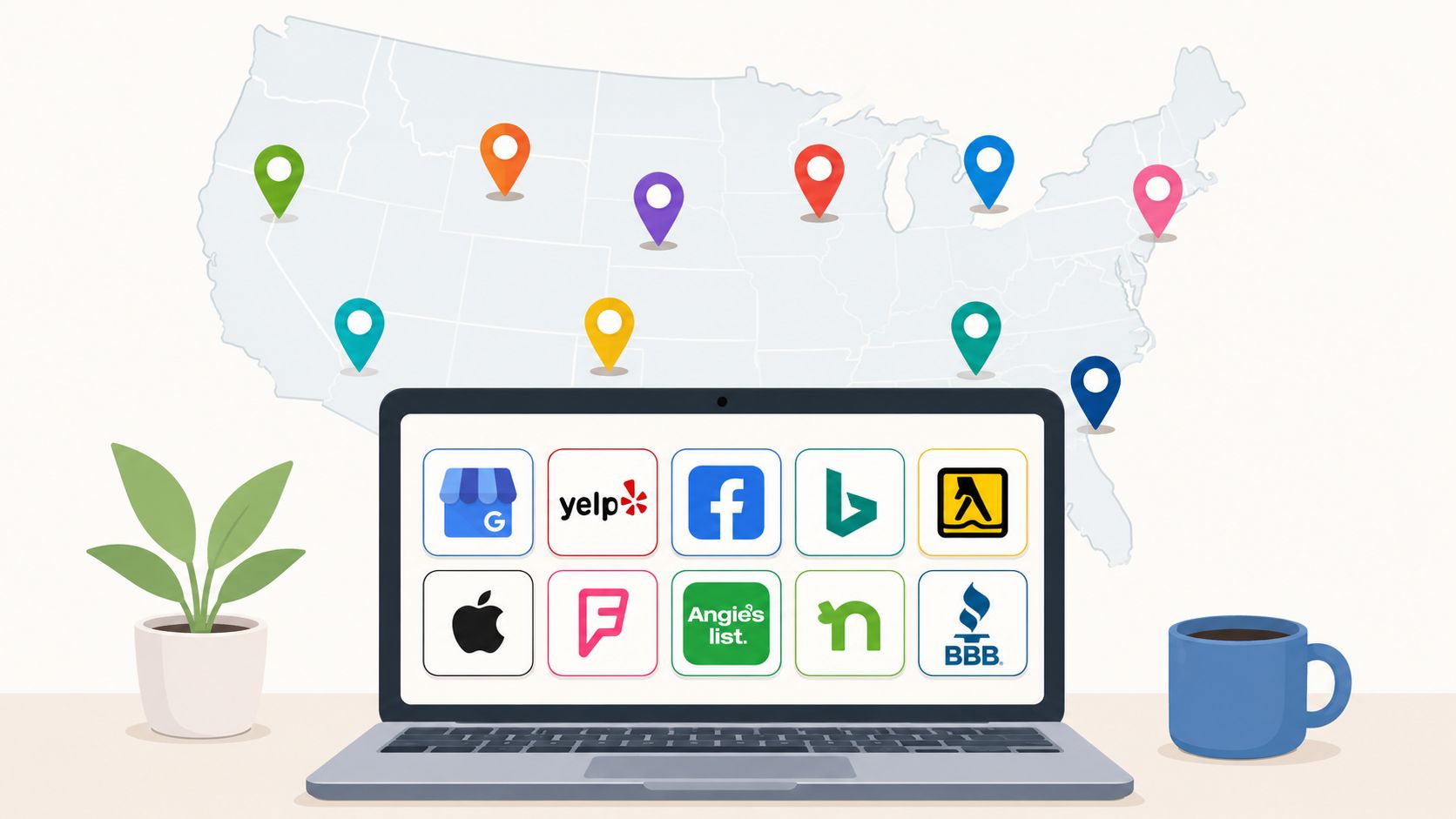
Directory profiles influence buying decisions before a prospect ever reaches your website. Customers compare hours, reviews, photos, categories, and map results on the platforms they already use, and weak listings lose that click to a competitor with cleaner information.
The mistake I see most often is poor prioritization. Small businesses and multi-location teams alike spend hours chasing low-value directory submissions while the profiles that drive real discovery are incomplete, inconsistent, or ignored. A wrong holiday schedule on Google, no photos on Apple Maps, or stale review responses on Yelp does more damage than missing a minor directory entry.
The practical way to handle business listing websites in the USA is to work in tiers.
Start with Foundational listings. These are the profiles that shape search visibility, map placement, and first-click trust. Then build Authority-Building listings that reinforce legitimacy and reputation. After that, expand into Extended Reach sites for broader citation coverage and secondary referral traffic. That sequence saves time and gets better results because effort goes to the listings customers check first.
If local search is a priority, this should connect to your broader Google Maps ranking strategy for local visibility, not sit off to the side as a one-time admin job.
SQ Magazine reports that 79% of consumers trust online business listings as much as personal recommendations, and 71% of new customers first discover a business through a directory listing before visiting the company website. That is why this guide does not treat every listing site as equal. The goal is to help you decide what to claim first, what to fully optimize, and what can wait until the core profiles are in good shape.
1. Google Business Profile

Google Business Profile sits at the top of the Foundational tier because it influences the two places local intent shows up fastest: Google Search and Google Maps. If a business only claims and fully optimizes one listing, this should be first.
It acts as the operating hub for local discovery. Customers use it to check hours, call, get directions, read reviews, compare photos, scan services, and decide whether your business looks active or neglected. That is why weak setup work here costs more than missing a secondary directory.
What improves results is rarely complicated. Choose the right primary category. Set the address or service area correctly. Keep the phone number and hours accurate. Add real photos, not stock filler. Write a clear description. Reply to reviews. Update holiday hours before they become a customer service problem.
Priority rule: Complete every field a customer might rely on before spending time on lower-tier listings.
Three areas usually separate strong profiles from average ones:
- Category and service alignment: The primary category shapes relevance. Secondary categories and services help Google understand the full offer, but only if they match what the business sells.
- Visual proof: Storefront, team, interior, exterior, and product or service photos help searchers confirm they found the right place.
- Review management: A steady response process matters. Prospects read how you handle complaints, delays, and praise, not just your star rating.
There are trade-offs. Google gives the biggest visibility upside, but it also creates the most maintenance. Duplicate profiles, verification delays, suspensions, user-suggested edits, and ranking swings are common. Businesses that depend on local leads should treat GBP as an active asset, not a one-time setup task. If map pack visibility matters, build it into your broader Google Maps ranking strategy for local visibility.
For teams that want a more tactical workflow, this local marketing guide for SMBs covers the day-to-day optimization details well.
In this tiered system, Google Business Profile is the profile to finish first, audit most often, and protect most carefully.
2. Apple Business Connect

A large share of local discovery now happens on phones, and plenty of those searches never touch Google. Apple Maps, Siri, iMessage, CarPlay, and other Apple surfaces influence where people drive, who they call, and which storefront looks trustworthy first. If your Apple presence is wrong, the problem shows up fast in missed calls, bad directions, and lower walk-in confidence.
In this tiered framework, Apple Business Connect belongs in the Foundational tier. It is not the first profile to build. Google still carries more weight for most local lead generation. But Apple is one of the first listings to clean up after Google because the upside is real and the maintenance load is usually lower.
What makes Apple valuable is control. Businesses can manage their place card details directly, which helps reduce the common mismatch between what customers see on their iPhone and what is accurate at the location. For single-location businesses, that usually means cleaner hours, better photos, and more accurate categories. For multi-location brands, location groups and role management make it easier to keep dozens or hundreds of listings consistent.
The strongest use cases are practical:
- Map accuracy: Correct address, pin placement, phone number, and hours help customers reach the right location without extra friction.
- Brand presentation: Photos, logo treatments, and business details shape whether the listing looks current or neglected.
- Action readiness: Features like calls, directions, website visits, and other business actions matter most when the customer already intends to visit.
Apple also has limits. It is weaker than Google or Yelp as a review and reputation channel, so I would not treat it as a primary review-building platform. Its job is discovery, routing, and trust at the decision point.
That trade-off matters. If a business has limited time, finish the core fields on Google first, then move Apple up the list before spending energy on lower-impact directories. That sequence fits the broader priority checklist in this article. Foundational listings get your best data first. Authority-building and extended-reach sites come after the main customer-facing profiles are accurate.
One more caution. Apple listings often get ignored because teams assume customers will figure things out anyway. They usually do not. Drivers follow the map pin. Mobile users tap the first number they see. If the place card is stale, the listing creates unseen lost visits and support headaches.
If you are already tightening your local presence, this fits well alongside a broader local marketing guide for SMBs. Treat Apple as one of the few profiles that deserves early attention, regular audits, and clean location data.
3. Bing Places for Business

A large share of local listing traffic still starts with Google, which is exactly why Bing gets missed. In practice, Bing belongs in the Foundational tier because it expands your search visibility with far less effort than building out a second major profile from scratch.
A significant advantage is operational. If your Google Business Profile is already accurate, Bing can pull in much of that data and shorten setup time. That matters for small teams, multi-location brands, and agencies trying to clean up core listings without turning one task into a week of copy-paste work.
I treat Bing as a priority right after Google and Apple, not because it drives the same volume, but because the cost-to-value ratio is strong. You can get the listing live, audit the imported fields, and move on without giving it the same level of weekly attention as your primary profiles.
A few checks make the difference between "claimed" and useful:
- Import first, then review everything: Imported hours, categories, and service details can still come through wrong or incomplete.
- Keep NAP consistent: Your name, address, and phone number should match your core listings exactly.
- Check the map pin: A bad pin creates missed visits, support calls, and avoidable frustration.
- Clean up duplicate locations: Multi-location accounts get messy fast if naming conventions and ownership are loose.
- Monitor reputation signals in one workflow: If you are tightening listings and response processes together, pair Bing maintenance with a review management service for local businesses.
The trade-off is simple. Bing usually will not outperform Google, Yelp, or even Apple for local intent. It still earns a place on the priority checklist because it gives you extended search coverage while staying close to Foundational-level effort.
That is the larger point of this tiered approach. Do the high-visibility listings first. Then add the platforms like Bing that widen reach without demanding much ongoing maintenance.
4. Yelp for Business

Yelp for Business deserves a higher spot than many business owners give it. In review-driven categories, a weak Yelp profile can cost calls even when your Google presence is solid.
I put Yelp in the Authority-Building tier. It is not a Foundational listing like Google Business Profile or Apple Business Connect, but it carries more influence than a standard directory if customers compare providers before they book. That is especially true for restaurants, med spas, salons, dentists, home services, law firms, hospitality, and local retail.
Yelp users rarely browse casually. They compare star ratings, read recent reviews, scan owner responses, and judge photo quality fast. That means your listing has to do more than exist. It has to reduce doubt.
Here is where I would focus first:
- Reviews and responses: Reply in a calm, specific way. Thank happy customers. Address complaints without sounding rehearsed or argumentative.
- Photos: Add real images of your space, team, work, menu, or results. On Yelp, poor visuals can sink conversion faster than thin copy.
- Business details: Tighten categories, specialties, service areas, hours, and attributes so visitors can tell whether you fit their needs.
- Lead tracking: If you test paid Yelp products, separate Yelp leads from Google leads and check close rate, not just raw inquiries.
The trade-off is real. Yelp can produce high-intent leads, but it also demands thicker skin. Review filtering frustrates owners, competitor comparisons are constant, and paid placements can burn budget if your page is weak or your sales process is slow.
Field note: Businesses usually underperform on Yelp for one of two reasons. They ignore it until a bad review sits unanswered, or they spend on ads before fixing photos, details, and response habits.
For the tiered checklist, the priority is straightforward. Claim the page, clean up every visible detail, add strong photos, and set a response routine. After that, monitor it as an Authority-Building asset, not as a daily channel. If Yelp reviews influence buying decisions in your category, pair the listing with a stronger review management process for local businesses.
5. Nextdoor for Business

Nextdoor for Business is different from the search-and-maps platforms above. It behaves more like neighborhood-driven discovery than classic local SEO. That changes how you should use it.
This platform works best when people buy based on proximity, familiarity, and local recommendations. Think plumbers, gardeners, cleaners, pet services, dentists, salons, neighborhood restaurants, and community-facing retail. If your business depends on being known in a tight geographic pocket, Nextdoor can support that.
Best use cases for neighborhood visibility
I'd put Nextdoor in the Authority-Building tier for local service businesses and storefronts with a clear neighborhood footprint. It's less valuable for broad B2B, less useful for companies with no local community angle, and not a substitute for map listings.
Its strengths are straightforward. A free business page gives you a local identity, recommendations carry social proof in a community context, and paid options can target nearby neighborhoods. That combination can work well when trust and familiarity drive action.
Use it well by keeping the tone local:
- Post like a neighbor, not a banner ad: Community updates, helpful reminders, seasonal tips, and local offers tend to fit better than hard-sell copy.
- Keep geography specific: Mention service areas, neighborhoods, and practical details people nearby care about.
- Watch message quality: Leads may be warmer because they're local, but they can also be casual. Fast response matters.
The main limitation is reach. Nextdoor won't give you broad search visibility or replace platforms that feed maps and branded discovery. It also doesn't provide the same SEO value as a stronger directory citation.
That's why I see it as a channel multiplier, not a base layer. For the right business, it can reinforce neighborhood word of mouth. For the wrong business, it becomes another profile to maintain without enough return.
6. Better Business Bureau

The Better Business Bureau isn't a growth channel in the same way Google or Yelp is. It's a trust layer. For some businesses, especially in services, finance-adjacent work, home improvement, legal, healthcare-adjacent categories, or any business where customers scrutinize credibility, that trust layer matters a lot.
BBB profiles often appear for direct searches of your company name. That means customers, procurement teams, and skeptical buyers may see your BBB record when they're validating whether you're legitimate.
When BBB is worth the effort
I treat BBB as Authority-Building. Not every business needs accreditation, and not every category gets the same lift from it. But a claimed, accurate profile is usually worth having, especially if branded search trust matters in your sales process.
BBB gives you a public profile with reviews, ratings, and complaint history. That's useful and uncomfortable at the same time. If you're going to maintain the profile, someone on your team needs to own complaint response and keep your business details current.
Two practical points matter here:
- Use the free profile first: Make sure the listing is claimed, accurate, and complete before evaluating accreditation.
- Assess complaint handling capacity: Public trust goes up when complaints get serious, timely responses. It goes down when the profile looks abandoned.
Some listings attract discovery. BBB mostly attracts verification. That's still valuable because a lot of customers verify before they buy.
The downside is time. Complaint management can be labor-intensive, and accreditation fees vary. If your category rarely sees buyers check BBB, don't force it into the same priority level as Google, Apple, Bing, or Yelp.
Still, if your business closes larger deals or depends on cautious buyers, BBB can support the kind of credibility that generic directories rarely provide.
7. Yellow Pages
Yellow Pages is a classic example of an Extended Reach platform. It's not where I'd start, and it's not where I'd spend heavy optimization time. But it can still add useful citation coverage if your foundational listings are already in shape.
A lot of business owners dismiss YP because it feels old. That's understandable. The smarter view is to treat it as a secondary directory that can reinforce consistency around your name, address, phone number, categories, and website.
What it's good for, and what it isn't
YP works best as a supporting citation, not a primary lead source. If you expect Google-level volume from it, you'll be disappointed. If you use it to extend accurate business data and maintain another legitimate web presence, it can still pull its weight.
I'd use it in three situations:
- Citation cleanup: Add or claim the listing so your core business data appears consistently across the web.
- Brand protection: Make sure old phone numbers, outdated URLs, or former addresses aren't floating around unmanaged.
- Supplemental directory visibility: Some users still browse directories directly, especially in familiar local service categories.
The trade-off is straightforward. Lead volume is usually lower than stronger local platforms, and sales outreach can follow if you submit listing details. Keep expectations modest and stay disciplined about what you buy.
YP becomes useful only after your top-tier profiles are complete. That's the pattern with most Extended Reach listings. They help once the foundation is stable. They don't rescue a messy foundation.
8. Manta

Manta belongs in the Extended Reach tier. That placement matters because businesses waste a lot of time treating every directory as if it deserves the same level of attention.
Manta can help with citation coverage, branded search visibility, and another indexed profile that supports your business identity online. It usually does not become a meaningful lead channel on its own. The practical use case is simple. Claim it after the Foundational and Authority-Building listings are accurate and complete.
That priority order saves time.
Manta works best for businesses that already have their core profiles under control and want to add a credible supporting citation without signing up for a giant directory grind. The profile gives you another place to publish your business name, address, phone number, website, categories, and company summary. For local SEO, that is the value.
I would use Manta for three specific jobs:
- Citation support: Add one more trustworthy mention of your core business details.
- Brand defense: Claim the profile so outdated contact info or duplicate business data does not sit unmanaged.
- Extended Reach coverage: Pick up some long-tail directory visibility once higher-priority platforms are finished.
The trade-off is straightforward. Manta is worth claiming, but not worth obsessing over. A clean, complete listing is enough for most businesses. Paid add-ons only make sense if you need outside help managing listings or do not have an internal process for keeping business data consistent.
As noted earlier, Manta has stronger directory authority than a lot of low-value listing sites. That gives it a place on the checklist. It still belongs below your main listings in priority, which is why it fits this article's tiered approach so well. Get the foundation right first. Use Manta to extend that work, not replace it.
9. Facebook Pages
Customers often check Facebook before they contact a local business. They want quick proof that the company is real, active, and easy to reach.
That is why Facebook belongs in the Foundational tier for many businesses, even though it does not work like a traditional directory. A Facebook Page pulls double duty. It supports discovery through search and platform browsing, then helps with validation through posts, photos, reviews, comments, and Messenger.
The practical priority is simple. Set up Facebook after your core business data is correct on Google Business Profile, Apple Business Connect, and Bing Places. Then use it as an active trust signal, not just another citation.
A strong page usually gets four things right:
- Core details match everywhere: Business name, address, phone number, hours, website, and primary category should stay aligned with your main listings.
- Recent activity is visible: A few current posts, updated cover and profile images, and fresh photos of the location or team are usually enough.
- Customer touchpoints are managed: If reviews, comments, or messages are open, someone needs to monitor them and respond.
- Service information is specific: List services, service areas, appointment options, and basic FAQs so visitors do not have to guess.
The trade-off is maintenance. Facebook can help conversion, but neglected pages create doubt fast. An outdated holiday post from two years ago, broken hours, or unanswered public comments can do more harm than a plain directory profile with limited features.
This platform is especially useful for restaurants, home services, med spas, salons, gyms, clinics, retail stores, and community-based businesses where buyers want visual proof and quick contact options. For B2B firms, Facebook is usually less important than LinkedIn, though it can still support brand validation. Teams building that side of visibility should also review these LinkedIn lead generation strategies to match the channel to the sales process.
My rule is straightforward. Claim the page, complete the profile, keep the business details accurate, and post often enough that the page does not look abandoned. In this tiered checklist, Facebook earns time early because it affects both discovery and trust.
10. LinkedIn Company Pages
B2B buyers rarely contact a company they cannot verify. LinkedIn helps close that trust gap fast, which is why it belongs in the Authority-Building tier for most businesses and can move into the Foundational tier for firms that sell primarily to other businesses.
Its job is different from Google Business Profile, Yelp, or Nextdoor. LinkedIn does not drive map visibility. It helps prospects, candidates, partners, and referral sources confirm that the company is real, active, and credible. For agencies, consultants, law firms, accounting firms, software companies, manufacturers, and other B2B brands, that check happens all the time.
A good LinkedIn Company Page does three things well:
- Clarifies positioning: Explain what the company does, who it serves, and the problems it solves.
- Supports credibility: Connect employee profiles to the page so visitors can see the team behind the brand.
- Shows signs of life: Publish occasional updates, hiring posts, client-safe wins, or short insights so the page does not look abandoned.
The trade-off is simple. LinkedIn rewards clear positioning and steady upkeep, but it is a weak use of time for businesses that depend on walk-in traffic or neighborhood discovery. A local restaurant, salon, or auto shop should finish the Foundational listings first. A B2B service firm should treat LinkedIn much earlier in the checklist because buyers often review the company page before they book a call or reply to outreach.
The page also works better when it matches the rest of your presence online. The company description, specialties, website URL, logo, and leadership signals should align with your site and other core listings. Mixed branding or vague copy makes the business look smaller and less established than it is.
If LinkedIn plays a role in sales, connect the page to a broader outbound and content plan using these LinkedIn lead generation strategies.
My rule is practical. Build the page if professional buyers may look you up, write a sharp description, connect the team, and keep it current enough to support trust. In this tiered system, LinkedIn earns priority based on audience fit, not because every business needs to spend time there.
Top 10 US Business Listing Sites Comparison
| Platform | ✨ Core features | ★ UX / Quality | 💰 Price & Value | 👥 Target audience | 🏆 USP |
|---|---|---|---|---|---|
| Google Business Profile (GBP) | Control Search & Maps listing, posts, reviews, messaging, bookings | ★★★★★ High local reach; essential for "near me" discovery | 💰 Free core; high ROI for local SEO | 👥 Local SMBs, storefronts, service providers | 🏆 Largest local search reach; direct intent traffic |
| Apple Business Connect (Apple Maps) | Edit place cards, promotions, Actions, location groups | ★★★★ Strong iOS mapping + clean analytics | 💰 Free; valuable iOS visibility | 👥 iPhone users, multi‑location brands | 🏆 Reach Siri & Wallet users; polished map presence |
| Bing Places for Business | Claim or sync from GBP, categories, photos, multi‑location | ★★★ Desktop/Windows audience; incremental reach | 💰 Free; easy setup via sync from Google | 👥 Windows/desktop users, incremental audiences | 🏆 Simple Google import; expands reach beyond Google |
| Yelp for Business | Claim pages, review management, messaging, ads/upgrades | ★★★★ Review‑driven UX; strong decision influence | 💰 Free profile; ads and upgrades paid (can be costly) | 👥 Restaurants, service businesses, hospitality | 🏆 High review influence; strong conversion signals |
| Nextdoor for Business | Free business page, posts, neighborhood targeting, promos | ★★★★ Trusted hyperlocal community experience | 💰 Free page; optional neighborhood ads | 👥 Neighborhood businesses, service territories | 🏆 Community recommendations & hyperlocal trust |
| Better Business Bureau (BBB) | Profiles, reviews, complaints; optional accreditation | ★★★ Trust & complaint resolution focus | 💰 Free profile; accreditation fees vary | 👥 Trust‑sensitive consumers & procurement | 🏆 Recognized trust seal and formal dispute process |
| Yellow Pages (YP.com) | Basic NAP listing, photos, reviews, paid placement options | ★★ Legacy directory UX; lower lead volume | 💰 Free basic; paid enhanced packages common | 👥 Directory‑oriented consumers, older demos | 🏆 Citation/backlink value & legacy recognition |
| Manta | Free company listing, citation scans, paid cleanup services | ★★ Modest traffic; good for long‑tail discovery | 💰 Free listing; affordable paid citation services | 👥 Small businesses needing citation coverage | 🏆 Cost‑effective citation hygiene for SMBs |
| Facebook Pages (Meta) | Pages, posts, events, messaging, Instagram/Shop integration | ★★★★ Massive audience; organic reach limited without ads | 💰 Free; paid ads for targeted reach | 👥 B2C retailers, local brands, social audiences | 🏆 Social engagement + granular ad targeting |
| LinkedIn Company Pages | Company overview, jobs, Showcase pages, analytics | ★★★★ Professional/B2B credibility; content‑driven growth | 💰 Free; LinkedIn Ads for paid targeting | 👥 B2B firms, professional services, recruiters | 🏆 Best platform for professional credibility & partnerships |
Turn Your Listings into a Powerful Growth Engine
A small group of listing platforms drives most of the effective visibility work. That is why a tiered plan beats a long submission spreadsheet every time.
Start with the Foundational tier. Google Business Profile, Apple Business Connect, Bing Places for Business, and Facebook Pages deserve first attention because they shape branded search, map visibility, and first-click trust. If those profiles are incomplete, inconsistent, or unmanaged, broader directory coverage will not fix the problem. It just spreads weak business data farther.
The next layer is Authority-Building. Yelp, Better Business Bureau, Nextdoor, and LinkedIn can improve trust, but only when they match how customers evaluate your business. A home services company may get real value from Nextdoor and BBB. A law firm may care more about Yelp and BBB. A B2B agency usually gets more from LinkedIn than from neighborhood apps. The point is fit, not box-checking.
Then use Extended Reach sites such as Yellow Pages and Manta to widen citation coverage after the core profiles are clean. Many teams, however, often waste time here. They claim twenty low-impact listings before they have fixed duplicate addresses, outdated hours, weak photos, or unanswered reviews on the platforms that customers already use.
A practical checklist keeps this manageable:
- Complete every Foundational profile first.
- Standardize your business name, address, phone number, primary category, hours, and website URL.
- Add original photos, service details, and a strong business description specific to each platform.
- Claim only the Authority-Building profiles that match your sales model.
- Expand to Extended Reach listings after the first two tiers are accurate.
- Assign ownership for updates and review responses.
Ownership matters more than many businesses expect.
Listings usually break for boring reasons. Someone changes store hours on Google but forgets Apple Maps. A franchise updates a phone number in one dashboard and leaves old citations live elsewhere. A former employee still controls a Facebook Page. None of that is complicated, but all of it hurts conversion when customers hit the wrong number, the wrong hours, or an unclaimed profile.
The best-performing setup is usually narrow and well maintained. A complete Google profile, a polished Apple place card, an accurate Bing listing, an active Facebook Page, and a few category-relevant authority profiles will outperform a messy presence across dozens of weak directories.
If internal bandwidth is thin, outside help can make sense. Agencies and listing management providers can handle setup, citation cleanup, review workflows, and recurring updates faster than an in-house team that treats listings as a side task. And if your broader SEO plan includes authority building beyond directory citations, it is worth exploring resources on how to get backlinks for your startup.
If you want a sharper local presence without wasting time on low-value directories, ReachLabs.ai can help you prioritize the right platforms, clean up inconsistent listings, strengthen reviews, and build a digital storefront that effectively supports discovery and conversion.