A campaign goes live on Monday. By Wednesday, a copycat site is bidding on your branded terms, a fake marketplace listing is undercutting your price, and an impostor social account is answering customer questions before your team sees them. For SMBs, brand abuse rarely starts as a legal problem. It shows up first in marketing metrics: lower conversion rates, wasted paid spend, more support volume, and customers who are no longer sure they found the legitimate business.
Brand protection deserves a place in the marketing operating plan because it directly affects acquisition efficiency and retention. If a counterfeit seller intercepts branded search traffic or a fake profile confuses buyers, CAC rises and campaign performance gets harder to explain. The issue is not abstract. It is operational.
Teams that handle this well do not treat brand protection as a generic checklist. They build a prioritized playbook across legal, digital, and channel operations, then assign clear owners inside marketing, ecommerce, support, and leadership. That structure matters because the trade-off is real. You can chase every minor misuse, or you can focus first on the issues that distort revenue, customer trust, and team bandwidth.
If your identity is still inconsistent across channels, fix that early. Clear naming, visual systems, and asset standards make enforcement faster and reduce internal confusion later. A stronger visual brand identity system gives your team a cleaner basis for monitoring, reporting, and taking action.
If you're expanding into the U.S. market, this guide on protegiendo tu marca en EE. UU. is a useful companion.
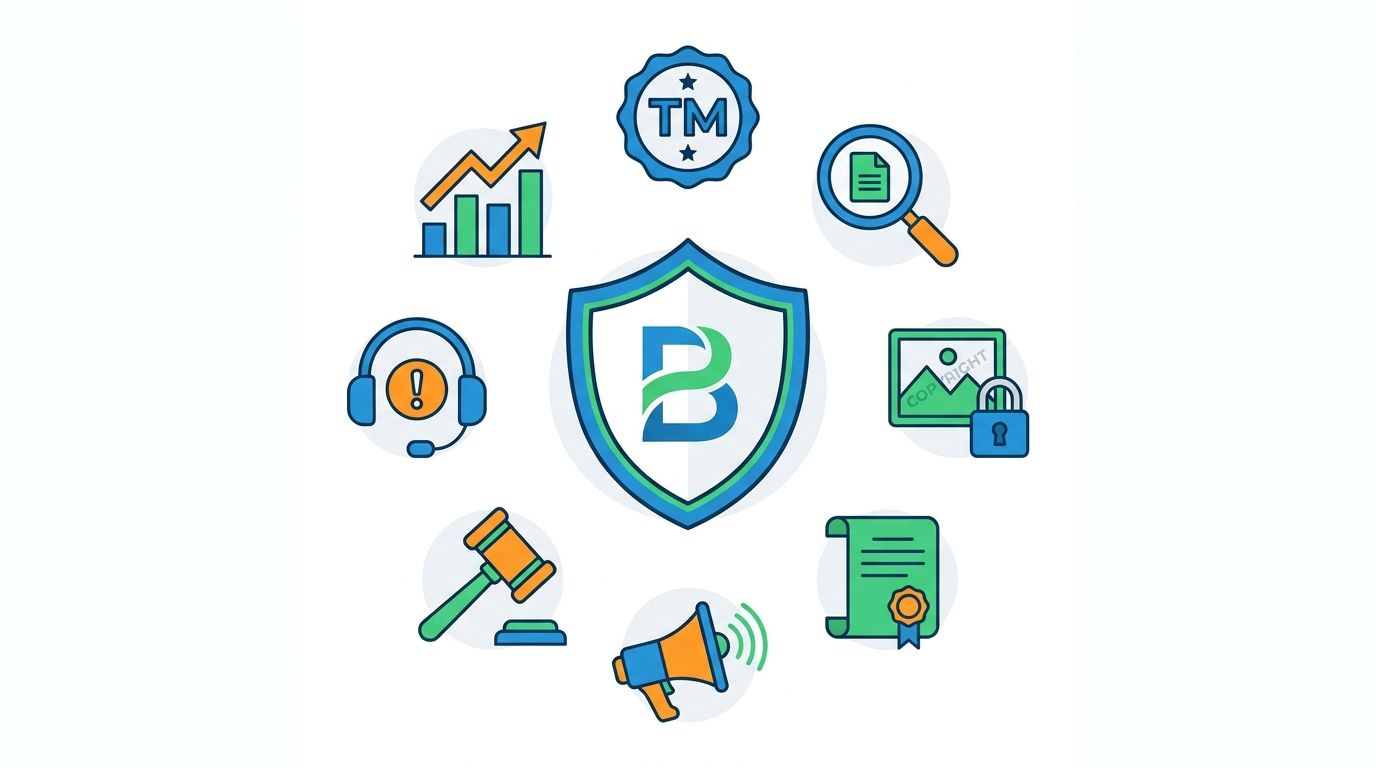
The good news is that a practical program does not require an enterprise security team. It requires priorities, documented workflows, and a marketing team that knows which threats to escalate first. These ten strategies are designed to help growing brands protect demand, protect trust, and keep marketing spend working as intended.
1. Trademark Registration and IP Protection
A campaign starts working, branded search picks up, and a competitor or reseller files a similar mark before you do. Now marketing has to explain why paid traffic is leaking, marketplace complaints stall, and the brand assets the team spent months building are suddenly harder to defend.
Trademark registration prevents that scramble. It gives your team a legal basis to remove infringing listings, challenge imitators, and protect the assets that drive recognition in the market. For SMBs, that matters because every hour spent on cleanup is an hour not spent on growth.

What marketing teams usually miss
Teams often file only the company name, then assume the core work is done. That leaves obvious gaps if demand is tied to a product family, a tagline in paid campaigns, packaging cues, or logo variants used across ads, ecommerce, and retail.
File based on market exposure, not internal org charts. If customers search for it, recognize it, or associate it with your offer, review whether it belongs in your protection plan.
Clear brand architecture makes that decision easier. If your identity is still inconsistent, tighten the system before filing. Strong visual brand identity planning helps teams define which names, marks, and visual elements deserve protection first.
Practical rule: File before a major launch, not after infringement appears.
Large brands show the pattern clearly. Coca-Cola protects core marks across markets. Nike protects the Swoosh and related brand assets. Apple protects the apple silhouette because recognition is not limited to words.
What to prioritize first
Start with the assets tied most directly to revenue and efficiency:
- Primary word mark: Your brand name and any product names customers actively search for
- Core logo assets: Current logo versions used across site, ads, packaging, and marketplace listings
- High-visibility taglines: Phrases that appear repeatedly in campaigns and have started to signal your brand
- Expansion coverage: Marks tied to categories, geographies, or channels you plan to enter next
The trade-off is cost versus exposure. A growing business does not need to file everything at once. It does need to protect the marks that support acquisition, conversion, partner sales, and repeat purchase. That is the practical standard.
What works is a filing plan tied to real usage and business priority. What fails is treating registration like administrative cleanup for later. Once demand exists, copycats move quickly, and marketing ends up funding awareness that someone else captures.
2. Digital Copyright Protection and Content Watermarking
Creative work gets copied because it's easy to copy. Product photography, ads, videos, sales decks, landing page graphics, and downloadable guides can all get lifted and reposted with almost no friction.
That makes copyright protection practical, not academic. If your business produces visual or written assets that support acquisition, retention, or partner sales, protect the assets that would hurt most if reused by a reseller, competitor, or scammer.
Early in the process, put your protection right into the asset.

A layered approach beats a single watermark
A visible watermark discourages casual theft. Invisible watermarking or embedded metadata helps you prove origin later. Copyright notices in deliverables and contracts reinforce ownership when the issue moves from marketing to legal.
Getty Images built a recognizable approach around visible watermarking. Adobe has also pushed content authenticity tooling to help creators prove provenance. Those examples matter because they show the same lesson: attribution and proof are separate jobs, and you need both.
Use this process on higher-value assets:
- Visible protection: Add branding to previews, pitch visuals, and downloadable creative samples.
- Invisible proof: Keep original files, metadata, edit history, and timestamps stored centrally.
- Registration focus: Register the assets that have long shelf life or strong commercial value.
- Monitoring habit: Run reverse image searches on hero visuals, product shots, and campaign graphics.
Teams that skip the archive step usually regret it. If you can't quickly pull original files, draft dates, source layers, and approved versions, even obvious copying becomes harder to enforce.
A quick explainer is useful for internal training and creative operations.
3. Social Media Brand Monitoring and Reputation Management
Most brand confusion now shows up first on social. A fake support account replies to comments. An impersonator posts a giveaway. A reseller uses your logo in a profile image and starts looking official.
That's why social monitoring has to move beyond notifications and occasional manual checks. Organizations that implement comprehensive digital risk protection report an average 60% reduction in successful brand impersonation incidents within the first year, according to DWB Project's digital risk protection overview.
Where this breaks down in practice
Marketing teams often monitor mentions but not impersonation patterns. Those are different workflows. Mention monitoring tracks conversation. Brand protection monitoring tracks unauthorized use of names, logos, imagery, executive identities, and support language.
For day-to-day execution, pair your listening stack with a response system. Your social team should know which reports go to platform support, which go to legal, and which need public clarification from the brand. ReachLabs' guide to reputation management on social media is a useful reference point for building that operational side.
Fast response matters more than perfect response. Customers rarely expect a brand to stop every fake account. They do expect clear guidance once confusion starts.
A few teams also use external data collection tools to track suspicious network behavior or recurring account patterns. If you're evaluating monitoring workflows, this overview from ScrapeCreators on scraping social platforms helps frame the tooling side.
What to monitor every week
- Brand name variants: Check common misspellings, abbreviations, and campaign hashtags.
- Executive identities: Watch for fake founder, support, or recruiter profiles.
- Engagement anomalies: Sudden comment spikes can signal scam replies or fake giveaways.
- Unauthorized sellers: Instagram, TikTok, and Facebook profiles often act as informal storefronts.
Apple moves quickly on fake support accounts because customer confusion spreads fast in comments and DMs. Smaller brands should treat that as the model.
4. Exclusive Brand Partnerships and Licensing Agreements
Bad partnerships damage a brand almost as efficiently as bad actors do. A retailer rewrites your product copy. An affiliate uses your logo in paid ads. An influencer agency republishes old brand assets after the campaign has ended.
The fix is simple in theory and often neglected in practice. Put usage rules in the agreement, not in a PDF that nobody reads after kickoff.
Structure matters more than legal jargon
Disney is the obvious example here. Its licensing ecosystem works because the creative rules and enforcement terms are inseparable. Partners don't get broad freedom and then a reminder to "stay on brand." They get precise permissions.
Your agreements should define:
- Asset scope: Which logos, taglines, visuals, and product names the partner may use.
- Channel scope: Where usage is allowed, including paid social, retail listings, email, events, and packaging.
- Approval rules: What needs written approval before publishing.
- End-of-use terms: When the partner must remove assets after a campaign or contract ends.
Many SMBs are too casual with reseller and influencer agreements. They assume goodwill will solve consistency problems. It won't. If the relationship matters enough to support with marketing assets, it matters enough to govern clearly.
The trade-off
Rigid controls protect consistency, but they can slow down partnerships. That's real. The answer isn't to remove controls. It's to create pre-approved asset packs, sample captions, image libraries, and escalation paths so partners can move quickly without improvising.
Unilever and other large consumer brands have spent years refining that balance. Smaller teams can do the same with fewer documents and clearer rules.
5. Domain and URL Protection Strategy
A campaign goes live Monday morning. Paid search is active, the email send is scheduled, and the sales team is sharing the landing page. By noon, a typo domain is already siphoning traffic, or a lookalike URL is being used in phishing emails. Marketing feels that failure first. Lower click trust, wasted spend, confused leads, and a support queue full of "Is this really you?"
That is why domain protection belongs in the marketing playbook, not just IT or legal.
Start with ownership. SMBs do not need a huge portfolio, but they do need to cover the domains that can hurt revenue if someone else gets them first. Prioritize the primary .com, key country extensions if you sell internationally, common misspellings, product-name domains tied to active campaigns, and the short branded URLs used in ads, QR codes, and offline materials.
The goal is simple. Reduce traffic leakage and remove avoidable trust friction.
What to register first
Use a tiered approach instead of buying domains at random.
- Tier 1: Core brand domains. Your main brand name across the extensions customers are most likely to assume.
- Tier 2: High-risk variants. Common typos, plural forms, hyphenated versions, and close spellings that could catch direct traffic or support phishing.
- Tier 3: Campaign and product domains. Names tied to flagship offers, seasonal launches, or high-budget paid media.
- Tier 4: Defensive redirects. Short, memorable URLs for social bios, print materials, events, and partner campaigns.
Teams often overspend on these considerations. If a variant is obscure, expensive, and unlikely to confuse a real buyer, skip it. If it could steal branded search clicks or make a fake email look believable, buy it.
Large brands such as Amazon and Microsoft can justify broad defensive registration because confusion at their scale gets expensive fast. Smaller teams need a narrower rule. Register what protects active revenue, brand search efficiency, and customer trust.
The operating controls that prevent avoidable losses
Registration is the first step. Ongoing control is what keeps the system intact.
- Use auto-renew on every owned domain. Domain loss still happens because renewal notices go to one former employee or one expired card.
- Centralize ownership and access. Keep registrar access, billing, DNS control, and recovery contacts in a shared system.
- Monitor new lookalike registrations. Review suspicious domains regularly and decide whether they create brand, fraud, or conversion risk.
- Match the response to the harm. Some cases call for a redirect request, abuse complaint, or legal escalation. Others just need to be watched.
- Coordinate domain reviews with campaign planning. If the team is launching a new product or creator program, review naming risk before creative goes live.
This matters for influencer and partner campaigns too. If creators are sending traffic to custom landing pages or promo URLs, use the same approval discipline you would use for ad creative. Teams building those programs can apply the same screening mindset they use in a micro-influencer sourcing process and extend it to the domains, redirects, and landing pages attached to each partnership.
One practical rule helps. If a domain touches paid traffic, email, affiliate links, or partner promotions, assign an owner, set a renewal policy, and document its purpose. That takes an hour now and saves days of cleanup later.
Lookalike domains are not just a security problem. They waste media spend and weaken conversion rates.
What fails is the one-time purchase mindset. New products, new channels, and new partnerships create new URL exposure. Review domain risk whenever marketing creates a new path to your brand.
6. Influencer Vetting and Partnership Verification
Influencer fraud isn't always dramatic. Sometimes it's a creator with inflated followers. Sometimes it's a clean-looking account with a weak audience fit. Sometimes it's a partner who looks safe until you review recent content closely.
For brand protection, vetting matters because creator partnerships transfer trust. If the audience doubts the creator, your brand absorbs that doubt.
Check the account like an operator
Don't rely on a media kit alone. Review audience quality, comment patterns, past sponsorships, disclosure habits, and how the creator behaves when criticism appears in public.
For practical vetting, use a repeatable workflow and document it. ReachLabs' resource on how to find micro-influencers is a strong starting point because smaller creators often deliver a better balance of credibility, control, and reviewability than large personalities with messy histories.
I'd look at the last stretch of content, not just the top-performing posts. Recent behavior tells you whether the creator is stable, brand-safe, and consistent. You're looking for signs of audience mismatch, erratic positioning, or sudden content shifts.
A review sequence that saves headaches
- Audience authenticity: Check whether comments look conversational or mechanically repetitive.
- Brand alignment: Review recent posts for tone, claims, visual quality, and disclosure practices.
- Partnership history: See how they handled previous sponsored content and whether the brand fit felt forced.
- Pilot before scale: Start small before committing your core campaign message to one voice.
Unilever and HubSpot are often cited for more structured creator screening. The lesson for SMBs is straightforward. Slow down the first deal so you don't spend the next month cleaning up the wrong one.
7. Brand Voice Guidelines and Messaging Standards
A brand can be legally protected and still sound scattered. That kind of inconsistency doesn't usually trigger legal risk, but it absolutely weakens recognition and makes impersonation easier.
When every team writes differently, customers have no stable reference point for the brand's consistent voice. That gives fake accounts, shady affiliates, and low-quality partners more room to imitate you convincingly.
Consistency is a protection layer
Nike's messaging stays recognizable because it has clear tonal boundaries. Slack and Mailchimp do the same in very different voices. The point isn't to sound polished. The point is to sound unmistakable.
A useful guide includes more than adjectives. It should define message pillars, phrase preferences, banned claims, response tone for support, escalation language for crises, and examples across channels.
Some teams make the mistake of writing an inspiring document that no one can use. A workable guide includes specifics:
- Approved language: Product naming, claim wording, tagline use, and category terms.
- Disallowed phrasing: Words that create legal, compliance, or trust problems.
- Scenario examples: Social reply, ad copy, sales email, partner blurb, and customer support message.
- Ownership rules: Who can approve exceptions and who updates the guide.
A strong brand voice guide doesn't make content robotic. It makes distributed teams sound like one company.
What fails most often
The guide gets built once and never revisited. Then a new product launches, the company shifts upmarket, or a founder changes positioning on podcasts while the rest of the team is still using old language.
Quarterly review is a smart rhythm here. Not because every sentence needs revision, but because inconsistency compounds when no one owns the standard.
8. Competitor Monitoring and Market Intelligence
Competitor monitoring isn't copying. It's defensive awareness.
If a competitor adopts a confusingly similar product name, bids aggressively on your branded queries, or starts using visual conventions that blur category distinctions, your team needs to know early. Waiting until customers mention the overlap is too late.
What to watch beyond rankings
Use tools like Semrush, Ahrefs, and SimilarWeb for search and traffic patterns, but don't stop there. Track landing page messaging, affiliate behavior, partner announcements, reseller positioning, and product naming trends.
The best intelligence reports are short and usable. One page can be enough if it answers the right questions: what changed, why it matters, and whether marketing, legal, or sales needs to act.
For example, Coca-Cola and Apple don't just monitor campaigns for creative inspiration. They watch how competitors frame category value and where customer confusion could emerge. Smaller brands should do the same at a lighter weight.
Useful signals to collect
- Naming overlap: Similar product or campaign names entering your space.
- Ad behavior: Competitors buying terms closely tied to your brand or flagship offers.
- Marketplace presence: New sellers or bundles that create confusion around official distribution.
- Visual convergence: Packaging, layout, or color systems that narrow brand distinction.
What doesn't help is collecting screenshots with no decision attached. Intelligence only matters if someone reviews it, routes it, and acts on it.
9. Legal Cease-and-Desist and Enforcement Actions
Eventually, someone won't respond to polite outreach. That's when enforcement has to get formal.
A cease-and-desist letter, DMCA notice, marketplace complaint, or domain dispute process is the point where brand protection stops being advisory and becomes consequential. If your documentation is weak, this stage becomes slow and expensive. If your documentation is clean, it becomes much more effective.
Build the evidence before you need it
Good enforcement files include screenshots, timestamps, URLs, source files, trademark records, contract language, and notes showing how the misuse harms customers or confuses the market. Save that material as the issue develops, not after the offender disappears.
A useful way to measure this work is with KPIs like mean time to detection, time to takedown, takedown success ratio, and fraud lost prevented, which CybelAngel highlights in its guidance for modern brand protection programs. Those metrics matter because they turn enforcement into an operating discipline, not just a legal expense.
Louis Vuitton and Disney are famous for aggressive enforcement. You don't need to mimic their posture to learn from them. The practical lesson is speed plus consistency. If you only enforce occasionally, repeat offenders learn that your standards are flexible.
Where teams make mistakes
- Waiting too long: Delay gives bad actors more time to profit and spread confusion.
- Sending vague notices: General complaints without proof are easy to ignore.
- Skipping escalation paths: Some cases need platform action first, others need counsel immediately.
- Failing to close the loop: Marketing, support, and sales should know what was removed and what risk remains.
Legal action is rarely the first tool. It does need to be a real tool.
10. Customer Authentication and Product Verification Systems
The cleanest brand protection strategy is the one that lets customers verify authenticity themselves. If a buyer can quickly confirm a product, account, or seller, confusion drops and support pressure eases.
This matters even more for brands with physical products, resale activity, premium pricing, or frequent promotions. If buyers hesitate at the point of purchase, every fake in the market weakens legitimate conversion.
Verification should be easy to use
QR codes, serialized labels, holograms, digital certificates, and account verification cues all help. The right method depends on the product and buying journey. Luxury goods, limited drops, supplements, electronics, and cosmetics each face different risks.

Consumers can also become active allies when brands teach them how to verify products by smartphone and spot fakes, as noted in Netcraft's overview of consumer-focused brand protection practices.
Nike's authentication approach around collectible footwear is a useful example. So are verification systems used by luxury brands and pharmaceutical packaging teams. The pattern is consistent. Verification only works when customers know it exists and can use it without friction.
The operational side matters
A product code is only useful if customer support can explain it, retail partners understand it, and your website shows buyers what to expect. The education layer is part of the protection layer.
Use a simple setup:
- Visible cue: A code, seal, or label customers can find immediately.
- Digital check: A landing page or app workflow that confirms authenticity.
- Support readiness: Agents trained to handle verification questions and suspicious reports.
- Fraud review: Internal tracking for recurring abuse patterns or failed scans.
10-Point Brand Protection Strategy Comparison
| Strategy | 🔄 Implementation Complexity | ⚡ Speed / Time to Impact | ⭐ Expected Effectiveness | 📊 Key Outcomes / Impact | 💡 Resource Requirements & Ideal Use Cases |
|---|---|---|---|---|---|
| Trademark Registration and IP Protection | High, formal legal filings and classification | Slow, typically 6–12 months to register | ⭐⭐⭐⭐⭐, strongest legal protection | 📊 Exclusive rights, enforceability, increased brand valuation | 💡 Legal fees, IP counsel; ideal for established brands and agencies managing multiple clients; tip: file before major launches |
| Digital Copyright Protection and Content Watermarking | Medium, implement visible/invisible marks and DRM | Fast to deploy watermarks; enforcement is ongoing | ⭐⭐⭐⭐, deters casual misuse, supports disputes | 📊 Maintains attribution, creates audit trail, protects portfolio | 💡 DRM tools and monitoring; ideal for creative/content agencies; tip: use visible + invisible watermarking and register high-value works |
| Social Media Brand Monitoring and Reputation Management | Medium–High, continuous tools + human review | Fast detection (real-time); responses are reactive | ⭐⭐⭐⭐, effective at early threat detection | 📊 Early issue detection, sentiment insights, counterfeit/fake account removal | 💡 Social listening subscriptions and trained team; ideal for consumer brands and influencer campaigns; tip: set alerts and crisis templates |
| Exclusive Brand Partnerships and Licensing Agreements | High, complex legal drafting and negotiations | Medium, negotiation and onboarding timelines | ⭐⭐⭐⭐, controls third‑party use, creates revenue | 📊 Consistent brand use, licensing income, reduced misuse | 💡 Legal counsel and clear brand guidelines; ideal for brands seeking monetized partnerships; tip: include audit and approval clauses |
| Domain and URL Protection Strategy | Low–Medium, domain purchases and monitoring | Fast to register domains; monitoring continuous | ⭐⭐⭐, good preventive measure | 📊 Prevents cybersquatting/phishing, captures mistyped traffic | 💡 Registrar fees, renewal management; ideal for digital-first businesses; tip: register common misspellings and set auto-renewals |
| Influencer Vetting and Partnership Verification | Medium–High, tools + manual review processes | Medium, vetting requires historical analysis | ⭐⭐⭐⭐, reduces fraud, improves campaign ROI | 📊 Higher authenticity, safer partnerships, better engagement | 💡 Verification tools and analyst time; ideal for influencer marketing; tip: use multi-step verification and document findings |
| Brand Voice Guidelines and Messaging Standards | Medium, documentation and team training | Medium, rollout requires onboarding | ⭐⭐⭐⭐, strong consistency and recognition | 📊 Consistent messaging, quality control, stronger recall | 💡 Creative resources and training; ideal for content-heavy brands; tip: provide templates and regular audits |
| Competitor Monitoring and Market Intelligence | Medium, tool subscriptions and analyst work | Fast to start; insights require ongoing analysis | ⭐⭐⭐⭐, valuable strategic intelligence | 📊 Early warning of threats, campaign and positioning insights | 💡 Semrush/Ahrefs subscriptions and analysts; ideal for growth/defense strategies; tip: automate alerts and quarterly reports |
| Legal Cease-and-Desist and Enforcement Actions | High, legal processes, jurisdictional complexity | Slow, takedowns and litigation can be lengthy | ⭐⭐⭐⭐⭐, strongest enforcement when applicable | 📊 Legally binding remedies, deterrence, possible damages | 💡 Significant legal costs and counsel; ideal for serious infringements; tip: maintain evidence and consider settlement options |
| Customer Authentication and Product Verification Systems | High, tech (QR, blockchain, holograms) and integration | Medium, development and rollout time | ⭐⭐⭐⭐, very effective for high-value products | 📊 Reduces counterfeits, builds customer trust, real-time verification | 💡 Development/maintenance costs and support training; ideal for e‑commerce, luxury, pharma; tip: use multi-layer verification with simple UX |
Build Your Brand Protection Playbook Today
A campaign finally starts working, branded search gets more expensive, support tickets spike, and a sales rep finds a fake profile using your name. That is how many SMB teams discover they do not have a brand protection problem on paper. They have an operating problem inside marketing, ecommerce, support, and partner management.
A usable playbook fixes that because it assigns decisions before the next incident hits. It should name your protected assets, the owner for each channel, the approval rules for partners and creators, the threshold for legal escalation, and the evidence your team needs for a takedown or complaint. With that structure in place, brand protection becomes repeatable instead of reactive.
For SMBs and lean marketing teams, the best plan is not to do everything at once. Start with the assets and channels that directly affect revenue efficiency. That usually means core trademarks, high-intent domains, social impersonation monitoring, counterfeit marketplace checks, and clear usage rules for agencies, affiliates, and influencers.
This is marketing work as much as legal work. Fake listings can undercut pricing and hurt conversion. A lookalike domain can siphon branded search traffic and waste paid media spend. Sloppy partner messaging can create confusion that slows pipeline and increases support volume. Protecting the brand protects the economics behind your acquisition efforts.
Timing matters.
Teams that wait until after a successful launch usually pay more in cleanup time, internal confusion, and preventable customer distrust. Protection works better when monitoring, approvals, and reporting paths are already set up. That is the difference between a contained issue and a week of Slack chaos.
A practical rollout works in phases. First, build an asset inventory and identify where misuse would hurt demand capture, partner performance, or customer trust fastest. Next, add monitoring, domain review, and takedown workflows. As the program matures, track a small set of operating metrics such as time to detection, time to takedown, takedown success rate, fraud prevented, and changes in customer complaint volume. Those numbers give leadership a clear view of business impact, not just legal activity.
The market is moving toward more formal systems, as noted earlier in the article. That trend reflects a simple shift in how teams operate. Brands need defined processes, shared ownership, and tools that reduce response time.
If you are building the playbook now, pick one or two moves that will lower risk and improve marketing efficiency this month. Register the marks that matter most. Set up domain and social monitoring. Define who can approve partner usage. Train support to spot impersonation and counterfeit signals. Then add enforcement steps and reporting once the basics are working.
If you want help turning these ideas into an actual operating system, ReachLabs.ai can support the work across brand strategy, creative governance, influencer programs, content operations, and digital visibility. For teams that need protection without losing marketing speed, that combination delivers significant value.