
At its core, a value proposition answers a very simple, very human question your customer is always asking: "Why should I choose you?"
It's not just a clever slogan or a tagline. It’s the fundamental promise you make to your customers—the clear, compelling reason they should buy from you instead of someone else. Get this right, and it becomes the foundation for every single thing your business does.
What Is a Value Proposition, Really?
Think of your value proposition as the very first handshake you have with a potential customer. It’s that initial, firm connection where you communicate exactly what you stand for and what you're bringing to the table. This isn't just marketing fluff; it's the strategic heart of your entire business.
When you truly nail your value proposition, it acts as a "North Star" for your company. It guides every decision you make, from which features to build next and how you price your products to the exact language your sales and marketing teams use.
A Simple Breakdown of a Value Proposition
To put it in the simplest terms, your value proposition needs to answer three questions for any potential customer glancing at your website or ad.
| Core Element | What It Answers for the Customer |
|---|---|
| Relevance | "How does your product solve my problem or improve my situation?" |
| Value | "What specific benefits can I expect if I use it?" |
| Differentiation | "Why should I buy from you and not your competitor?" |
If your headline, sub-headline, and a few bullet points on your homepage can't answer these three things in under 5 seconds, you're losing people.
Why Your Audience Comes First
Here’s the thing: you can't create a message that resonates if you don't know who you're talking to. A value proposition developed in a boardroom, without any real customer insight, is almost guaranteed to fall flat.
To make a promise that actually connects, you need to get inside the heads of your ideal customers. What keeps them up at night? What are their biggest frustrations, goals, and day-to-day challenges?
This is where putting in the work on audience research pays off. Before you write a single word, you have to know:
- Who are they? Get specific about their demographics, roles, and responsibilities.
- What are their pain points? What specific problems can you make disappear?
- What do they value most? Are they looking to save time, make more money, or just gain peace of mind?
Building a crystal-clear picture of your audience is the non-negotiable first step. If you need a hand with this, our guide on how to create buyer personas breaks down the process. This clarity ensures your value proposition isn't just a generic statement—it's a tailored solution for the right people.
Why a Strong Value Proposition Is Non-Negotiable
A clear value proposition isn't just marketing fluff for your homepage. It’s the strategic bedrock that aligns your entire company. Think of it as your internal compass—it makes sure your product, sales, and support teams are all speaking the same language and pulling in the same direction.
Without that unifying message, things get messy fast. Your product team might start building features that don't actually solve the customer's core problem, while the sales team sells a version of your product that doesn't really exist. This kind of misalignment creates confused customers, drains resources, and grinds growth to a halt.
A great value proposition acts as the connective tissue, binding every department to a single, customer-centric mission. It's the definitive answer when an engineer asks, "Why are we building this?" or a marketer wonders, "What’s the real point of this campaign?"
It Helps You Stand Out in a Noisy World
Let's be honest: the market is crowded. Your potential customers are drowning in thousands of marketing messages every single day. A vague, generic statement about what you do just becomes more of that background noise.
This is where a powerful value proposition comes in. It cuts right through the clutter. In a single, clear statement, it tells people who you're for, what problem you solve, and exactly why you’re the best choice. This isn't just for your customers, either—it forces your own team to get hyper-focused on what really matters.
Your value proposition is the promise you make to your customers. More importantly, it’s the standard you set for your own business. It defines the value you must deliver, day in and day out, to earn and keep their trust.
When your message is this sharp, every piece of content, every ad, and every sales call becomes more potent. You start attracting customers who are a better fit from the get-go, which means higher-quality leads and a much smoother sales process.
The Massive Gap Between Having One and Getting It Right
Here’s the thing: just having a value proposition isn't the goal. The real work is in creating one that actually connects with people. The numbers here are pretty shocking. While 64% of businesses claim to have a value proposition, only a tiny 2.2% of companies have one that’s actually effective. If you want to dig into why so many messages miss the mark, this value proposition analysis is a great read.
That huge gap shows just how many companies struggle to translate what their product does into what their customer truly needs. They get stuck on features and fail to communicate the real-world benefits. This is exactly why knowing how to build a killer value proposition isn't just a "nice-to-have" skill—it's essential for any business that wants to thrive.
It Directly Impacts Your Bottom Line
At the end of the day, a well-crafted value proposition is a serious engine for growth. You can see its impact across the most important parts of your business:
- Better Conversion Rates: When a visitor lands on your site and instantly gets what you’re about, they’re far more likely to take the next step. It’s that simple.
- Deeper Brand Loyalty: A clear promise, delivered consistently, builds trust. And customers who trust you stick around for the long haul and tell their friends about you.
- A Real Competitive Edge: It forces you to get specific about what makes you different. That unique angle becomes your shield against the competition, giving people a rock-solid reason to choose you.
Putting in the effort to nail your value proposition isn't just a marketing task. It's a fundamental business strategy that pays for itself over and over again.
What Makes a Great Value Proposition Tick?
A truly powerful value proposition isn’t just a single clever slogan. It’s a carefully assembled message with distinct parts, all working in harmony. Think of it like building a high-performance engine—every single piece has a specific job, and they all need to fit together perfectly to generate any real power.
Typically, this means you have a headline, a short paragraph that adds some detail, and a few bullet points that drive the main benefits home. When you get this combination right, you create a clear, persuasive pitch that someone can grasp in just a few seconds.
The Headline: Your Big, Bold Promise
This is the first thing anyone reads, and it has one critical job: grab their attention with a clear, benefit-focused promise. Your headline should boil down the single biggest, most desirable result a customer gets from you. A weak headline is forgettable; a strong one is specific and makes you lean in.
Let's see what a little polish can do:
- Before: "Easy-to-Use Project Management Software"
- This is bland and sounds like a dozen other tools. It doesn't promise anything specific.
- After: "Finish Your Projects on Time and Under Budget, Every Time"
- Now that’s a promise. It speaks directly to a core desire—efficiency and cost control—and makes you want to know how it’s possible.
The Subheadline or Paragraph: Who It's For and How You Do It
Right after that knockout headline, you need to add a bit of substance. A subheadline or a quick two-to-three-sentence paragraph is the perfect place to elaborate on your promise. This is where you clarify who your product is for and how you deliver on that big promise you just made. You're adding crucial context and showing you genuinely understand your customer's world.
Here’s how to build on that initial promise:
- Before: "Our platform helps teams collaborate."
- Still way too generic. Which teams? How exactly does it help?
- After: "Designed for remote marketing agencies, our platform brings your communication, file sharing, and client approvals into one intuitive dashboard. Stop wasting time hunting for feedback in endless email chains."
- Much better. We now know the target audience (remote marketing agencies) and exactly how it solves their biggest headache (chaotic communication).
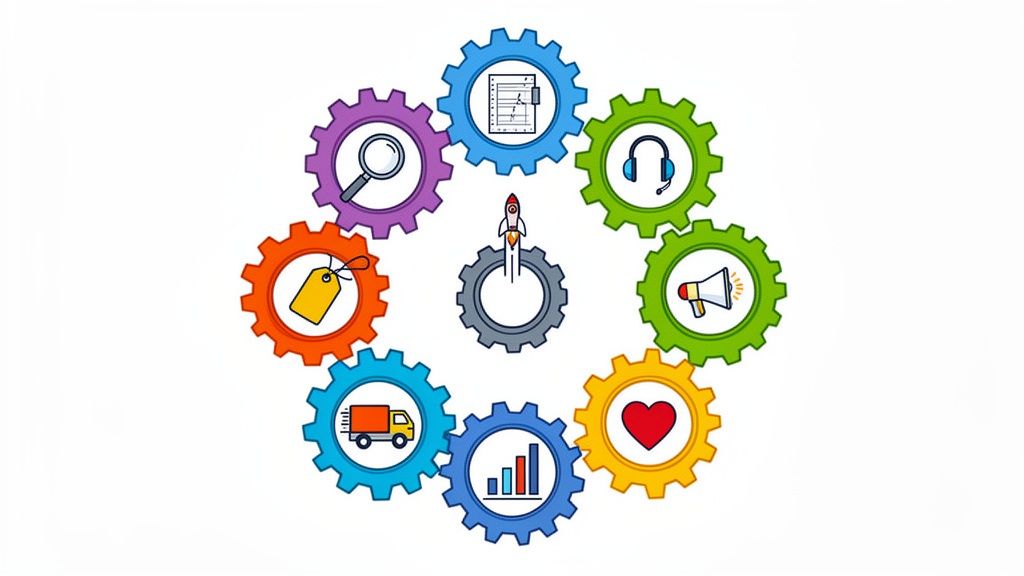
This visual shows how a well-defined value proposition acts as a compass for your entire business strategy, not just marketing.
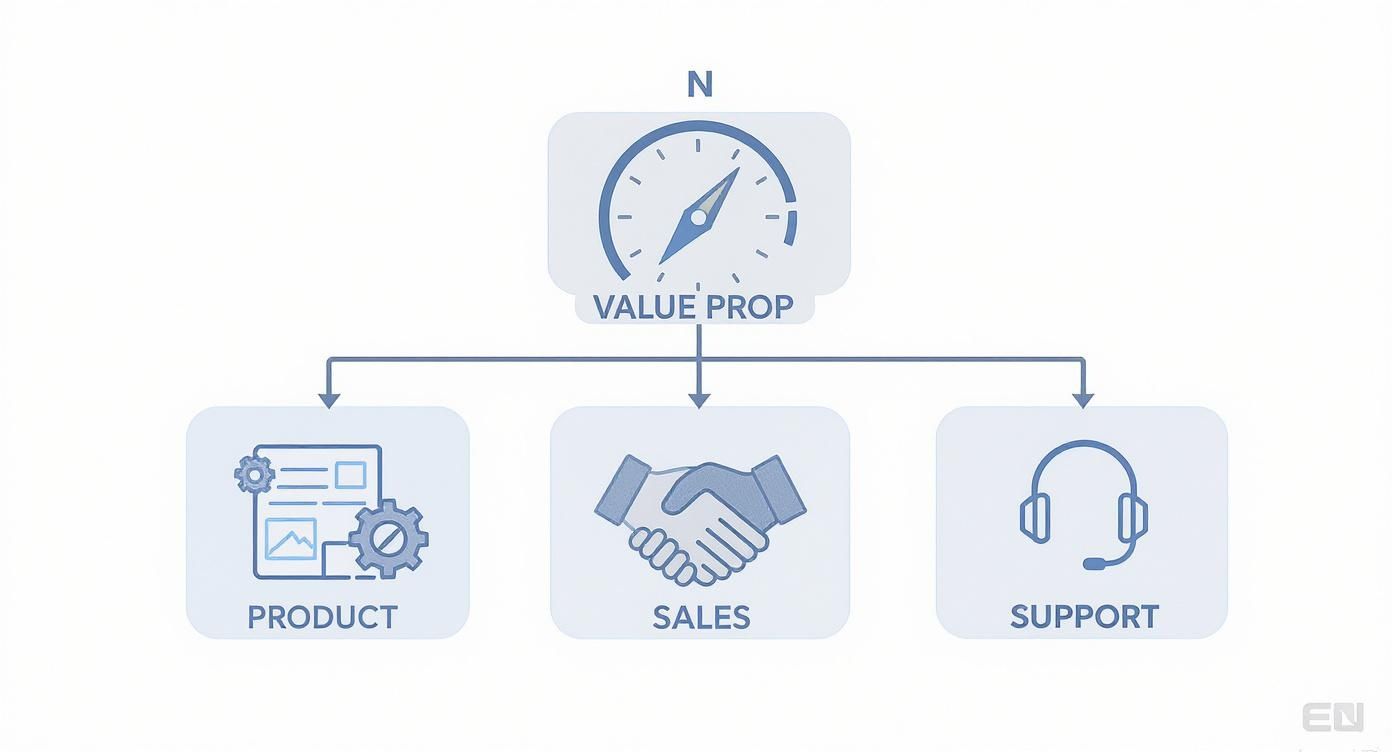
As you can see, your value proposition should be the north star that guides how your product, sales, and support teams all communicate and operate.
Key Benefits: The Proof Behind the Promise
Finally, it's time to back up your claims with cold, hard proof. A bulleted list is perfect for this, highlighting three or four key benefits or features that make your promise a reality. These points have to be concrete and focused on what the customer gets, not just on what your product does. This all starts with knowing your customer inside and out, which is why something like an Ideal Customer Profile Template & Guide is so valuable.
Let’s bring our example home with some tangible benefits:
- Before:
- Task tracking
- File storage
- Reporting features
- After:
- Automate your workflow: Launch projects in minutes, not hours, with pre-built templates designed for agency work.
- Get client approvals faster: Let clients comment directly on deliverables to eliminate confusing, back-and-forth feedback loops.
- See real-time progress: Track project budgets and timelines with a one-click dashboard, so there are no more end-of-month surprises.
Each of these elements builds on the one before it, creating a logical story that pulls the reader in. While crafting a value proposition is a key step, it's part of a much bigger picture; learn how it all fits together in a complete https://www.reachlabs.ai/brand-messaging-framework/. By breaking down its anatomy, you can move from just having an idea to building a message that truly resonates.
A Step-by-Step Guide to Crafting Your Message
Alright, we’ve covered the theory. Now, let’s get our hands dirty and build one from scratch. Moving from concept to creation can feel intimidating, but the good news is you don’t need to be a marketing wizard to nail this. It’s really a methodical process of asking the right questions and then piecing the answers together.
Forget the guesswork. Here’s a proven, four-step framework that will take you from a blank page to a powerful value proposition that actually connects with your audience.
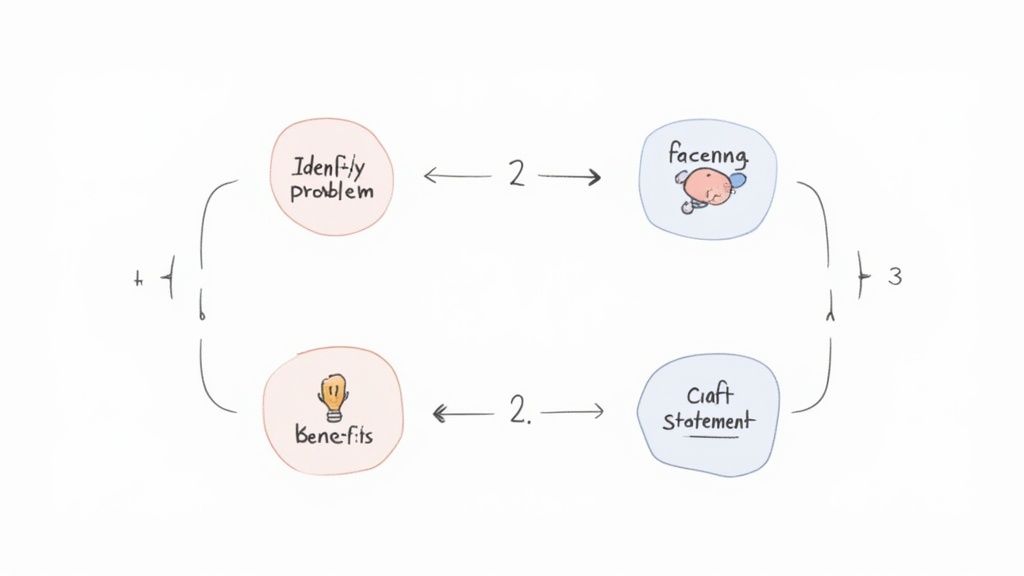
Step 1: Identify Your Customer's Core Problem
Before you ever talk about your solution, you have to live inside your customer's problem. A value proposition that doesn't solve a real, nagging pain point is just noise. Your mission here is to get painfully specific about the challenge your target customer faces day in and day out.
Start digging with questions that get beneath the surface:
- What's the biggest frustration in their workday that relates to what you offer?
- What jobs are they trying to get done that are just too slow, too expensive, or way too complicated?
- What are the hidden costs of not fixing this problem? Think wasted time, lost revenue, or just plain stress.
This isn't about what you think their problems are; it's about what they actually experience. This level of customer intimacy is where the magic happens. To get a better handle on this, learning https://www.reachlabs.ai/what-is-audience-segmentation/ is a great starting point for pinpointing these specific needs.
Step 2: List Your Tangible Benefits
Okay, you’ve defined the problem. Now, how does your product or service make it go away? This is where many businesses trip up—they list features instead of benefits. A feature is what your product does; a benefit is what the customer gets.
Key Takeaway: People don't buy features; they buy better versions of themselves. Your value proposition needs to sell the outcome, not the mechanics.
For every feature you have, force yourself to translate it into a tangible benefit. Here’s an example:
- Feature: "Our software uses 256-bit encryption."
- Benefit: "Keep your client data completely secure and sleep well at night knowing you're protected from breaches."
The benefit answers the customer’s silent but all-important question: "So what?"
Step 3: Define Your Unique Differentiator
Let's be real: your competitors are also trying to solve this problem. So, why should someone choose you? Your unique differentiator is the one thing you do better than anyone else. It's your secret sauce, your competitive edge boiled down to a single, powerful idea.
Your differentiator could be rooted in a few different areas:
- Technology: You’ve built something proprietary that makes you faster or more effective.
- Service: You offer a level of human support that your competitors can't or won't match.
- Price: You deliver the same (or more) value for a significantly lower cost.
- Design: Your product is just remarkably simpler or more enjoyable to use.
Be honest with yourself here. A vague claim like "we're the best" is empty and instantly forgettable. A sharp differentiator like "the only project management tool built from the ground up for solo creatives" is specific, memorable, and powerful. If you need a structured way to map this out, understanding what is a Lean Canvas can be a huge help.
Step 4: Assemble It All with a Proven Template
Time to bring all these pieces together. Using a template can provide a solid structure and make sure you don't miss anything important. One of the most effective frameworks out there is Geoffrey Moore's classic from "Crossing the Chasm."
It follows this simple, fill-in-the-blanks format:
For [target customer] who [statement of need or opportunity], our [product/service name] is a [product category] that [statement of key benefit]. Unlike [primary competitive alternative], we [statement of unique differentiation].
Let's put it into practice with a fictional example—a simple accounting tool:
"For freelancers and solo entrepreneurs who struggle to manage their finances and invoices, our product, 'SoloSync,' is an accounting platform that automates invoicing and expense tracking to save you 10+ hours a month. Unlike complex enterprise software, we offer a simple, clean interface that you can master in under 15 minutes."
See how that works? This template forces you to be concise while hitting all the critical notes: audience, problem, solution, benefit, and what makes you different. It turns all your hard research into a clear, compelling statement.
How to Test and Validate Your Value Proposition
So, you’ve crafted your value proposition. That's a huge step, but it’s really just the beginning. A powerful message isn't born in a boardroom; it’s proven in the real world with direct feedback from the people who matter most: your customers.
Think of your first draft as a solid, well-educated guess. Now it's time to treat it like a hypothesis that needs to be tested, validated, and refined. This is what separates the brands that truly connect from those that just make noise. A value proposition is a living statement, not something you carve in stone.
To make sure it hits the mark, you have to get out of your own head and start gathering both quantitative data (the "what") and qualitative insights (the "why"). This constant feedback loop is what will turn a good message into an unforgettable one.
Gathering Quantitative Data
Quantitative data gives you the hard numbers on how your message is actually performing. It’s the most direct way to see if one version of your value prop is driving better business results than another. The goal here is simple: measure action.
One of the best tools for the job is A/B testing. It’s a straightforward concept: show two different versions of your value proposition to two different groups of your audience and see which one comes out on top.
- Landing Page Headlines: Your headline is prime real estate. Test your main value proposition right there on your homepage or a key landing page. The winning version is the one that gets a higher conversion rate—be it a sign-up, a demo request, or a sale.
- Ad Copy: Run paid ad campaigns on platforms like Google or LinkedIn with ads that feature different value propositions. Keep an eye on metrics like click-through rate (CTR) and cost per conversion to see which message is the most compelling.
- Email Subject Lines: Launching a new feature? Test different value props in your email subject lines and see which one gets the most opens. It’s a quick and easy win.
These tests take the guesswork out of the equation. You get clear, undeniable proof of what language actually motivates your audience to click.
Uncovering Qualitative Insights
While numbers tell you what is happening, qualitative feedback tells you why. This is where you find the rich, human context behind the data and begin to understand the real-world problems and emotional drivers of your customers.
A value proposition isn't what you think is valuable about your product. It’s what your customers perceive as valuable. The only way to know for sure is to ask them.
You can gather this essential feedback through a few tried-and-true methods:
- Customer Surveys: Use tools like SurveyMonkey or Typeform to ask direct, open-ended questions. Try things like, "In your own words, what's the main benefit you get from our product?" or "If you were to recommend us to a friend, what would you say?"
- One-on-One Interviews: Nothing beats a real conversation. Schedule short 15-20 minute calls with new customers, loyal users, and even people who chose a competitor over you. Ask about their challenges, what they were looking for, and listen closely to the exact words they use.
- On-Site Polls: Put a simple, one-question poll on your website asking visitors what they’re trying to accomplish today. This captures their immediate intent and shows you whether your message aligns with their goals right in that moment.
The language your customers use is pure gold. It’s almost always more direct, clear, and powerful than the marketing copy you could write on your own. Weaving this "voice of the customer" directly into your value proposition is one of the fastest ways to make it resonate.
In fact, robust market research shows these kinds of insights can boost product launch success rates by up to 85%. To go deeper, you can learn more about how market research shapes a winning message and discover insights on refining your value proposition on kadence.com.
Value Proposition Examples You Can Learn From
Theory is one thing, but seeing a great value proposition out in the wild is what really makes the concept stick. The best way to get a feel for what works is to look at brands that have absolutely nailed their messaging. Let's break down a few examples from companies you probably know and see how they tie everything back to their core promise.
It’s not just about what they say, but why it resonates so deeply with their audience.
Slack: The Digital Headquarters
Slack's value proposition is a masterclass in getting straight to the point. They promise to be the one place where work happens.
- Headline: "Move faster with your tools in one place"
- Subheadline: "Automate away routine tasks and focus on what matters most."
Notice how they aren't selling a "messaging app." They're selling productivity and a calmer, more organized workday. Their message zeros in on a universal frustration for office workers: scattered information and chaotic communication. By positioning themselves as the "digital headquarters," they offer a clear solution—a single, searchable platform for every conversation and tool.
The real magic in Slack's approach is its focus on the outcome. It doesn't lead with a list of features like "channels" or "integrations." It leads with the promise of "moving faster," which is the result every customer is actually paying for.
Shopify: The All-in-One Commerce Platform
Shopify’s value proposition is crafted perfectly for aspiring entrepreneurs who want to start selling online but dread the technical hurdles.
- Headline: "The global commerce platform"
- Subheadline: "Build your business with Shopify to sell online, offline, and everywhere in between."
The genius here is that the message is all about empowerment. Shopify isn't just offering you a way to build a website; it's giving you the tools to build a business. The language is broad and inspiring ("everywhere in between"), speaking directly to the big dreams of its target audience. It takes the overwhelming task of starting a company and presents a single, unified solution for everything from web design to payment processing.
It’s a simple, powerful message: we make the complex part of starting a business easy, so you can focus on your idea.
Stripe: Payments Infrastructure for the Internet
Stripe speaks to a more technical crowd—developers and online businesses—but its value proposition is just as clear and compelling.
- Headline: "Financial infrastructure for the internet"
- Subheadline: "Millions of companies of all sizes—from startups to Fortune 500s—use Stripe’s software and APIs to accept payments, send payouts, and manage their businesses online."
This works so well because it speaks the language of its users while broadcasting power and reliability. Instead of just saying "payment processing," they use the term "financial infrastructure." This immediately communicates a more robust, scalable, and essential solution.
Then, they seal the deal with social proof. By name-dropping both "startups" and "Fortune 500s," they instantly build credibility. The message is clear: whether you're a tiny startup or a global enterprise, our platform is trusted, powerful, and built to handle your business.
Common Questions About Value Propositions
Even with a solid framework, a few common questions always seem to pop up. Let's clear up some of the usual points of confusion so you can get this right.
Getting these details ironed out is what separates a value proposition that truly works from one that just sounds like generic marketing fluff.
Slogan vs. Value Proposition
People mix these two up all the time, but they have completely different jobs.
-
A slogan is a catchy, memorable marketing tagline. Think of Nike’s “Just Do It.” It’s brilliant for brand recall and creating an emotional spark, but it doesn’t tell you a thing about their shoes. It's a feeling, not an explanation.
-
A value proposition is the nitty-gritty promise of what a customer gets. It’s a strategic statement focused on solving a specific problem and explaining why you’re the best choice. The slogan is the memorable chant; the value prop is the reason someone should buy in the first place.
One Message or Many?
So, do you need just one value proposition or several? The honest answer is: both.
You should have one overarching value proposition that acts as the North Star for your entire brand. This is your core promise. But from there, it's smart to create different versions tailored to specific products or customer segments.
For example, a software company's pitch to a huge enterprise client will sound very different from its message to a small startup. The enterprise version will stress security and scalability, while the startup version will likely focus on affordability and ease of use—even if it's the same core product.
A value proposition isn't a "set it and forget it" statement. It should evolve with your market, your customers, and your competition. Regular reviews keep it sharp, relevant, and effective.
How Often Should I Update It?
Think of your value proposition as a living document, not a stone tablet. You should give it a hard look at least once a year or any time there's a major shift in your business.
What counts as a major shift? Things like launching a big new feature, expanding into a new market, or seeing a tough new competitor enter the ring. Staying on your toes here ensures your message always hits the mark.
Ready to craft a message that truly connects? The experts at ReachLabs.ai specialize in building powerful brand strategies that drive real results. Discover how we can elevate your brand's voice today.