

Ever feel like you’re pouring money into marketing but can't quite tell what's actually working? That's a common problem, and it's exactly what a marketing audit is designed to solve.
Think of it as a comprehensive, no-stone-unturned check-up for your entire marketing engine. It’s a systematic review of your strategies, activities, goals, and results, designed to give you a clear, objective picture of your performance. The audit shines a bright light on what’s driving real growth, what's draining your budget, and where your best opportunities are hiding in plain sight.
Why A Marketing Audit Matters

Imagine your marketing operation is a high-performance race car. On the outside, it might look impressive and seem fast. But under the hood, small issues—a misaligned ad campaign, a leaky sales funnel, or messaging that no longer connects—could be slowing you down and costing you the race.
A marketing audit is like popping the hood with an expert mechanic. It’s a deep dive that inspects every single component to ensure the whole machine is running at peak performance.
This process replaces guesswork with a clear, data-driven roadmap. Instead of just hoping your SEO is working or wondering why a campaign fell flat, you get concrete answers. It's the most effective way to gain clarity and ensure every dollar you spend moves the needle. For a great overview of the fundamentals, this guide explains what a marketing audit is in more detail.
Moving Beyond Simple Checklists
It's important to understand that a real marketing audit goes far beyond a simple checklist. While a brand audit is more focused on your company's perception, positioning, and consistency (you can learn more about that in our guide here: https://www.reachlabs.ai/what-is-a-brand-audit/), a marketing audit is all about the machinery—the performance, efficiency, and ROI of your entire marketing operation.
This gives you an honest, 360-degree view of everything you're doing. The benefits are immediate and tangible:
- Spot Inefficiencies: Pinpoint the exact channels or campaigns that are eating up your budget without delivering the results you need.
- Discover New Opportunities: Find untapped audiences, fresh content angles, or new channels your competitors haven't even thought of yet.
- Optimize Your Spend: Confidently shift your budget away from low-performing activities and double down on what works for a much better ROI.
- Align Everything with Your Goals: Make sure every single marketing task, from a social media post to a major campaign, is directly contributing to your bigger business objectives.
The numbers don't lie. Organizations that regularly conduct marketing audits are 32% more likely to report above-average marketing ROI. Why? Because they often find they can reallocate 10–30% of their budget from wasteful channels to high-return activities after just one audit.
Breaking Down the Core Components of an Audit

A proper marketing audit isn’t just a quick peek at your ad spend. It's a comprehensive, systematic teardown of your entire marketing machine. To really get what’s happening, you have to look at all the interconnected pieces, from the big-picture strategy all the way down to the specific tools you use every day.
Think of it like a full vehicle inspection. You don’t just check the tires. You pop the hood to check the engine (your strategy), look at the transmission and drivetrain (your channels), make sure the paint job and interior are appealing (your messaging), and test the onboard computer and sensors (your tech). Every single part has to work together for the car to run smoothly and efficiently.
Your High-Level Strategy and Objectives
This is the very foundation of everything you do. The audit always starts here, asking the tough questions about where you’re going and why. Are your marketing goals actually clear and measurable? Even more importantly, are they genuinely helping you hit your larger business targets?
This part is all about your big-picture thinking. We dig into your ideal customer profiles, how you stack up against the competition, and what’s happening in the market. If this strategic foundation has cracks—say, you're chasing the wrong audience or your goals are fuzzy—everything else you do will suffer. It's that simple.
An audit might find that a goal like "increase brand awareness" is far too vague to be useful. A much stronger, actionable objective would be something like, "Achieve a 20% increase in organic brand-name searches and a 15% lift in social media share of voice within six months."
Channel and Tactical Effectiveness
With a clear strategy in place, the audit then gets into the weeds of how you’re executing. This is where we examine every single channel to see if it’s actually pulling its weight. A thorough review needs to cover all the bases:
- Search Engine Optimization (SEO): Are you showing up for the keywords that matter? Is your site technically sound, and are you building the kind of backlinks that move the needle?
- Content Marketing: Is your content genuinely attracting and converting your ideal customers? Is it strategically designed to guide them through their buying journey?
- Paid Media (PPC): What’s your return on ad spend (ROAS) really look like? Are your campaigns structured for success, or are you just throwing money at keywords and hoping for the best?
- Social Media Marketing: Let's look past the vanity metrics. Which platforms are driving real engagement and, ultimately, leads and sales?
- Email Marketing: Are people actually opening and clicking your emails? We'll check your key metrics and see how well your automated sequences are nurturing leads and keeping customers happy.
Messaging and Tech Stack Analysis
Finally, the audit looks at what you’re saying and the tools you’re using to say it. Your messaging and positioning need to be perfectly consistent and compelling everywhere your brand shows up. Does your tone of voice resonate, and is it crystal clear why someone should choose you over a competitor?
At the same time, we have to inspect your marketing technology (MarTech) stack. This means looking at every tool you use for analytics, automation, customer relationship management, and everything in between. Are they all playing nicely together? Or are there gaps, overlaps, and bad data costing you a fortune in wasted time and money? A clunky tech stack can bring even the most brilliant strategy to a screeching halt.
The Metrics and KPIs That Tell the Real Story
Let’s be honest: without the right data, a marketing audit is just a collection of opinions. Key performance indicators (KPIs) are what give your analysis teeth, turning subjective observations into a clear, objective picture of what’s actually working.
Think of KPIs as the diagnostic readouts for your marketing engine. They tell you precisely which parts are firing on all cylinders and which are sputtering out, wasting fuel.
But looking at these numbers in isolation can be incredibly misleading. A high click-through rate (CTR) on an ad campaign might feel like a win, but it’s just a vanity metric if none of those clicks ever become leads or sales. The trick is to organize your KPIs along the customer journey, connecting every action directly to its impact on your bottom line.
From Awareness to Action
A proper audit tracks performance across the entire customer journey, from the first time someone hears about you to the moment they become a loyal customer. This gives you a complete view of how well you're attracting, engaging, and converting your audience.
We typically break this journey into three core stages:
-
Brand Awareness: This is the top of your funnel, where we measure how effectively you’re reaching your target audience. Key metrics include things like website traffic, social media reach, and your share of voice (how often your brand is mentioned compared to competitors).
-
Lead Generation: In the middle of the funnel, the focus shifts from eyeballs to action. Here, you’ll analyze conversion rates on landing pages, cost per lead (CPL), and lead quality scores to see if you're not just attracting people, but the right people.
-
Customer Value: At the bottom of the funnel, it’s all about business impact. The most critical KPIs here are Customer Acquisition Cost (CAC), Customer Lifetime Value (LTV), and the big one: marketing return on investment (ROI). Our guide to essential marketing performance metrics offers a deeper look into these crucial numbers.
A well-structured audit doesn’t just report on these metrics; it digs into the relationships between them. For instance, it might reveal that while your SEO is driving tons of organic traffic (a top-of-funnel win), the bounce rate on your key landing pages is sky-high, pointing to a serious disconnect in your mid-funnel strategy.
A comprehensive audit requires tracking metrics across the entire customer journey. Here’s a look at some of the most essential KPIs to watch at each stage.
Essential KPIs Across the Marketing Funnel
| Funnel Stage | Key Performance Indicator (KPI) | What It Tells You |
|---|---|---|
| Awareness (Top) | Website Traffic | How many people are finding and visiting your digital storefront. |
| Awareness (Top) | Social Media Reach & Impressions | The size of the potential audience seeing your brand and content. |
| Consideration (Middle) | Conversion Rate (e.g., form fills) | The percentage of visitors taking a desired action on your site. |
| Consideration (Middle) | Cost Per Lead (CPL) | How much you're spending, on average, to acquire a single lead. |
| Consideration (Middle) | Click-Through Rate (CTR) | The effectiveness of your ads and content in compelling users to click. |
| Conversion (Bottom) | Customer Acquisition Cost (CAC) | The total cost to acquire one new paying customer. |
| Conversion (Bottom) | Customer Lifetime Value (LTV) | The total revenue you can expect from a single customer over time. |
| Conversion (Bottom) | Return on Investment (ROI) | The ultimate measure of profitability for your marketing efforts. |
By tracking these KPIs together, you can pinpoint exactly where prospects are dropping off and focus your resources on fixing the leaks in your funnel.
Connecting Metrics to Real Growth
The real power of a marketing audit is in using this data to make smarter decisions that directly grow the business. It’s about turning insights into action.
When companies commit to a full audit and act on its recommendations, the results can be dramatic. We've seen firms report average increases of 18–28% in conversion rates and a 12–22% reduction in cost-per-acquisition (CPA) within a year.
These gains often come from fixing fundamental issues like attribution gaps, which can help you start taking credit for a huge chunk of previously unattributed revenue. You can discover more about these findings and see how data clarity fuels growth. This process turns your audit from a simple report card into a strategic roadmap for maximizing every dollar you spend.
Your Step-By-Step Guide to a Marketing Audit
Knowing you need an audit is one thing, but actually doing one is a whole different ballgame. A real marketing audit isn’t some chaotic scramble for data. It’s a structured, methodical process that starts with high-level planning and ends with concrete, actionable steps.
Breaking it all down into manageable phases is key. It keeps you from getting overwhelmed and ensures nothing important gets missed. Think of it like building a house: you need a solid blueprint before you ever pour the foundation, and the frame has to be up before you can even think about the interiors.
Phase 1: Planning and Scoping
This first phase is all about setting the stage. Before you even glance at a single metric, you have to define what you're trying to accomplish and what "success" actually looks like. An audit without clear goals is just a rudderless ship.
Start by asking the big questions. Are you trying to boost lead quality? Maybe you need to slash your customer acquisition costs or just get your brand name out there more. Your objectives will tell you which metrics really matter. Once your goals are locked in, it's time to gather your tools. Get your logins ready for Google Analytics, your CRM, social media accounts, and any ad platforms. This is the blueprint phase—defining the scope and getting your resources in order.
The most common mistake I see people make with marketing audits is skipping the planning phase entirely. Jumping straight into data without clear goals is like starting a road trip with no destination in mind. You'll burn a lot of fuel, sure, but you won't end up anywhere useful.
Phase 2: Data Collection
With your goals clearly defined, it's time to gather the raw materials. This is where you systematically pull both quantitative data (the hard numbers) and qualitative information (the context behind them) from all your marketing channels.
This isn't just about downloading a bunch of reports. It’s about being selective and collecting the right data that directly ties back to the goals you set in Phase 1. You'll need to compile performance metrics from every single active channel to see the full picture. For a detailed framework on what to look for on your website, our web audit checklist is a fantastic starting point.
This visual breaks down the essential KPIs to track at each stage of the customer journey, from that first point of contact to delivering real value.
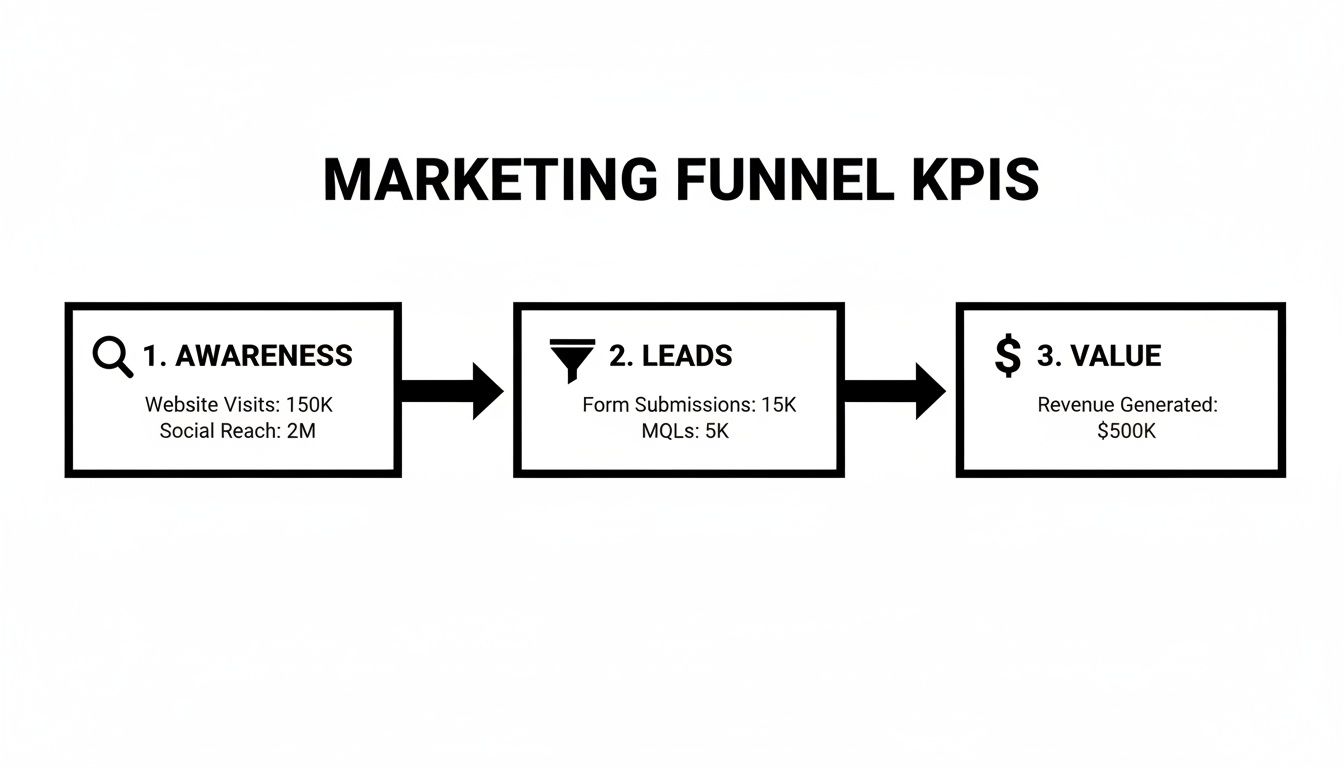
Tracking metrics across the entire funnel helps you spot exactly where potential customers are dropping off, letting you focus your analysis on plugging the biggest leaks.
Phase 3: Analysis and Insight
Data on its own is just noise. This is the phase where you turn that noise into something meaningful by connecting the dots. Start looking for patterns, trends, and anything that seems out of place. Why did one campaign absolutely crush it while another fell flat? Is there a weird disconnect between your social media engagement and actual website conversions?
Here, you'll compare your performance against past results and industry benchmarks. To see these principles in action, checking out a guide to improving Google Ads performance can show you how to analyze data for a specific, high-stakes channel. The goal is to move beyond just knowing what happened and truly understanding why it happened.
Phase 4: Action and Implementation
Finally, all those brilliant findings need to be translated into a clear, prioritized action plan. An audit report that just sits on a shelf collecting dust is a complete waste of everyone's time and effort. The final result should be a roadmap that outlines specific, measurable actions.
Every single recommendation needs an owner, a deadline, and a metric for success. Prioritize these actions based on their potential impact versus the effort required to get them done. This is how you turn a simple historical review into a forward-looking strategy that actually drives growth.
How Real Companies Use Audits to Win
It’s one thing to talk about audits in theory, but it’s another thing entirely to see them in action. The real magic happens when you see how a deep-dive review can uncover game-changing opportunities that lead directly to growth.
Let's move past the hypotheticals and look at some real-world examples. These aren't just about spotting mistakes; they're stories of how companies connected the dots between a thorough audit and a much healthier bottom line.
Uncovering Hidden Customer Goldmines
First up, an e-commerce brand that felt like they were just throwing money at the wall with their ad spend. They were targeting a massive, generic audience, and their return on investment (ROI) had completely flatlined. Frustrated, they decided to conduct a full audit.
The process forced them to dig into their customer data in a way they never had before. What they found was a complete surprise: a small, almost forgotten customer segment was driving over 50% of their repeat business. These were their best customers, yet they were getting the least amount of marketing love.
With this new clarity, they completely shifted their ad budget. They stopped shouting at everyone and started talking directly to this high-value group with tailored campaigns. The result? A 40% jump in marketing ROI in just three months. The audit didn't just find a problem; it pointed them straight to their most profitable audience.
Fixing the Content-to-Conversion Gap
Now, let's look at a B2B software company. Their blog was an absolute traffic monster, pulling in thousands of visitors every month with great articles. But there was a huge problem—all that traffic was a dead end. Almost nobody was converting into a lead.
A content and conversion pathway audit quickly pinpointed the disconnect. They were masters at getting people in the door but had no idea what to do with them once they arrived. Their articles had no clear calls-to-action, no next steps, and no mid-funnel content to bridge the gap from casual reader to potential buyer.
Their audit highlighted a classic marketing mistake: building a fantastic front door with no hallway leading to the rest of the house. Attracting visitors is only half the battle.
Based on the audit's recommendations, they completely re-engineered their content flow. They started adding relevant calls-to-action within posts, created in-depth guides for download, and launched a webinar series to engage their most interested readers. This strategic fix tripled their monthly demo requests, turning their blog from a vanity metric into a legitimate lead generation machine.
Rescuing Lost Leads from a Broken System
Finally, picture a local service business pouring money into local SEO and paid ads, only to see a trickle of leads come in. They were on the verge of scrapping their whole strategy, convinced it was a failure.
A technical audit of their marketing stack told a different story. The real villain wasn't their marketing, but a simple technical glitch. A misconfiguration in their CRM meant that every time someone filled out the form on their most important landing page, the lead went nowhere. It vanished into thin air, never making it to the sales team.
Once they fixed that one broken connection, they instantly recovered 30% more qualified leads that had been lost in the system. The audit proved their marketing was actually working great—their internal plumbing was just broken. That single finding saved them from ditching successful campaigns and gave their sales pipeline an immediate, much-needed boost.
We Get These Questions All the Time
Even with a solid plan, a few questions always pop up when it's time to kick off a marketing audit. Let's get them out of the way so you can dive in with total confidence.
How Often Should We Be Doing This?
Think of a full-blown marketing audit as your annual physical. It’s a comprehensive check-up that gives you a strategic baseline for the year ahead.
But if you're in a market that moves at lightning speed or you notice a sudden, scary dip in performance, don't wait. Shifting to a six-month cycle is a much safer bet. For more focused areas like SEO or content, we recommend quick, quarterly check-ins to keep things nimble and on track.
Can I Do This Myself, or Do I Need to Hire an Agency?
You absolutely can tackle an audit internally, and it’s a fantastic way to build your team’s expertise. The big catch? It's tough to be objective about your own work.
Bringing in an external agency like ReachLabs.ai gives you a fresh pair of eyes, completely detached from internal politics or past project attachments. We can spot things you're too close to see and benchmark your performance against what’s really working across the industry. Sometimes, the best route is a hybrid one, where your team collaborates with an outside expert to get the best of both worlds.
The single biggest mistake is failing to act on the findings. An audit report that sits on a shelf is a wasted investment. The value is realized through implementation, not just discovery.
Ready to stop guessing and start growing? The team at ReachLabs.ai uses data-driven audits to find untapped opportunities and build marketing strategies that actually move the needle. Discover how we can help.