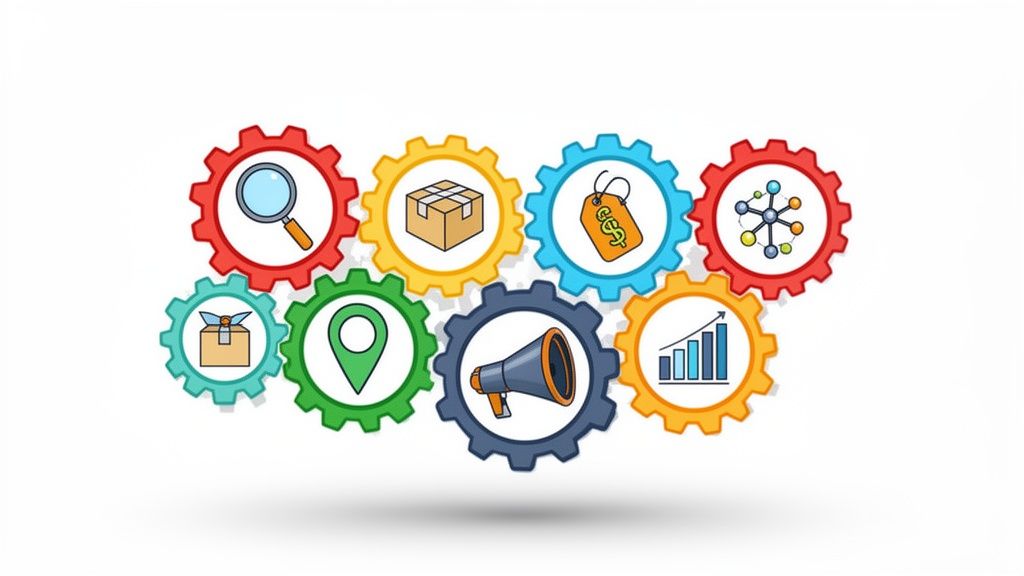
Marketing functions are really just the essential activities a company uses to find, attract, and retain customers. Think of them as the integrated systems inside a high-performance engine. Each part—from market research to customer service—has to work in perfect sync to drive the business forward and build sustainable growth.
The Engine of Growth: Understanding Marketing Functions
At its heart, marketing is the engine that powers a business. But what are the marketing functions that make it run? They are the fundamental building blocks of your entire go-to-market strategy.
When these functions are properly aligned, they create a powerful system for delivering value, building relationships, and ultimately, making money. Without a clear understanding of each function, businesses often end up with a random collection of tactics instead of a unified strategy, which just leads to wasted resources and missed opportunities.
This concept map shows how marketing acts as an engine with three primary goals: finding new customers, attracting them to your brand, and fostering loyalty to keep them.

As you can see, each stage is just one part of a continuous cycle. This really drives home the need for an integrated approach. Now, let’s break down each individual function to see how it contributes to this powerful growth engine.
A High-Level Overview of Core Activities
Before we get into the nitty-gritty of each area, it helps to see how all these pieces fit together. Each function has a distinct purpose, but they all rely on each other to be truly effective.
For example, your promotional activities are guided by solid market research, and your pricing strategies are directly tied to how your product is developed. This synergy is exactly what separates successful marketing from a series of disconnected, random acts.
To truly grasp how these components work together, seeing them in action through real-world examples is invaluable. Gaining a solid foundation is always the first step toward mastering the strategy.
For those looking to deepen their foundational knowledge, exploring some of the top marketing books to read is a great starting point, as they offer timeless insights into these core principles.
To give you a quick reference, the table below provides a snapshot of the main functions we’ll be exploring and their primary goals.
Core Marketing Functions at a Glance
This table offers a quick summary of the essential marketing functions and what they aim to achieve, giving you a clear, high-level overview before we dive deeper into each one.
| Marketing Function | Primary Objective |
|---|---|
| Market Research | To understand customer needs, market trends, and competitors. |
| Product & Service | To develop solutions that solve customer problems effectively. |
| Pricing | To set a price that reflects value and meets business goals. |
| Promotion | To communicate value and persuade customers to purchase. |
| Place (Distribution) | To make products and services accessible to target customers. |
| Branding | To build a strong, recognizable, and positive brand identity. |
| Digital Channels | To engage with customers where they spend their time online. |
| Analytics | To measure performance, gather insights, and optimize strategy. |
| Customer Relations (CRM) | To build and maintain long-term, profitable customer relationships. |
Think of this as our map for the journey ahead. Each of these functions is a critical stop, and understanding them individually is the key to seeing how they create a powerful, cohesive marketing machine.
1. Market Research: Your Strategic Blueprint
Think about it this way: you wouldn't build a house without a blueprint. So why would you build a marketing strategy without one? That blueprint is market research. It’s the foundational function of marketing, the part where you do a whole lot of listening before you ever start talking.
This process is all about gathering and making sense of information—about your ideal customers, what your competitors are up to, and the general vibe of the market. The real goal isn't just to hoard data; it's to transform that data into a clear roadmap that guides everything else you do. Get this right, and every other marketing effort becomes more targeted and effective from the get-go.

Gathering Actionable Intelligence
To draw up an accurate blueprint, you need the right materials. Market research gives you these tools, but it's crucial to mix different methods to see the full picture.
Great research balances two kinds of data:
- Quantitative Data: This is the "what." It's all about the numbers—the hard stats you get from customer surveys, website analytics, or sales reports. This data tells you what is happening.
- Qualitative Data: This is the "why." It's the story behind the numbers, uncovered through customer interviews, focus groups, and social media comments. This reveals the motivations, frustrations, and feelings driving the behavior you see in the quantitative data.
To truly understand the "why," knowing how to conduct a focus group effectively can be a game-changer. When you combine both types of data, you get a much richer, more three-dimensional view of your market.
From Data to Direction
Once the information is in, the real work begins: turning it all into a strategic direction. This is where you connect the dots, turning raw numbers and conversations into actual intelligence you can use. A huge part of this is figuring out exactly who your ideal customer is and how to group your wider audience into meaningful segments. If you want to dive deeper into this, our guide on what is audience segmentation is a great next step.
Market research is about turning wild guesses into calculated risks. When you understand what your customers are feeling, what they need, and what they want, you can make smart decisions instead of expensive mistakes.
A classic metric for measuring customer sentiment is the Net Promoter Score (NPS). It’s deceptively simple, asking customers one question: "On a scale of 0-10, how likely are you to recommend us?" The answers sort your customers into Promoters, Passives, and Detractors, giving you a clear snapshot of customer loyalty.
By keeping an eye on your NPS and other key performance indicators (KPIs), you create a feedback loop. This ongoing conversation ensures your marketing blueprint stays fresh and aligned with what people actually want, paving a clear path to real, sustainable growth.
2. Crafting Value with Product and Pricing
Once you’ve mapped out the terrain with solid market research, it’s time to build something your audience actually wants. This leads us directly to two of marketing’s most intertwined functions: product and pricing. They’re two sides of the same value coin—one creates it, and the other communicates it.
The product function is all about bringing a solution to life. Whether you're crafting a physical gadget, developing a slick piece of software, or delivering an expert service, this function steers the entire journey from a spark of an idea to a full-blown launch. The goal is simple: build the right thing for the right people.
The Art of Building the Right Solution
Great products aren't happy accidents. They're born from a disciplined process that takes all those customer needs you uncovered in your research and molds them into real-world features and benefits. This is the world of product management, a discipline that guides a product through its entire existence.
Product management is a cornerstone of marketing, overseeing how offerings are developed, branded, and managed to meet customer needs head-on. It's a field being completely reshaped by technology; in fact, a staggering 92% of marketers say AI is having a profound impact on their roles. And it pays to focus on fundamentals like this—businesses that ground their strategy in core marketing functions grow nearly 30% faster than those just chasing the latest trends.
You can dive deeper into these marketing findings and see how AI is shaping the industry.
We often think about a product's journey in stages, known as the product lifecycle: introduction, growth, maturity, and decline.
Knowing exactly where your product sits on this curve is crucial. It tells you when to hit the gas on marketing spend, when to roll out new features, or even when it’s time to plan a graceful exit. Your strategy has to evolve right alongside your product.
Pricing: More Than Just a Number
Pricing isn’t just about putting a number on something; it's one of the strongest messages you send to the market. It instantly communicates what a customer should expect. A low price might signal a bargain, while a high price suggests premium quality and experience. This is why your pricing has to be perfectly in sync with your product and your brand.
Finding the right price is a delicate balancing act. You have to cover your costs and keep an eye on the competition, but most importantly, your price must align with what the customer believes your product is worth.
Pricing is the moment of truth in marketing. It's where the abstract concept of 'value' gets translated into a concrete number that a customer must accept or reject.
Let’s break down two common ways to approach it:
- Competitive Pricing: This is when you set your price largely based on what competitors are charging. It’s a go-to strategy in crowded markets with similar products, but it’s a slippery slope. If you’re not careful, you can find yourself in a race to the bottom on price, which nobody wins.
- Value-Based Pricing: This approach flips the script. Instead of looking outward at competitors or inward at costs, you look at the customer. The price is based on the perceived value the product delivers. Think about it: if your software saves a client $10,000 a year, charging $2,000 for it feels like a fantastic deal because the value is so clear.
Creating an Irresistible Offer
The ultimate goal here is to fuse your product and your pricing into a single, irresistible offer. You hit this sweet spot when the value you’re providing feels so much greater than the price you’re asking.
Take a local coffee shop. The "product" isn't just the coffee in the cup. It’s the warm greeting from the barista, the reliable Wi-Fi, and the cozy chair in the corner. The price of that latte is a reflection of the entire experience.
Or consider a small marketing agency. Their "product" might be a monthly retainer that includes detailed reports, strategic advice, and a dedicated account manager. The price is set to reflect that high-touch, personalized service.
When your product’s features and its price point work together in perfect harmony, you don’t just make a sale. You create an offer that builds real, long-term customer loyalty and drives sustainable profit.
Even if you have the world's best product at a perfect price, it won't matter if nobody knows it exists. This is where promotion comes in. It’s the function that takes your brand's story and broadcasts it to the right audience.
Think of it as your company's megaphone. Without a solid promotional strategy, even the most innovative solutions get drowned out by the competition. This function covers every way you communicate with your market, from a viral TikTok campaign to a well-placed article in an industry magazine.

Deconstructing The Modern Promotional Mix
Not too long ago, promotion meant newspaper ads, maybe a billboard, and some radio spots. Today, the marketing toolkit is infinitely more complex, blending those traditional methods with a dizzying array of digital channels. This strategic blend of tactics is what we call the promotional mix.
A smart mix isn't about throwing everything at the wall to see what sticks. It's about carefully choosing the right channels to reach your specific audience where they already spend their time and are most open to hearing from you.
This kind of strategic communication has never been more crucial. Global advertising spend is on track to hit a staggering $1.04 trillion, with a massive 68.7% of that going directly into digital channels. This signals a seismic shift toward data-driven, online-first strategies. A big part of this trend involves retail media networks (RMNs), which are already delivering 1.8x better results than typical digital ads. You can find more fascinating insights in these promotional marketing statistics.
Choosing The Right Channels
Your promotional channels have to match your target customer. A B2B tech company will almost certainly find its best leads on LinkedIn, whereas a trendy fashion brand will probably crush it on Instagram and TikTok.
Here are a few essential channels every modern marketer should consider:
- Content Marketing: This is all about creating and giving away valuable content—think blog posts, how-to videos, or insightful podcasts—to attract and connect with your audience. The goal is to build trust and authority, not just to make a quick sale.
- Search Engine Optimization (SEO): This is the art and science of getting your website to rank higher in search results for the terms your customers are using. It’s an incredibly powerful way to get in front of people who are actively looking for what you offer.
- Paid Advertising (PPC): Platforms like Google Ads and social media ads let you put your message directly in front of hyper-specific audiences. You pay when someone clicks, giving you a direct and immediate line to potential buyers.
- Public Relations (PR): This channel focuses on managing your public image and earning media coverage. A feature story in a respected publication or a glowing review from an influencer builds a kind of credibility that money simply can't buy.
Figuring out the right mix often means weighing the benefits of different approaches. For a closer look at two popular options, check out our guide on organic vs. paid social media strategies to see how they stack up.
Promotion is not just about being loud; it's about being heard by the right people. It's a conversation, not a monologue, and the best conversations happen on common ground.
Measuring What Truly Matters
One of the best things about modern promotion is that it's measurable. You don't have to guess if your campaigns are working anymore. By tracking the right Key Performance Indicators (KPIs), you can see exactly what’s moving the needle and what needs to be changed.
Two of the most important metrics for promotional success are:
- Conversion Rate: This is the percentage of people who take the action you want them to, whether that's buying a product, filling out a contact form, or signing up for your email list. It's a direct measure of how persuasive your campaign really is.
- Customer Acquisition Cost (CAC): This metric tells you, in plain dollars, how much you're spending to get a new customer through a specific channel. Just divide your total campaign spend by the number of new customers it brought in.
By keeping a close eye on these KPIs, you create a powerful feedback loop. You can continuously refine your promotional mix, double down on the channels that are working, and cut the ones that aren't. This ensures every dollar in your marketing budget is working as hard as it possibly can.
Connecting with Customers Through Distribution
So, you've got a fantastic product. How does it actually get into your customers' hands? That critical journey is handled by distribution—what marketers often call 'Place' in the classic marketing mix. This function is the all-important bridge between your business and your buyer, making sure your product shows up at the right time and in the right location.
Think of distribution as the circulatory system of your business. Your great product and compelling message are the heart and brain, but the whole system fails without an efficient network to deliver that value to every corner of the market. Whether it’s a physical item on a store shelf or a digital service on a screen, distribution is what makes your offering accessible.
Choosing Your Path to The Customer
The paths a product can take to reach a customer are more varied now than ever before. The real trick is to pick the channels that match how your target audience actually shops and interacts with brands. Each option has its own trade-offs, from massive reach to a highly controlled, personal customer experience.
Here are a few of the most common distribution channels:
- Direct-to-Consumer (DTC): This is when you sell straight to your customers, usually through your own e-commerce website or physical stores. This model gives you maximum control over your brand and the customer relationship.
- Retail Partnerships: You can get your products onto the shelves of established brick-and-mortar stores or big online retailers. This approach lets you tap into the retailer's existing foot traffic and loyal customer base.
- Wholesalers and Distributors: This involves selling in bulk to intermediaries, who then turn around and sell to retailers. It’s a powerful way to scale up and get into new markets quickly.
- Digital Marketplaces: Listing your products on platforms like Amazon or Etsy gives you instant access to a massive, built-in audience of people who are ready to buy.
If you're in a service-based business, distribution looks a little different. It might mean delivering your software through a SaaS platform, offering consultations through an online booking portal, or providing exclusive content through a subscription. But the principle is exactly the same: make your service easy to find, access, and use.
The Rise of Omnichannel Distribution
Modern customers don't live in separate online and offline worlds; they flow between them without a second thought. An omnichannel experience recognizes this new reality by weaving all your touchpoints—from your website and social media to your physical store—into one seamless journey.
Imagine someone discovering your brand on Instagram, doing some research on your website, checking out the product in a physical store, and finally buying it through your mobile app. A solid omnichannel strategy makes sure every single step of that journey feels smooth, consistent, and connected.
Distribution isn't just about logistics; it's a huge part of the customer experience. A delayed shipment, a clunky website, or an "out-of-stock" notice can sour a customer's perception of your brand just as much as a bad product.
This is a critical marketing function because it directly affects both customer satisfaction and your own operational efficiency. In fact, many distribution channels are becoming powerful marketing platforms in their own right. For instance, retail media networks are now outperforming traditional digital ads by 1.8x on key performance metrics because they reach customers right at the point of purchase. In the same vein, some brands are seeing a 25% higher marketing ROI just by distributing their products through specialized online communities. You can dig into more global distribution trends on marcom.com.
At the end of the day, a smart distribution strategy is about more than just moving boxes or delivering services. It’s a powerful competitive advantage that ensures the value you’ve worked so hard to create actually reaches your customers exactly when and where they need it. That connection is fundamental to building lasting relationships and driving real growth.
Unifying Your Functions for Maximum Impact
All these marketing functions we've discussed are powerful on their own. But their real potential isn't unlocked until they start working together as a single, cohesive system.
I like to think of a marketing strategy as an orchestra. Market research is the composer, product development crafts the instruments, pricing sets the acoustics of the hall, and promotion is the conductor leading the performance. Each part is essential, but you only create something that truly resonates with the audience when they all play in perfect harmony.
This is where so many businesses stumble. They treat each marketing function as a separate silo, leading to wasted effort and a disjointed, confusing experience for the customer. The goal is to break down those walls and build a unified strategy where every single activity supports and amplifies the others.

From Disconnected Tasks to a Strategic System
So, what does this synergy actually look like in the real world? It's all about creating a constant flow of information and feedback between each function.
The insights you pull from market research should directly inform how your product team develops new features. That product’s unique value must then line up perfectly with your pricing strategy and the core message of your promotional campaigns. It all has to connect.
And it doesn't stop there. Your distribution channels—the "place" in the marketing mix—have to match the behaviors of the audience you’ve so carefully researched. If your data shows that customers value speed and convenience above all else, an inefficient or slow distribution network will undermine everything else you've built.
This interconnectedness creates a powerful feedback loop. For example, customer service conversations can reveal common pain points with your product. That feedback then fuels new research initiatives and, ultimately, product improvements. This is how you shift from a linear, "set it and forget it" plan to an agile, self-improving marketing machine.
An Actionable Framework for Integration
Getting all these moving parts to sing in harmony requires a deliberate effort to connect the dots. A great place to start is with a simple audit of what you're already doing. Ask the tough questions to find the gaps and opportunities for better alignment.
To begin unifying your marketing functions, consider these steps:
- Map Your Customer Journey: Trace the entire path a customer takes with your brand, from the moment they first hear about you to post-purchase support. Identify which marketing function "owns" each touchpoint and look for any jarring transitions or inconsistencies.
- Facilitate Cross-Functional Communication: This sounds like corporate jargon, but it's simple: get your teams talking. Set up regular meetings or shared dashboards where different functional teams can exchange insights. The on-the-ground feedback from your sales team is pure gold for your product and promotion teams.
- Establish Unified KPIs: While each function needs its own specific metrics, you also need shared, high-level Key Performance Indicators (KPIs) that everyone is working toward. Think Customer Lifetime Value (CLV) or overall revenue growth.
Building a cohesive marketing system isn't a one-time project; it's a fundamental shift in mindset. It means viewing marketing not as a department, but as a core business process that everyone—from product developers to customer support—has a hand in.
Ultimately, understanding what are marketing functions is just the first step. The real magic happens when you weave them into a singular, strategic force. For a much deeper dive into creating this synergy, check out our guide on building an integrated marketing strategy.
By transforming a collection of separate tasks into a unified system, you create a marketing engine that is not only more efficient but also capable of driving predictable, scalable, and sustainable growth.
Frequently Asked Questions About Marketing Functions
As you start to connect these ideas to your own business, some practical questions are bound to pop up. Let's tackle a few of the most common ones we hear from business owners and marketing teams.
We'll look at where to start if you're a small business with a tight budget and how these classic marketing principles hold up in today's fast-moving digital world.
Which Marketing Function Is Most Important for a Small Business?
For a small business, everything starts with market research. This is non-negotiable. Without a crystal-clear picture of your target customer, their real-world problems, and who you’re up against, every other marketing dollar you spend is a gamble. Think of it as the foundation of your house—get it wrong, and the whole structure is unstable.
After you've nailed that down, promotion becomes your next priority. You need to get the word out to generate those critical first sales. For most small businesses, this means focusing on smart, cost-effective digital strategies like content marketing, targeted social media, and email to reach the right people without breaking the bank.
"Your job will not be taken by AI. It will be taken by a person who knows how to use AI. So, it is very important for marketers to know how to use AI.” – Christina Inge, Harvard Division of Continuing Education
Christina’s point here is crucial—it's not just about what you do, but how you do it. Mastering the modern tools within each function is what gives you a competitive edge.
How Have Digital Channels Changed Core Marketing Functions?
The fundamental goals of marketing haven't changed one bit. You still need to understand your customers, create something they value, and tell them about it. Those core ideas are timeless.
What has changed completely are the tools and methods we use to get the job done.
- Distribution (Place): Instead of a physical storefront, your "place" is now an e-commerce website, a mobile app, or an online marketplace.
- Promotion: Forget relying on just print ads or TV commercials. Today, promotion is all about SEO, social media advertising, and email marketing.
The biggest shift, though, is the instant feedback loop. Digital channels give us real-time data, allowing us to measure, tweak, and optimize on the fly—a luxury marketers from 30 years ago could only dream of.
How Often Should a Business Review Its Marketing Functions?
You should plan a deep dive into your overall marketing strategy at least once a year. This is your chance to zoom out and make sure the big picture still makes sense.
But the day-to-day functions demand a much closer watch.
Your promotional campaigns and pricing strategies, for example, need to be looked at quarterly, if not monthly, based on their performance data. And market research isn’t a one-and-done task; it’s an ongoing process of listening to your customers and keeping an eye on the competition. The goal is to build an agile marketing machine that can pivot quickly, not a rigid plan that gathers dust.
By understanding what are marketing functions and how they fit together, you can build a powerful engine for growth. At ReachLabs.ai, we specialize in weaving these functions into a seamless, data-driven strategy that gets results. Discover how our full-service marketing approach can elevate your brand.