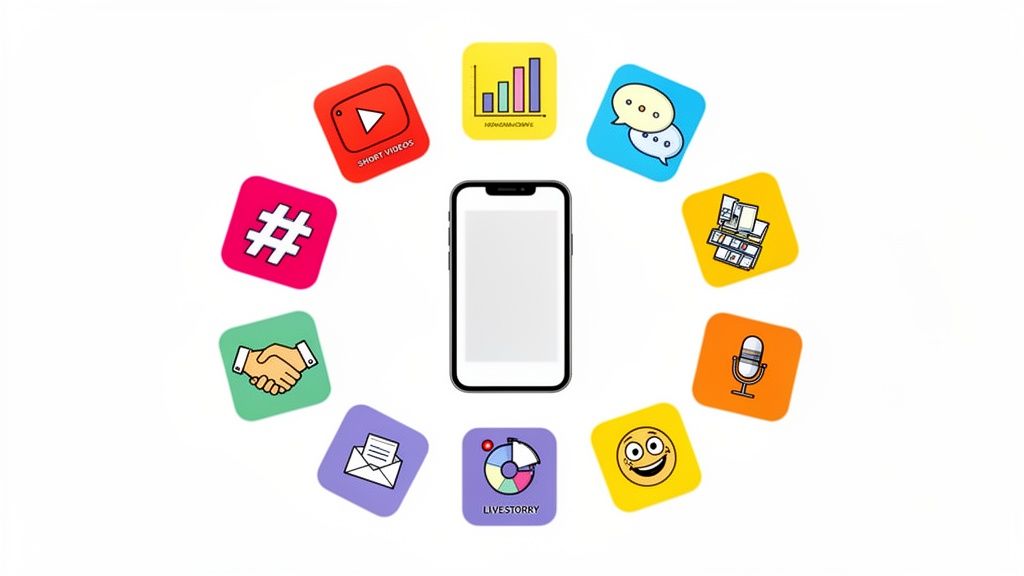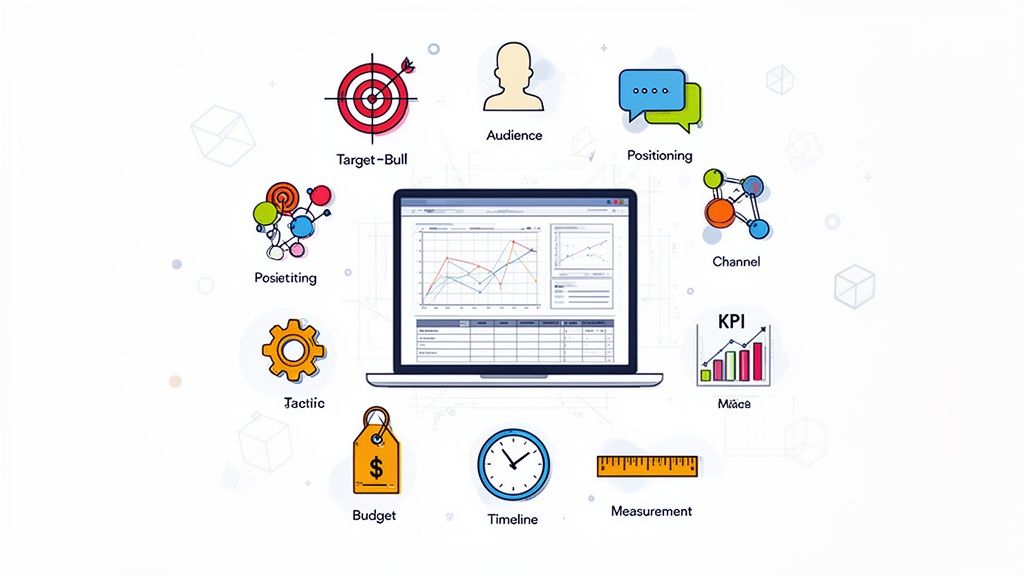

Staring at a blank content calendar can be one of the most daunting tasks for any marketer or business owner. The pressure to consistently create engaging, high-performing posts is immense, and it’s easy to fall into a repetitive cycle of posting the same types of content. This often leads to audience fatigue, stagnant growth, and missed opportunities to connect with your community on a deeper level. The solution isn't just to post more, but to post smarter by diversifying your approach with a strategic mix of content formats. A well-rounded strategy is built on understanding the different social media content categories and knowing when and how to deploy each one for maximum impact.
This guide moves beyond generic advice and provides a comprehensive, actionable playbook for building a dynamic and effective content strategy. We will break down twelve essential content categories, from educational tutorials that establish your authority to behind-the-scenes glimpses that build trust and interactive polls that spark conversation. Think of this as your resource for ending the content creation guesswork for good.
For each category, you will find:
- Actionable Examples: Real-world scenarios to inspire your next post.
- Platform-Specific Best Practices: Tailored advice for Instagram, TikTok, LinkedIn, and more.
- Objectives & KPIs: Clear goals and metrics to measure success.
- Frequency Prompts: Guidance on how often to incorporate each type into your calendar.
By the end of this article, you will have a clear framework for diversifying your feed, keeping your audience engaged, and systematically achieving your marketing goals. Let’s dive into the categories that will transform your social media presence from a simple broadcast channel into a vibrant community hub.
1. Educational/Tutorial Content
Educational content is a cornerstone of any robust social media strategy, positioning your brand as a credible, authoritative resource. This category focuses on teaching your audience something valuable, solving a problem, or simplifying a complex topic related to your industry. By generously sharing knowledge, you build trust and foster a loyal community that views your brand as a go-to expert.
This type of content is powerful because it addresses a primary reason people use social media: to learn. It shifts the dynamic from a hard sell to a helpful exchange, nurturing leads who are not yet ready to buy but are seeking information.
Key Insight: The goal of educational content isn't just to inform, but to empower. When your audience feels more capable after consuming your content, they build a strong, positive association with your brand.
Best Platforms & Formats
- LinkedIn: In-depth articles, text-based carousels breaking down industry concepts, and short video tutorials.
- Instagram: How-to Reels, step-by-step carousel posts, and informative Stories with Q&A stickers.
- TikTok: Quick tips, "things you didn't know" videos, and fast-paced tutorials.
- YouTube: Long-form, detailed video tutorials and explainers.
- Pinterest: Infographics and step-by-step visual guides.
Actionable Implementation Template
- Objective: Establish authority and build community trust.
- KPIs: Shares, saves, comments, website clicks (to blog posts or resources).
- Execution:
- Identify Pain Points: Use keyword research or customer feedback to find common questions (e.g., "how to properly clean suede shoes").
- Choose a Format: Create a 60-second Instagram Reel demonstrating the cleaning process.
- Structure the Content:
- Hook: "Stop ruining your suede! Here’s the right way to clean it."
- Steps: Show 3-4 clear, visual steps.
- CTA: "Save this for later & share your results in the comments!"
- Frequency: Post 1-2 educational pieces per week to consistently provide value.
2. Behind-the-Scenes Content
Behind-the-scenes (BTS) content pulls back the curtain on your brand, offering an authentic, unpolished glimpse into your daily operations, production process, and team culture. This powerful category humanizes your brand, moving beyond polished marketing messages to reveal the real people and processes that make your work possible. By showcasing the journey, not just the destination, you build a deeper, more relatable connection with your audience.
This content thrives because it satisfies natural human curiosity. Consumers want to connect with brands that feel genuine and transparent. Showing the "messy middle," the challenges, and the day-to-day reality fosters a sense of inclusivity and trust that a finished product alone cannot achieve.
Key Insight: Authenticity is the currency of behind-the-scenes content. People don't expect perfection; they crave connection. Sharing the imperfect, human moments is what builds a loyal and engaged community.
Best Platforms & Formats
- Instagram: Raw, unedited Stories showing a day in the life, Reels compiling clips of a product being made, or a carousel post introducing team members.
- TikTok: Fast-paced videos showing order packing, office antics, or a quick look at a new project in development.
- LinkedIn: Posts about company culture, team milestones, and employee spotlights that showcase the professional yet human side of the business.
- YouTube: Vlogs showing a "week in the life" at the company, or longer-form videos detailing the creation of a specific product or campaign.
- Facebook: Live Q&A sessions with team members or live-streamed tours of your workspace or event setup.
Actionable Implementation Template
- Objective: Humanize the brand and increase audience trust and relatability.
- KPIs: Engagement rate (likes, comments), Story replies, video completion rate.
- Execution:
- Identify a Process: Choose a visually interesting and easy-to-understand process, like assembling a new product.
- Choose a Format: Film short, casual clips throughout the day for an Instagram Story.
- Structure the Content:
- Hook: "Ever wonder how our [Product Name] is made? Come hang with us in the workshop today!"
- Steps: Post 5-7 short video clips showing different stages, from raw materials to final assembly. Include team members.
- CTA: Use a poll sticker: "What part of the process surprised you most?" to encourage interaction.
- Frequency: Post 2-3 pieces of BTS content per week, especially on Stories, to maintain an authentic presence.
3. User-Generated Content (UGC)
User-Generated Content (UGC) is the ultimate form of social proof, leveraging content created by your audience rather than your brand. This powerful category includes customer photos, video testimonials, unboxing clips, and reviews, transforming your followers from passive consumers into active brand advocates. By showcasing real people using and loving your products, you build unparalleled authenticity and trust.
This content is effective because it feels genuine and relatable, cutting through the noise of polished brand messaging. It fosters a vibrant community, making customers feel valued and seen when their contributions are highlighted. For a deeper dive into harnessing the power of your audience, explore developing a modern User-Generated Content (UGC) strategy.

Key Insight: UGC isn't just content; it's a conversation. It shifts the marketing focus from the brand talking at its audience to the community talking with and about the brand, creating a powerful cycle of engagement.
Best Platforms & Formats
- Instagram: Reposting customer photos to your feed, sharing tagged Stories, and creating Reels from user-submitted video clips.
- TikTok: Duetting or stitching user videos, creating challenges with branded hashtags, and showcasing unboxing experiences.
- Facebook: Sharing positive customer reviews and testimonials in a branded graphic format within community groups or on your page.
- X (formerly Twitter): Retweeting customer praise and creating threads that feature multiple user testimonials.
- Pinterest: Curating a board dedicated to customer photos or creations, like IKEA's #IKEAhacks.
Actionable Implementation Template
- Objective: Build social proof, increase brand trust, and generate authentic content.
- KPIs: Mentions, uses of branded hashtag, engagement on UGC posts, submissions.
- Execution:
- Launch a Campaign: Create a simple, memorable branded hashtag (e.g., #GoProAwards).
- Incentivize Participation: Offer a chance to be featured on your page, a discount code, or entry into a giveaway for those who use the hashtag.
- Engage and Amplify:
- Hook: "Show us how you use [Product]! Tag us with #[YourBrandHashtag] for a chance to be featured."
- Monitor: Actively track the hashtag and engage with submissions.
- CTA: "We love seeing our products in the wild! Want to be next? Share your photo with #[YourBrandHashtag]."
- Frequency: Feature UGC at least 2-3 times per week to encourage continuous participation and keep your feed authentic.
4. Video Content (Short-Form & Live Streaming)
Video content has become the undisputed heavyweight champion of social media engagement. This category splits into two powerful forms: concise, attention-grabbing short-form video and real-time, interactive live streaming. Short-form content like Reels and TikToks leverages trending audio and fast-paced edits to capture interest instantly, while live streams offer an unfiltered, authentic connection that builds deep community trust.
This dual approach allows brands to be both highly produced and perfectly raw. Short-form video is ideal for reach and discovery, feeding algorithms that prioritize dynamic visual content. Live streaming, on the other hand, is unmatched for fostering loyalty and facilitating direct, real-time conversations with your audience, from Q&As to exclusive product launches. For deeper insights into the specific types of video content gaining traction, explore the latest short-form video trends.
Key Insight: Short-form video is the "handshake" that gets you noticed, while live streaming is the "conversation" that builds the relationship. A complete strategy uses both to attract and retain an audience.
Best Platforms & Formats
- TikTok: The epicenter of short-form trends, challenges, and user-generated content.
- Instagram: Reels for polished, trending content and Instagram Live for Q&As and collaborations.
- YouTube: Shorts for discoverability and YouTube Live for in-depth events and product reveals.
- Facebook: Facebook Live is excellent for community-focused broadcasts and Q&A sessions.
- LinkedIn: LinkedIn Live is suited for professional B2B webinars, interviews, and industry panels.
Actionable Implementation Template
- Objective: Maximize reach and engagement while fostering authentic community interaction.
- KPIs: Views, watch time, shares (short-form), live viewers, comments per minute (live stream).
- Execution:
- Identify a Topic: Choose a "behind-the-scenes" topic, like a tour of your workspace.
- Choose a Format: Create a 30-second Instagram Reel highlighting 3 interesting parts of the office.
- Structure the Content:
- Hook: "Ever wondered where the magic happens? ✨"
- Clips: Show quick, dynamic shots of the space, synchronized to a trending song.
- CTA: "What part of our office do you want to see next? Comment below!"
- Frequency: Post 3-5 short-form videos per week. Go live 1-2 times per month for key events or announcements.
5. Carousel/Slideshow Posts
Carousel posts are a versatile and engaging format that allows you to tell a story or share in-depth information across multiple slides. This category of social media content encourages users to actively swipe through a sequence of images or videos, significantly increasing dwell time and interaction on your posts. It’s perfect for breaking down complex ideas, showcasing a product from multiple angles, or presenting a compelling narrative.
This format functions as a mini-presentation within a single post, making it highly effective for both education and promotion. By combining visuals and text across several frames, you can guide your audience through a journey, making the information more digestible and memorable than a single-image post.
Key Insight: Carousels transform passive scrolling into an active experience. The "swipe to see more" action is a micro-commitment that makes the user more invested in your content and more likely to absorb your full message.
Best Platforms & Formats
- Instagram: The native home of the carousel. Ideal for step-by-step guides, photo dumps, before-and-after reveals, and data storytelling.
- LinkedIn: Text-heavy PDF carousels (documents) are excellent for sharing professional insights, case studies, and presentation slides.
- Facebook: Supports multi-image posts that can be used similarly to Instagram carousels for product showcases or event highlights.
- Pinterest: While not a traditional carousel, "Idea Pins" function similarly, allowing for a sequence of video and static slides.
Actionable Implementation Template
- Objective: Increase engagement, educate the audience on a specific topic, and drive traffic.
- KPIs: Saves, shares, swipe-through rate, comments, clicks on the final CTA.
- Execution:
- Identify a Topic: Choose a topic that benefits from a sequence (e.g., "5 mistakes to avoid when buying a home").
- Design the Carousel:
- Hook (Slide 1): Create a compelling cover with a bold title that sparks curiosity. "Buying a Home? Don't Make These 5 Costly Mistakes."
- Content (Slides 2-6): Dedicate one slide to each mistake, using a clear visual and minimal text.
- CTA (Slide 7): End with a clear call-to-action. "Want more expert tips? Download our free homebuyer's guide. Link in bio!"
- Add Directional Cues: Use arrows or text prompts like "Swipe left" to guide users through the content.
- Frequency: Post 1-3 carousels per week, especially for topics that require more explanation than a single image can provide.
6. Infographic/Data Visualization Posts
Infographics and data visualizations are one of the most shareable social media content categories, transforming complex information into visually appealing, easily digestible graphics. This content type excels at presenting statistics, processes, or survey results in a format that is quick to scan and understand. By making data less intimidating and more engaging, you can capture attention and position your brand as a knowledgeable industry leader.
This category works because humans process visual information far more quickly than text. A well-designed infographic can convey a powerful message in seconds, making it perfect for the fast-paced nature of social media feeds. It's an effective way to communicate authority and provide significant value without requiring the audience to read a lengthy article.
Key Insight: Data visualization isn't just about making numbers look pretty; it's about telling a compelling story. The most effective infographics guide the viewer to a clear conclusion, turning raw data into a persuasive narrative.
Best Platforms & Formats
- Pinterest: Tall, vertical infographics are native to the platform and highly shareable.
- LinkedIn: Professional-looking charts and data-driven carousels perform exceptionally well, especially for B2B insights.
- Instagram: Simplified "mini-graphics" for single feed posts or multi-slide carousels breaking down a larger infographic.
- X (Twitter): Share a compelling chart or a key section of an infographic as an image to drive engagement and clicks.
- Facebook: Ideal for sharing full infographics that can be easily clicked and viewed in more detail.
Actionable Implementation Template
- Objective: Increase content shareability and establish data-backed authority.
- KPIs: Shares, saves, inbound links from blogs, comments tagging others.
- Execution:
- Identify a Data Story: Find a compelling statistic or trend from an internal report or industry study (e.g., "55% of consumers prefer brands with active social communities").
- Choose a Format: Design a visually clean, branded mini-infographic for a LinkedIn carousel. Learn more about effective data visualization for marketing on reachlabs.ai.
- Structure the Content:
- Hook: "Slide 1: The One Stat That Changes Everything About Community Management."
- Steps: Slides 2-4: Visualize the key statistic and related data points with icons and charts.
- CTA: "Slide 5: What does this mean for your brand? Drop your thoughts below!"
- Frequency: Post one data-driven visual per week or bi-weekly to consistently provide high-value, shareable insights.
7. Testimonial/Review Content
Testimonial content leverages your most powerful marketing asset: the authentic voice of a happy customer. This category includes customer reviews, success stories, and case studies that showcase real-world positive experiences with your brand. It serves as powerful social proof, building credibility and reducing purchase friction for potential customers.
This content is effective because it’s inherently more trustworthy than brand-created messaging. When a prospect sees someone like them achieving the results they desire, it makes the promised outcome feel attainable and authentic. This transforms satisfied customers into a volunteer sales force, providing validation that advertising simply cannot replicate.
Key Insight: Testimonials are not about your brand boasting; they are about your customers' success. The focus should always be on their journey and transformation, with your product or service positioned as the tool that enabled their win.
Best Platforms & Formats
- Instagram: Quote graphics in carousels, customer takeover Stories, or Reels featuring short video testimonials.
- LinkedIn: Detailed case studies published as articles or carousel posts, especially for B2B. Video testimonials featuring industry professionals.
- Website/Landing Pages: Embedding video testimonials and written reviews to build trust at key conversion points.
- Facebook: Sharing user-generated photos and positive review screenshots (with permission) in posts or ads.
- YouTube: Compiling multiple short customer clips into a montage or hosting longer, in-depth customer success story interviews.
Actionable Implementation Template
- Objective: Build trust, provide social proof, and increase conversion rates.
- KPIs: Engagement rate, comments (especially from prospects asking questions), lead generation, conversion rate on linked pages.
- Execution:
- Identify Advocates: Reach out to customers who have left positive reviews or tagged you in posts.
- Choose a Format: Ask a satisfied customer if they would be willing to record a short (30-60 second) vertical video answering a specific prompt (e.g., "What was your biggest win using our product?").
- Structure the Content:
- Hook: Use a text overlay with the customer's main result: "How Sarah saved 10 hours a week."
- Story: Let the customer share their brief before-and-after story in their own words.
- CTA: "Want results like Sarah? Tap the link in our bio to learn more!"
- Frequency: Feature a customer story or review 1-2 times per month to consistently reinforce brand credibility.
8. Meme/Humorous Content
Meme and humorous content leverages internet culture, wit, and relatable comedy to create highly shareable and entertaining posts. This category is designed to humanize a brand, making it more approachable and memorable. By tapping into trending formats and shared cultural moments, you can connect with your audience on an emotional level, sparking engagement that feels organic rather than promotional.
This content type excels because it prioritizes entertainment, a key driver of social media consumption. Brands like Wendy's and Netflix have mastered this by using humor to build a distinct personality, turning their social profiles into must-follow accounts. When done right, humorous content can generate massive organic reach and positive brand sentiment.
Key Insight: The most effective humorous content doesn't feel like an advertisement. It feels like an inside joke shared between the brand and its community, strengthening the bond through shared laughter.
Best Platforms & Formats
- Twitter: Witty one-liners, brand banter, and quick-reaction memes related to current events.
- Instagram: Image macros on the grid, relatable Reels using trending audio, and funny Story stickers.
- TikTok: Participating in trending comedy challenges, creating brand-specific skits, and using humorous sounds.
- Facebook: Relatable image memes and funny videos that appeal to a broad demographic and encourage tagging friends.
Actionable Implementation Template
- Objective: Increase brand personality, virality, and engagement.
- KPIs: Shares, likes, comments, follower growth, brand mentions.
- Execution:
- Identify a Trend: Notice a popular meme format (e.g., the "He's a 10 but…" trend).
- Choose a Format: Create a simple text-on-image graphic for Instagram and Twitter.
- Structure the Content:
- Hook: Use the familiar meme format: "He's a 10 but…"
- Relatable Pain Point: Connect it to your industry: "…he thinks 'social media content categories' just means posting product photos."
- CTA: "Tag a marketer who would understand. #MarketingHumor"
- Frequency: Use sparingly, perhaps 1-2 times every two weeks, to maintain impact and avoid brand dilution.
9. Interactive Content (Polls, Quizzes, Surveys)
Interactive content transforms your audience from passive consumers into active participants. This category includes polls, quizzes, surveys, and Q&As that invite direct input, making your community feel heard and valued. It’s a powerful tool for boosting engagement, gathering customer feedback, and creating a two-way conversation.
This content type excels because it leverages the human desire to share opinions and test knowledge. Instead of just broadcasting a message, you create a participatory experience. The data gathered from these interactions provides invaluable insights into audience preferences, pain points, and interests, directly informing your future content strategy.
Key Insight: Interactive content is a low-friction way to conduct market research. Every poll answered or quiz completed is a data point that helps you understand your audience on a deeper level.
Best Platforms & Formats
- Instagram: Stories polls, quizzes, sliders, and question stickers are ideal for quick, fun engagement.
- LinkedIn: Polls are excellent for gathering professional opinions and sparking industry-specific discussions.
- Facebook: Polls within groups or on Pages can generate high levels of interaction and debate.
- Twitter (X): Polls are a native feature used to quickly gauge public opinion on timely topics.
- Website/Blog: Embedded quizzes (like those popularized by BuzzFeed) can drive traffic and capture leads.
Actionable Implementation Template
- Objective: Increase audience engagement and gather valuable customer insights.
- KPIs: Engagement rate, poll/quiz completions, response volume, comments on results.
- Execution:
- Identify an Insight Gap: Determine what you want to learn about your audience (e.g., "Which of our new product features are most exciting?").
- Choose a Format: Create a multi-slide Instagram Story poll.
- Structure the Content:
- Hook: "Help us shape the future! Which new feature are you most excited for?"
- Steps: Dedicate one Story slide to each feature, using a poll sticker for voting ("This one!" vs. "Maybe later").
- CTA: "Thanks for voting! We'll share the results tomorrow and a deep-dive on the winning feature."
- Frequency: Post 1-3 interactive pieces per week to maintain a conversational and engaging feed.
10. Motivational/Inspirational Content
Motivational content taps into the universal human desire for encouragement and emotional connection. This category includes uplifting quotes, inspiring success stories, and personal growth tips designed to make your audience feel positive and empowered. It works by creating an emotional resonance that transcends simple product features or services, associating your brand with feelings of hope, determination, and achievement.
This content is highly shareable because it makes people feel good, and they want to pass that feeling on to their networks. By offering a moment of inspiration, you provide value that goes beyond the transactional, building a community that feels genuinely seen and supported by your brand.
Key Insight: True inspirational content isn't about generic platitudes. It's about authentic storytelling and shared vulnerability that reflects the audience's own struggles and aspirations, making them feel understood.
Best Platforms & Formats
- Instagram: Visually appealing quote graphics for the feed, inspirational Reels featuring transformation stories, and uplifting text-based Stories.
- Facebook: Longer-form posts sharing personal success stories or community member spotlights.
- LinkedIn: Career-focused motivational posts, reflections on professional growth, and celebrating team milestones.
- Pinterest: Quote graphics and aesthetically pleasing images paired with inspirational captions.
- TikTok: Short videos sharing a personal breakthrough, "get ready with me" videos with a motivational voiceover, or quick pep talks.
Actionable Implementation Template
- Objective: Increase brand affinity and boost organic reach through high shareability.
- KPIs: Shares, saves, comments expressing emotional connection (e.g., "I needed this today!").
- Execution:
- Identify Audience Aspirations: Understand what your community is striving for (e.g., a fitness audience wants to feel stronger and more confident).
- Choose a Format: Create a simple, branded quote graphic for Instagram.
- Structure the Content:
- Visual: A clean, easy-to-read quote like, "The only bad workout is the one that didn't happen."
- Caption: Share a short, personal anecdote about a time you almost skipped a workout but felt amazing after.
- CTA: "Tag someone who needs to hear this today!"
- Frequency: Post 1-2 pieces of motivational content per week, especially on days when audiences might need a boost (like Monday mornings).
11. Product Showcase/Unboxing Content
Product showcase content moves beyond static catalog images, bringing your offerings to life by demonstrating their features, benefits, and real-world applications. This category includes everything from slick, professionally produced product videos to raw, authentic unboxing experiences that create a sense of excitement and anticipation for the viewer. It's a direct way to answer customer questions and overcome purchase hesitation.
This content is critical for e-commerce and retail brands as it bridges the gap between online browsing and the tangible experience of a product. By showing an item in use, from multiple angles, or being unboxed for the first time, you help customers visualize ownership and make a more confident purchasing decision.
Key Insight: People don't just buy products; they buy the experience and the solution the product provides. Showcase content should focus less on specs and more on the feeling and outcome of using the product.
Best Platforms & Formats
- YouTube: Detailed unboxing videos, in-depth product reviews, and long-form "how it's made" content.
- Instagram: Aesthetic product Reels, detailed carousel posts highlighting features, and Shopping tags on lifestyle photos.
- TikTok: Satisfying unboxing ASMR, quick "get ready with me" videos featuring products, and before-and-after transformations.
- Pinterest: High-quality product pins linked to shop pages and Idea Pins demonstrating product use cases.
Actionable Implementation Template
- Objective: Drive product consideration and increase conversion rates.
- KPIs: Product page clicks, add-to-carts, conversion rate, comments asking product-specific questions.
- Execution:
- Select a Hero Product: Choose a popular or new product with visual appeal (e.g., a new skincare serum).
- Choose a Format: Create a 30-second TikTok showing the unboxing experience and first application.
- Structure the Content:
- Hook: "Unbox our new glow serum with me!"
- Steps: Show the satisfying packaging, the texture of the product, and a clip of it being applied.
- CTA: "Tap the link in our bio to get yours!"
- Frequency: Feature 2-3 product-focused posts per week, varying the format to keep content fresh.
12. Trending/News Commentary Content
Trending content, also known as newsjacking or culture-tagging, involves creating timely posts that comment on current events, viral moments, or breaking news relevant to your brand. This approach inserts your brand into existing conversations, leveraging the momentum of a popular topic to gain visibility and showcase your brand's personality and relevance.
This type of content is effective because it capitalizes on high-volume, real-time discussions, allowing your brand to reach a wider audience beyond your existing followers. When executed well, it makes your brand feel current, witty, and culturally aware, demonstrating that you are not just broadcasting messages but are an active participant in the digital world.
Key Insight: The power of this content category lies in its speed and relevance. Success isn't just about joining the conversation; it's about adding a unique, brand-aligned perspective to it before the moment passes.
Best Platforms & Formats
- X (formerly Twitter): The prime platform for real-time commentary, witty text-based quips, and meme-based reactions.
- TikTok: Creating videos that use trending audio, filters, or challenges and adapting them to a brand's niche.
- Instagram: Reels that re-enact or comment on a viral trend; Stories that use trending stickers or polls about a current event.
- LinkedIn: Thought leadership posts or articles that provide a professional, industry-specific take on relevant business news.
Actionable Implementation Template
- Objective: Increase brand relevance, reach, and engagement by tapping into current events.
- KPIs: Reach, impressions, engagement rate (likes, comments, shares), profile visits.
- Execution:
- Identify a Trend: Monitor trending topics on X and TikTok. A major pop culture event (like an awards show) is happening.
- Choose a Format: A celebrity wears an outfit that vaguely resembles your product's packaging. Create a side-by-side image for Instagram.
- Structure the Content:
- Hook: "We knew this look felt familiar… 😉"
- Visual: Place an image of your product next to the celebrity photo.
- CTA: "Who wore it better? Let us know in the comments! #AwardsShow"
- Frequency: As relevant trends arise. This is opportunistic, not a scheduled post, but aim to act on 1-2 relevant moments per month.
12-Category Social Media Content Comparison
| Content Type | Implementation Complexity 🔄 | Resource Requirements ⚡ | Expected Outcomes ⭐ / 📊 | Ideal Use Cases 💡 | Key Advantages ⭐ |
|---|---|---|---|---|---|
| Educational / Tutorial Content | 🔄🔄🔄 High — research, scripting | ⚡⚡ Moderate — recording + editing | ⭐⭐⭐ High authority; 📊 long-term traffic | Training, how-tos, skill series | ⭐ Positions as expert; evergreen |
| Behind‑the‑Scenes Content | 🔄🔄 Low‑Medium — informal filming | ⚡ Low — minimal equipment | ⭐⭐ Strong engagement; 📊 builds trust | Culture, production process, team stories | ⭐ Humanizes brand; easy to produce |
| User‑Generated Content (UGC) | 🔄🔄 Low — curation & permissions | ⚡ Low — community-driven | ⭐⭐⭐ High authenticity; 📊 social proof | Campaigns, hashtag challenges, testimonials | ⭐ Cost-effective; increases reach |
| Video (Short‑Form & Live) | 🔄🔄🔄 Medium‑High — trend planning + live ops | ⚡⚡⚡ Variable — frequent production | ⭐⭐⭐ High virality; 📊 strong analytics | Viral campaigns, launches, real‑time Q&A | ⭐ Algorithm‑favored; high engagement |
| Carousel / Slideshow Posts | 🔄🔄 Medium — multi‑slide design | ⚡⚡ Moderate — design assets | ⭐⭐ Better dwell time; 📊 improved engagement | Step‑by‑step, product lines, storytelling | ⭐ Supports complex stories; swipe engagement |
| Infographic / Data Visualization | 🔄🔄🔄 High — data design & sourcing | ⚡⚡⚡ High — design tools & expertise | ⭐⭐ High shareability; 📊 clarifies data | B2B, reports, educational stats | ⭐ Makes complex data scannable |
| Testimonial / Review Content | 🔄🔄 Low — coordination with customers | ⚡ Low — recording or quotes | ⭐⭐⭐ High conversion influence; 📊 trust signal | Case studies, product pages, ads | ⭐ Strong social proof; credible |
| Meme / Humorous Content | 🔄 Low — quick creation, trend timing | ⚡ Low — minimal production | ⭐⭐ High shareability; 📊 rapid reach spikes | Brand voice, community engagement, relatability | ⭐ Viral potential; low cost |
| Interactive (Polls, Quizzes, Surveys) | 🔄🔄 Medium — question design & flow | ⚡⚡ Moderate — platform features | ⭐⭐⭐ High engagement; 📊 gathers audience data | Feedback, lead gen, engagement boosts | ⭐ Direct insights; participatory reach |
| Motivational / Inspirational Content | 🔄 Low — simple creation | ⚡ Low — basic graphics | ⭐⭐ Emotional resonance; 📊 frequent shares | Community building, daily posts, awareness | ⭐ Easy to produce; high emotional pull |
| Product Showcase / Unboxing | 🔄🔄 Medium — staging + shooting | ⚡⚡ Moderate — product access & production | ⭐⭐ High purchase intent; 📊 measurable ROI | E‑commerce, launches, reviews | ⭐ Demonstrates value; drives conversions |
| Trending / News Commentary | 🔄🔄🔄 High — rapid response & risk review | ⚡ Low‑Medium — fast production | ⭐⭐ Immediate visibility; 📊 short‑lived spikes | Timely reactions, cultural moments | ⭐ Boosts relevance; fast follower growth |
Putting It All Together: Building Your Content Machine
We've journeyed through a comprehensive landscape of twelve distinct social media content categories, moving far beyond generic advice to uncover the strategic engine behind high-performing social media. From the trust-building power of Educational Content and Testimonials to the community-fostering magic of Behind-the-Scenes and User-Generated Content, the message is clear: a one-dimensional content strategy is no longer viable. Success in today’s fragmented digital ecosystem demands versatility, intention, and a deep understanding of what motivates your audience to engage.
This exploration has revealed that each content type is not an isolated tactic but a specialized tool. Humorous memes capture fleeting attention, while data-rich infographics establish authority. Interactive polls open direct lines of communication, and powerful video content forges deep emotional connections. Mastering these categories means you're no longer just posting; you're strategically communicating.
From Categories to a Cohesive Calendar
The true power of this knowledge is unlocked when you move from understanding individual social media content categories to weaving them into a cohesive, dynamic content calendar. A truly effective strategy isn't about choosing one or two favorites; it's about creating a balanced diet of content that serves different segments of your audience and guides them through their journey with your brand.
Think of your content plan as a narrative. One week, you might use an infographic to establish a problem (Educational Content), follow it up with a customer review video that validates your solution (Testimonial Content), and then share a lighthearted meme (Humorous Content) to keep engagement high. This multi-faceted approach prevents audience fatigue and ensures your feed remains a valuable, engaging, and unpredictable destination.
Key Takeaway: The goal is not to master every category at once, but to build a strategic mix that aligns with your brand's voice, your audience's preferences, and your specific business objectives for each campaign.
Your Actionable Next Steps
To transform this knowledge into measurable results, it's time to put it into practice. Don't let this be just another article you've read. Take immediate, deliberate action.
- Conduct a Content Audit: Review your last 30 days of social media posts. Which of these twelve categories did you use? Which were neglected? Identify the gaps and imbalances in your current strategy.
- Identify Two New Categories to Test: Based on your audit and audience understanding, select two new content types you haven't tried before. Perhaps it's launching your first live stream or actively soliciting User-Generated Content for a new campaign.
- Map Categories to Your Funnel: Assign specific content types to different stages of the customer journey. Use Educational and Inspirational content for top-of-funnel awareness, Product Showcases and Testimonials for mid-funnel consideration, and UGC or Behind-the-Scenes for bottom-funnel loyalty and retention.
- Define and Track Your KPIs: For each new content type you test, refer back to the key performance indicators discussed. Are you aiming for shares, saves, comments, or conversions? Set a clear benchmark and measure your performance rigorously.
By systematically integrating this diverse palette of social media content categories, you elevate your brand from a simple broadcaster to a sophisticated publisher. You build a resilient, adaptable content machine that can pivot with trends, foster genuine community, and drive tangible business growth. The path forward is clear: diversify your content, measure its impact, and build a brand that your audience doesn't just follow, but actively champions.
Feeling overwhelmed by the sheer number of content ideas and the planning required to execute them? Let AI be your strategic partner. ReachLabs.ai can help you brainstorm, generate, and schedule diverse content across all these categories, turning your strategy into a seamless workflow. Visit ReachLabs.ai to discover how you can build your content machine faster and more effectively.