Your team is posting. The designer is making assets. Someone is replying to comments. The calendar looks full.
But the business still has the same question every month: what is social doing for us?
That gap is where most brands stall. They confuse activity with strategy. A busy content calendar can hide a weak brand position for a long time. You see posts going out, but the message shifts week to week. One campaign sounds premium, the next sounds playful, and the next sounds like it was copied from a competitor's feed. The result isn't just mediocre engagement. It's a brand people can't clearly place in their minds.
A social media brand strategist fixes that problem. Not by posting more, but by deciding what the brand should mean, how social channels should express that meaning, and which signals from the audience should reshape the brand itself.
Social isn't only a distribution channel. It's a live feedback system for brand position, audience language, and product demand.
That's the difference between “doing social” and using social as a business function.
The Strategic Shift Your Social Media Needs
A lot of teams are already doing the visible work. They publish reels, write captions, answer DMs, and test trends. The problem is that execution without a governing strategy turns social into a treadmill. You keep moving, but you don't get much farther.
That's expensive in a market this large. The global social media management market is projected to reach $39.14 billion in 2026, while total social media advertising spend is projected at $317.33 billion for 2026, driven by the need to reach 5.66 billion active social media users worldwide according to Fortune Business Insights on the social media management market.
What changes when strategy comes first
A social media brand strategist starts with questions that many others skip:
- What role should social play in growth? Brand awareness, lead education, customer retention, product feedback, or a mix.
- What should the brand be known for? Not broad values on a slide deck, but repeatable ideas people can associate with you.
- Where is the message breaking? Across channels, offers, audiences, and campaign formats.
- What is the audience telling you? Through comments, saves, objections, repeated questions, and language patterns.
Without those answers, content gets reactive. Teams post because the calendar says Tuesday needs a post.
With those answers, social becomes directional. Every asset has a job.
For teams trying to tighten execution on major channels, practical resources like Facebook and Instagram AI strategies can help with workflow and messaging support. But those tools work best after the brand has already defined its voice, priorities, and audience logic.
The first fix is usually an audit
Before rewriting your content plan, diagnose the current one. A proper social media audit process shows where the breakdown is happening. Usually it's one of three places:
Message drift
The brand sounds different across campaigns, creators, and channels.Channel confusion
Every platform gets the same content with minor edits, even though each audience expects something different.Weak commercial mapping
Content exists, but nobody can explain how it supports pipeline, retention, or category authority.
Practical rule: If your team can't explain why a content pillar exists, it probably shouldn't be a pillar.
The shift your social media needs isn't more volume. It's a clearer operating system. That's the strategist's job.
Strategist vs Manager Defining the Two Critical Roles
Most hiring mistakes happen because companies ask one person to be both the architect and the builder. Then they wonder why strategy feels thin or execution feels rushed.
A social media manager and a social media brand strategist are not the same role, even when one person temporarily handles both.

Think architect and builder
The architect decides what the structure needs to do. The builder makes sure it gets built correctly.
That same split applies here. As the University of Minnesota notes in its overview of brand strategy roles, brand strategists develop long-term strategies that strengthen identity and market position through research into trends, competitors, and psychographics, while social media managers focus on daily execution. Read that distinction in the University of Minnesota's explanation of the brand strategist role.
Here's the practical difference:
| Role | Primary focus | Typical output |
|---|---|---|
| Social media brand strategist | Brand position, audience insight, long-term direction | Messaging framework, audience profiles, content pillars, channel roles |
| Social media manager | Daily publishing, engagement, workflow, reporting | Scheduled posts, comment handling, creator coordination, performance updates |
What each role actually owns
A strategist usually owns decisions like:
- Audience definition based on psychographics, pains, motives, and buying triggers
- Positioning choices that separate the brand from close competitors
- Voice rules so the brand sounds consistent under pressure, not just in planned posts
- Content architecture so every recurring theme serves a business purpose
A manager usually owns:
- Publishing operations across tools and channel calendars
- Community engagement in comments, messages, and reactive moments
- Asset coordination with design, copy, and video teams
- Performance monitoring on what shipped and how it landed
A good manager can spot useful patterns. A good strategist turns those patterns into a new direction.
The video below is a useful companion if you want a broader view of how these marketing roles often get blended and confused in practice.
If you hire a manager and expect strategic repositioning, you'll get polished execution of an unclear idea.
That's not a talent problem. It's a role design problem.
The Anatomy of a Social Media Brand Strategy
A strategy isn't a mood board, and it isn't a posting schedule. It's a decision system.
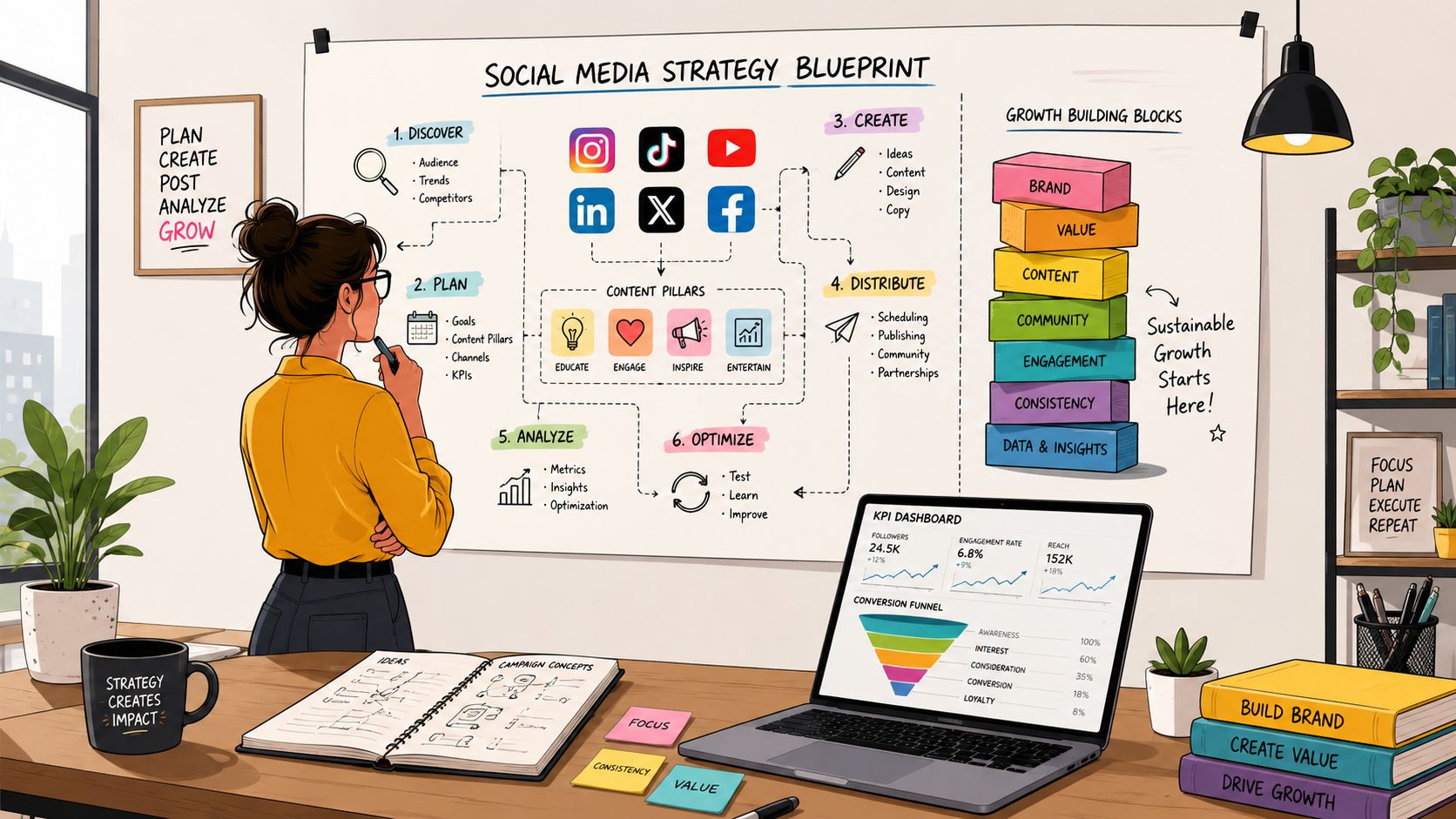
When a strategist does the job well, the final document gives the team a clear answer to six questions: who we're talking to, what we want to be known for, where each platform fits, what stories we'll repeat, how content supports the buyer journey, and how success will be judged.

The six parts that matter
A working strategy usually includes these components:
Audience definition
Not “women 25 to 40” or “B2B founders.” A strategist builds audience logic around pain points, objections, aspirations, and language. Good strategy names what the audience is trying to solve.Competitive analysis
This is less about copying formats and more about identifying white space. Who owns which message in your category? What tone is overused? Where are competitors promising the same thing?Brand voice and messaging
Vague adjectives prove ineffective. “Authentic” is not a usable voice instruction. Strong voice guidance tells a writer how to handle humor, authority, disagreement, technical language, and customer skepticism.Platform role definition
Instagram shouldn't do the exact same job as LinkedIn. One channel may build cultural relevance. Another may educate buyers. Another may support retention.Content pillars and themes
Pillars should be durable enough to scale, but narrow enough to mean something. If a pillar could apply to any company in your industry, it's too generic.Measurement framework
The team needs a shared definition of winning. Not just engagement. Not just reach. The strategy should state what each content type is supposed to produce.
What weak strategy documents get wrong
Weak strategies usually fail in one of these ways:
- They describe platforms, not the brand
- They list content ideas, not strategic choices
- They confuse campaign goals with category position
- They skip conversion logic and only talk about awareness
A better way to structure your own planning process is to build from business goals outward. This guide on how to create a social media strategy is useful because it frames social planning as a business system rather than a content checklist.
Good strategy reduces decision fatigue. Bad strategy creates more meetings.
The test is simple. If a new copywriter, designer, or agency partner joined tomorrow, could they use your strategy to make consistent choices without constant supervision? If not, the blueprint isn't finished.
Key Skills That Define an Elite Strategist
An elite strategist doesn't just “know social.” That phrase usually means they know formats, trends, and platform habits. Useful, but incomplete.
The role is broader. A social media brand strategist operates at the intersection of marketing, data analysis, content creation, and psychology, using analytics platforms to connect performance data to strategic adjustments that improve visibility and community growth, as described in this practitioner breakdown on YouTube.
The hard skills are only half the job
The strongest strategists are fluent in the mechanics:
Analytics literacy
They can look at engagement, traffic, conversion paths, and retention signals without treating every spike as insight.Research discipline
They study competitors, audience behavior, comment patterns, and recurring objections before they approve a pillar or campaign angle.Channel judgment
They know when a format is native to a platform and when it feels copied over from somewhere else.Brief writing
They can translate strategy into creative direction a writer, editor, designer, or creator can use.
But technical fluency alone doesn't produce strong positioning.
The softer skills create the real edge
What separates a solid operator from an elite strategist is usually judgment.
A strategist needs empathy to understand what the audience is really trying to resolve. They need storytelling skill to package the same truth in different ways without becoming repetitive. They need enough psychological curiosity to notice why a message works, not just that it worked.
That last part matters more than people admit.
A dashboard can tell you which post got attention. It can't, by itself, tell you whether the post succeeded because it reduced risk, signaled status, clarified a problem, or mirrored the audience's internal language. A strategist has to interpret that.
What this looks like in real work
The best strategists tend to do a few things consistently:
- They read comments like research notes, not noise.
- They ask sales and support teams what prospects keep misunderstanding.
- They look for message patterns across campaigns instead of chasing isolated wins.
- They challenge requests that create short-term activity but weaken the brand's position.
Field note: If someone can only talk about hooks, posting times, and trends, they probably know execution. Strategy requires a point of view about the market, the audience, and the brand's place between them.
That's why this role is hard to fake in interviews. Tactics are easy to describe. Strategic thinking shows up in how someone frames trade-offs.
How Strategists Connect Social Media to Business Goals
The fastest way to waste a social budget is to treat content as decoration. It may look active, but it isn't tied to a commercial job.
A strategist fixes that by mapping content to business outcomes before the calendar gets built. That changes everything. Instead of asking “what should we post next week,” the team starts asking “what should our next month of content help the business achieve?”

Outcome-driven content beats mood-driven posting
With strategy, outcomes are measurable. According to Helms Workshop on social media branding, brands using outcome-driven content pillars tied to commercial priorities see 2.4x higher conversion rates than brands posting by feel or without a defined framework.
That finding matches what many teams experience in practice. When content pillars are tied to actual business priorities, the feed gets sharper. You stop publishing random “engagement posts” and start creating assets that educate buyers, reduce friction, support offers, and reinforce position.
What business alignment looks like
A strategist typically connects social to goals in a few concrete ways:
Lead education
Content addresses objections before a sales call, so prospects arrive with more context.Brand differentiation
Repeated messaging trains the market to associate the brand with a specific point of view or problem space.Customer retention
Social listening reveals confusion, unmet expectations, and product friction that can be fixed outside marketing.Product input
Audience questions and repeated feature requests can shape roadmap discussions, not just community replies.
That last point gets ignored too often. Social data should influence product and offer decisions, not just content themes.
The trade-off most teams avoid
Strategic content usually looks less random and less “fun for the sake of fun.” Some stakeholders resist that because the old way feels more creative. But unstructured creativity often produces scattered messaging.
A strategist isn't there to make content less creative. They're there to make creativity compounding.
One practical example of this kind of support is using a specialist partner to turn business goals into campaign systems. Teams sometimes use agencies such as ReachLabs.ai when they need help with brand strategy, content creation, and digital campaign planning under one process rather than treating each as a separate function.
A strong social strategy doesn't ask every post to sell. It makes sure the full body of work moves buyers closer to a decision.
That's a very different standard from “did this post get decent engagement?”
Measuring Strategic Impact Beyond Likes and Follows
A lot of reporting still hides behind vanity metrics because they're easy to export and easy to celebrate. Likes feel positive. Follower growth looks clean in a chart.
Neither tells leadership much about business impact on its own.
That matters because 71% of consumers say their purchasing choices are swayed by social media content and influencer recommendations, according to Sprout Social's social media statistics roundup. If social affects buying decisions that directly, then measurement has to move past surface activity.
A better way to evaluate performance
Use a layered view instead of one giant pile of metrics.
Brand awareness
At the top of the funnel, look for signs that the brand is becoming easier to recognize and place.
- Share of conversation
- Reach on pillar content
- Sentiment patterns
- Brand search lift and direct interest signals
These metrics answer a simple question: are more of the right people noticing you, and are they understanding what you stand for?
Consideration and engagement
At this point, strategy starts showing whether the message is resonating, not just appearing.
- Clicks on educational and offer-adjacent posts
- Saves and shares on pillar content
- Comment quality
- Profile actions after high-intent content
A comment like “we've been evaluating this exact issue” is often more useful than a batch of generic likes.
Conversion and advocacy
In this setting, social proves commercial value.
- Social-referred leads
- Demo or signup completions from social traffic
- Assisted conversions
- User-generated content and referrals
If you need a practical companion for reporting discussions, this article on how to prove content value is useful because it focuses on connecting content performance to real outcomes rather than vanity metrics alone. A separate framework for measuring social media ROI can also help teams structure attribution conversations more clearly.
Don't ask whether social is “working.” Ask which part of the buyer journey it is improving, and how you know.
What not to reward
If you reward teams only for reach, they'll chase reach. If you reward them only for engagement, they'll chase lightweight interaction. Measurement shapes behavior.
That's why strategist-level reporting should always connect platform activity to a business objective. Otherwise the team will optimize for what looks good in-platform, even when it does little for the company.
Hiring Your Strategist A Checklist and Key Questions
Hiring a social media brand strategist gets easier when you stop looking for someone who “knows content” and start looking for someone who can make positioning decisions under uncertainty.
A polished portfolio can hide weak strategic thinking. Nice campaigns don't prove someone built the underlying logic. Sometimes they only prove the team had a good designer and a decent paid budget.

What to check before the interview
Use this shortlist before you spend time on calls:
Strategy samples
Ask for planning documents, messaging frameworks, audits, or content architecture. Don't settle for screenshots of posts.Decision quality
Look for evidence that they made choices about audience, positioning, channel role, and content scope.Measurement maturity
See whether they talk about business goals or default to vanity metrics.Cross-functional thinking
Strong strategists can work with founders, designers, sales leads, and content teams without reducing everything to trend talk.
Questions that reveal real strategic ability
These questions tend to separate strategists from tacticians:
Walk me through how you'd diagnose our current social presence.
A tactician jumps into post ideas. A strategist starts with audience, brand position, consistency, and business goals.Tell me about a time audience behavior changed your messaging.
You want to hear how they used insight to revise the brand's expression, not just tweak captions.How do you decide what each platform should do for a brand?
Weak candidates talk about broad platform stereotypes. Strong ones talk about audience behavior, buying context, and message fit.Which metrics would matter most for a business like ours, and which would you treat cautiously?
Good answers show judgment, not a giant KPI list.How would you build content pillars from our commercial priorities?
This exposes whether they can connect social to revenue logic.What would make you challenge a stakeholder request?
The best strategists protect clarity. They don't say yes to every trendy idea.
Red flags worth taking seriously
Watch for these patterns:
- They only discuss execution
- They can't explain trade-offs
- They over-index on trends
- They avoid hard questions about ROI
- They present generic templates as custom strategy
The best hire usually sounds calmer than the most charismatic one. They ask sharper questions. They notice inconsistencies quickly. They can explain why a brand is underperforming without blaming the algorithm for everything.
A strong social presence starts with strong decisions. If your team needs support defining positioning, content systems, or channel roles, ReachLabs.ai works with brands on strategy-led marketing programs that connect brand voice, content execution, and growth objectives.