
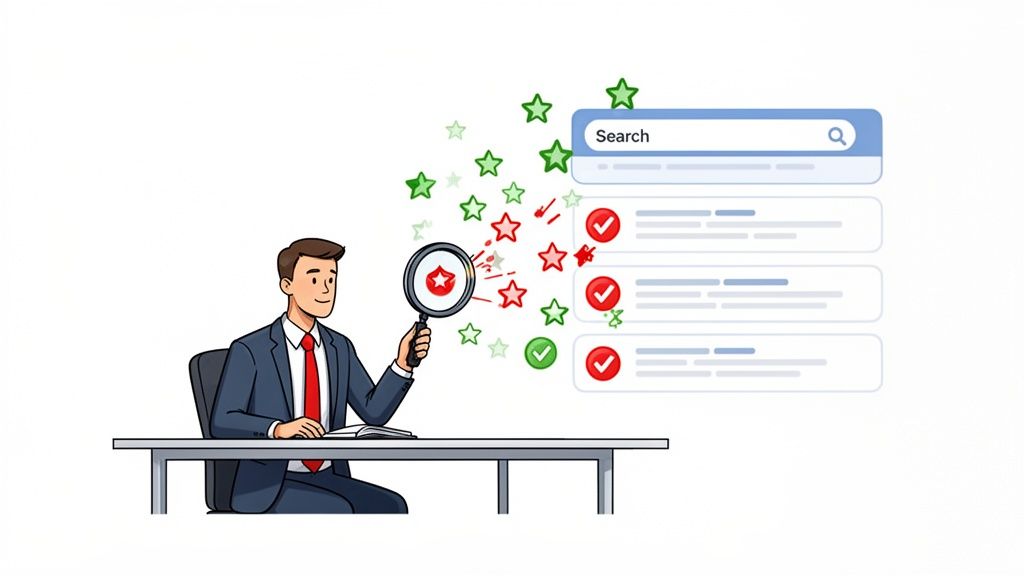
When you're trying to remove negative search results, you're really looking at three different game plans: getting the content taken down directly, burying it with SEO, or building a wall of positive content to overshadow it. While a direct takedown is obviously the quickest win, it's often the hardest to pull off. That’s why suppression and proactive building are usually the most reliable strategies for the long haul.
The True Cost of a Bad Online Reputation
But before we get into the how, let's talk about the why. Negative search results aren't just an annoyance or a bit of bad PR; they're a direct threat to your revenue, your credibility, and the future of your brand. A single negative link can completely short-circuit a customer's journey, causing them to abandon a purchase they were seconds away from making.
This is exactly why managing your reputation can't be an afterthought. Waiting for a crisis to hit before you act is a recipe for disaster when first impressions are made on the first page of Google.
Understanding the Financial Impact
The financial damage from a bad online reputation is real and it happens fast. Think about it: when someone searches for your brand, they're usually close to making a decision. If they find negative articles, bad reviews, or hit pieces at that exact moment, it plants a seed of doubt that sends them running straight to your competition.
In fact, research shows that nearly 45% of potential customers have found something online that made them decide not to do business with a company. A simple search becomes a major liability. One angry review can easily scare away dozens of prospects. A great resource from ReputationX.com goes into more detail on removal tactics.
Here's a rule of thumb we've seen play out time and time again: it takes roughly 12 positive pieces of content to bury the damage from just one negative result. That lopsided ratio shows you just how much work it takes to recover from even a small hit.
To give you a clearer picture, let's break down the core ways you can tackle these negative results.
Core Strategies to Combat Negative Search Results
Here’s a quick overview of the primary methods for addressing harmful online content, categorized by approach.
| Strategy Type | Primary Method | Best For |
|---|---|---|
| Direct Action | Takedowns & Legal Options | Defamatory, false, or copyrighted content where you have legal standing. |
| Defensive SEO | Suppression & Burying | Content that is opinion-based, old, or can't be legally removed. |
| Proactive Building | Content Creation & Promotion | Establishing a long-term positive reputation and insulating against future attacks. |
Each of these strategies plays a different role, and the most effective campaigns often use a combination of all three to protect a brand's online presence.
The Erosion of Trust and Credibility
Beyond the immediate financial loss, negative search results chip away at the very thing your brand is built on: trust. A damaged reputation doesn't just hurt sales; it makes it harder to attract great employees, land strategic partnerships, or even get positive press. Every negative link is like a flashing sign that screams "unreliable."
This loss of trust has a ripple effect. As your credibility drops, so does customer loyalty and the willingness of people to recommend you. You can learn more about the benefits of online reputation management in our other guide. In today's market, your online reputation is your most critical asset. Protecting it isn't just a good idea—it's essential for survival.
Your Initial Takedown and Removal Playbook
Seeing a damaging article or review pop up in your search results is a gut-punch. The immediate reaction is to want it gone, now. But panicking won't help. The best first move is always a measured one, focusing on direct and efficient actions to get that negative content removed before it starts to fester.
Think of this as your initial playbook. Before diving into complex SEO suppression campaigns, we first want to exhaust the most straightforward options.
First things first: you need a complete picture of the problem. You can't fight an enemy you can't see. Start by thoroughly searching for your brand, your key people, and your products on Google. Go beyond the first page. Keep a running list of every single negative URL you find in a simple spreadsheet. This document will become your command center.
With your list in hand, it's time to triage. Not all negative links are created equal, and trying to tackle everything at once is a recipe for frustration. You need to assess each one to figure out where to focus your energy for the biggest impact.
Assessing the Threat Level
I like to categorize each piece of negative content to decide which ones to attack first and how. It really helps bring clarity to what can feel like a chaotic mess.
Here are the metrics I look at:
- Search Engine Visibility: Is the link staring customers in the face on page one for a critical search term? A nasty comment on page 5 is a problem for another day. A defamatory post in the top 3 results is a five-alarm fire.
- Severity of Content: You have to be honest here. Is the content truly defamatory and false, or is it just a brutally honest customer review? Outright lies and copyright theft give you solid ground for removal requests. A legitimate bad experience is a different beast.
- Website Authority: A negative article from a major news outlet is a much bigger deal—and much harder to remove—than a rant on some forgotten forum.
- Potential Business Impact: Which links are actively costing you money? Look for content that could be scaring away customers, spooking potential investors, or making it harder to hire great people. Those are your top priorities.
This methodical approach turns a vague, overwhelming problem into a series of clear, manageable tasks. If you want to go deeper on building out your plan, Raven SEO offers a comprehensive guide to removing negative search results that lays out a fantastic strategic framework.
Pursuing Direct Content Removal
Once you've prioritized your list, the goal is to get the content taken down at the source. This is the holy grail. If you can get the page removed from the original website, it will eventually vanish from Google’s search results for good.
How you approach this depends entirely on who published the content.
Expert Tip: I can't stress this enough: always keep your communication professional and level-headed. Firing off an angry, threatening email is the fastest way to get ignored or, worse, make the publisher double down.
For platforms like Google, Yelp, or Facebook, your first stop should be the "report" or "flag" feature. Every platform has terms of service that prohibit things like fake reviews, spam, hate speech, or clear conflicts of interest. If a review breaks a specific rule, report it and clearly state which policy it violates. It’s not always a guaranteed win, but it's a necessary first step. Our guide on removing reviews from Facebook can walk you through the specifics for that platform.
This is the basic flow we follow for any reputation campaign—a progression from direct action to long-term defense.

When dealing with blogs or smaller news sites, your best bet is to reach out to the author or webmaster directly. Do a little digging to find their contact info and send them a polite, concise email.
Your email should cover three key things:
- Introduce Yourself: Briefly say who you are and why you're reaching out.
- Pinpoint the Content: Always include the direct URL of the page you're concerned about.
- State Your Request Clearly: If the facts are wrong, provide proof and ask for a correction. If it's an old story about an issue you've since fixed, explain what you did and politely ask if they'd consider an update or removal.
Sometimes, a webmaster won't remove the content but might be open to a compromise. One great option is to ask them to add a "noindex" tag to the page. This is a small piece of code that tells search engines not to include the page in search results. The article stays live on their site, but it disappears from Google. It's a win-win.
What to Do When Your Google Reviews Disappear
It's a sinking feeling. You’ve worked hard to earn a stream of positive reviews, and then one day, a chunk of them are just… gone. This isn't just frustrating; it can feel like the ground is falling out from under your business's reputation.
This problem, which many of us call the "Google Review Purge," can make any negative search results you're already fighting feel ten times worse.
And we're not just talking about Google catching a few obviously fake reviews anymore. Thanks to aggressive new AI, the platform is now flagging and removing countless legitimate reviews. It leaves good business owners completely baffled, watching their hard-earned star ratings plummet overnight.
Why Is Google Deleting Good Reviews?
At its core, Google is obsessed with being a source of truth. To fight the tidal wave of fake feedback online, its review-filtering algorithm has become incredibly strict. The unfortunate side effect is a ton of collateral damage, with genuine customer opinions getting caught in the crossfire.
We see this problem hit hardest in industries that rely on a high volume of reviews, like home services contractors and medical practices. For them, a steady stream of new feedback is the lifeblood of their local marketing. If you don't understand what's triggering these removals, you're left fighting a battle you can't win.
The scale of this is pretty staggering. In 2026, Google has massively ramped up its efforts, deleting reviews from more than 60,000 businesses across the globe. We worked with one company that had a fantastic week, bringing in 260 new reviews. The next morning, Google had wiped out 100 of them. Their rating dropped by 0.2 points, and their local search visibility tanked almost immediately.
On average, most businesses can expect 5-15% of their reviews to be removed over time. But for some, that rate can spike dramatically, wrecking their star ratings. Since review volume is a direct ranking factor, this hurts their position in the local pack. You can get a deeper look into how Google is handling review removals on almcorp.com.
The main takeaway here is that simply having a strategy to "get more reviews" is broken. You need a more resilient plan that anticipates Google's filters to protect your reputation.
Losing your positive reviews is a quiet killer for any campaign to remove negative search results. A strong, healthy review profile is your best shield against the damage a single bad piece of feedback can do.
Red Flags That Get Reviews Deleted
Google's algorithm is a pattern-matching machine. It’s looking for anything that seems unnatural or inauthentic. Even if your customer is 100% genuine, certain behaviors can get their review zapped without warning.
Here’s what we see tripping people up all the time:
- Reviews from Your Office Wi-Fi: If you have a tablet or "review kiosk" in your office, any reviews left from it are coming from the same IP address. Google sees this and assumes they're fake.
- Canned or Templated Wording: Giving customers a script or a template is a huge mistake. When the algorithm sees multiple reviews using the same phrases, it flags them as spam.
- A Sudden Burst of Reviews: Going from getting one review a month to 50 in a single day is a massive red flag. That kind of unnatural velocity looks suspicious.
- Reviews from "Ghost" Accounts: Feedback from a brand-new Google account with no profile picture, no history, and no other reviews looks fishy and is often deemed less credible.
- Weird Geolocation: If your business is a local bakery in Miami, a review from a user whose account is clearly logging in from Seattle is going to raise suspicion.
Just one of these might not cause an issue, but a few of them together dramatically increase the odds of your best reviews vanishing into thin air.
Building a Review Strategy That Lasts
To protect your hard-earned reviews, you have to start playing by Google's unwritten rules. This isn't about gaming the system; it's about focusing on quality and authenticity over sheer quantity.
A sustainable approach looks a lot more like this:
First, stop asking for reviews in person. Instead of handing a customer a tablet, send them a follow-up email or text with a direct link to your Google Business Profile. This ensures the review is posted from their own device, on their own network, at a later time—all signals of authenticity.
Next, encourage them to be specific and unique. Don't just ask for a 5-star review. Prompt them with open-ended questions that get them thinking, like, "What part of the experience stood out to you?" or "How did our team make your day better?" This naturally leads to more diverse, detailed, and trustworthy reviews.
Finally, pace your requests. Make asking for feedback a normal part of your daily workflow. By spreading out your requests, you'll create a steady, natural-looking flow of new reviews instead of scary, sporadic spikes.
When you get smarter and more strategic about how you collect feedback, you build a review profile that's tough enough to withstand Google’s algorithm changes. This creates the strong foundation of positive proof you need to insulate your business from the harm of any negative results that pop up.
Mastering SEO Suppression to Bury Negative Results
So, you’ve tried asking nicely to get that negative content taken down, and it went nowhere. It's a common story. When polite requests and official channels fail, it's time to stop asking for help and start taking control. This is where SEO suppression comes in—it's your best offensive play to remove negative search results from public view.
The idea isn't to magically delete the harmful content. Instead, you're going to bury it. You'll push it so far down the search rankings that for all practical purposes, it no longer exists.

I like to think of Google’s first page as prime digital real estate. Right now, a negative article is sitting on a premium lot, tarnishing your name. Your job is to become a developer. You're going to build ten bigger, better, and more authoritative properties on all the lots surrounding it until that negative piece is completely overshadowed. It's a systematic process of creating and promoting a flood of positive content that you own and control.
Building Your Digital Fortress
First things first: you need to know exactly which search queries are surfacing the damaging content. Is it your brand name? "Your Brand + reviews"? Your CEO's name? Get specific. Once you’ve identified the battlefield, you can start building your arsenal.
This isn't about just writing a few blog posts and hoping for the best. It requires a coordinated content assault designed to outrank the negative result for those specific keywords. Your goal is to create a diverse portfolio of positive assets, including things like:
- Optimized Blog Posts: Long-form, highly detailed articles that directly or indirectly address the keywords bringing up negative results.
- Detailed Case Studies: Nothing shouts "we're good at what we do" louder than a case study showcasing a client's success.
- Engaging Video Content: A well-made video on YouTube or Vimeo can rank on its own in Google Search, giving you another powerful, positive result.
- Professional Social Media Profiles: Fully built-out profiles on LinkedIn, X (formerly Twitter), and Facebook often dominate the first page for personal or brand name searches.
- Guest Articles on Authoritative Sites: Placing content on respected industry blogs not only builds credibility but also gives you another positive search result that you control the narrative of.
This is a long-term play. You're essentially creating a library of high-quality content designed to dominate the conversation around your brand, pushing all that negative noise into the background. A solid initial assessment is crucial, and for businesses that need a clear roadmap, a professional SEO audit service can pinpoint exactly where to focus your efforts.
The Power of Authority and Backlinks
Creating great content is only half the battle. For your positive pages to outrank a negative one—especially if it's on a high-authority news site—they need their own authority. In the SEO world, authority is primarily built with high-quality backlinks.
A backlink is simply a link pointing from one website to another. Google sees these as votes of confidence. The more credible and relevant the sites linking to your positive content are, the more trust Google places in it, and the higher it will rank.
This is where most DIY reputation campaigns stumble. People create the content but then fail to promote it effectively. Without a dedicated strategy to build backlinks, your new, positive pages will just sit there, lacking the power to displace the established negative ones.
This part of the process involves reaching out to other websites, blogs, and industry publications to earn links back to your positive assets. It's slow and meticulous work, but it's the engine that drives a successful suppression campaign. Every quality backlink you earn acts like a lever, hoisting your positive content up while pushing the negative content further down.
Positive Content Asset Comparison for SEO Suppression
Not all content types have the same punch when it comes to SEO suppression. You need to pick the right tools for the job, weighing their potential impact against the resources you have.
This table breaks down some of the most common content assets and their role in a suppression campaign.
| Content Type | SEO Impact | Resources Required | Best For |
|---|---|---|---|
| Owned Blog Posts | High | Medium (Time, Writing) | Building a long-term content hub and ranking for many keywords. |
| Guest Posts | High | High (Outreach, Time) | Quickly gaining authority by borrowing another site's credibility. |
| Social Media Profiles | Medium | Low (Setup Time) | Dominating search results for your exact brand or personal name. |
| Video Content | Medium-High | High (Production Costs) | Engaging users and ranking on both Google and YouTube. |
| Press Releases | Low-Medium | Medium (Cost, Distribution) | Generating initial buzz and potentially getting picked up by news sites. |
Ultimately, a mix-and-match approach is most effective. You could create a cornerstone blog post, support it with a short video, and then write several guest posts that link back to both. This creates a powerful, interconnected web of positive content that search engines simply can't ignore. The name of the game is relentless, consistent execution. Suppression is a war of attrition, and victory belongs to those who have the most high-quality content and the patience to see the campaign through.
Building a Proactive and Resilient Online Reputation

Once you've cleaned up existing reputation fires, the real work begins. The ultimate goal is to shift from playing defense to playing offense—building a brand so strong that future negative content simply bounces off. This proactive approach is your long-term insurance policy.
Instead of waiting for a crisis to hit, you'll be creating an overwhelming wave of positive content that acts as a shield. When your digital presence is this positive, a single bad review or negative article struggles to get any oxygen.
The Math of Mistrust and the Power of Volume
I often talk about what I call the 'Math of Mistrust,' and the numbers don't lie. One study found a staggering 94% of people will avoid a business because of negative online reviews. That’s a brutal reality.
To counter this, I developed the '0.1% Rule,' a strategy focused on generating so much positive feedback that negative reviews make up less than 0.1% of your total. While some say it takes around 12 positive mentions to cancel out one bad one, the real battle is won through overwhelming volume. By flooding the zone with good, you make any single negative voice statistically irrelevant. It’s a powerful way to neutralize these silent revenue killers.
The goal isn't just to remove negative search results; it's to make them irrelevant. When you have hundreds or thousands of glowing reviews, one disgruntled customer's post loses its power and becomes a mere blip on the radar.
This volume-based strategy is the best defense against whatever the internet might throw at you next.
Implementing Smart Review Funnels
The secret to generating that kind of volume is a smart review funnel. This isn't about hiding from criticism. It's about making sure feedback goes to the right place. The system actively prompts happy customers to share their thoughts publicly while guiding unhappy customers to a private channel where you can solve their problem.
Here’s how it works in practice:
- The Ask: First, you send an automated email or text after a purchase, asking for a quick rating of their experience.
- The Happy Path: If someone gives you a high score (say, a 9 or 10), the system thanks them and then seamlessly directs them to public sites like Google or Yelp to share their great experience.
- The Unhappy Path: If the rating is low, they're routed to a private feedback form instead. This gives you a chance to learn what went wrong and fix it directly, often turning a negative experience into a positive one.
This process lets you capture crucial feedback for internal improvement while simultaneously building an impressive public portfolio of social proof. It's a true win-win.
A Sustainable Plan for Brand Monitoring
Of course, a proactive strategy is nothing without consistent monitoring. You can’t fix what you don’t know is broken. Setting up a system to track what’s being said about your brand is non-negotiable.
The easiest place to start is with Google Alerts. It’s free and a great first step. Set up alerts for your company name, key products, and the names of your executives. You’ll get an email anytime new content mentioning those terms gets indexed.
For a deeper dive, you'll want to look into paid reputation management tools. These platforms offer much more, including:
- Sentiment analysis to gauge the tone of online conversations.
- Comprehensive tracking across social media, forums, and news sites.
- Monitoring your search rankings for your most important keywords.
Managing all of this can feel like a full-time job, because sometimes it is. If you find yourself overwhelmed, it’s often wise to partner with an expert, like a dedicated SEO consultant, who can handle the tools and tactics for you. Consistent monitoring is the only way to stay in control of your brand’s narrative.
Answering Your Top Questions
When you're trying to remove negative search results, a lot of questions come up. Let's get straight to the ones we hear most often from people in your exact situation.
How Long Does It Take To Remove a Negative Search Result?
This is the million-dollar question, and the honest answer is: it varies. There’s no simple timeline.
If you’re lucky, you might have a clear policy violation on a platform like Google or Facebook. In those cases, a direct removal request can get the job done in just a few days or weeks. But asking a news outlet or blogger to retract a story is a different beast entirely. It could happen overnight, or it could never happen at all.
That's why we often turn to SEO suppression. This is a longer-term strategy, usually taking anywhere from 3 to 9 months to successfully bury a negative result. The exact timeframe really hinges on how authoritative that negative link is and how much competition exists for your target keywords.
A word of caution: anyone promising you an instant fix is selling you a fantasy. Real reputation repair is a marathon, not a sprint. It requires a patient, methodical approach.
Can I Sue Someone to Remove Negative Content?
You technically can, but it should be the absolute last tool you reach for. Filing a defamation lawsuit is a massive undertaking—it's expensive, public, and drags on forever.
The biggest risk? It can backfire spectacularly. You might end up drawing even more attention to the content you want to disappear, a phenomenon known as the Streisand Effect. To even have a chance of winning, you have to prove the statements are factually false and that they caused your business tangible harm. This is a very high bar to clear, especially with opinion-based content like customer reviews.
In nearly every case, you'll get a better, faster, and more cost-effective outcome by investing those resources into a robust SEO suppression campaign. Always speak with a qualified attorney before even thinking about going down the legal road.
When Should I Hire a Professional Reputation Management Agency?
It’s time to call for backup when the situation feels overwhelming or the potential damage is significant.
You should seriously consider hiring an agency if you're facing:
- Multiple negative results dominating the first page of Google.
- Hard-hitting articles from high-authority news organizations.
- A simple lack of time or in-house knowledge to execute a long-term strategy.
Professionals come equipped with specialized tools, battle-tested methods, and media relationships that you just don't have access to. They can navigate complex situations much more effectively. If you’ve been trying on your own for a few months without seeing any real progress, that's a sure sign you need an expert in your corner.
At ReachLabs.ai, we focus on building proactive strategies that put you back in control of your brand's story. Discover how our team can help you control your digital narrative.