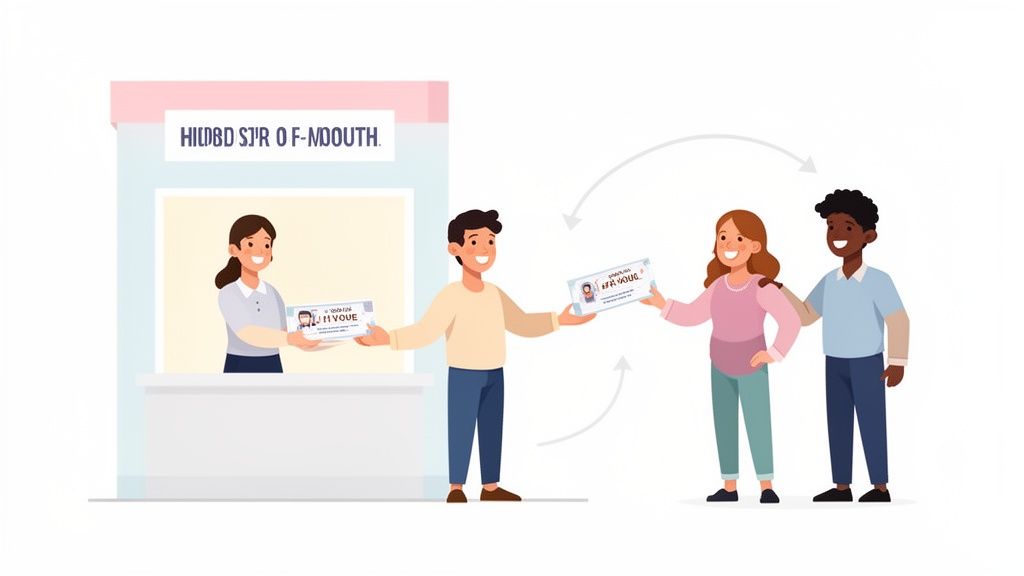
Referral programs are more than just a marketing tactic; they’re about turning your happiest customers into your most effective sales team. Instead of sinking your budget into ads, you can tap into the power of word-of-mouth to bring in high-quality leads who are already primed to love what you do.
Why Referrals Are a Small Business’s Secret Weapon
As a small business owner, it’s tough to go head-to-head with the massive ad budgets of larger companies. Pouring money into Google or Meta ads can feel like a losing battle, often delivering a frustratingly low return and making sustainable growth seem out of reach. This is precisely where a solid referral strategy can completely change the game.
Think about it. Rather than shouting into the digital void and hoping someone listens, you’re letting your best customers do the talking for you. This approach is a direct and powerful solution to the ever-increasing cost of acquiring new customers, all by leaning on the most trusted marketing tool there is: genuine human connection.
The Unmatched Power of Trust
The data doesn't lie. A staggering 92% of consumers trust recommendations from people they know far more than any other type of advertising. When a friend raves about a new local restaurant or a reliable contractor, that endorsement carries an authenticity that no paid ad can ever hope to match.
Here's a fascinating insight: there's a huge "ask gap" in the market. While a massive 83% of satisfied customers say they are willing to refer a business they like, only 29% ever actually do. This gap isn't a problem; it's a massive, untapped opportunity waiting for businesses that simply create a formal, easy-to-use referral system.
For small businesses, the numbers are even more stark. Research shows that 60% of all new business for small companies comes directly from referrals, making it their single most important growth channel. To really harness this potential, you need to understand how to build effective small business referral programs.
A Real-World Example
Let's imagine two local coffee shops.
Shop A burns through thousands of dollars every month on social media ads. They get some traffic, but many visitors are one-and-done customers. Their acquisition costs are high, and their marketing feels like a constant, expensive gamble.
Then there's Shop B. They set up a simple referral program: "Bring a friend, and you both get a free pastry." Suddenly, their regulars aren't just customers; they're advocates, actively bringing in friends who are excited to be there.
This simple shift accomplishes so much:
- It drastically lowers their customer acquisition cost.
- It brings in high-quality customers who arrive with a built-in positive recommendation.
- It boosts loyalty and encourages repeat business, directly improving customer lifetime value.
This isn't just some fluffy promotional idea. It's a core strategy for authentic, sustainable growth. By empowering your existing customer base to become your champions, you create a powerful, self-sustaining engine that drives revenue and builds a true community around your brand. To dig deeper into fostering these valuable relationships, check out our guide on how to increase customer lifetime value.
Designing a Referral Program That Actually Works
Knowing you need referrals is one thing. Actually building a program that gets them is where most small business owners hit a wall. The good news? You don't need a complicated, expensive system. The secret is creating a simple, compelling offer that turns your happiest customers into your best advocates.
Your goal is to build an engine that runs in the background, motivating people to spread the word without draining your time or confusing everyone involved. Let's start with the most important piece of the puzzle: the incentive.
Choosing Your Incentive Model
The reward you offer is the fuel for your entire program. It directly impacts how many people join in and the quality of the leads they send your way. There's no one-size-fits-all answer here, so you need to pick a structure that makes sense for your business and your customers.
Here are the most common models I've seen work for small businesses:
Dual-Sided Rewards: This is the classic "give $20, get $20" setup. It's wildly popular for a reason—it rewards both the person referring and their friend. This makes your customer feel generous, not like a pushy salesperson.
Single-Sided Rewards (Referrer Only): In this case, only the existing customer gets a reward. This approach can work if you have a die-hard fan base that already loves talking about you. The reward is just a nice bonus for something they might have done anyway.
Single-Sided Rewards (New Customer Only): Here, only the newly referred friend gets a discount or perk. It’s less common because there’s no direct motivation for your current customer, but it can be a decent strategy for pure customer acquisition if your advocates are highly engaged.
Tiered Rewards: This model is perfect for your super-fans. It offers better rewards as they refer more people. For example, their first referral might earn them a 10% discount, but after five successful referrals, they could unlock a free product or a significant service credit.
The right choice really depends on your business. A local coffee shop might do great with a dual-sided "buy one, get one free" offer, while a marketing consultant could offer a free strategy session as a high-value, single-sided reward. To help you decide, here’s a quick breakdown of how these models stack up.
Choosing Your Referral Incentive Model
This table compares the most common referral incentive models to help you figure out which structure best fits your business goals and customer base.
| Incentive Model | How It Works | Best For | Key Advantage |
|---|---|---|---|
| Dual-Sided | Both the referrer and the new customer receive a reward. (e.g., "Give $20, Get $20") | E-commerce, subscription services, and businesses wanting rapid growth. | High participation rates; feels like a gift, not a sales pitch. |
| Single-Sided (Referrer Only) | Only the existing customer who made the referral gets a reward. | Businesses with a very loyal customer base and high-value products. | Rewards your best advocates and encourages repeat referrals. |
| Single-Sided (New Customer Only) | Only the new customer who was referred receives an incentive. | Businesses focused purely on acquiring new customers at a lower cost. | A low-friction way to attract new buyers through a trusted source. |
| Tiered or Gamified | Rewards increase in value as the referrer brings in more new customers. | Service businesses, agencies, or brands with "super-fans." | Motivates your most influential customers to become true partners. |
Ultimately, the best incentive is one that feels valuable to your customers but is also sustainable for your business. Don't be afraid to start small and test what resonates.
Defining What a Successful Referral Looks Like
Once you've picked an incentive, you need to be crystal clear about what triggers the reward. Ambiguity is the fastest way to kill a referral program. Does the friend just need to sign up for your email list, or do they have to make a purchase?
The golden rule is to keep it simple and transparent. Your customers should understand the rules in five seconds flat. If they have to dig through a page of terms and conditions, they'll just move on.
For most businesses, it’s best to tie a successful referral directly to revenue. A bulletproof rule is that the reward is paid out only after the new customer makes their first purchase over a certain amount. This ensures you're paying for real business, not just lukewarm leads.
Getting this architecture right is foundational. A well-designed program can slash your customer acquisition costs (CAC) by up to 25% because referred customers convert at rates 3-5 times higher than people from other channels. Data from thousands of Shopify stores shows referral programs can generate 10-30% of total revenue. Models like dual-sided rewards boost this even more, increasing participation by a reported 29% and turning happy customers into a genuine growth engine. You can see more compelling referral marketing statistics from Extole to understand the potential.
Before you even begin, though, there’s a critical question you have to ask yourself. This flowchart breaks it down perfectly.

The takeaway is simple: a referral program just amplifies what’s already there. If your customers aren't happy, your first job is to fix the core experience. No incentive in the world can make up for a bad product or service.
Combine the right reward with clear rules, and you'll create a program that feels effortless and valuable. It's a blueprint that not only brings in new business but also deepens your relationship with your existing customers. If you want to dive deeper into other practical methods, our guide explains more about how to get referrals effectively.
How to Get the Word Out About Your Program
So you’ve designed a fantastic referral program. That’s a huge first step, but it’s only a first step. If your customers don't know it exists, it’s just a great idea collecting dust. Getting the word out is just as important as the program's design—it’s what turns your idea into a real source of growth for your business.
Think of promotion less like a single, loud announcement and more like an ongoing conversation. You want to gently and consistently weave it into how customers already interact with you, making it a natural part of their experience.

Find Your "Happy Moments"
Timing is everything. From my experience, asking for a referral at just the right moment makes all the difference. The trick is to pinpoint the exact times when your customers are happiest with your brand.
Instead of just blasting the message out to everyone at once, zero in on these golden opportunities:
- Right After a 5-Star Review: A customer just told the world they love you. This is the perfect time for an automated email that says something like, "Thanks for the kind words! Know someone else who’d love our service? Here’s a little something for both of you."
- On the Post-Purchase "Thank You" Page: The moment someone clicks "buy," they're feeling good about their decision. Use that excitement. A simple banner on the confirmation page saying, "Love your new gear? Share us with a friend and you both get $15 off!" is incredibly effective.
- After You’ve Solved a Problem: When your customer support team turns a potential problem into a great experience, that customer is often feeling relieved and grateful. A quick, personal follow-up from the support agent that includes a mention of the referral program can work wonders.
- When They Hit a Milestone: If you run a subscription service, celebrate their loyalty. An email that says, "Happy one-year anniversary with us! To celebrate, we've bumped up your referral bonus for this month," makes them feel special and encourages sharing.
The goal is to ask when they feel the most positive about you. When you do that, the ask feels less like a marketing pitch and more like a natural, welcome suggestion.
Weave Your Program Into Every Channel You Own
For your referral program to really take off, it has to be visible. You can’t just mention it once and expect people to remember. It needs to show up consistently wherever your customers are.
Here's how you can make it a familiar sight across your different platforms.
Email Marketing Is Your Best Friend
Your email list is a direct line to your most loyal fans. Don't just send one big announcement and call it a day.
- Kick things off with a dedicated email. Make it exciting and crystal clear what your customers "give" and "get." Use a bold, can't-miss call-to-action like "Start Sharing & Earning Now."
- Add it to your newsletter. A small, permanent section in the footer or sidebar of your regular emails serves as a constant, gentle reminder.
- Tuck it into transactional emails. A simple "P.S. Did you know you can get $10 for referring a friend?" at the bottom of an order confirmation or shipping notification is a surprisingly powerful tactic.
Don't Forget Your Website and Physical Store
Your own website and storefront are prime real estate. You control the space, so use it!
| Channel | Promotional Tactic | Sample Copy |
|---|---|---|
| Website | Use a sitewide banner or a subtle pop-up after a user has been browsing for a bit. | "Give a Friend 20% Off, Get $20!" |
| Dedicated Page | Create a simple landing page explaining how the program works. Link to it from your main menu or footer. | "Share the Love. Refer a Friend." |
| In-Store Signage | Place small signs at the register or slip flyers into shopping bags. | "Ask Us How to Get a Free Coffee!" |
| Employee Scripts | Train your team to mention the program during checkout, especially when a customer seems really happy. | "I'm so glad you love it! By the way, you should know about our referral program…" |
Always Be Testing Your Message
Your first idea for a headline or offer might not be the one that gets the most traction. This is where a little bit of testing can have a huge impact on your results.
Try A/B testing different parts of your message to see what your customers respond to:
- Headlines: Pit a direct offer like "Give $10, Get $10" against something more benefit-focused like "Share the Love and Earn Rewards."
- Offers: Does a percentage discount (like 20% off) work better than a flat dollar amount (like $20)? The only way to know is to test.
- Imagery: See if a photo of real, happy customers outperforms a clean graphic that illustrates the reward.
By promoting your program consistently across all your channels and fine-tuning your messaging over time, you’ll keep it top-of-mind. It will transform from a forgotten feature into a reliable engine for bringing in new, high-quality customers who already trust you because their friends do.
Launching Your Program for Maximum Impact
You’ve got your referral program designed and you know how you'll promote it. Now for the exciting part: the launch. But getting this right is more than just flipping a switch and hoping people notice. A smart rollout is about building momentum, catching any hiccups early, and making sure your program becomes a reliable growth engine from day one.
From what I've seen, the most effective launches don't start with a massive, public push. They begin with a quiet, controlled "soft launch" aimed at a very specific group: your most loyal customers and biggest fans.
Start with an Insider-First Soft Launch
Before you broadcast your new program to the world, take a step back. Handpick a small group of your best customers and invite them to be the very first participants. These are the people who already rave about your brand, leave you glowing reviews, and have probably mentioned you to friends without any incentive at all.
This insider-first approach does a couple of brilliant things.
First, it’s your final real-world test. These loyal customers are far more likely to forgive a minor glitch in the signup process or a slight delay in a reward. Their feedback is pure gold—it helps you spot and fix confusing instructions, broken links, or any other friction points before the general public runs into them.
Second, it makes your top advocates feel seen and valued. An email with a subject line like, "You're Invited: Get a First Look at Our New Referral Program," creates an immediate sense of exclusivity. That small gesture goes a long way in strengthening their loyalty and gets them even more excited to start sharing.
Here’s a quick game plan for your soft launch:
- Find Your Champions: Pull a list of customers with repeat purchases, high lifetime value, or recent positive feedback.
- Send a Personal Invite: Write a simple email explaining that you're launching something new and you'd be honored if they were the first to try it.
- Ask for Feedback: Be direct. Ask them what they think about the process. Is it easy? Is the reward exciting enough?
- Watch Closely: Track their progress to see where things are working smoothly and where people might be getting stuck.
This initial phase, which might just last a week or two, gives you priceless insights and builds a foundation of early success stories you can use later on.
Build Your Dedicated Referral Landing Page
Once you've ironed out the kinks, you need a home base for your program. A dedicated, high-converting landing page is non-negotiable for any small business referral program. This page has one job and one job only: to clearly explain the program and make signing up an absolute breeze.
Keep your landing page simple, clean, and focused. Get rid of any extra clutter—no competing promotions or navigation links that could pull a visitor's attention away.
Your referral landing page should answer three questions in under ten seconds: What's in it for me? What's in it for my friend? How do I start? If it takes longer than that to understand, you've already lost them.
Here are the must-have elements for a powerful referral page:
- A Killer Headline: Lead with the benefit. Something like "Give 20%, Get $20" or "Share the Love and Earn Rewards" is direct, punchy, and instantly understood.
- A Simple How-To: Use a 1-2-3 step format or simple icons to show how it works. Think: Share Your Link -> Your Friend Buys -> You Both Get Rewarded.
- Clear Calls-to-Action (CTAs): Your buttons should be impossible to miss and use action-oriented text like "Get My Referral Link" or "Start Sharing Now."
- Social Proof: This is where you use feedback from your soft launch! Featuring a quote like, "It was so easy to share, and my friend loved the discount!" builds instant trust.
This page becomes the anchor for all your promotional efforts. Every email, social post, and banner you create should point right back here.
Weave Referrals into the Entire Customer Journey
A launch isn't just a one-and-done event; it's the start of making referrals a core part of your brand's DNA. To really get the most out of your program, you have to make it a natural part of the customer experience. Look at every touchpoint a customer has with your business and ask yourself, "Can I mention the referral program here?"
This means you have to go beyond a single announcement email. Weave it into your automated emails, your website, and even your packaging.
- Welcome Email Series: After you've welcomed a new customer, add a P.S. to a later email in the sequence. "Loving your experience so far? The best compliment you can give is a referral."
- Newsletter Footers: Add a permanent, eye-catching block to the bottom of every single newsletter that links directly to your referral landing page.
- Post-Purchase Follow-up: The moments after a customer makes a purchase are a golden opportunity. A few days after an order is delivered, send an email checking in on their experience and include a prominent note about the referral program.
By making your program a consistent and visible part of the customer journey, you turn it from a short-term campaign into a sustainable, long-term asset. This methodical approach to your launch will help you build momentum fast and create a system that keeps bringing high-quality, trusted new customers to your door.
Measuring Success and Proving Your ROI

Getting your referral program off the ground is a huge win, but the work isn't over. The real question is: is it actually working? To turn your program into a reliable growth engine, you have to look past the anecdotal wins and start tracking the numbers that matter. This is how you prove its value and make smart tweaks along the way.
But don't worry, you don't need a degree in data science. You can get a clear picture of your program’s health by focusing on just a handful of key performance indicators (KPIs). Knowing which KPI metrics for small business reports to watch is half the battle.
The Core Metrics You Can't Ignore
Think of your referral program as a simple funnel. A certain number of customers will sign up, a smaller group will actually share it, and an even smaller group will successfully convert their friends into new customers. Your job is to measure what’s happening at each of these stages.
Here are the essentials for your referral dashboard:
Participation Rate: This is your starting point. It's the percentage of your customer base that has actually joined your program. If this number is low, it’s a red flag that your program might not be visible enough or the incentive isn't catching their eye.
Share Rate: Of the customers who joined, how many are actually sending out their referral link? This tells you a lot about your advocates' motivation. High participation but low sharing often points to a clunky process or a confusing message.
Referral Conversion Rate: This is where the magic happens. It’s the percentage of referred friends who follow through and make a purchase. A high conversion rate is a great sign that your advocates are bringing in high-quality, ready-to-buy leads.
These three metrics tell a story together. A high participation rate with a low share rate signals a promotion or usability issue. On the other hand, a high share rate with a low conversion rate could mean the offer for the new customer isn't quite sweet enough.
To keep things simple, I always recommend building a small dashboard to track these key numbers. Here’s a quick breakdown of what that could look like.
Key Metrics for Your Referral Program Dashboard
| Metric | What It Measures | Industry Benchmark | How to Improve It |
|---|---|---|---|
| Participation Rate | % of customers who join the program. | 2-10% | Increase program visibility with emails, pop-ups, and social media posts. Boost the incentive for joining. |
| Share Rate | % of participants who share their link. | 10-20% | Simplify the sharing process (one-click shares). Provide pre-written messages. Remind participants to share. |
| Conversion Rate | % of referred friends who make a purchase. | 5-15% | Make the friend's offer more compelling. Ensure a seamless landing page experience for new visitors. |
Tracking these numbers week over week will give you a real-time pulse on your program's health and show you exactly where to focus your efforts.
Nailing Down Your Program’s ROI
Now for the ultimate question: is your program making you money? Calculating your Return on Investment (ROI) is how you answer that question with confidence.
First, add up your total program costs. This includes all the rewards you've paid out, plus any software fees or marketing expenses dedicated to the program.
Next, figure out the total value generated by the new customers who came from referrals. The best way to do this is by calculating Customer Lifetime Value (CLV)—the total profit you expect to make from a customer over their entire relationship with you.
Simple ROI Formula: (Revenue from Referred Customers – Total Program Costs) / Total Program Costs
Let's walk through a real-world example. A local coffee shop spends $200 on free coffee rewards in one month. Those referrals bring in 10 new regulars, and the shop knows each one has an average CLV of $150. The total value generated is $1,500. That's a 6.5x ROI. Now you can see how a referral program becomes a profit center, not just another expense.
The financial impact is hard to ignore. We see small businesses achieve an average ROI of 5-8x, with top-performing programs driving 10-30% of their total new revenue. What’s more, referred customers tend to bring in 30-57% more referrals themselves, creating a self-sustaining growth loop.
Ultimately, tracking your program's success connects your efforts to real business outcomes. It helps you reduce your overall Customer Acquisition Cost and proves that rewarding your happiest customers is one of the smartest marketing moves you can make.
Got Questions About Your Referral Program? I've Got Answers.
Even with the best-laid plans, a few questions always crop up when you're launching your first referral program. Let's walk through some of the most common ones I hear from business owners so you can move forward with confidence.
How Much Should I Actually Offer as a Reward?
This is the big one, but it doesn't have to be a shot in the dark. A great rule of thumb is to offer a reward that’s worth about 10-20% of your average purchase price. This makes the incentive feel substantial enough to be worth someone's time, without eating into your profits.
So, if your average sale is around $100, a reward between $10 and $20 is the sweet spot. If you run a service business, think bigger. A small cash reward might fall flat, but something like one month of free service or a major credit toward a future project can be incredibly motivating. The goal isn't to find a magic number—it's to offer something that your customers will genuinely value.
What's Better: Cash Rewards or Store Credit?
For almost every small business I've worked with, store credit or a product discount wins, hands down. Why? Because it does two jobs at once. It rewards your loyal customer for spreading the word, and it immediately encourages both them and the new customer to shop with you again. It’s a self-feeding loop that builds loyalty and customer lifetime value.
Cash is a great motivator, sure, but it doesn't keep people in your world. Once that money is spent at the grocery store or on Amazon, the connection to your brand is gone. Store credit keeps them right where you want them: engaged with your business.
Cash rewards can work for high-ticket B2B services or certain affiliate programs. But if you run an e-commerce shop, a local service, or a café, store credit is simply the smarter play. It transforms your referral program from a simple acquisition tool into a powerful loyalty engine.
How Can I Stop People From Gaming the System?
Fraud prevention is essential, but it doesn't need to be a fortress. Your first and most important line of defense is giving every customer their own unique referral code or link. This simple step makes it easy to trace every single referral back to a specific person. Good referral software will even do this for you automatically.
Beyond that, you need to set some clear ground rules in your terms and conditions. Be explicit about what counts as a real referral. Some common rules that work really well are:
- Set a minimum purchase amount for the new customer.
- Strictly forbid self-referrals (no, you can't refer yourself with a new email address).
- Add a "cool-down" or approval period. This means rewards are only paid out after the return window on the new customer's purchase has closed.
Many referral platforms also have fraud detection features that flag suspicious behavior, like a bunch of referrals coming from the same IP address or a crazy number of sign-ups in a few hours. A combination of clear rules and the right tools is all you need to keep your program honest and effective.
Ready to build a marketing strategy that turns your happy customers into your best salespeople? ReachLabs.ai provides the expert guidance and hands-on execution to create referral programs that actually work. Find out how we can help grow your brand at https://www.reachlabs.ai.