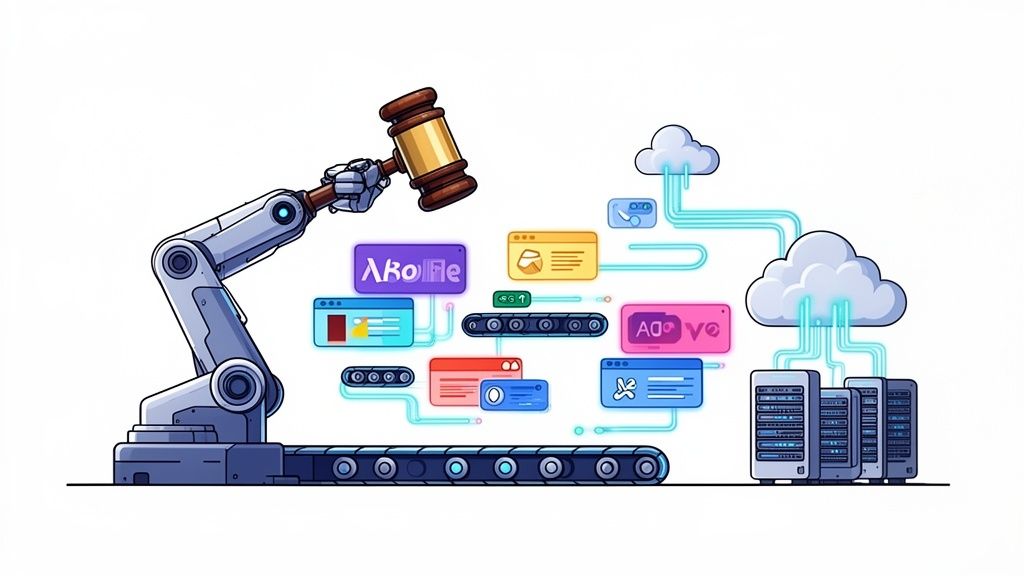
Imagine trying to buy ad space across thousands of websites one by one. You'd spend all day on the phone, negotiating rates and signing contracts. It sounds exhausting, right? Now, picture a digital stock market for advertising, where you can buy and sell ad space in the blink of an eye.
That’s essentially what programmatic ad buying is. It’s a powerful, automated way to purchase digital ads using data and technology, cutting out the slow, manual process of the past.
What Are Programmatic Ad Buys and Why They Matter Now
For a long time, buying digital ads was a surprisingly manual affair. It involved a lot of back-and-forth between advertisers and publishers. Programmatic advertising completely changed the game. Instead of buying a fixed number of ad views on a single site, advertisers now use smart technology to bid on individual ad placements across the entire internet, all in real time.
Think of it as a lightning-fast auction. The moment you land on a webpage, the empty ad space is put up for sale. In the background, advertisers’ platforms instantly analyze anonymous data about you—things like your interests, recent browsing activity, and general location. Based on that info, they decide if you’re the right person to see their ad and place a bid. This all happens in milliseconds, and the highest bidder’s ad is what you see as the page finishes loading.
The Driving Force Behind Modern Advertising
So why has this automated approach become the standard? It comes down to three key advantages: speed, scale, and precision. Instead of making an educated guess about where their audience might be online, advertisers can use data to find specific people wherever they browse. This means ad budgets are spent far more effectively, reaching individuals who are genuinely likely to be interested.
This efficiency is why we've seen a huge shift in marketing dollars. The global programmatic ad market is growing at an incredible pace, with experts projecting spending will race past $725 billion by 2026. Here in the US, the market is on track to top $203 billion, sending a clear message that automation delivers better targeting and performance. You can see how these programmatic trends are reshaping digital advertising to get a sense of where the industry is headed.
Key Takeaway: Programmatic buying isn’t just about making things faster. It’s about making smarter, data-backed decisions at a scale no human team could ever manage. It levels the playing field, allowing businesses of any size to compete for attention.
This shift means that understanding programmatic advertising is no longer just for tech specialists—it’s a must-know for anyone serious about growing a business online. It gives you the power to:
- Reach Your Ideal Customer: Move beyond simple demographics and target users based on their actual behaviors and what they’re looking for right now.
- Maximize Ad Spend: Stop wasting money on impressions that don't matter and focus your budget exclusively on relevant audiences.
- Scale Campaigns Effortlessly: Tap into a massive, web-wide inventory of ad space, all managed from one central platform.
How the Programmatic Ad Buying Ecosystem Actually Works
Let's pull back the curtain on how programmatic ad buying really works. Forget the old-school image of ad buyers wining and dining publishers. Think of it more like a lightning-fast, automated stock market for digital ad space. The entire transaction—from a user landing on a page to an ad appearing—happens in the milliseconds it takes for that page to load. For a deeper dive, check out this great resource: A No-Nonsense Guide to Programmatic Ad Buys.
The action starts the moment someone clicks on a website. That site's owner, the publisher, wants to get the best price for their available ad slots. To do this, they use a Supply-Side Platform (SSP). You can think of the SSP as the publisher's sales agent, packaging up the ad space and announcing its availability to the market.
On the other side of the coin, you have advertisers who are looking for the right eyeballs for their campaigns. They use a Demand-Side Platform (DSP), which acts as their expert buying agent. An advertiser logs into their DSP and sets their targeting parameters—maybe they want to reach "women aged 25-34 who live in major cities and have shown interest in sustainable fashion."
The Key Players in a Programmatic Transaction
This whole high-speed auction hinges on a few key pieces of technology working together seamlessly. It’s a system built from the ground up to connect sellers with the most relevant buyers in real time.
So, where do the buyers (DSPs) and sellers (SSPs) meet? They all come together in a central marketplace called an Ad Exchange. The Ad Exchange is the auctioneer. It takes the ad inventory from the SSP and, at the same time, fields bids from all the DSPs whose advertisers want to reach that specific user.
This infographic breaks down the incredible benefits of this automated process.

As you can see, programmatic is all about combining massive scale with incredible speed and targeting precision. In less than the blink of an eye, the Ad Exchange sorts through all the bids, picks the highest one, and the winning ad is instantly served back to the user's browser. It all happens so fast that the ad is there waiting as the page finishes loading.
The Role of Data in the Ecosystem
So, what’s the secret sauce that makes all this so incredibly effective? It all comes down to data. This is where a Data Management Platform (DMP) comes into play, often working hand-in-hand with a DSP. Think of a DMP as a massive, organized library of anonymous user data.
A DMP is what allows advertisers to move beyond simple demographics. It gathers, sorts, and segments audience data from all over, letting brands build hyper-specific customer profiles for their campaigns.
For example, a DMP might know that a particular (anonymous) user has been researching trips to Costa Rica. A travel brand’s DSP can see this signal and decide to bid more aggressively for that user's ad impression, knowing an ad for an eco-lodge is highly relevant right now. This is what truly sets programmatic apart—it turns the art of ad buying into a precise, data-driven science.
Understanding Programmatic Auctions and Pricing Models
So, we've met the key players in the programmatic world. Now for the multi-million dollar question: How is the price for an ad decided in a flash, and how do you actually pay for it? The entire system hinges on a process called Real-Time Bidding (RTB).
Imagine the New York Stock Exchange, but for ad space. The moment someone loads a webpage, an auction for the ad slots on that page instantly kicks off. Every interested advertiser (through their DSPs) throws a bid into the ring. The highest bidder wins, and their ad is served. This whole chaotic, high-stakes trade happens in about 100 milliseconds—literally faster than you can blink.
Choosing Your Pricing Model
Winning the bid is just the first step. The next question is, how much do you actually pay? That’s not left to chance; it's determined by the pricing model you chose when you set up your campaign. Picking the right one is absolutely critical and depends entirely on what you’re trying to achieve.
Here are the most common pricing models you'll work with:
- Cost Per Mille (CPM): With CPM, you pay a flat rate for every 1,000 times your ad is shown (an "impression"). This is the go-to model for brand awareness campaigns where your main goal is getting your message in front of as many relevant eyeballs as possible.
- Cost Per Click (CPC): Here, you only open your wallet when someone actually clicks on your ad. If your campaign's mission is to drive traffic to your website or a landing page, CPC is your best friend.
- Viewable CPM (vCPM): This is a smarter, more accountable version of CPM. You still pay per 1,000 impressions, but only for those that were verifiably viewable—meaning at least 50% of the ad was on-screen for at least one second. It’s a great way to make sure you're paying for ads people had a real opportunity to see.
Choosing the right pricing model is essential for connecting your spending to your actual business goals. This table breaks down which model to use for different campaign objectives.
Programmatic Pricing Models vs Campaign Goals
| Pricing Model | Best For (Campaign Goal) | How It Works |
|---|---|---|
| CPM (Cost Per Mille) | Brand Awareness & Reach: Maximizing the number of people who see your ad. | You pay a fixed price for every 1,000 ad impressions served. |
| CPC (Cost Per Click) | Traffic & Consideration: Driving users to your website or landing page. | You only pay when a user physically clicks on your ad. |
| vCPM (Viewable CPM) | Guaranteed Visibility: Ensuring your ad was actually seen by a human. | You pay for 1,000 impressions, but only if they meet industry viewability standards. |
Ultimately, your choice of pricing model directly impacts how your campaign's success is measured and how efficiently your budget is spent.
Key Insight: Trying to drive direct sales with a CPM model is like using a hammer to turn a screw. It’s the wrong tool for the job. You have to align your payment model with your primary campaign goal, or you're just setting your budget on fire.
Accessing Exclusive Inventory with PMPs
The open auction is a massive marketplace, but sometimes you need something more exclusive. What if you want to guarantee your ads appear only on top-tier, premium websites? That’s where a Private Marketplace (PMP) comes into play.
Think of a PMP as a VIP, invitation-only auction. A publisher bundles their best ad placements and offers them to a hand-picked group of advertisers at a pre-negotiated floor price. For buyers, this means getting first crack at high-quality inventory with far more transparency and brand safety. For publishers, it’s a way to get better value for their premium real estate. It’s a true win-win that helps build valuable direct relationships in an otherwise automated ecosystem.
Mastering Audience Targeting with Programmatic Data
The real magic of programmatic advertising isn’t the automation—it’s the uncanny ability to find the exact person who needs your product, right when they’re looking for it. We’ve moved far beyond the old "spray and pray" approach of blanketing the internet with ads and just hoping for a few clicks. Programmatic lets you zero in on people based on their actual behaviors, interests, and what they’re about to buy.

This kind of targeting is only possible because of the sheer amount of data flowing through the ecosystem. To really get a handle on programmatic, you need to understand the different kinds of information you can work with. These fall into three main buckets, and each one plays a totally different role in your campaigns.
The Data That Fuels Your Targeting
The data you use is the lifeblood of any campaign. Getting a firm grip on the differences between first, second, and third-party data is the first step toward building a strategy that actually works without burning through your budget.
First-Party Data: This is your gold mine. It’s the information you collect yourself, directly from your customers and prospects. Think purchase histories from your CRM, email newsletter sign-ups, or analytics data from your own website. It’s the most accurate and valuable data you’ll ever have.
Second-Party Data: Think of this as buying someone else's first-party data directly from the source. For example, an airline might sell its (anonymized) audience data to a luxury hotel chain. The hotel can then target ads to people who have just booked a flight to a city where they have a property. It's a private, direct partnership.
Third-Party Data: This is data gathered from thousands of different sources, bundled together by data companies, and sold on open exchanges. It gives you incredible reach and lets you target broad categories like “new homeowners” or “car shopping.” While it offers massive scale, it’s not as precise as the other two types.
Putting Your Data to Work
Once you have this data, the fun begins. You can start applying it through a few core targeting strategies. Each one helps you connect with people at different points in their buying journey, from initial awareness to the final click.
Key Insight: The best campaigns don't just pick one targeting method. They layer them. A smart strategist might use contextual targeting to find new audiences, behavioral targeting to narrow in on them, and retargeting to seal the deal.
A tried-and-true tactic is behavioral targeting, where you serve ads based on a user's past online activity. If someone has been reading a lot of reviews for running shoes, you can show them an ad for your latest model. It just makes sense.
Another essential approach is contextual targeting. This is all about relevance—placing your ad next to content that aligns with your product. An ad for premium coffee beans showing up on a blog post about the best home espresso machines is a perfect example.
And of course, there’s retargeting. This tactic is laser-focused on bringing back people who have already visited your site or used your app but didn't convert. By showing these warm leads a friendly reminder or a special offer, you can gently nudge them back to finish what they started. If you want to dive deeper into this specific strategy, our guide on what retargeting is in digital marketing breaks it all down.
How to Measure and Optimize Your Programmatic Campaigns
Getting your programmatic campaigns live is just the starting line. The real work—and where you’ll find the biggest wins—begins with what you do next: constantly measuring performance and fine-tuning every part of your strategy. If you aren't keeping a close eye on the data, you're essentially flying blind and leaving money on the table.

The beauty of programmatic is its agility. You have the power to react to what the data is telling you and make smart adjustments on the fly. This isn’t a "set it and forget it" channel; it's about building a feedback loop of testing, learning, and improving.
Identifying the KPIs That Matter Most
To start optimizing, you first need to know what you’re aiming for. It's easy to get lost in a sea of metrics, so focus on the key performance indicators (KPIs) that tie directly back to your actual business goals.
- Return on Ad Spend (ROAS): This is the bottom-line metric. For every dollar you put into your campaign, how many dollars in revenue did you get back? A healthy ROAS is the clearest sign that your advertising is truly profitable.
- Conversion Rate: This number tells you what percentage of people who clicked your ad went on to complete your goal—whether that was making a purchase, signing up for a demo, or downloading a guide.
- Viewability: An impression doesn't count if nobody sees it. Viewability tracks the percentage of your ads that were actually visible to a user, ensuring your budget is spent on real exposure, not wasted on unseen ads at the bottom of a page.
Key Insight: Don't get distracted by vanity metrics like raw impressions or clicks. A high ROAS and a strong conversion rate are the true north stars of a successful programmatic campaign that actually grows your business.
A Workflow for Continuous Improvement
Optimization is a process, not a one-time fix. It’s a systematic workflow where you constantly test different variables to get more performance out of every ad dollar. You can learn more about how to optimize your campaigns in real-time and turn data into action.
A solid optimization routine looks something like this:
- A/B Test Your Creatives: Never assume you know what will work best. Pit different headlines, images, and calls-to-action against each other to see what truly connects with your audience. You’d be surprised how small tweaks can deliver big results.
- Refine Your Audience Segments: Constantly check which audiences are driving the best results. Funnel more budget toward your top-performing segments and don't be afraid to pause the ones that are lagging behind.
- Adjust Bids and Budgets: Use the real-time data from your DSP to move money to the channels and placements that are working hardest. If certain inventory is delivering a high ROAS, consider bidding more aggressively to win those valuable impressions.
Of course, optimization isn't just about tweaking bids. Strong performance starts with great ads. To make sure your creative is compelling enough to drive action, it helps to understand how to create AI video ads that convert.
Protecting Your Investment and Brand
Finally, optimization is as much about protection as it is about performance. Ad fraud and brand safety are huge issues in the programmatic world. In fact, some reports show that ad fraud can siphon off as much as 22% of paid ad spend, making it a very real threat to your budget.
Stay on top of this by actively using whitelists to ensure your ads only run on approved, high-quality websites. Just as importantly, review your placement reports on a regular basis. If you spot any suspicious or low-quality domains, block them immediately to protect your brand’s reputation and your ad spend.
In-House vs. Agency: The Programmatic Crossroads
Sooner or later, every business serious about programmatic advertising hits a fork in the road. Do you build your own team from the ground up, or do you hand the keys over to an agency? It’s a classic dilemma, and the right answer depends on your tolerance for cost, your need for control, and how much time you can realistically invest.
Taking everything in-house gives you ultimate control, no question. But it's a huge commitment. You're not just hiring a person; you're building a department. That means steep salaries for true specialists, expensive seats for top-tier DSPs, and a constant budget for training just to keep pace with the ad tech world.
The alternative is a traditional agency. They bring expertise to the table from day one, which is a major plus. The downside? Your business can easily become just another name on a long client roster. It's tough to get the dedicated, focused attention you need, and you might find their strategies feel a bit recycled or cookie-cutter.
Finding a Better Way to Manage Programmatic Ads
There’s a third option that bridges the gap. A specialized partner like ReachLabs.ai operates differently, blending the dedicated focus of an in-house team with the deep, battle-tested expertise of a top-tier agency. It’s a hybrid model built for real results.
We’ve seen firsthand that programmatic success isn’t driven by generalists. It’s driven by a coordinated team of specialists who live and breathe this stuff—from navigating the intricacies of ad exchanges to mining data for hidden opportunities.
At ReachLabs.ai, our goal is to act as your dedicated programmatic department. We handle the complex technical work and relentless optimization so you can focus on running your business, all while we deliver measurable growth.
Instead of asking a small marketing team to wear a dozen different hats, we provide a focused crew where each person is an expert in their part of the programmatic puzzle. This ensures every single campaign is managed with a specialist's touch.
How Expertise and Data Drive Growth
Our entire approach is built on a simple but powerful foundation: deep data analysis and the right tools for the job. We don’t just launch campaigns and hope for the best. We build a complete strategy that’s hard-wired to your specific business goals, constantly tracking performance and refining our approach to make every dollar count.
This focused model gives our partners a clear edge:
- Smarter Spending: You get the benefits of a full programmatic team without the massive overhead of hiring one yourself.
- True Specialization: You gain immediate access to professionals with years of focused experience in programmatic advertising.
- Custom-Built Strategy: Your plan is designed from scratch to hit your unique revenue targets and business objectives.
If you’re ready to see what a dedicated, expert team can do for your advertising performance, learn more about our PPC and ad management services today.
Answering Your Top Programmatic Questions
Diving into programmatic advertising always brings up a few key questions. Let's tackle the most common ones I hear from clients to clear up any confusion and get you on the right track.
What’s the Real Difference Between Programmatic and RTB?
This one trips a lot of people up, but it's simpler than it sounds.
Think of programmatic as the entire philosophy and toolkit for automating ad buying. It’s the whole system—the software, the data, the workflows—that replaces manual negotiations with technology.
Real-Time Bidding (RTB) is just one part of that system. It's the most common mechanism, the live auction where ad space is sold to the highest bidder in the blink of an eye. So, while most programmatic buying uses RTB, it's not the only way. You can also have programmatic deals done through private marketplaces (PMPs) that don't involve an open auction.
Simply put: RTB is a major component of programmatic, but programmatic is the bigger picture.
How Much Money Do I Actually Need to Start?
You don't need a Fortune 500 budget to get in the game anymore. While a tiny $50 test won't give you much to work with, the barrier to entry has fallen dramatically over the years.
Many excellent self-serve Demand-Side Platforms (DSPs) let you get started with a test budget in the $1,000 to $5,000 per month range. This is a sweet spot—enough to gather real data on performance, experiment with different audiences, and figure out what’s working before you commit to a larger investment.
The goal isn't to spend big right away. It's to start smart, learn fast, and then scale your budget based on proven results.
How Is the "Cookiepocalypse" Affecting Programmatic?
The phase-out of third-party cookies is definitely shaking things up, but it's not the end of programmatic advertising. Far from it. The industry is already shifting its focus and finding new, often better, ways to reach the right people.
Here’s what’s becoming more important:
- First-Party Data: This is gold. The data you've collected directly from your own customers (with their consent, of course) is now the most valuable asset you have for targeting.
- Contextual Targeting: This is a return to basics, but with a modern twist. Instead of chasing users around the web, you're placing ads on pages directly related to your product. Think running shoe ads on a marathon training blog.
- Unified ID Solutions: The ad tech world is building new privacy-first identification methods that don't rely on third-party cookies to understand user behavior across different sites.
This new reality just means that having a smart data strategy and focusing on high-quality ad placements is more critical than ever.
Ready to elevate your advertising strategy without the guesswork? ReachLabs.ai combines specialist expertise with data-driven insights to deliver programmatic campaigns that drive real growth. Learn how our team can become your competitive advantage.