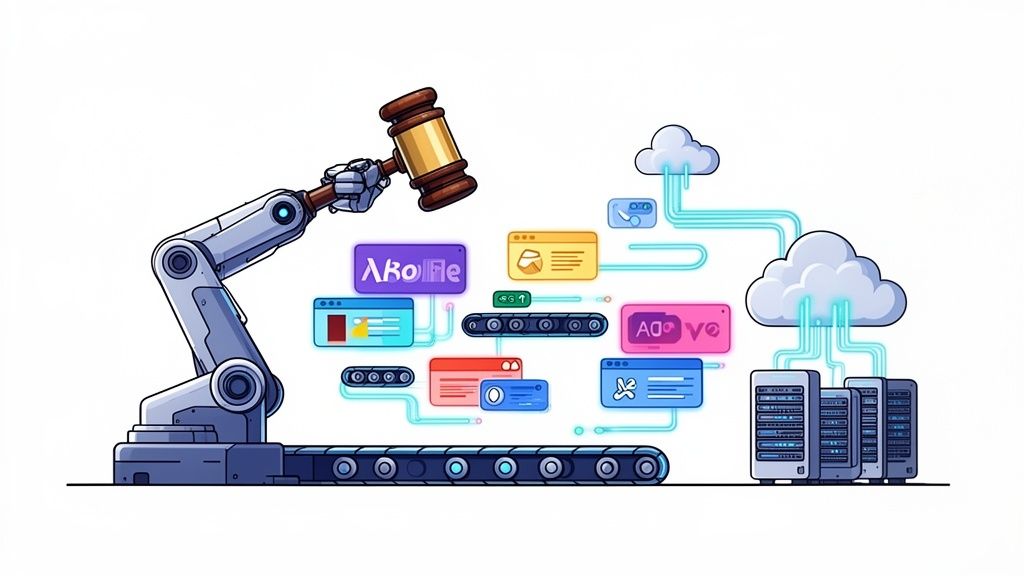
Outsourcing creative services simply means bringing in outside specialists—think freelance graphic designers, video production houses, or expert copywriters—to handle specific creative projects for your business. This isn't just a move for giant corporations anymore. It's a smart, strategic way for businesses of all sizes to tap into top-tier talent, get things done faster, and control costs without the massive overhead of a full-time, in-house creative department.
Why Outsourcing Creative Services Is a Strategic Advantage
Let's think of your business like a film crew. Your director is brilliant, but you wouldn't ask them to also compose the musical score and operate the camera. You'd bring in a specialist for each role to create a masterpiece. The same logic applies to your creative work. A successful brand needs a whole suite of creative assets—from eye-catching social media graphics and compelling video ads to persuasive website copy.
This is where outsourcing creative services shifts from a simple cost-saving tactic to a real strategic advantage.
Instead of stretching your internal team to their breaking point, you can bring in the perfect expert for each specific task. This approach transforms your creative operations from a potential bottleneck into a powerful engine for growth. It’s all about becoming more agile, accessing specialized skills exactly when you need them, and letting your core team focus on what they do best: steering the ship and driving your brand’s vision.
Access a Global Pool of Specialized Talent
One of the biggest wins is gaining instant access to a massive, worldwide talent pool. Need an animator who excels in a niche 3D style? Or a writer who knows the ins and outs of the fintech industry? Finding, hiring, and onboarding that person full-time is a long and expensive journey.
Outsourcing plugs you directly into a network of these experts. You can build a "dream team" for any project without the burden of long-term commitments, which is a game-changer for complex or one-off projects that demand skills your team just doesn't have.
Accelerate Your Speed to Market
In today's market, speed is everything. A new product launch, a critical marketing campaign, or a quick response to a competitor's move can't afford to wait weeks for creative assets to be ready.
Outsourcing gives you the firepower to get projects off the ground and out the door—fast. External creative teams are built for efficiency. They have optimized workflows and often work across different time zones, which means your campaigns can launch on schedule and keep your brand in the conversation. That extra speed is a serious competitive edge.
The numbers back this up. The global outsourcing market hit a total contract value of $92.5 billion, and it's estimated that around 80% of businesses worldwide now outsource in some capacity to boost their efficiency. This isn't a fad; it's a fundamental shift in how successful companies operate and scale.
Outsourcing is not about giving up control; it's about gaining capability. By tapping into external expertise, you empower your internal team to focus on high-level strategy and innovation, rather than getting bogged down in production tasks.
This smart division of labor is crucial for scaling a modern business. When you understand how to properly outsource marketing services, you build a more creative, resilient, and adaptable organization ready to take on whatever comes next.
Here’s a quick breakdown of the strategic advantages:
At-a-Glance Benefits of Creative Outsourcing
This table summarizes the core advantages businesses gain when they start outsourcing creative tasks, providing a quick reference for decision-makers.
| Benefit Area | Strategic Advantage |
|---|---|
| Talent & Skills | Instantly access a global network of specialized experts without the cost of hiring. |
| Cost Efficiency | Reduce overhead associated with full-time salaries, benefits, and equipment. |
| Speed & Agility | Launch campaigns and projects faster, allowing your business to react quickly to the market. |
| Focus on Core | Free up your internal team to concentrate on high-level strategy and core business functions. |
| Scalability | Easily scale creative output up or down based on project demands and business needs. |
| Innovation | Gain fresh perspectives and new ideas from outside experts who bring diverse experiences. |
Ultimately, weaving outsourcing into your creative strategy allows you to build a more dynamic and competitive brand without breaking the bank.
Identifying Which Creative Services to Outsource
Figuring out what to hand off and what to keep in-house can feel a bit like a tightrope walk. Get it right, and you fly. Get it wrong, and… well, it can get messy. The secret is knowing the difference between the work that defines your brand and the work that just needs to get done.
A really effective way to draw this line is with the "Core vs. Chore" framework.
Think of your "Core" work as the soul of your brand. These are the big-picture, strategic tasks that only your internal team can really own—things like setting the brand vision, mapping out high-level campaign strategy, or building those critical client relationships. This is your secret sauce.
"Chores," on the other hand, are the necessary but often repetitive, time-sucking, or highly specialized tasks that are perfect candidates for an external partner. Outsourcing these frees up your team to double down on the core mission, which is where the real magic of outsourcing happens.
Performing a Creative Self-Audit
To separate your core from your chores, you need to take a good, hard look at your team's current creative workload. A quick internal audit will shine a spotlight on the best tasks to delegate first.
Just ask yourself and your team a few straightforward questions:
- Is this a one-off project or a continuous need? Big, one-time projects like a full website redesign or creating a new animated explainer video are ideal for outsourcing. You get top-tier expertise without having to hire someone full-time for a skill you only need temporarily.
- Does this task demand a niche skill we just don't have? Let's be honest, not everyone is a master of 3D modeling, video production, or dense technical copywriting. It's almost always faster and more cost-effective to bring in an expert than to try and train a generalist on your team.
- Is the workload for this task all over the place? If you need a flood of social media graphics for a product launch but then things go quiet for weeks, an outside partner gives you the power to scale up or down instantly. No more paying for downtime.
- Is this task eating up hours with little strategic return? Think about all the time spent on repetitive work like resizing dozens of ad creatives or editing raw podcast audio. These are classic "chores" that can seriously bog down your most valuable people.
Answering these questions honestly creates a clear roadmap. You'll know exactly where to start to get the biggest, quickest wins for your team's bandwidth and focus.
Key Takeaway: The point isn't to offload your most critical work. It's about strategically delegating the tasks that keep your team from focusing on what actually moves the needle, allowing them to operate at a much higher, more strategic level.
This decision tree gives you a great visual for how this choice plays out.
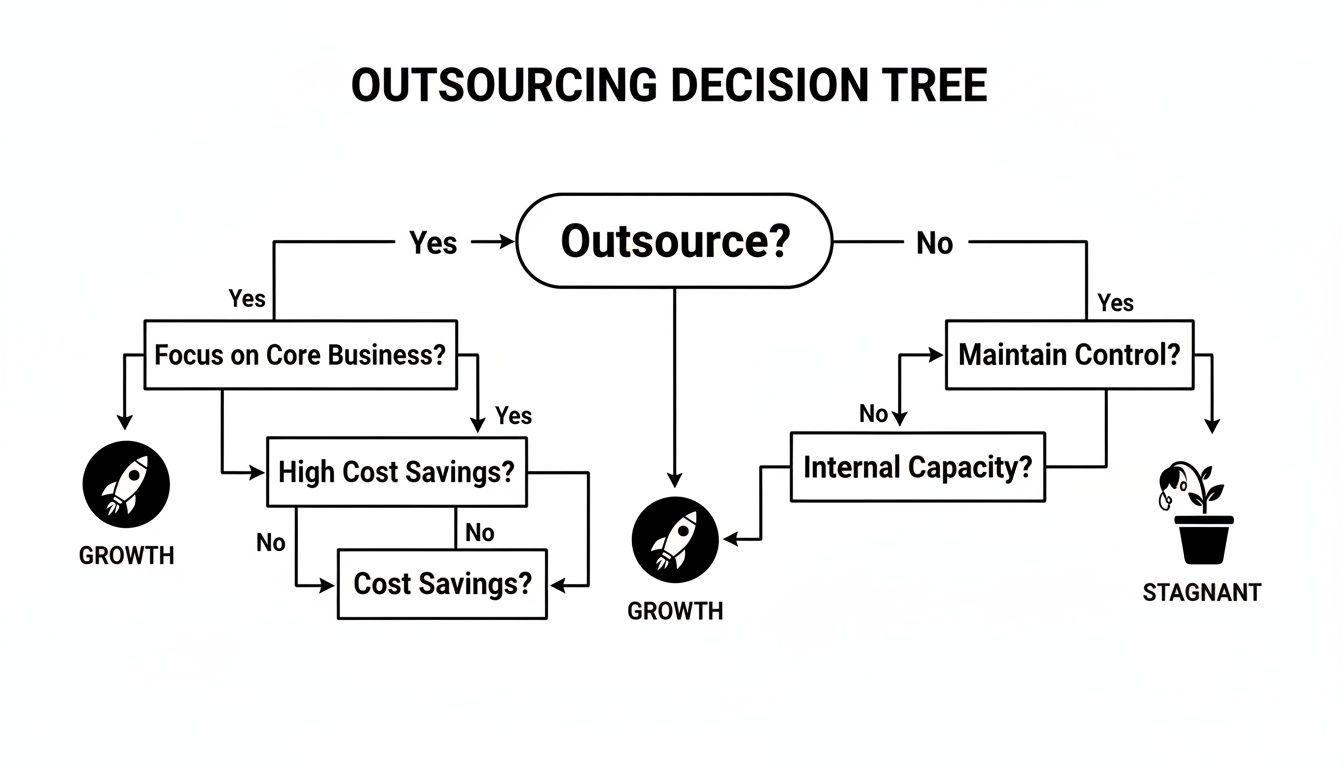
As you can see, making a smart choice to outsource can put your business on the fast track to growth, while trying to do everything yourself can often lead to stagnation.
Common Starting Points for Outsourcing
After your audit, a few clear candidates for outsourcing will probably jump out at you. Most businesses find their footing and get some early wins by starting with one of these common creative needs.
Here are a few of the most frequently outsourced creative services:
- High-Volume Graphic Design: This covers the daily grind of creating social media posts, blog headers, and endless variations of digital ads. Outsourcing ensures you always have a steady stream of fresh content without completely burning out your in-house team.
- Video Production and Editing: Everyone knows video works, but it's a beast to produce. Specifically, exploring video editing outsourcing can dramatically elevate the quality and slash turnaround times for everything from customer testimonials to slick promotional shorts.
- Specialized Content Creation: This bucket includes any content that requires deep, specific expertise. Think of things like technical whitepapers, data-heavy infographics, or industry-specific case studies where a subject matter expert makes all the difference.
- Presentation Design: Turning a bunch of data and ideas into a compelling, professional slide deck is a true art form. A great external partner can build powerful presentations for sales pitches, investor updates, or webinars that actually keep people engaged.
Starting with one of these well-defined areas is a smart move. It allows you to build a solid partnership and a smooth workflow before you start thinking about expanding your outsourcing efforts to other creative operations.
The Real Pros and Cons of Outsourcing Creative Work
Thinking about outsourcing your creative work? It's a big move, and it’s way more than just handing off tasks to someone else. This is a strategic decision that can either unlock incredible growth or create massive headaches. Let's get real about what you can expect—the good, the bad, and the things nobody tells you about.
The upsides are often bigger than you'd guess. We're not just talking about saving a bit of cash. Outsourcing opens up a world of specialized talent, breathes new life into tired campaigns, and helps you get your ideas out the door so much faster.
But you have to go in with your eyes open. Juggling time zones, making sure a new team actually gets your brand, and protecting your confidential ideas are real challenges. If you don't have a plan, things can go south quickly.
The Clear Advantages of Outsourcing
When you get it right, outsourcing feels like a superpower. It lets you go toe-to-toe with the big players without needing their massive budgets.
The biggest win? Instant access to world-class, specialized talent. Maybe you need a motion graphics whiz for a single project, or a copywriter who knows the ins and outs of a super-niche industry. Hiring these folks full-time is often a non-starter—it’s just too expensive and impractical. Outsourcing lets you tap into A-list talent for exactly what you need, when you need it.
This isn't a niche strategy anymore; it's how modern business gets done. Over 50% of U.S. companies now outsource key marketing functions like content strategy and social media to bring in these expert skills. And with 63% of organizations recently bumping up their outsourcing budgets, it’s obvious this is a proven path to getting more done. You can explore more about these outsourcing trends to see just how common this approach is.
Beyond raw talent, outsourcing gives you incredible flexibility. Your creative needs aren't static—they spike during a product launch and dip in quieter months. An external partner lets you scale your creative horsepower up or down on a dime, without the drama of layoffs or the cost of paying a team to sit on their hands. That kind of agility is a serious competitive edge.
Potential Pitfalls and How to Navigate Them
Of course, it’s not all sunshine and rainbows. Giving an outside team the keys to your brand's creative kingdom comes with risks you absolutely have to manage. Ignoring these potential traps is how promising partnerships fall apart, leaving everyone frustrated.
Here are the most common hurdles you'll face:
- Brand Inconsistency: An external team won’t absorb your brand’s voice and vibe by osmosis. Without a rock-solid onboarding process and a crystal-clear brand style guide, their work can feel generic or completely off-key, which can seriously damage your marketing efforts.
- Communication Gaps: Trying to collaborate across different time zones, cultures, and communication styles is a recipe for misunderstanding. A simple request can get lost in translation if you haven't set up clear channels and a single point of contact.
- Intellectual Property Risks: You're sharing sensitive project details and company secrets with a third party. This always carries a risk. You absolutely must have strong contracts, non-disclosure agreements (NDAs), and "work for hire" clauses locked down to ensure you own every single asset they create for you.
A Cautionary Tale: I once saw a tech startup outsource its big launch video to a freelancer halfway around the world. The brief was vague, communication was spotty, and the final video completely missed the point of the product. All the back-and-forth on revisions ended up delaying the launch, costing them crucial momentum and a lot of money.
That story gets to the heart of it: the success of outsourcing has less to do with the vendor you pick and everything to do with the systems you build to manage the relationship. Proactive communication, thorough documentation, and crystal-clear expectations are your best defense. If you plan for these challenges, you can build a partnership that consistently delivers fantastic work.
How to Choose the Right Creative Partner
Finding the right outsourcing partner is a lot like hiring a key employee—the diligence you put in upfront pays off big time later. You aren't just buying a logo or a video; you're investing in a relationship. The goal is to find a partner who feels like a natural extension of your team, someone who not only executes tasks but genuinely gets your strategy and actively contributes to it.
Choosing the right creative team demands a methodical approach that goes well beyond a quick glance at their polished portfolio. A slick presentation can easily hide a clunky workflow or terrible communication skills. Your vetting process needs to test for both their technical chops and the softer skills that make or break a great partnership.

Start with a Crystal-Clear Creative Brief
Before you even think about searching, you have to know exactly what you're looking for. A detailed creative brief is your most powerful tool here. It forces you to get crystal clear on your objectives, target audience, key messages, and what success looks like, making sure everyone is on the same page from day one.
Think of your brief as the North Star for potential partners. It gives them the context they need to put together an accurate proposal and show you their most relevant work. A vague brief only leads to vague proposals and, almost always, disappointing results. To really nail this, understanding processes like Mastering the Request for Proposal (RFP) process can make your selection smoother and lead to much better outcomes.
Look Beyond the Portfolio
A stunning portfolio is a great start, but it really only tells part of the story. You need to dig deeper to see how a potential partner actually thinks and solves problems. When you're reviewing their work, ask specific questions that pull back the curtain on their process.
- "What was the biggest challenge on this project, and how did you solve it?" This gets right to their problem-solving skills and resilience.
- "What were the business results of this creative work?" This reveals if they connect their creative output to real business goals like generating leads or boosting conversions.
- "Can you walk me through your typical feedback and revision process?" This tells you everything about how they collaborate and handle constructive criticism.
Their answers will quickly show you whether they are strategic thinkers or just order-takers. For a deeper dive on this, our guide on how to choose a marketing agency offers more great questions and frameworks to use.
Assess Soft Skills and Cultural Fit
Technical talent is table stakes, but it's the soft skills that make a partnership truly work. Things like communication, proactivity, and cultural alignment are just as crucial as a great design eye or sharp writing. Pay close attention to how they interact with you in those first few conversations.
Do they ask smart, insightful questions about your business? Are they responsive and clear communicators? Do they seem genuinely invested in your success? A partner who is proactive and easy to work with will save you countless hours and headaches down the line.
The global nature of outsourcing adds another layer. The U.S. leads with $213.57 billion in outsourcing spending, but there are incredible opportunities everywhere. For example, India’s $121 billion industry is a global powerhouse, while China's services sector adds a million employees yearly, highlighting the massive scale of available talent. Knowing these dynamics can help you find partners that fit both your budget and your workflow.
Run a Paid Trial Project
Honestly, the single best way to test chemistry and capability is to start with a small, paid trial project. This is your chance to see them in action in a real-world scenario before you lock into a long-term contract. A trial could be as simple as designing one social media graphic, writing a single blog post, or editing a short video clip.
This "test drive" is invaluable. It shifts the evaluation from talk to action, showing you their real workflow, communication style, and ability to deliver on-brand work against a deadline.
This small investment upfront can save you from a costly mismatch later, ensuring you land a creative partner who truly clicks with your team and helps you hit your goals.
Building a Seamless Creative Workflow Together
Alright, you’ve picked your creative partner. Now the real work starts. The success of outsourcing isn't just about finding top-tier talent; it's about building the systems that let that talent shine. A clunky, disorganized process will sabotage even the best designer or copywriter. The goal here is to create a workflow so smooth that your external team feels like they’re just down the hall.
Think of it as building a bridge between your company and your new partner. A sturdy bridge needs a solid foundation and clear, well-marked lanes. For this partnership, that foundation rests on three non-negotiable pillars: a rock-solid brand guide, a predictable communication cadence, and shared project management tools. Skipping these steps is a classic mistake that almost always leads to inconsistent work and painful, endless revisions.
Establishing Your Brand's North Star
Your brand style guide is, without a doubt, the single most important document you’ll hand over. It’s the North Star that keeps every single deliverable—from a quick social media graphic to a major ad campaign—feeling like it came from your brand. A vague or incomplete guide is a recipe for disaster.
A good guide is so much more than just your logo and color palette. To really set your creative partner up for success, it needs to cover:
- Voice and Tone: Show, don't just tell. Include real examples of how your brand talks. Are you witty and informal? Authoritative and academic?
- Visual Identity: Go deep on logo usage, typography, color codes (HEX, RGB, CMYK), and the style of imagery you use. You absolutely need a "do's and don'ts" section to prevent common mistakes.
- Audience Personas: Give them a snapshot of who they're creating for. This context is what turns a good design into a resonant one.
A detailed guide takes the guesswork out of the equation. It empowers your partner to hit the ground running and makes the whole process smoother for everyone.
Designing Your Communication and Project Management Rhythm
Clear communication and transparent project tracking are the lifeblood of any good remote partnership. Without a defined system, requests vanish into the ether, deadlines get missed, and frustration starts to build on both sides.
First things first: assign a single designated point of contact on your team. This person is the main liaison, channeling all feedback and requests to prevent the chaos of mixed signals from multiple stakeholders. Next, lock in a regular check-in schedule. This could be a quick daily stand-up on Slack or a more in-depth weekly video call to review progress and look at the week ahead.
Key Insight: The best workflows aren't rigid; they are consistent. A predictable rhythm for communication and feedback builds trust and allows your outsourced team to work proactively, anticipating your needs instead of just reacting to last-minute requests.
To keep everyone on the same page, you need a shared project management tool like Asana, Trello, or Monday.com. This creates a single source of truth where both teams can see project statuses, deadlines, and feedback in real time. This kind of visibility is the cornerstone of effective creative operations management and ensures everyone is pulling in the same direction.
Crafting an Effective Onboarding Process
The first two weeks with your new partner are critical. A thoughtful onboarding process sets the tone for the entire relationship. Don't just fire off a brief in an email and hope for the best. A structured onboarding gets them fully integrated into your world so they can start delivering great work, fast.
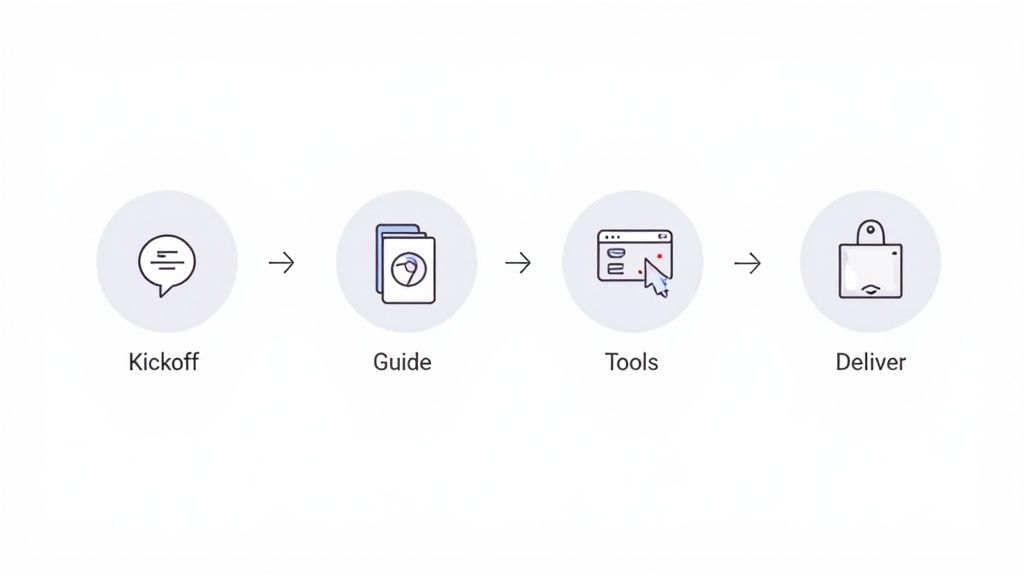
A solid onboarding plan usually follows a simple path:
- The Kickoff Call: Get on a video call to introduce the key players, walk them through the brand guide, and talk through the first project.
- Tool Integration: Make sure they have access to everything they need—the project management board, Slack or Teams channels, and any digital asset libraries.
- The First Project: Start with a smaller, well-defined task. This is a great way to test out the workflow and feedback loop in a low-stakes environment.
By investing a little time upfront to build a robust workflow and a proper onboarding, you turn what could be a simple vendor relationship into a true creative partnership. This proactive approach helps you sidestep the common pitfalls and creates a collaborative space where great work can actually happen.
Measuring the ROI of Your Outsourced Creative Team
So, you’ve outsourced your creative work. How do you actually know if the investment is paying off? If you’re only looking at surface-level metrics like “likes” or “shares,” you’re missing the real story. Measuring the return on investment (ROI) isn’t just about justifying an expense line on a spreadsheet; it’s about building a smart, data-driven partnership that gets better over time.
The only way to do this right is to connect the creative work directly to your business goals. You need to set up Key Performance Indicators (KPIs) that are tailor-made for the specific work you’re getting. A gorgeous social media graphic is one thing, but a graphic that drives a 15% higher click-through rate to your product page? That's a tangible win.
This really requires a shift in thinking. You have to move past asking, "Did we get the assets on time?" and start asking, "How did these assets actually perform?"
Linking Creative Output to Business Goals
To measure success, every creative request needs to be tied to a specific, trackable outcome. The KPIs you watch will change dramatically depending on what you're outsourcing. Before you even start a project, ask yourself: what do I want someone to do after they see this?
Here’s how that looks in practice for a few common services:
- For Social Media Graphics:
- Engagement Rate: Are people commenting, sharing, and saving the post?
- Click-Through Rate (CTR): What percentage of people are clicking the link in your post?
- Conversion Rate: Of those who clicked, how many completed an action like signing up or making a purchase?
- For Blog Content and SEO:
- Organic Traffic Growth: Are more people finding these specific articles through search engines?
- Keyword Rankings: Is your position on Google improving for the keywords you care about?
- Leads Generated: How many new contacts did you get from forms or calls-to-action within the content?
When you track these kinds of numbers, your feedback sessions with your creative partner become much more productive. The conversation shifts from a subjective "I like this design" to an objective "This design style boosted our landing page conversions by 8%."
Looking Beyond the Numbers
While hard data is king, don't forget about the qualitative wins that come from outsourcing creative services. These benefits are a little trickier to put a number on, but they have a massive impact on your team’s performance and your business as a whole.
A major, often-missed ROI component is the value of reclaimed internal time. If outsourcing saves your marketing manager ten hours a week, that's ten extra hours they can dedicate to high-level strategy, team development, or customer research.
Think about these less-obvious returns:
- Increased Team Capacity: What bigger projects can your in-house team finally tackle now that they aren't buried in production work?
- Improved Sales Enablement: Is the sales team telling you the new brochures or slide decks are helping them close deals faster?
- Enhanced Brand Perception: Have you noticed more positive comments or mentions about your brand’s look and feel online?
A simple performance dashboard that tracks both your hard KPIs and this kind of qualitative feedback is a game-changer. Review it regularly with your creative partner to build accountability and make sure your collaboration is always pushing toward real, valuable results.
Got Questions About Outsourcing Creative Work?
Even when you're sold on the idea, taking the plunge into outsourcing creative services can feel a little daunting. A few practical questions always seem to pop up. Let's tackle those head-on so you can move forward with confidence and know exactly what to expect.
Here are the three big ones that almost everyone asks before they get started.
How Much Does It Cost to Outsource Creative Services?
This is always the first question, and the honest-to-goodness answer is: it depends. The cost can swing wildly based on what you need, who you hire, and how you structure the deal. For instance, a freelance graphic designer might charge anywhere from $25 to $150 an hour, while a full-service agency could command a monthly retainer of $3,000 to $10,000 or more.
You'll generally run into three common ways to pay for creative work:
- Hourly Rates: This works well when the project scope is a bit fuzzy or you just need quick help here and there.
- Per-Project Fees: Perfect for clear, one-and-done projects like building a new website or creating an animated video.
- Monthly Retainers: The best option for consistent, ongoing needs, like managing your social media graphics or designing blog posts every week.
Just remember, the cheapest option is rarely the best value. A low-cost provider who's still learning the ropes can end up costing you more in time, frustration, and endless rounds of revisions.
How Do I Protect My Intellectual Property?
It's completely normal to feel a bit nervous about handing over your business's secret sauce. The good news is that protecting your intellectual property (IP) is straightforward with the right legal paperwork in place. This is a non-negotiable step that has to happen before a single file is exchanged.
Think of your contract as your fortress. It needs a clear clause stating that all work produced is "work for hire." This means that once you pay for it, your company owns every bit of the intellectual property. This little phrase is your single most powerful safeguard.
On top of that, always have your creative partner sign a Non-Disclosure Agreement (NDA) before you dive into the confidential details. Sticking with reputable agencies and freelancers who have a solid track record gives you an extra layer of security and helps you sleep better at night.
Can an Outsourced Team Really Understand Our Brand?
Absolutely—but it won't happen by accident. An external team can't just psychically absorb your company's vibe and voice. It takes a deliberate and thoughtful onboarding process from your end to make it work.
Start by handing them a detailed brand style guide covering everything from your mission and tone of voice to your color palette and customer profiles. Then, the crucial part: schedule a real kickoff meeting to walk them through it, share the "why" behind your brand, and let them ask questions.
The trick is to treat them like an extension of your own team, not just a faceless vendor you send tasks to. Ongoing communication, open feedback, and a real dialogue are what will allow an outsourced team to truly get your brand and champion it authentically.
At ReachLabs.ai, we don't just work for you; we work with you. We embed our creative team into your workflow to become a seamless extension of your company, driving results that truly move the needle. See how we can elevate your brand by visiting our site at https://www.reachlabs.ai.