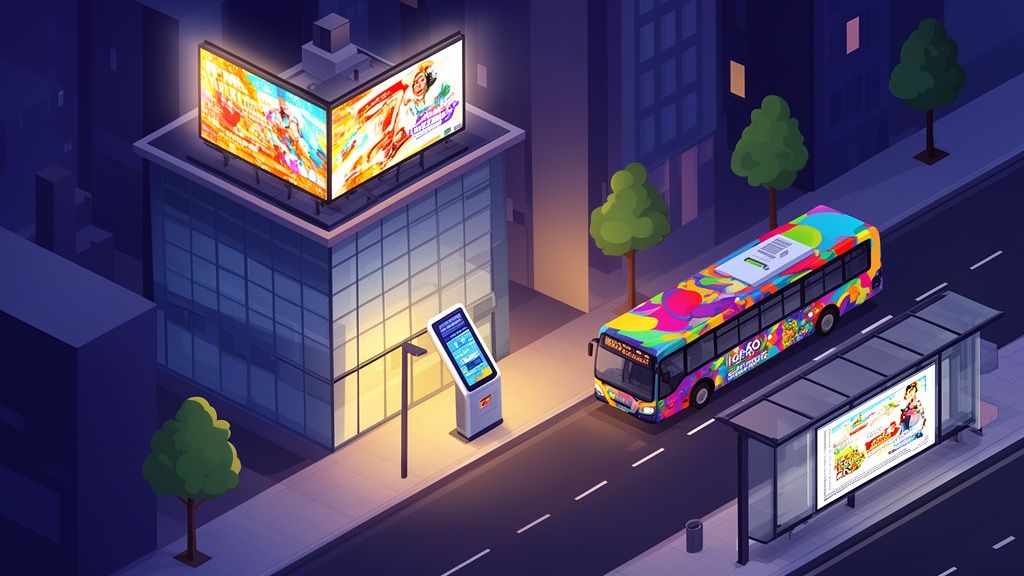
Out of home placements are, quite simply, any ads you see once you step outside your front door. It’s a huge category, covering everything from the classic roadside billboards we all know to vibrant digital screens in airports, ads wrapped around city buses, and even interactive kiosks you might tap on at the mall.
If an advertisement exists in the physical world where people live, work, and play, it's considered an out of home placement.
Why OOH Matters in a World Drowning in Digital Ads
Ever wish you could run an ad campaign that people couldn't skip, block, or fast-forward? That's the unique power of out of home (OOH) advertising. In a time when we’re all a bit tired of endless pop-ups and intrusive online ads, OOH offers a break from the digital noise.
Think of it as the city’s own art gallery, funded by brands. It’s woven into the fabric of our daily lives, creating a shared experience that’s impossible to ignore. A stunning visual on the side of a skyscraper or a clever message on a bus shelter screen becomes part of the public landscape, not an interruption.
The Comeback of a Classic
Far from being a relic of the past, OOH is making a huge comeback. Why? Because it delivers a sense of authenticity and real-world impact that many digital-only campaigns just can't match. And the data proves it. In the second quarter of 2025 alone, OOH ad revenue in the U.S. climbed to $2.86 billion, a 3% jump from the year before.
So, what’s fueling this revival? It boils down to a few key strengths:
- It Feels Real: People tend to trust a physical ad more than a digital one. A billboard feels like a permanent, confident statement, while a pop-up can feel fleeting and sometimes deceptive.
- It’s Unforgettable: Big, bold, and creative OOH ads stick in our minds. Their sheer scale and artistry lead to much higher brand recall.
- It Bridges the Physical and Digital: The best OOH campaigns don't exist in a vacuum. They’re designed to spark action, driving people to search online, post on social media, or visit a brand's website.
The real magic of out of home placements is their physical presence. A brand isn't just interrupting someone's feed; it's becoming a part of their actual day-to-day journey.
OOH's Place in the Marketing Mix
It helps to see where OOH fits in with other channels. TV advertising, for instance, has massive reach but struggles with ad-skippers. For a deeper look at how these two powerful mediums differ, this Billboard vs. TV advertising comparison breaks it down nicely.
Ultimately, the resurgence of out of home placements is happening because they offer something incredibly rare today: a genuine, unblockable moment of connection between a brand and its audience. That's why OOH isn't just an option anymore—it's an essential part of any smart marketing strategy.
A Guide to the Different Types of OOH Advertising
When you think of out-of-home advertising, what probably comes to mind are those giant billboards you see on the side of the highway. While those are definitely a huge part of the OOH world, they're just the beginning. The modern landscape of out of home placements is incredibly diverse, giving brands a whole suite of tools to work with.
Think of it less as a single instrument and more like a full orchestra. You have different sections—from classic, static displays to dynamic digital screens—each with a unique role to play in building a powerful campaign. Getting a handle on this spectrum is the first step to making smart, strategic buys.
At a high level, the world of out-of-home is split into two big families: classic (static) formats and their newer, digital counterparts. To get a sense of the foundational formats, it's helpful to review the different types of outdoor signs for business that make up this channel.
The Unmissable Power of Static Billboards
Static billboards are the tried-and-true workhorses of OOH. These massive printed displays are built for one primary goal: creating enormous brand awareness. Lock down a prime spot on a busy commuter route or in a bustling downtown area, and you guarantee thousands of eyes on your message, day in and day out.
Their real strength is in their unwavering presence. A static ad gives you 100% share of voice on that board, meaning your creative is always visible for the entire flight of the campaign. This constant repetition is fantastic for drilling a brand name or tagline into the public's memory, making it a very effective play for long-term brand building.
This chart shows that basic division between the classic formats and the newer digital ones.

While they both live under the OOH umbrella, their uses and capabilities couldn't be more different.
The Flexible Future: Digital Out of Home (DOOH)
If static billboards offer permanence, Digital Out of Home (DOOH) brings flexibility and intelligence to the table. DOOH simply refers to any ad delivered on a screen, from those massive digital bulletins overlooking Times Square to the small interactive panels in a mall. Instead of a single printed image, these screens can rotate through a loop of different ads and even show full-motion video.
But where DOOH really shines is in its ability to react to the real world in real time. A digital ad's content can be triggered to change based on specific conditions:
- Time of Day: A cafe can run ads for lattes in the morning and switch to herbal tea promotions in the afternoon.
- Weather: A department store could automatically start showing ads for umbrellas the moment it starts to rain.
- Live Data Feeds: An airline can display fluctuating flight prices or a sports network can show live scores.
This ability to be contextually relevant makes DOOH incredibly effective at grabbing attention right when it matters most. It gets even more powerful when you consider how programmatic ad buys enable the automated, data-driven purchasing of these digital ad slots.
Breaking Down the Major OOH Categories
Beyond the static vs. digital split, OOH placements are also grouped by where they exist in the physical world.
- Transit Advertising: This is advertising that moves. We're talking about everything from fully wrapped buses and trains to ad cards inside subway cars and displays in airports. Transit is phenomenal for reaching commuters and travelers repeatedly throughout their journey.
- Street Furniture: These are the displays you see at eye level, woven directly into the city's fabric. Think bus shelters, newsstands, and phone kiosks. They're perfect for targeting pedestrians in specific city blocks and driving foot traffic to local storefronts.
- Place-Based Media: This is all about targeting a captive audience based on their location and mindset. Ads inside gyms, movie theaters, shopping centers, and even bars allow brands to connect with people during moments that are highly relevant to what they're selling.
Deciding on the right format isn't just about budget; it's a strategic choice. A massive highway billboard is for building long-term brand memory. An interactive kiosk in a shopping mall is for triggering an immediate purchase. The best campaigns often mix and match these out of home placements to guide a customer all the way from initial awareness to final action.
How to Plan a High-Impact OOH Campaign
Putting together a truly effective out of home campaign is more art than science, but it’s an art backed by a ton of data. It’s not about just getting seen; it’s about being seen by the right people, in the right place, at a moment when your message can actually sink in. Forget just "getting your name out there." A high-impact campaign starts with a sharp, specific goal.
Are you trying to pull people into a new store? Get them to download your app? Let them know about a flash sale? Your objective dictates everything that comes next. A goal like, "Boost foot traffic at our downtown location by 15%," gives you a clear target to aim for and a benchmark for success.
Using Data to Pinpoint Your Placements
Anyone who still thinks OOH is a "spray and pray" medium is stuck in the past. These days, planning is all about precision. We have access to incredible data that shows us exactly where your audience is and where they're going, letting us place ads along their natural path.
We do this by layering several types of information:
- Mobile Location Data: We can see, through anonymized data, the real-world journeys people take—where they live, work, shop, and hang out.
- Demographic Insights: This helps us find neighborhoods or districts with a high concentration of your ideal customers, whether it’s young professionals, families, or high-income households.
- Traffic and Transit Patterns: Good old-fashioned traffic counts and public transit data show us the busiest roads, intersections, and commuter hubs, guaranteeing more eyeballs on your ad.
When you weave these data sets together, you essentially create a "heat map" of your audience's daily life. It allows you to move from guessing where your ads should be to knowing where they’ll intersect with the people who matter most.
Demystifying OOH Pricing Models
To get the most out of your budget, you need to understand how OOH advertising is actually priced. The cost can swing wildly depending on the location, the ad format, and even the time of year. It’s not a simple rate card.
The money flowing into the industry tells the story. The global out-of-home market is on track to hit $41.82 billion by 2025, and a huge part of that is the explosive growth of digital OOH (DOOH), which is expected to expand by 8.44% to $22 billion. With North America making up 40% of the entire market and projected to grow another 6.3% in 2025, it's clear advertisers are seeing major value here. You can dig into the specifics in these 2025 OOH advertising trends.
Key Takeaway: OOH pricing isn't a single flat rate. It’s a dynamic system influenced by the value of the audience you are trying to reach in a specific location and at a particular time.
Here are the main ways you'll see OOH sold:
- Cost Per Mille (CPM): This is the classic advertising metric: the cost for every thousand people who are estimated to see your ad. It’s a great way to compare the relative cost of different placements.
- Location-Based Cost: This one’s pretty straightforward. A billboard in Times Square costs a fortune because of its iconic status and massive foot traffic. A sign on a quiet country road does not. You pay for the prestige and the eyeballs.
- Share of Voice (SOV): This applies to digital screens that rotate through multiple ads. You buy a percentage of the ad loop. If you buy a 10% SOV, your ad will appear 10% of the time.
- Flat Fee: For static formats like a traditional billboard or a bus wrap, you’ll typically pay a single rental fee for a set amount of time, like four weeks or a full quarter.
Getting a handle on these models is the first step toward building a plan that’s both effective and efficient. It gives you the power to negotiate better deals and make sure every dollar you spend is working to hit your goals.
Measuring the ROI of Your OOH Placements
For years, the biggest question plaguing out of home advertising was simple but maddeningly difficult to answer: "Is it actually working?" Marketers knew their billboard was getting eyeballs, but proving it drove sales felt like trying to count raindrops in a storm.
Thankfully, the days of relying on rough traffic counts and gut feelings are long gone. Modern measurement tools have transformed OOH from a fuzzy brand-awareness play into a performance-driven channel. We can now connect the dots between someone seeing an ad in the physical world and taking a valuable action, a shift that's crucial for justifying your budget and sharpening future campaigns.
The secret to this evolution is the smartphone that’s in nearly every pocket. By using anonymized, aggregated mobile location data, we can finally see the customer journey in a whole new light.
Mobile Attribution and Foot Traffic Studies
The most direct way to measure an out of home placement's impact is to see what people do right after being exposed to it. This is where mobile attribution comes in. The process works by identifying mobile devices that were near your OOH ad and comparing their behavior to a control group that wasn't exposed.
This approach lets us answer the critical ROI questions:
- Foot Traffic Lift: Did people who saw your bus shelter ad actually walk into your store? Attribution studies can show a direct, measurable lift in store visits from the exposed audience.
- App Installs: A campaign for a new mobile game running on digital screens in a mall can be directly linked to a spike in app downloads from devices that were in that location.
- Website Visits: We can measure the increase in traffic to your website coming from the specific geographic areas where your ads are live.
Think of your billboard as a powerful signal. Mobile attribution is the receiver that picks up the audience's response, giving you the concrete evidence needed to prove your OOH spend is driving real-world results.
Tracking Digital and Brand Lift
The influence of OOH doesn’t just stop with physical actions. A great campaign creates a ripple effect that we can now track online. These "digital echoes" are powerful indicators of both ROI and brand health.
One of the strongest effects is the lift in online search. Data consistently shows that OOH campaigns can drive a 10-50% increase in branded search queries. As more brands recognize this trackable impact, they're shifting their budgets accordingly. With out-of-home advertising forecasted to grow over 5% globally in 2025, a significant 16% of marketers are planning to boost their OOH spend by at least half, moving funds away from channels suffering from digital fatigue. You can dive deeper into these expert predictions for OOH in 2025.
Beyond search, you can also measure:
- Brand Awareness Surveys: By polling audiences in markets with and without your OOH ads, you can measure the direct lift in metrics like brand awareness, ad recall, and purchase intent.
- Social Media Mentions: Track the volume of social chatter and user-generated content tied to your campaign, often identified through a unique hashtag you promote on the ad itself.
Ultimately, calculating the return on your investment is fundamental to any marketing effort. If you need a refresher on the basics, you might find our guide on how to calculate marketing ROI helpful. By combining these modern measurement techniques, you can finally build a complete picture of how your out of home placements contribute directly to your business goals.
Creative Best Practices for Unforgettable OOH Ads

Even the most perfectly chosen out of home placements will completely miss the mark if the creative isn't up to snuff. In the OOH world, you aren’t working with a captive audience. You have just a few fleeting seconds to grab the attention of someone speeding down the highway or rushing through an airport.
This reality has led to what many in the industry call the unofficial "seven-second rule." Your ad’s entire message—the concept, the brand, and the call to action—has to land in seven seconds or less. This isn't the place for subtlety or complex narratives; it demands a creative approach that’s bold, brutally simple, and impossible to ignore.
Think of it as visual shouting, not a quiet conversation. The goal is to sear an idea into someone's mind at a glance, using powerful imagery and just a handful of words to tell a quick, memorable story.
Embrace Simplicity and Contrast
When you're designing for the great outdoors, less is always more. Your creative is literally competing with the world around it—buildings, traffic, trees, and other ads. The only way to win that fight for attention is with a design so clean and focused it cuts through the noise.
Here’s how to make that happen:
- Use Bold, Contrasting Colors: High-contrast pairs like black and yellow or red and white are your best friends. They pop from a distance. Steer clear of soft pastels or nuanced gradients that will wash out in the bright sun or at night.
- Employ Large, Legible Fonts: Pick a clean, bold typeface and make it massive. If someone has to squint to read your message, you’ve already lost.
- Limit Your Word Count: Stick to a single, powerful headline—seven words or fewer is a great rule of thumb. Every extra word you add dramatically decreases the chances it will be read in full.
- Focus on One Striking Visual: A single, dominant image is infinitely more powerful than a busy collage. That one visual should be the hero of your ad, instantly telegraphing your core idea.
An OOH ad should be like a great movie poster. It conveys the entire mood, story, and main character in a single, powerful image that sparks immediate curiosity.
By stripping your creative down to its most essential elements, you give your message the best possible chance of being understood in that brief window of opportunity.
Harness the Power of Context
Beyond solid design, the most brilliant out of home placements feel like they belong right where they are. This is called context-aware creative, and it’s where the ad feels like it was designed for that specific location, at that specific moment.
For instance, a digital billboard can react to real-time data. A coffee shop could push ads for iced coffee as soon as the temperature climbs past 80 degrees. A rideshare service could show messages about dodging traffic jams right as rush hour hits.
This kind of relevance makes an ad feel less like an interruption and more like a smart, helpful piece of information. When your message syncs up with what your audience is actually experiencing—whether it’s the weather, a local festival, or the time of day—it becomes far more memorable and effective.
Integrating OOH with Your Digital Marketing Strategy

The smartest marketers know their out of home placements don't live in a vacuum. A big, bold billboard isn't the end of the story—it’s the beginning. It should act as the first domino, kicking off a whole chain reaction that energizes your entire online presence.
Think of it this way: your OOH ad is the opening hook that grabs mass attention and sparks curiosity. Your digital channels, from social media to search ads, are then perfectly positioned to capture that interest and guide people toward making a purchase. When you get these two playing together, the result is far more powerful than what either could achieve on its own.
And this isn't just theory; the data backs it up. One study revealed that a staggering 74% of mobile users take some kind of action on their phone after seeing a digital OOH ad. That’s a clear signal that a well-placed physical ad is one of the best ways to trigger an immediate digital response.
Building a Bridge from Physical to Digital
The trick is making the jump from the physical ad to your digital world feel completely effortless. You have to give people a simple, obvious next step. Today’s best campaigns use a few clever tactics to close that offline-to-online gap.
Here are a couple of go-to methods:
- QR Codes and NFC Tags: These are your most direct on-ramps. A QR code on a transit ad or an NFC tag embedded in a coffee shop table can instantly take someone to a landing page, an app download, or a special offer. No friction.
- Unique Hashtags or URLs: A catchy, campaign-specific hashtag does more than just drive traffic; it encourages people to share on social media, turning your audience into an army of advocates. A short, memorable URL is also great for billboards, as drivers can easily recall it later.
By creating these direct paths, you’re turning a passive glance into an active, valuable interaction.
Amplifying Your Reach with Geofencing and Retargeting
This is where things get really interesting. Instead of just hoping people who saw your billboard will remember to search for you, you can now proactively reach them online. The technology that makes this happen is called Geofencing.
By drawing a virtual perimeter around your out of home placements, you can identify the mobile devices that passed through that area. This gives you the power to retarget the exact same people who saw your physical ad with perfectly timed digital ads. So, that person who walked past your digital kiosk at the mall could see a follow-up ad in their Instagram feed that very evening.
This strategy creates a powerful echo. The billboard plants the seed of awareness, and the targeted mobile ad reminds them of your brand, keeping you top-of-mind and nudging them further down the path to purchase.
Getting this synergy right is what separates a good campaign from a great one. To learn more about tying all your channels into a cohesive plan, take a look at our guide on creating an integrated marketing strategy. When you make your OOH and digital efforts work hand-in-hand, you don't just boost performance—you maximize the impact of every single dollar you spend.
Common Questions About Out of Home Placements
Diving into the world of out-of-home advertising can bring up a lot of questions, especially if it’s your first time. That's perfectly normal. Let’s walk through some of the most common ones we hear so you can plan your next campaign with confidence.
Is OOH Advertising Too Expensive for Small Businesses?
This is probably the biggest myth we have to bust. When people think of OOH, they often picture a massive, glittering billboard in Times Square—and yes, that costs a fortune. But that’s just one tiny, high-end slice of the pie. The reality is that OOH offers a huge range of affordable and effective options for businesses of any size.
The key is to think locally and strategically. You don't need a national budget to make a local impact.
- Place-Based Ads: Think about where your customers already are. You can run ads on digital screens in local gyms, bars, waiting rooms, or shopping centers your audience frequents.
- Street Furniture: You can own a whole neighborhood with ads on bus shelters or information kiosks. It’s a fantastic way to build brand presence and drive foot traffic right to your door.
- Programmatic DOOH: This is a game-changer for flexible budgets. Instead of a long-term contract, you can buy specific ad impressions on digital screens, targeting only the most effective times of day or days of the week.
How Does Programmatic DOOH Differ From Traditional OOH Buying?
Think of it like this: traditional OOH is like leasing an apartment for a full year, while programmatic is like booking a hotel room only for the nights you actually need it. With a traditional buy, you’re typically signing a longer-term contract for a single, static placement. This gives you 100% share of voice on that specific sign for the entire duration.
Programmatic Digital Out of Home (pDOOH) is a smarter, more flexible way to buy ads on digital screens using automated technology. It’s about buying an audience in a specific moment, not just renting a physical space.
Instead of just paying for a board, you're paying for moments. You can set your ads to trigger based on real-time data—like running a promotion for cold drinks when the weather gets hot, showing ads for rideshares when flights are delayed at an airport, or even reacting to the score of a live sports game. This makes every dollar you spend work harder by delivering a far more relevant message.
What Are the First Steps to Launching an OOH Campaign?
Getting your first out of home placements off the ground might seem like a huge task, but it’s really just a series of manageable steps. A clear process is the best way to make sure your campaign is strategic from the start.
- Define a Clear Goal: What result are you actually after? Is it to increase foot traffic to your new store by 15%? Is it to make your brand a household name in a specific zip code? A specific goal is a measurable one.
- Identify Your Audience and Their Journey: Get into the mindset of your ideal customer. Where do they live, work, and hang out? Use data and simple observation to map out their daily routines and physical paths.
- Research Available Inventory: Start exploring what's out there. You can browse media owner websites or, even better, partner with a specialist agency that knows the local inventory inside and out.
- Develop Simple, Bold Creative: You’ve got about seven seconds to make an impression, so clarity is everything. Your message needs to be understood with a quick glance. Think big fonts, a clear image, and a simple call to action.
- Establish Your Measurement Plan: Before you launch, decide how you'll know if it worked. Will you track a unique promo code? Monitor for a lift in website traffic from the campaign area? Or will you run a formal foot traffic study?
Ready to integrate high-impact out of home placements into your marketing strategy? ReachLabs.ai combines data-driven insights with world-class creative to build campaigns that get noticed and drive real results. Let's build your next campaign together.