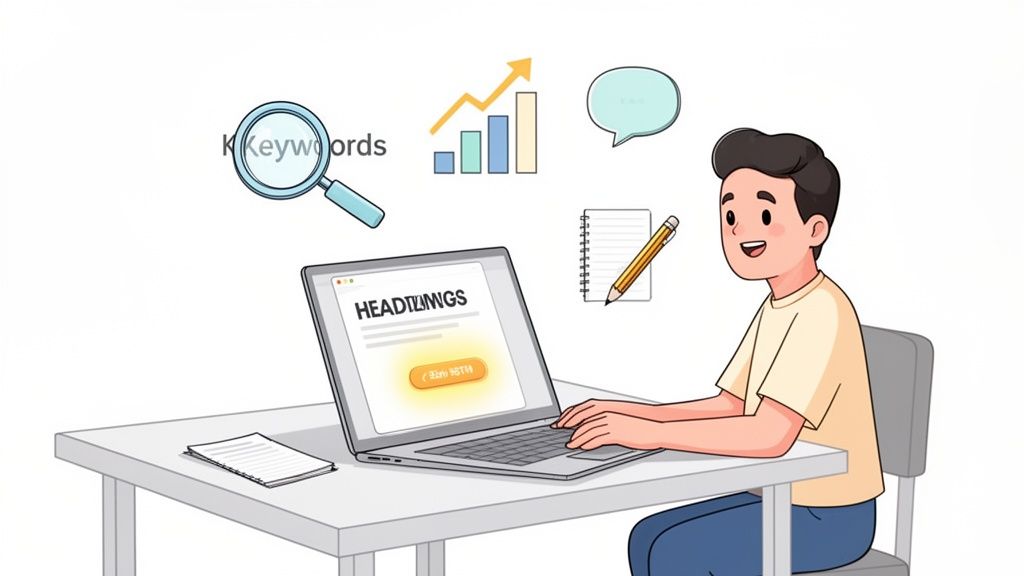
Writing for the web is so much more than just filling a blank page. To create content that actually moves the needle—driving traffic and winning customers—you have to get the foundation right. This means digging into who your audience really is and what they’re typing into Google long before you write a single headline.
Frankly, this upfront work is what separates content that vanishes into the digital ether from content that becomes a real business asset.
Laying the Groundwork with Audience and Keyword Insights
Before you even think about drafting, you need to roll up your sleeves and do some research. Amazing web content isn't a fluke; it's the result of a solid strategy built on two pillars: a deep understanding of your audience and a smart keyword plan. Getting this phase right dictates the success of everything that follows.
The content marketing world has exploded for a reason. Back in 2018, the global market was valued at a respectable $36.8 billion. Fast forward to 2022, and that number rocketed to $413.3 billion. With a staggering 82% of companies now actively using content marketing, the competition is no joke. To cut through the noise, your content has to be perfectly aligned with your business goals and, more importantly, your audience's needs.
Deeply Understanding Your Audience
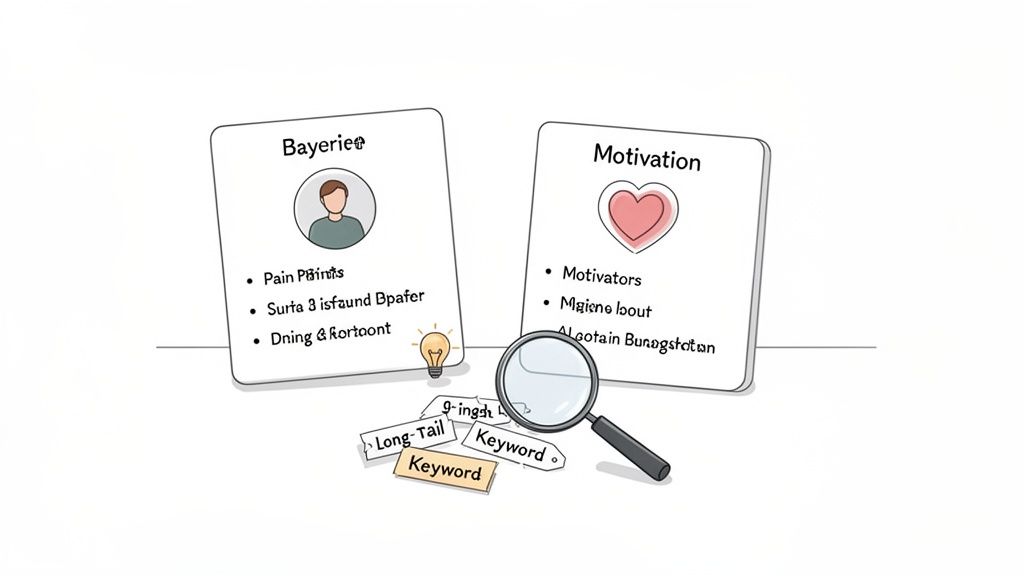
To write something that truly connects, you have to know exactly who you're talking to. I’m not talking about vague demographics like "millennials living in the city." You need to build out detailed buyer personas that capture the real-life pain points, goals, and motivations of your ideal reader.
Think about it this way: are you writing for a generic "marketing professional," or are you writing for "Jenna," a 34-year-old marketing director who's under pressure to prove her team's ROI and is desperately searching for a better way to track campaign performance? Writing for Jenna allows you to create content that speaks directly to her problems and offers a real solution. It feels personal because it is personal.
So, how do you get these kinds of insights?
- Talk to Your Customers: Hop on a call with a few of your best clients. Ask them what their biggest challenges were before they found you and what made them choose you over a competitor.
- Spy on Your Competitors (Ethically!): Check out the top-ranking articles for your target topics. The comment sections are often a goldmine of unanswered questions and raw, honest feedback from your target audience.
- Survey Your Email List: A quick, simple survey can reveal what your subscribers are struggling with and what content they’d love to see from you.
For a more structured approach, our guide on how to create buyer personas breaks down the entire process step-by-step. This work ensures your content isn't just seen, but actually felt.
Key Takeaway: The goal here isn't just to describe your audience—it's to develop genuine empathy for them. Once you understand their world, you can create content that they'll see as an indispensable resource.
This whole foundational process—from persona to keywords—is what sets you up for success.
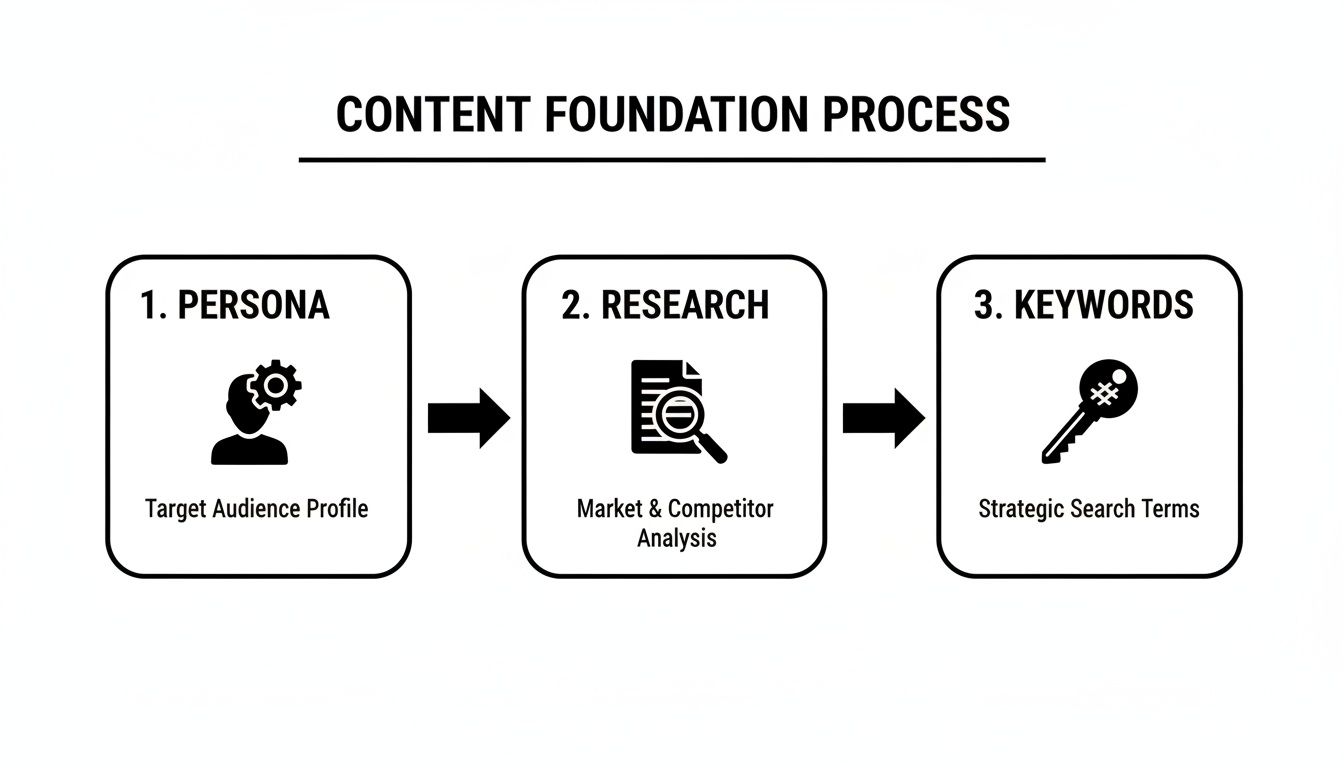
As you can see, a crystal-clear audience persona is the non-negotiable starting point that informs every other strategic move you make.
Uncovering High-Intent Keywords
Once you know who you're writing for, it's time to figure out what they're searching for. Keyword research isn't about finding phrases to cram into your article. It’s about decoding the intent behind the search. This is the secret to attracting traffic that actually converts.
Search intent generally falls into one of three buckets:
- Informational: The user wants to learn something (e.g., "how to write web content").
- Transactional: The user is ready to buy or take action (e.g., "hire content writer").
- Navigational: The user is trying to find a specific site (e.g., "Outrank blog").
Your sweet spot is often targeting high-intent, long-tail keywords. These are longer, more specific phrases that show a user is much further along in their journey. For instance, instead of going after the broad term "web content," you'd be much better off targeting "how to write web content for a small business website."
That level of specificity means your content can provide a direct, satisfying answer to their query. When you do that, you're not just more likely to rank—you're more likely to earn a new customer. By grouping these related keywords into thematic clusters, you'll start building topical authority, which is a powerful signal to Google that you're an expert in your field.
Crafting Content Structures That Readers and Google Love
You could have the most brilliant insights ever, but if they're trapped inside a giant wall of text, your readers will be gone in a heartbeat. Great content structure isn’t just about making things look pretty; it’s about respecting your reader's time and giving them the answers they need without a struggle.
Think of it this way: you’re writing for two very different audiences at once. First, there are the impatient humans who scan for quick answers. Second, there are the methodical search engine crawlers that need a clear map to index your content.
Luckily, what works for one usually works wonders for the other. A logical, scannable structure helps users find what they need and simultaneously tells Google what your page is about.
Embrace the Inverted Pyramid
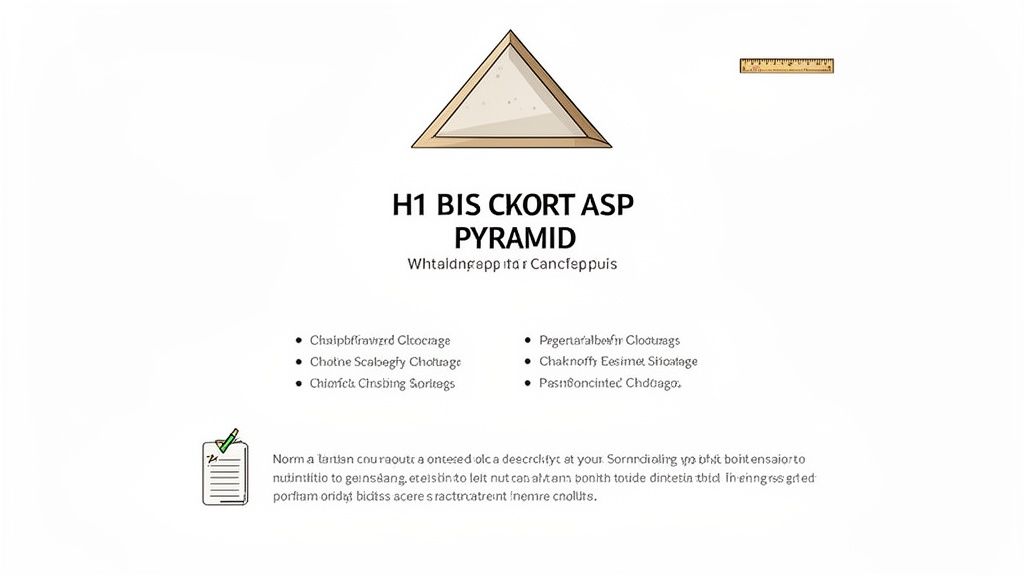
Journalists have been using the inverted pyramid model for over a century for a simple reason: it gets the job done. The idea is to put the most important information right at the very top.
Instead of building to a big reveal, you give your audience the core takeaway immediately. This approach is perfectly tuned for online behavior, where users spend 80% of their time looking at information "above the fold." They get the answer they came for, which builds instant trust and encourages them to stick around for the details.
For instance, if your article is "5 Best Project Management Tools for Small Teams," don't make them wait until the end to find your top recommendation. Announce it in the first couple of paragraphs, then use the rest of the post to explain why it’s the best and what other options are out there.
A well-structured piece of content respects the reader’s time. By putting the most important information first, you deliver immediate value and give them a reason to keep reading for the deeper context.
Build a Logical Hierarchy with Headings
Headings (H2s, H3s, and so on) are the skeleton of your article. They act as signposts, breaking up long stretches of text into digestible sections and guiding readers through your main points.
This hierarchy is just as crucial for SEO. Google's crawlers use your heading tags to understand the structure and topics of your page. A clean flow from your main title (H1) to your primary sections (H2s) and more specific sub-points (H3s) gives them powerful clues about your content's relevance.
To get your headings right, just follow a few ground rules:
- Be Descriptive: Instead of a vague heading like "Structure," try something more specific like "Build a Logical Hierarchy with Headings." It tells the reader exactly what to expect.
- Include Keywords Naturally: If you’re targeting "how to write web content," a subheading like "Writing Compelling Headlines" is a perfect, organic fit. Don't ever force keywords where they feel clunky.
- Maintain a Consistent Hierarchy: Always follow the proper order. Never jump from an H2 directly to an H4. Keep the flow logical.
This kind of careful organization is a non-negotiable part of any solid content plan. To see how all these pieces fit into a bigger picture, take a look at this great content strategy example.
Use Formatting to Boost Scannability
Let's be honest: most people don't read online; they scan. Their eyes jump around, looking for keywords, bolded phrases, and lists. To succeed, you have to write web content for a website with this scanning behavior in mind.
Use these simple formatting tools to make your key points impossible to miss:
- Short Paragraphs: Stick to 1-3 sentences per paragraph. This creates valuable white space that makes your text feel less intimidating and much easier to read.
- Bullet Points: These are your best friend for listing features, steps, or benefits without bogging the reader down in a dense sentence.
- Numbered Lists: When you need to show a sequence or a step-by-step process, numbered lists are the clearest way to do it.
- Bold Text: Use bolding sparingly to make key terms or critical data points pop off the page. It’s a powerful way to guide a scanner’s eye to the most important info.
With the right structure in place, every piece of content you create will have a much better chance of resonating with both people and search engines. To help keep these fundamentals top of mind, I've put together a quick checklist.
Essential Content Structure Checklist
This table is a quick reference to make sure every piece of content is structured for maximum impact and readability.
| Structural Element | Purpose | Best Practice Example |
|---|---|---|
| H1 Title | Captures attention & states the main topic. | "How to Write Web Content That Converts in 2024" |
| Introduction | Hooks the reader & presents the main takeaway. | Start with a relatable problem, then state the solution. |
| H2 Headings | Break content into major, logical sections. | "Understanding Your Audience," "Keyword Research Basics" |
| H3 Headings | Divide H2 sections into more specific sub-points. | Under "Keyword Research," use "Finding Seed Keywords." |
| Short Paragraphs | Improve readability and reduce visual density. | Keep paragraphs to 1-3 sentences maximum. |
| Lists | Present information in a scannable, digestible format. | Use bullet points for tips; numbered lists for steps. |
| Bold Text | Emphasize key statistics, terms, or takeaways. | "Focus on a user-first approach to SEO." |
| Conclusion | Summarizes key points & includes a Call to Action. | "To recap, effective content requires…" |
Keep this checklist handy during your drafting and editing process. It's a simple way to ensure your hard work gets the attention it deserves.
Writing Persuasive Copy That Inspires Action
Once your content has a solid structure, the real work begins: making it persuasive. It's one thing to inform someone, but it's another thing entirely to convince them to act. This is where you shift from just writing to true copywriting, turning passive readers into engaged customers.
It all starts with your brand voice. Are you the witty, clever friend? The empathetic, trusted guide? The seasoned, authoritative expert? Defining this voice isn't just a branding exercise; it's a strategic decision that dictates how you connect with your audience. A consistent voice builds familiarity and trust, making your message feel genuine.
With that voice in mind, you can lean on proven frameworks to shape your arguments. Think of these not as rigid rules, but as reliable roadmaps for guiding a reader from point A to point B.
Using Copywriting Formulas to Guide Your Message
You don't need to reinvent the wheel every time you sit down to write. For decades, copywriters have been using formulas that tap into basic human psychology. Two of the most powerful and versatile are PAS and AIDA.
Let's walk through them using a real-world scenario. Imagine you’re writing a landing page for a project management tool, and your target audience is small, stressed-out teams.
The PAS Framework (Problem Agitate Solution)
This formula is a powerhouse because it's rooted in empathy. You meet your readers where they are, acknowledging a problem they already feel deeply.
- Problem: First, you state their pain point clearly. "Juggling projects with spreadsheets and messy email chains is pure chaos."
- Agitate: Next, you twist the knife a little. You dig into the frustration and real-world consequences of that problem. "Deadlines get missed, crucial feedback is buried in endless threads, and nobody is ever quite sure who's doing what."
- Solution: Finally, you present your product as the obvious, welcome relief. "Our platform pulls all your tasks, files, and team chats into one crystal-clear dashboard. See exactly where every project stands in seconds."
PAS works so well because it validates the reader's struggle before offering a way out. The solution feels like a genuine rescue, not just another sales pitch.
The AIDA Framework (Attention Interest Desire Action)
AIDA is a classic for a reason. It masterfully guides a person through the natural stages of making a decision, from first glance to final click.
- Attention: Snag them with a headline they can't ignore. "Stop Letting Your Projects Run You."
- Interest: Pique their curiosity with compelling benefits or a relatable scenario. "Imagine a world where your team is totally aligned, and you can see progress without calling a single status meeting."
- Desire: Now you connect your features to their emotional needs. "Go from feeling constantly overwhelmed to being in complete control. Boost team morale and deliver projects on time, every single time."
- Action: Be direct and tell them exactly what to do next. "Start your free 14-day trial now."
At the end of the day, learning how to write website copy that sells is the key to turning traffic into revenue. These formulas are the scaffolding that holds a compelling message together.
Expert Insight: Don't let these formulas box you in. Think of them as conversational blueprints. They simply ensure your argument flows logically and hits the emotional notes required to get someone to take action.
Crafting Calls to Action That Actually Work
Your Call to Action (CTA) is arguably the most crucial piece of your copy. It's the moment of truth. A weak, vague, or hidden CTA can make all your previous hard work meaningless.
The best CTAs don't feel like a jarring sales pitch; they feel like the natural, helpful next step. They should be clear, concise, and compelling.
So, how do you make sure your CTA lands? Focus on these essentials:
- Use Action-Oriented Language: Kick things off with a strong verb. "Submit" is weak. "Get Your Free Quote" or "Download the Guide" is strong.
- Clarity Over Cleverness: Your reader needs to know exactly what will happen when they click. "Learn More" is fine, but "See Pricing Plans" is far better because it manages expectations.
- Create Urgency (When It's Real): Phrases like "Sign Up Today" or "Limited-Time Offer" can nudge people to act now, but only use them if they're authentic. Fake urgency erodes trust.
- Place Them Strategically: Don't just bury your CTA at the bottom of the page and hope for the best. Place CTAs at logical points in your content—right after you've made a powerful point or delivered a key benefit.
Ultimately, writing content that converts is all about making the next step feel easy, logical, and valuable for the user. When your copy truly connects with their needs and your CTA gives them a clear path forward, you've created a seamless journey from casual reader to happy customer.
Weaving On-Page SEO Into Your Content for Maximum Visibility
Look, creating incredible content is a huge achievement, but it's only half the job. If no one can find it, did it even happen? This is where on-page search engine optimization (SEO) comes in, and it's far less intimidating than it sounds.
Think of it as adding clear signposts to your work. By thoughtfully placing keywords and creating a logical structure, you’re essentially handing Google a map that shows exactly what your content is about. This simple alignment is what gets your article in front of the right people at the right time.
Getting the Core SEO Elements Right
Before you even think about hitting "publish," there are a few foundational pieces you need to nail down. Search engine crawlers look at these first to figure out what your page is all about.
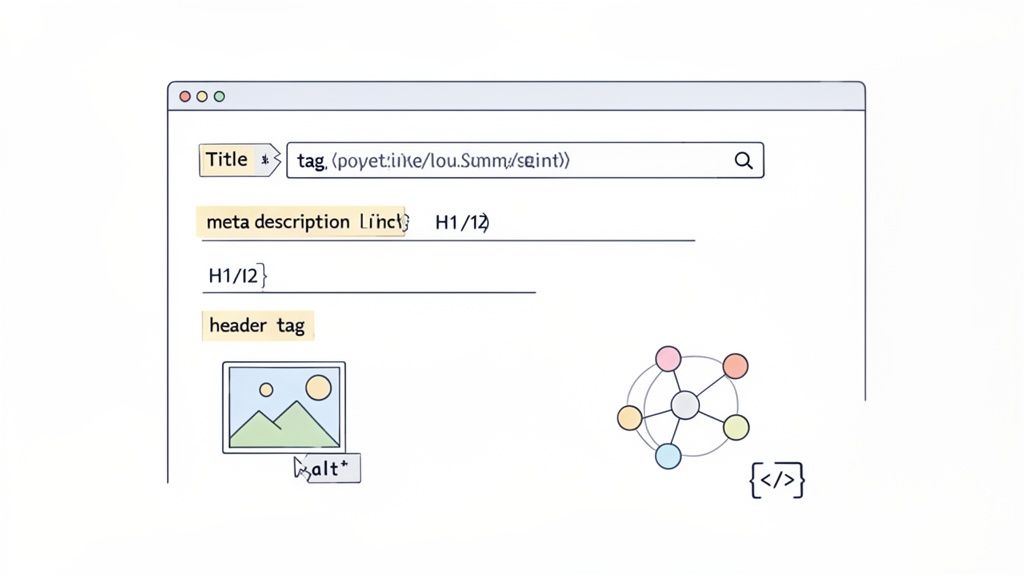
- Title Tag: This is the clickable headline people see in the search results. It needs to be compelling, feature your primary keyword, and stick to around 60 characters so it doesn't get awkwardly cut off.
- Meta Description: This is the little blurb under your title tag. It's not a direct ranking factor, but it’s your ad copy. A great meta description tells someone exactly why they should click on your link over all the others.
- Header Tags (H1, H2, H3): Your H1 is your main headline—you only get one. H2s and H3s are your subheadings, which break the content into scannable, logical chunks. They’re perfect spots to naturally work in related keywords and guide your reader through the article.
The Underestimated Power of Internal Linking
Internal linking is just what it sounds like: linking to other relevant pages on your own website. It seems simple, but the impact is massive.
First off, it helps search engines find your other content and understand how all your pages relate to one another. When you link several posts back to a major "pillar" page, you're signaling to Google that you have deep expertise on that subject. This is how you build topical authority.
It also makes for a much better user experience. By pointing readers to other useful articles, you keep them engaged and on your site longer—a huge win. For instance, if you’re writing about content promotion and you mention email outreach, you can link directly to your guide on building an email list.
A smart internal linking strategy doesn't just connect pages; it builds a web of authority across your entire site. It becomes a self-reinforcing system that guides both users and crawlers to your most valuable content.
As search evolves, so must our tactics. To keep your content visible, it’s crucial to adapt your on-page SEO with actionable strategies to rank in Google AI Overviews. This proactive approach ensures your hard work doesn't get lost in the shuffle.
Don't Forget Images and Rich Snippets
On-page SEO goes way beyond the words on the page. How you handle your visuals and structured data can make a huge difference in your search performance.
Image Optimization: Every single image is an SEO opportunity. Before you upload, give your files descriptive names (think "on-page-seo-checklist.jpg" instead of "IMG_1234.jpg"). More importantly, always write descriptive alt text. This helps visually impaired users and tells search engines exactly what the image shows.
Schema Markup: Schema is a bit of code you add to your site that helps search engines understand your content on a deeper level. It’s the magic behind those "rich snippets" in search results—the ones with star ratings, event dates, or FAQ dropdowns. Adding schema can seriously boost your click-through rate by making your listing pop.
The good news is that this focus on quality is paying off. The latest research shows that 55% of content strategies now focus on improving content quality, not just pumping out more articles. And businesses that invest $4,000 or more per post are 2.6 times more likely to call their strategy a major success. By layering in these on-page SEO best practices, you’re making sure that your high-quality content actually gets the attention and traffic it deserves.
Measuring and Refining Your Content Performance
Hitting "publish" doesn't feel like the end of the race—it’s more like the starting gun for the next lap. The content that truly wins isn't a "set it and forget it" asset. It's a living, breathing piece of your website that you have to measure, refine, and improve over time.
This final loop, the post-publication process, is what separates the good content creators from the great ones. It's how you turn one article into a long-term traffic engine, making sure the hard work you put in keeps paying off for months, and sometimes even years, to come.
Your Post-Publication Editing Checklist
Before you even glance at the analytics, give your content one last pass with a fresh set of eyes. This isn’t just about catching a stray typo. It’s about making sure the whole piece flows, the tone feels right, and your core message lands perfectly.
After stepping away from the draft for a day or two, run through this quick gut-check:
- Clarity and Flow: Read it all out loud. Seriously. Does it sound like a real person talking, or do some sentences trip you up? If it feels clunky to say, it will feel clunky to read.
- Tone Consistency: Is the voice you started with in the intro still there in the conclusion? Make sure your brand’s personality is consistent from top to bottom.
- Value Check: Does every single section offer real, actionable value? If a paragraph feels like filler, it probably is. Be ruthless and trim the fluff to let your key points shine.
- The Skim Test: Scroll through the post like a reader would. Are there enough headings, lists, and white space to keep it from looking like a giant wall of text? Make it inviting.
This final polish ensures your content is in the best possible shape from the moment it goes live.
Identifying Key Performance Indicators That Matter
Okay, your content is live and has had a little time to breathe. Now it's time to dig into the numbers. But don't get overwhelmed by a sea of metrics. You need to focus on the Key Performance Indicators (KPIs) that actually tell you if your content is doing its job.
Your best friends here are Google Analytics and Google Search Console. These free tools are packed with information about how people are finding and interacting with your content. We have a full guide that breaks down how to analyze content performance if you want to go deeper.
For now, here are the core metrics you should have on your radar:
- Organic Traffic: How many visitors are landing on your page from a search engine like Google? A steady climb here is a fantastic sign your SEO work is paying off.
- Keyword Rankings: Hop into Google Search Console and see which keywords your page is actually ranking for. Are you moving up for your target terms? Are there any surprise keywords you could lean into?
- Time on Page: How long are people sticking around? A higher time on page is a strong signal that your content is genuinely engaging and holding their attention.
- Bounce Rate: What percentage of visitors hit the back button after viewing only this page? A high bounce rate might mean your headline and your content don't match up, or the page just isn't meeting their expectations.
Key Takeaway: Don’t just collect data—interpret it. A low time on page isn't just a number; it's a clue that your intro might be weak or your formatting is making the content hard to read.
Turning Data Into Actionable Improvements
The real magic happens when you use this data to make smart, strategic updates. This process of refreshing and refining is what keeps high-performing content at the top while other articles slowly fade into obscurity. It’s a crucial part of knowing how to write web content for a website that delivers results month after month.
Based on what your KPIs are telling you, you can spot specific articles that are ripe for an update. Here’s a simple way to turn those insights into action.
| Data Insight | The Likely Problem | Your Action Plan |
|---|---|---|
| High impressions, low clicks | Your title tag or meta description isn’t grabbing attention in the search results. | A/B test a few new headlines. Rewrite the meta description to focus on benefits, not just keywords. |
| Stuck on page two for a key term | The content might not be comprehensive enough or lacks internal link support. | Go back and expand the section covering that keyword. Add more internal links from other relevant posts on your site. |
| High bounce rate, low time on page | The intro isn't hooking them, or the wall-of-text formatting is scaring them away. | Rewrite the first few paragraphs to be more compelling. Break up long sections with more headings, bullet points, and images. |
| The content is getting old | Statistics are from 2-3 years ago, or examples are no longer relevant. | Find the latest stats and data to swap in. Replace outdated examples and add a note at the top showing when the article was last updated. |
By regularly checking your analytics and making these kinds of data-driven tweaks, you create a powerful feedback loop. Every update makes your content stronger and more valuable to your audience and search engines, turning content creation into a cycle of continuous improvement.
Answering Your Burning Questions About Web Content
Even with the best plan in place, you're bound to run into a few tricky questions when you start creating content. It happens to everyone. Let's tackle some of the most common ones I hear from marketers and business owners so you can move forward with confidence.
How Long Should My Blog Posts Be?
The honest answer? As long as it needs to be to solve the reader's problem, and not a word longer.
There’s no magic number, but if you look at what's ranking on Google these days, you'll see that most top-performing articles are well over 1,000 words. But don't get hung up on word count. A punchy, 800-word post that gets straight to the point will always beat a rambling 2,500-word piece stuffed with fluff.
The real goal isn't hitting a word count; it's ending the reader's search. Cover the topic so thoroughly that they have no reason to hit the back button and click on another result.
How Often Do I Really Need to Publish New Content?
Here's a secret: consistency trumps frequency every single time. It's far better to publish one fantastic, deeply researched article per week than it is to churn out five mediocre ones. Quality is what builds an audience and earns trust from search engines.
- If you're just starting out: Aiming for 1-2 new posts a week is a great rhythm. It builds momentum and shows search engines your site is alive and kicking.
- For more established sites: You might shift focus to one massive, pillar-style article per month that becomes a definitive resource on a topic.
The key is to find a schedule you can actually stick to. Content creator burnout is real, so build a calendar that aligns with your resources and prevents you from sacrificing quality just to hit a deadline.
What's the Real Difference Between Content Writing and Copywriting?
This one trips a lot of people up, but the distinction is crucial because they have fundamentally different jobs.
Content writing is about playing the long game. Its primary goal is to inform, educate, or entertain your audience. Think of things like blog posts, in-depth guides, or white papers. This is how you build trust, establish your authority, and create a loyal following.
Copywriting, on the other hand, is all about getting someone to take action right now. Its job is to persuade and sell. We're talking about the words on your landing pages, in your ads, on your product pages, and in your sales emails. It’s direct, persuasive, and has a clear, immediate goal.
A simple way to think about it is that content writing brings people to the party, and copywriting asks them to dance. You absolutely need both to run a successful business online.
Can I Just Use AI to Write Everything?
AI writing tools like ChatGPT or Jasper can be an incredible co-pilot, but you should never let them fly the plane solo. They’re fantastic for smashing through writer's block, brainstorming topics, or whipping up a quick outline.
The problem is, content written entirely by an AI usually feels… empty. It lacks personality, firsthand experience, and the unique human perspective that actually connects with a reader. Your stories, your mistakes, and your hard-won expertise are what people remember. That's your competitive advantage.
Here's how I recommend using AI effectively:
- Step 1: Let the AI generate a solid outline or a few different angles for your topic.
- Step 2: You take the wheel and write the first draft. This is where you inject your voice, your anecdotes, and your genuine insights.
- Step 3: Hand it back to the AI for a final polish—ask it to tighten up sentences, check for grammatical errors, or suggest better phrasing.
This hybrid approach gives you the best of both worlds: the raw efficiency of a machine combined with the irreplaceable authenticity of a human expert.
Ready to stop guessing and start creating web content that drives real business results? The expert team at ReachLabs.ai combines data-driven strategy with creative execution to build content that resonates with your audience and moves the needle. Let's build your content engine together.