

Keeping up with the never-ending demand for fresh content can feel like you're on a hamster wheel. Let's be honest, for most marketing teams, it's a frantic scramble. But learning how to scale content creation isn't just about churning out more stuff. It’s about making a strategic pivot to build a powerful, efficient content engine that lets you show up everywhere that matters.
This playbook is your guide to building exactly that. We'll get into the nitty-gritty of the systems, team structures, and tech you need to make it happen.
Why Your Content Needs to Scale Now

That pressure you feel to create more, faster? It's not in your head. It's a fundamental shift in how people consume information. Your audience is everywhere—jumping between TikTok, LinkedIn, blogs, and podcasts. A single, amazing blog post just doesn't have the reach it used to.
To stay relevant, your brand needs to be a consistent, valuable presence on all the channels your customers frequent. If you don't have a system for scaling, you'll hit a wall, and that wall is where growth stalls and common pain points begin to fester.
The Real Cost of Not Scaling
When your content production can't keep pace, the fallout hits hard. I've seen it countless times: teams get burned out by the constant pressure and impossible deadlines, which tanks morale and sends good people looking for the exit.
Even worse, the quality of the work takes a nosedive. When you're rushing, your brand voice gets wobbly, the insights are surface-level, and you completely miss the mark with your audience. That inconsistency kills trust and chips away at your authority. Instead of being the go-to resource, you just become more noise. The true cost isn't just wasted budget; it's the missed chances to generate leads, drive sales, and build a loyal following.
A Glimpse Into the Future of Content
The global appetite for great content is exploding. The content creation market is on track to hit USD 73.49 billion by 2031, with a seriously impressive 11.09% annual growth rate. What’s driving this? A massive shift to cloud-based tools, which now power nearly 70% of the market's revenue and let teams create amazing work from anywhere.
You can dig into the full research on the content creation market to see just how big these trends are. The takeaway is crystal clear: the businesses that figure out how to scale their content effectively are the ones that will win.
A scalable content engine is your company's most powerful asset for building brand equity. It moves you from one-off campaigns to a continuous conversation with your audience, creating a moat of authority that competitors can't easily cross.
To help you get there, let's start with a high-level look at the core components we're going to build.
The Pillars of a Scalable Content Engine
Think of this table as the blueprint for what's to come. It’s a quick look at the core components of a scalable content system, giving you an overview of the practical strategies we'll cover in this guide.
| Pillar | Core Function | Key Outcome |
|---|---|---|
| Assessment & Audit | Analyze current content performance, team capacity, and workflows. | A clear baseline and data-backed priorities for scaling. |
| Strategy & Governance | Define goals, target audience, messaging, and quality standards. | A unified vision that guides every piece of content. |
| Team Models | Structure your team with in-house, agency, or freelance talent. | The right mix of skills and resources to execute your strategy. |
| Tooling & Automation | Implement technology to streamline creation, management, and distribution. | Increased efficiency and fewer manual bottlenecks. |
| Workflows & SOPs | Document step-by-step processes for every content-related task. | Consistency, predictability, and easier team onboarding. |
| Repurposing & Atomization | Break down large assets into smaller pieces for multiple channels. | Maximum ROI and reach from every core piece of content. |
| Measurement & ROI | Track key metrics to prove content's impact on business goals. | Justification for investment and insights for optimization. |
Each of these pillars is a critical piece of the puzzle. In the following sections, we’ll dive deep into each one, giving you the actionable steps to build an engine that turns your content operation into a predictable source of business growth.
Laying the Groundwork: Your Content Scaling Blueprint

Trying to scale content creation without a solid plan is a recipe for chaos. It’s like trying to build a house without a blueprint—you might get a few walls up, but you'll end up with a wobbly structure that's bound to collapse. A real plan starts with a clear-eyed look at what you’re already doing.
Before you even think about hiring writers or buying new software, you have to run a content audit. This isn't about criticizing past efforts; it's about digging into your own data to make smarter decisions. Stop guessing and start with the facts.
Uncovering Hidden Gems with a Content Audit
The term "content audit" can sound a bit intimidating, but it doesn't have to be. Your goal is simple: find out what's working, what's not, and where your biggest opportunities are hiding. This is the bedrock of how to scale content creation because it shows you exactly what to do more of and what to cut loose.
Get started by pulling all your content into a spreadsheet. List out your blog posts, case studies, white papers—every significant asset you’ve produced. Then, track the metrics that actually matter to your business.
- Traffic: How many people are actually seeing this piece?
- Engagement: Are they sticking around? Are they sharing it?
- Conversions: Is it driving leads, demo requests, or sales?
- Keyword Rankings: Where does it show up on Google for important terms?
Once you start analyzing this data, powerful patterns will emerge. You might find that your case studies are lead-generation machines, or that a couple of old blog posts are still pulling in a surprising amount of organic traffic. These insights are pure gold.
Your best-performing content is your roadmap. It tells you exactly what your audience craves and what the search engines reward. Scaling becomes a matter of replicating that success, not reinventing the wheel every time.
Once you know what works, you can build a real strategy around it. Maybe that means doubling down on in-depth case studies or giving your top-ranking posts a refresh. You’re no longer just creating content for the sake of it; you’re making calculated investments.
Establishing Your Content Governance Model
As you scale and bring more people into the mix—freelancers, agencies, new team members—keeping everything consistent becomes a huge headache. This is where a content governance model saves the day. Think of it as your team’s North Star, making sure every piece of content feels like it came from your brand, no matter who wrote it.
This isn't some stuffy rulebook meant to kill creativity. It's a set of simple, clear guidelines that actually empowers creators by showing them exactly what success looks like. Your governance model should be a living document that’s easy for everyone to find and use.
Your model should nail down a few core things:
- Brand Voice and Tone: Are you authoritative and formal, or friendly and conversational? Show, don't just tell, with clear examples of what to do and what to avoid.
- Style Guide: Get into the nitty-gritty of grammar, punctuation, and formatting (like how to use bolding or headings). How should your company name and products be written?
- Quality Standards: Define what "good" actually means. This could be anything from requiring original data and expert quotes to a certain depth of analysis.
- SEO Guidelines: Lay out the rules of the road for keyword research, on-page optimization, and your internal linking strategy.
For a more structured approach to documenting all this, our guide on building a content marketing strategy template can help you get everything down on paper.
From Random Acts of Content to a Strategic Engine
I once worked with a small tech company that published blog posts whenever someone had a spare afternoon. The content was all over the place, with no clear purpose. After we ran a simple audit and put a governance model in place, everything changed.
They found that their posts about specific software integrations were driving the most demo requests. Boom. Armed with that data, they built an entire content calendar around that theme, producing a series of deep-dive articles, a webinar, and tons of social clips. Their new governance model made sure every single piece had the same expert tone and a crystal-clear call-to-action.
The result? In just one quarter, their qualified leads from content shot up by 40%. They stopped throwing content at the wall to see what would stick and started building a predictable growth engine. That's the power of having a blueprint. And to really take it to the next level, that blueprint has to include a content repurposing strategy that actually grows your reach to get the most mileage out of your best work.
3. Building Your Modern Content Dream Team
Let's be honest: a brilliant strategy is just a document without the right people to make it happen. As you move from random acts of content to building a predictable growth engine, getting the team structure right is everything.
This isn't just a budget decision. It's about matching your talent to your business goals, the complexity of your product, and how fast you need to move. So, let’s get into the practical reality of what works.
The In-House Specialists Model
An in-house team is your dedicated crew. They live and breathe your company culture, your product, and your mission every single day.
This model is a game-changer for companies with really technical or complex products. Imagine a B2B SaaS business selling a niche data analytics platform—it's far easier to train an internal writer on those deep nuances than to constantly re-brief an outside partner.
That deep integration also creates incredible brand consistency and lets you move fast. When your writer, designer, and SEO analyst are in the same daily meetings, you can switch up tactics on a dime and keep a tight, cohesive voice across everything you publish. The trade-off, of course, is the significant cost of salaries, benefits, and ongoing training.
Partnering With a Content Agency
Hiring a full-service agency is like plugging a ready-made content department directly into your business. This is the perfect move when you need a wide range of specialized skills and serious momentum without the long-term overhead of hiring.
An agency brings experience from a ton of different clients, which means they come packed with fresh perspectives and proven, battle-tested workflows.
Think about a startup that just closed a Series A round and needs to dominate a new market, fast. An agency can help them launch a massive content and PR blitz in weeks, a timeline that would be impossible to hit by hiring from scratch. The key is to treat them like a true partner, not a vendor. Just remember, they'll never be as deeply embedded in your culture as an in-house team, which can sometimes create a slight gap.
Your team structure is a direct reflection of your scaling priorities. If deep product knowledge is non-negotiable, build in-house. If speed and specialized expertise are paramount, an agency is your accelerator. If flexibility is key, the hybrid model wins.
Assembling a Flexible Hybrid Team
The hybrid model—a lean in-house team managing a network of trusted freelance specialists—often gives you the best of both worlds. This setup gives you the strategic stability of an internal lead, like a Content Manager, while letting you tap into specialized talent on demand.
You can build a go-to roster of experts: a freelance video editor for your new YouTube series, a graphic designer for slick infographics, and a technical writer for that deep-dive white paper. It's incredibly cost-effective and built for scale, since you only pay for the exact skills you need, right when you need them. For a closer look at making this work, check out our guide on the modern content marketing team structure.
This mirrors a major trend. Small and medium-sized enterprises (SMEs) are growing fastest at a 14.1% CAGR, and they often thrive by outsourcing to specialists. With 80% of marketers already using AI and blogs remaining a top investment through 2026, this flexible approach is essential for executing powerful, personalized strategies. You can find more insights on the Agility PR blog.
Vetting Your External Partners
Whether it's a freelancer or an agency, your vetting process has to go way beyond just looking at a portfolio. You're not just hiring a pair of hands; you're looking for a partner who gets your business goals.
Here are a few questions I always ask to see how they really think and work:
- How do you measure the success of your content? You want to hear answers that go past vanity metrics like traffic. Look for a focus on business outcomes—lead generation, conversion rates, and pipeline influence.
- Can you walk me through your typical workflow for a project like this? This question peels back the curtain on their process, communication style, and whether they have their act together.
- What's your process for getting up to speed on our brand voice and audience? A great partner will have a formal discovery or onboarding process, not just a "we'll figure it out" attitude.
- How do you handle feedback and revisions? The right answer shows they see feedback as a collaborative tool for making the work better, not as a personal criticism.
Choosing the right model and being picky about your partners is how you build a resilient, high-output team that will drive your entire content strategy forward.
Choosing Your Tech Stack for Peak Efficiency
Let's be honest: your ability to scale content creation is only as good as the tools you use. A solid tech stack isn't just a "nice-to-have"—it’s the engine that powers your entire operation. It's what crushes bottlenecks, automates the soul-crushing grunt work, and frees up your team to do what they do best: create.
Without the right tech, even a brilliant strategy will eventually get bogged down by manual processes, endless spreadsheets, and chaotic email chains. Think of your stack as a specialized toolkit where every piece has a crucial job, working together to keep the content machine running smoothly.
The Four Pillars of a Scalable Tech Stack
To build a system that can actually handle growth, you need to cover four key areas of your workflow. Each one tackles a different part of the content production line, from the spark of an idea all the way to measuring its impact.
- Project Management Hubs: This is your command center, your single source of truth. Without it, you're flying blind. Tools like Asana, ClickUp, or Trello get everyone on the same page. They let you assign tasks, track deadlines, and see exactly where every piece of content stands at a glance.
- Ideation and SEO Tools: You can't scale content by just guessing what people want to read. You need data. Platforms like SEMrush and Ahrefs are indispensable for digging into keyword research, seeing what your competitors are up to, and finding those golden content gaps. This turns brainstorming from a shot in the dark into a calculated, strategic move.
- Creation and Collaboration Tools: This is where the magic happens—the writing, designing, and polishing. Of course, you have your basic word processors, but scaling means bringing in more firepower. AI writing assistants can speed up first drafts, while collaborative design tools make the review and feedback process a breeze.
- Analytics and Performance Dashboards: If you can't measure it, you can't improve it. Scaling without knowing what’s working is just creating more noise. Tools like Google Analytics and HubSpot are non-negotiable for tracking the metrics that matter, from traffic and engagement to actual leads and sales.
A well-chosen set of tools can dramatically reduce friction in your workflow. Here's a look at how different tools fit into a scalable process.
Essential Tools for Your Content Workflow
| Function | Tool Category | Example Tools | Impact on Scaling |
|---|---|---|---|
| Strategy & Planning | Project & Editorial Management | Asana, Trello, ClickUp | Centralizes your entire content calendar, giving you a bird's-eye view of all moving parts. |
| Ideation & Research | SEO & Topic Discovery | SEMrush, Ahrefs, AnswerThePublic | Ensures you're creating content people are actively searching for, maximizing your ROI. |
| Drafting & Creation | AI Writing Assistants | Jasper, Copy.ai | Drastically cuts down first-draft time, allowing writers to focus on editing and polishing. |
| Design & Visuals | Collaborative Design Platforms | Canva, Figma | Empowers non-designers to create high-quality visuals and streamlines the feedback loop. |
| Distribution | Social Media Schedulers | Buffer, Hootsuite | Automates social promotion, ensuring your content gets in front of the right audience consistently. |
| Measurement | Analytics & Reporting | Google Analytics, HubSpot | Provides hard data on what's working (and what's not), enabling you to double down on success. |
Each tool in this chain does more than just solve a single problem—it hands the baton cleanly to the next stage, creating a smooth, repeatable system that can handle a much higher volume of content.
Weaving AI into Your Content Workflow
AI isn't some far-off concept anymore; it's a real, practical tool that can help you scale content right now. Forget the sci-fi fear of robots replacing writers. The smart play is to use AI as a powerful assistant that handles the heavy lifting, so your team can focus on strategy, creativity, and that all-important human touch.
AI should be your team's most valuable player, not its replacement. Use it to accelerate first drafts, generate ideas, and automate repetitive tasks, but always leave the final polish, fact-checking, and brand personality to your human experts.
This isn't just a trend—it's happening at a massive scale. A staggering 94% of marketers plan to use AI for tasks like blog creation by 2026, and 80% are already using it in some way. It’s a major reason the content market is projected to hit USD 69.8 billion by 2030. You can find more on these marketing statistics on HubSpot.
So, how do you actually put this into practice?
- Drafting Outlines: Give an AI tool a target keyword and a few key points, and it can generate a solid, structured outline in minutes. This saves hours of research and gives your writer a running start.
- Generating Social Copy: Take that finished blog post and ask an AI to spin it into a dozen different social media updates. It can quickly create variations tailored for LinkedIn, Twitter, and Facebook, saving your social media manager a ton of time.
- Brainstorming and Idea Generation: Feeling stuck? Feed a broad topic to an AI, and it can spit out a list of blog titles, interesting angles, or sub-topics you hadn't even considered.
Ultimately, this is about creating a human-AI partnership. The machine handles the repetitive, time-sucking tasks, while your team provides the critical thinking and authentic voice that actually connects with your audience. That hybrid approach is the real secret to scaling with both speed and quality.
Getting Your Workflows in Order
Having the right people and the right tech is half the battle. But the real secret to scaling content isn't just about adding more resources—it's about building repeatable systems that actually work. A well-documented workflow is more than just a process chart; it’s your operational playbook that turns potential chaos into a smooth, predictable production line.
This is what separates the teams that are constantly scrambling from the ones that are strategically building a powerful content engine. A solid system ensures everyone knows their part, what’s expected of them, and where the project goes next. It's how you eliminate the friction that grinds momentum to a halt.
Think of it like this:
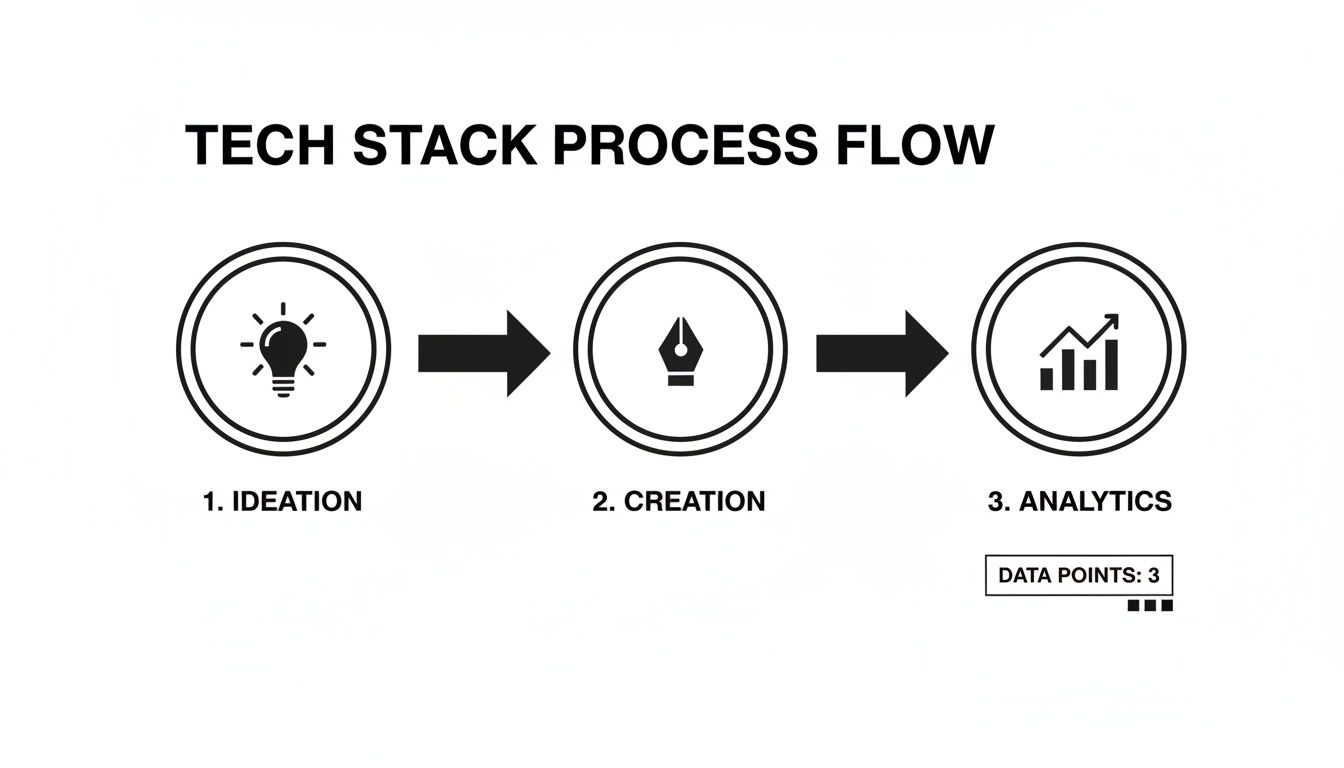
A successful content operation flows logically from data-driven ideation, to focused creation, and finally to performance analysis—which then feeds right back into your next round of ideas. It’s a continuous feedback loop.
Map Out Your Master Content Workflow
Your master workflow should be the single source of truth for your entire content lifecycle. It’s the high-level map showing every stage, from the initial spark of an idea all the way through to the final promotion push. It also needs to assign clear ownership for each step.
There’s no one-size-fits-all template here, but every solid workflow I've ever seen includes these core stages:
- Ideation & SEO Briefing: This is ground zero. It’s where you do your keyword research, spy on the competition, and put together a detailed content brief. The brief should cover the goal, target audience, primary and secondary keywords, and key talking points.
- Drafting & Creation: The writer or creator takes the brief and runs with it, producing the first draft of the blog post, video script, or case study.
- Review & Editing: The draft then moves through a couple of key checkpoints. This usually involves a subject matter expert for technical accuracy, an editor for clarity and brand voice, and a final proofread to catch any stray grammar mistakes.
- Design & Production: Once the copy is locked, designers get to work on visuals, video editors create the final cut, or the content gets formatted and staged in your CMS.
- Publishing & Promotion: The content finally goes live! This triggers the promotion plan—social media posts get scheduled, email newsletters go out, and any outreach campaigns are launched.
By clearly defining these stages, you create clean handoffs. The writer knows exactly when the editor is taking over, and the social media manager knows precisely when a new piece is ready for them. For a deeper dive, our guide on building a content marketing workflow is a great resource.
Create Simple, Actionable SOPs
If your master workflow is the map, your Standard Operating Procedures (SOPs) are the turn-by-turn directions. An SOP is just a simple, step-by-step checklist for a task you do over and over again. You don’t need a 50-page manual for everything, but you absolutely should have SOPs for your most common content types.
An SOP isn't about killing creativity; it's about removing guesswork. It frees up your team's brainpower to focus on producing incredible work instead of getting bogged down by process questions.
For something like a blog post, a practical SOP might look like this:
- Get the Brief: Review all project requirements in your project management tool (e.g., Asana).
- Dig In: Gather stats, find expert quotes, and pull any relevant internal data.
- Outline Approval: Post the outline in the designated Slack channel for the editor to review.
- Write V1: Get the first draft done in Google Docs, keeping the company style guide handy.
- Self-Edit: Run the draft through a tool like Grammarly for a quick check.
- Hand-Off: Tag the editor in Asana and move the task to the "Editing" column.
This kind of clarity is a game-changer. And to make sure everyone can actually find these documents when they need them, it’s critical to have strong knowledge management best practices for growing teams in place.
The Magic of Content Atomization
One of my favorite strategies for scaling is content atomization. It’s the art of taking one big, foundational piece of content and smashing it into dozens of smaller assets for different channels. You’re essentially working smarter, not harder, to squeeze every last drop of value out of your biggest content investments.
Let's say you just hosted a one-hour webinar with a top industry expert. That single recording is an absolute goldmine. Don’t just post the video and call it a day! You can atomize it into a month’s worth of high-quality content.
Here’s how that one webinar can fuel your entire calendar:
- The Original Asset: 1 one-hour webinar recording.
- Atomized Into…
- 1 long-form blog post summarizing the webinar's key takeaways.
- 5-7 short video clips (60-seconds or less) for TikTok, Reels, and YouTube Shorts.
- 10+ eye-catching quote graphics for Instagram and LinkedIn.
- 1 thought leadership article for LinkedIn based on a core theme.
- 1 dedicated email newsletter with highlights and a link to the full recording.
- 1 downloadable PDF checklist based on the actionable advice shared.
Just like that, one hour of effort populates your content calendar for weeks. This approach multiplies your output without multiplying your team's workload, helping you stay consistent across all the channels that matter.
Measuring Success and Proving ROI
Let’s be honest. Scaling your content without measuring its impact is like driving with your eyes closed. You feel the motion, sure, but you have no idea if you're actually getting closer to your destination or heading straight off a cliff. To really show the value of all this hard work, you have to draw a straight line from every piece of content to a real business result.
This means we have to stop patting ourselves on the back for vanity metrics. Page views and social likes are nice little ego boosts, but they won't convince your leadership team to give you a bigger budget. What they want to see are the numbers that hit the bottom line.
Moving Beyond Vanity Metrics
The real trick to proving ROI isn't just about collecting data; it's about collecting the right data. When you're creating content at scale, you need to be able to follow the breadcrumbs from a blog post all the way to a signed contract. It’s a fundamental shift away from top-of-funnel fluff toward metrics that show you’re actually influencing the business.
Your job is to have solid answers ready for the tough questions your CFO is going to ask:
- Lead Quality: Are the leads our content is bringing in actually good fits? Or are we just attracting window shoppers?
- Conversion Rates: What percentage of people reading our content are actually taking the next step, like booking a demo or downloading a gated asset?
- Sales Pipeline Influence: How many deals currently in our sales pipeline were touched by a piece of our content at some point?
- Customer Acquisition Cost (CAC): Is content actually a more cost-effective way to get customers compared to our paid ad campaigns?
When you can answer these questions with confidence, the entire conversation changes. Content stops being a "cost center" and starts being seen for what it is: a predictable, measurable revenue driver.
Building Your KPI Dashboard
You don’t need a ridiculously complex analytics setup to get started. In fact, a simple, focused dashboard is way more powerful than a spreadsheet with a hundred different data points nobody understands. The goal is to pick a handful of Key Performance Indicators (KPIs) that tell a clear, compelling story.
Your KPI dashboard shouldn't just be a jumble of numbers. It needs to tell a story: how a stranger finds you, becomes a reader, then a lead, and finally a customer—all because of the content you created.
Here’s a practical example of a dashboard you could build. You can use a tool like Google Analytics or HubSpot, or even just a well-organized spreadsheet.
| Metric | What It Measures | Why It Matters for Scaling |
|---|---|---|
| Content-Sourced Leads | The number of new leads generated directly from a content asset. | This is your direct link between content creation and sales pipeline growth. |
| Lead-to-MQL Rate | The percentage of those leads that become Marketing Qualified. | This tells you if you're attracting the right audience, not just any audience. |
| Assisted Conversions | How often content was part of a customer’s journey, even if it wasn't the last click. | This proves content’s crucial supporting role in closing deals. |
| Organic Traffic Growth | The increase in non-paid search traffic to your key content pillars and pages. | This demonstrates the long-term, compounding value of your SEO work. |
Focusing on these core metrics gives you the ammunition you need to have productive conversations about your content's performance and why it deserves more investment.
Communicating Your Wins to Leadership
Collecting the right data is only half the battle; you also have to present it effectively. When you're reporting up to your leadership team, ditch the marketing jargon and get straight to the point. Frame everything in the language they speak fluently: revenue, growth, and efficiency.
Instead of saying, "Our blog traffic was up 20% last month," try this:
"That new blog series on integration workflows boosted our organic traffic by 20%, which brought in 35 new marketing-qualified leads. Sales has already confirmed that 5 of those have become qualified opportunities, adding an estimated $75,000 to the pipeline."
See the difference? The first statement is just a boring data point. The second one tells a powerful story about how your scaled content operation is directly fueling the company's growth. This is how you don't just keep your budget—you make a rock-solid case for expanding it.
At ReachLabs.ai, we specialize in building scalable content engines that do more than just make noise—they drive real, measurable business results. Our team of specialists connects every piece of content to your core objectives, turning your marketing efforts into a predictable source of revenue.
Ready to see how a data-driven content strategy can transform your growth? Explore our services at ReachLabs.ai and let's start building together.