

If you want to find the best keywords for your business, you need to change your entire mindset. Stop chasing high-volume, vanity search terms. Instead, get obsessed with understanding the real language your audience uses and the problems they're trying to solve.
The goal is to pinpoint the exact questions, pain points, and phrases they turn to when looking for answers you can provide. It’s all about matching their intent, not just stuffing their words onto a page.
Moving Beyond Keywords to Understand Your Audience

Most keyword strategies fall flat for one simple reason: they start with what the business thinks it should rank for, not what a customer is actually typing into Google. This inside-out approach creates content that completely misses the mark. You end up targeting terms with the wrong intent or jumping into a competition you have no chance of winning.
Real success in SEO starts with a mental flip. For a moment, forget about "finding keywords." Focus entirely on decoding what your audience truly needs.
What’s keeping them up at night? What specific words do they use to describe their frustrations? Getting the answers to these questions is the bedrock of any strategy that brings in high-quality traffic.
Why Audience Intent Matters More Than Ever
Look, the goal isn't just to get more visitors. It's to attract the right visitors—the ones who are genuinely looking for what you offer and are likely to become customers. This all comes down to mastering search intent, which is the "why" behind every search query.
Someone searching for "best project management software" is in a completely different headspace than someone searching for a "Gantt chart tutorial." Your content has to be laser-focused on that specific intent to stand a chance.
The scale of this challenge is massive. Google owns about 90% of the global search market and handles something like 8.5 billion searches every single day. The competition is absolutely brutal. The top five organic results get around 70% of all the clicks, so you have to be strategic and pick your battles wisely. If you're interested in the numbers, you can dig into more of these SEO statistics to see just how competitive it is.
The most powerful keyword insights won't come from a fancy tool. They come from listening—really listening—to your customers. Pay close attention to the exact phrases they use on sales calls, in support tickets, and in online reviews. That’s where the gold is.
Adopting this audience-first approach pays off in a big way:
- Higher Conversion Rates: You naturally pull in people who are actively looking for the solutions you sell.
- Improved Topical Authority: When you create content that thoroughly answers your audience's questions, Google starts seeing you as an expert.
- Long-Term Resilience: An audience-focused strategy is built on genuine value, making it far less vulnerable to the whims of algorithm updates.
At the end of the day, effective keyword research is less about staring at spreadsheets and more about developing empathy. It’s the art of stepping into your customer's shoes and seeing the world—and the search bar—through their eyes.
Finding Your Starting Point with Seed Keywords
Every solid keyword strategy starts with a handful of core ideas. We call these seed keywords, and they’re the broad terms that capture what you sell or do. Think of them less as the final keywords you'll target and more as the starting blocks for the entire research race.
The biggest mistake I see people make is trying to brainstorm these in a vacuum. The best seed keywords aren't invented; they're discovered. To find them, you have to get out of your own head and into your customer’s world.
Tune In to Your Customer's Voice
For just a moment, forget all the corporate jargon and industry-speak you use every day. Your actual customers use simple, direct language to talk about their problems, and your job is to find out exactly what that is.
The good news? This intelligence is probably already flowing right through your business. You just have to know where to look.
- Customer Service Logs: Your support tickets and chat transcripts are a goldmine. What specific pain points do people bring up again and again? What words do they use to describe their issues?
- Sales Call Recordings: Your sales team is on the front lines every single day. Listen to how prospects actually talk about their needs and challenges. Their language is unfiltered and incredibly valuable.
- Online Communities: Spend some time lurking in forums like Reddit, Quora, or niche industry groups. This is where people ask for help and vent their frustrations openly, giving you direct access to their vocabulary.
This simple shift in approach changes everything. You move from guessing what people are searching for to knowing what they're searching for.
For example, a SaaS company might think their primary seed keyword is ‘project management software.’ But after listening to a few sales calls, they realize almost no one says that. Instead, prospects are asking for a ‘team collaboration tool,’ a ‘deadline tracking app,’ or ways to ‘manage remote team tasks.’ These are far more powerful seed keywords because they come directly from the customer.
From Brainstorming to Building Your Initial List
Once you've collected this raw intel, it's time to start building your initial list of seed keywords. The key here is not to filter or judge anything yet—just get all the relevant ideas down on paper.
Let's go back to that project management SaaS company. Their brainstorming process might produce two very different kinds of lists.
| Obvious Seed Keyword | Customer-Driven Seed Keyword |
|---|---|
| Project software | Team collaboration tool |
| Task management | Task organizer for small business |
| Workflow automation | Automate client approvals |
| Gantt chart maker | Visual project timeline |
See the difference? The customer-driven keywords are way more specific and packed with intent. They aren't just describing a feature; they're describing a solution to a real problem. That distinction is everything.
Starting with these authentic, customer-derived terms provides a much stronger foundation for your research. They act as a compass, pointing you in the right direction as you begin using tools to expand your list and uncover the phrases that will actually grow your business. This initial work ensures your entire SEO strategy is aligned with your audience right from the start.
Using Research Tools to Uncover Opportunities

Alright, you’ve got your seed keywords—the core concepts straight from your customers. Now it’s time to amplify their potential. This is where keyword research tools come into play, but don't just think of them as simple phrase finders. They're more like intelligence-gathering platforms that can unearth entire topic areas and user questions you never even knew existed.
A good tool takes your initial ideas and explodes them into hundreds, sometimes thousands, of related queries. More importantly, it attaches crucial data points to each one, like search volume and keyword difficulty. This is how you turn a simple list of ideas into a strategic map packed with content opportunities.
Getting this right is a huge deal. The SEO market was valued at a staggering $82.3 billion in 2023 and is on track to hit $143.9 billion by 2030. With over 53% of all website traffic originating from organic search, getting a handle on these tools is non-negotiable for capturing your piece of the pie. You can dig deeper into the numbers in this market report.
Choosing the Right Tool for the Job
You don't need to break the bank on the most expensive platform right out of the gate. The real secret is understanding what different tools are good at and picking one that fits your immediate goals and budget.
There are dozens of tools out there, each with its own strengths. To help you navigate the options, here's a quick rundown of some of the most popular choices.
Keyword Research Tool Comparison
| Tool | Best For | Key Feature | Pricing Model |
|---|---|---|---|
| Ahrefs | In-depth competitive analysis and backlink data. | "Content Explorer" for finding popular content on any topic. | Subscription (Premium) |
| Semrush | All-in-one SEO and marketing toolkit. | Comprehensive position tracking and competitor insights. | Subscription (Freemium) |
| Google Keyword Planner | Advertisers and validating initial search demand. | Search volume estimates directly from Google's data. | Free (with Google Ads account) |
| Ubersuggest | Beginners and small businesses on a budget. | Easy-to-understand interface and content ideas. | Subscription (Freemium) |
| AnswerThePublic | Finding question-based keywords and user intent. | Visualizes search questions in a "search cloud." | Subscription (Freemium) |
This table is just a starting point. Your best bet is to try a couple of the free or freemium versions to see which interface and feature set you feel most comfortable with. Ultimately, the "best" tool is the one you'll actually use consistently.
A classic rookie mistake is exporting the biggest list of keywords you can find. Your objective isn't to build a massive, overwhelming spreadsheet. It's to strategically gather intelligence that helps you make smarter content decisions.
A Practical Workflow Example
Let’s go back to our SaaS company and its seed keyword, "team collaboration tool." Once you plug that into a solid research tool, you start seeing the real magic happen.
You won't just get slight variations of your term. You'll uncover entire sub-topics and different angles of user intent. For example, the tool might spit out ideas like:
- Question-Based Keywords: "how to improve team collaboration remotely"
- Comparison Keywords: "Asana vs Trello for small teams"
- Niche-Specific Keywords: "collaboration tools for marketing agencies"
- Feature-Driven Keywords: "software with shared calendars and task lists"
This process shines a light on the specific problems your audience is trying to solve and the exact language they're using to find solutions. These insights are the foundation of a truly data-driven content marketing strategy. As you organize these findings, you’ll naturally start seeing clusters of related terms—these will become the building blocks for your entire content plan.
How to Analyze and Prioritize Keywords That Matter
Anyone can generate a massive keyword list. That’s the easy part. The real challenge—and where most SEO strategies fall flat—is figuring out which of those terms are actually worth your time and effort. This is all about separating the high-impact opportunities from the digital noise.
The entire process boils down to evaluating three core pillars for every keyword on your list: search volume, ranking difficulty, and user intent. Nail this balance, and you'll turn a simple list of phrases into a powerful roadmap for attracting the right kind of traffic.
First, Get a Handle on Search Intent
Out of those three pillars, user intent is hands-down the most important. It’s the ‘why’ behind every single search query. You absolutely have to ask yourself: what is this person really trying to accomplish with this search? If you get this wrong, you'll create content that completely misses the mark, no matter how perfectly you try to optimize it.
Think about it this way. A search for "how to fix a leaky faucet" has clear informational intent. That person wants a guide, a tutorial, or maybe a quick video walkthrough. But someone searching for "plumbers near me" has transactional intent—they're ready to pick up the phone and hire someone right now. Trying to rank a blog post for that second query would be a massive waste of resources.
The goal isn't just to answer the query; it's to satisfy the underlying need. If you can do that better than anyone else on page one, you’ll win. That’s the secret to finding keywords that drive real business results.
Getting this right is non-negotiable because it dictates the type of content you need to create. Aligning your content format with what the user actually wants is essential for ranking.
To help clarify this, let's break down the main types of search intent. Each one signals a different stage in the user's journey and requires a unique content approach.
Understanding Search Intent Types
| Intent Type | Description | Example Keyword | User Goal |
|---|---|---|---|
| Informational | The user is looking for information or an answer to a specific question. | "what is content marketing" | To learn or understand something. |
| Navigational | The user wants to find a specific website or webpage. | "Facebook login" | To go to a particular online destination. |
| Commercial | The user is researching products or services before making a purchase. | "best running shoes for flat feet" | To compare options and make an informed decision. |
| Transactional | The user is ready to make a purchase or take a specific action. | "buy iPhone 15 online" | To complete a transaction. |
Recognizing these subtle differences allows you to create content that speaks directly to the user's needs at that exact moment, which is exactly what Google wants to see.
Balance Search Volume with a Realistic Shot at Ranking
Once you’ve figured out the intent behind a keyword, it’s time to look at the numbers. Search volume tells you roughly how many people are searching for a term each month, while keyword difficulty (KD) gives you a score for how hard it will be to crack the first page of Google.
It's always tempting to chase those flashy, high-volume keywords, but they are almost always hyper-competitive. A much smarter approach, especially if your website is still building authority, is to find the strategic sweet spots: keywords with solid monthly search volume and a lower, more achievable difficulty score.
This is where understanding different keyword types comes into play.
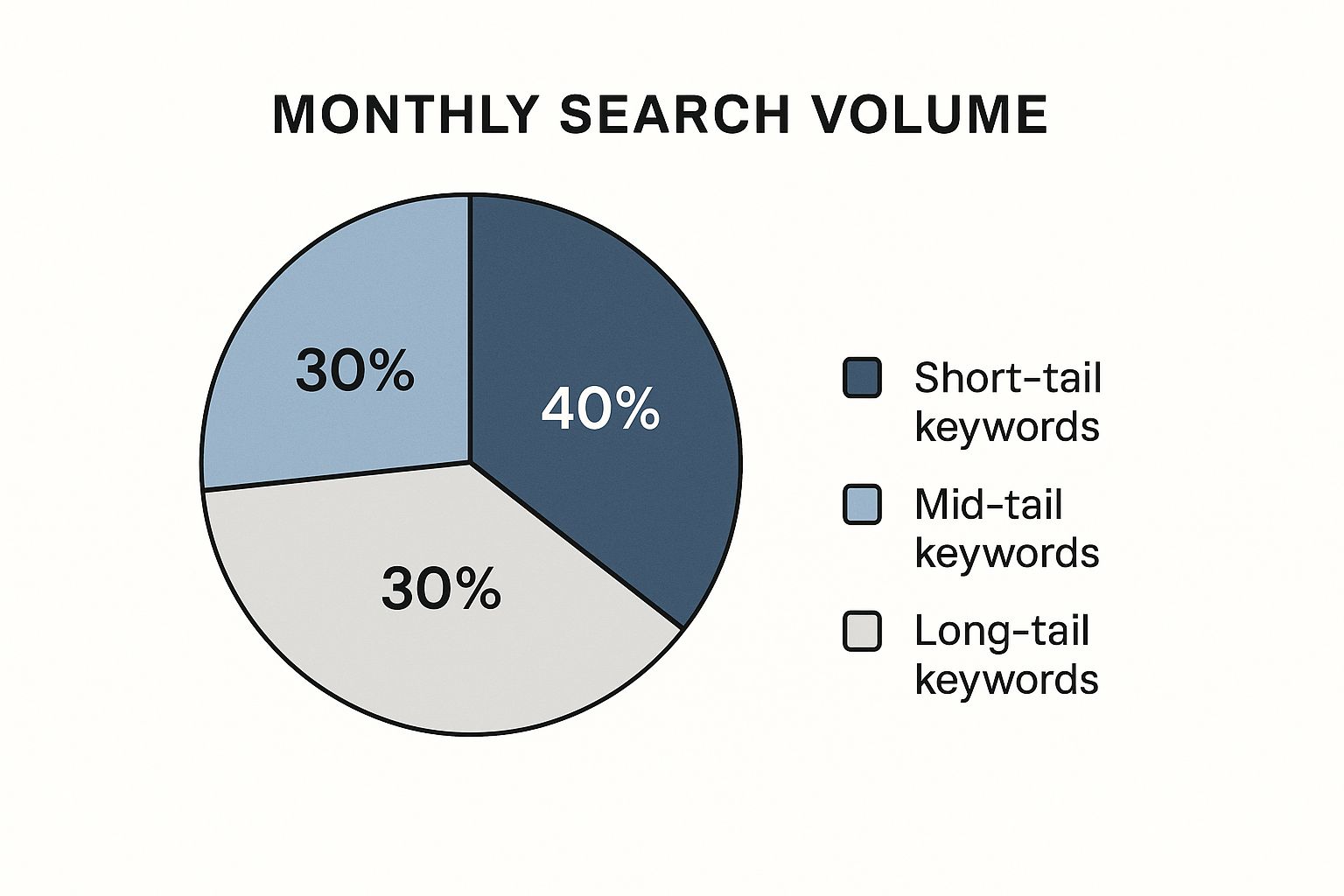
While those short-tail "head" terms look great on paper, the real opportunity often lies in the mid-tail and long-tail.
In fact, these long-tail keywords—those longer, more specific phrases—make up around 70% of all global search traffic. They might have lower search volume individually, but they bring in highly qualified traffic and tend to have much better conversion rates because the user's intent is so specific. This lines up with what we know about search behavior, with data showing that 52.65% of Google searches are informational. You can discover more insights about these SEO statistics to help shape your strategy.
A Simple Framework for Prioritization
Now, let's bring it all together. You don’t need a complicated system to prioritize your list; a simple spreadsheet will do the trick. The goal is to evaluate each keyword against a few key criteria to create a priority score.
Here’s a practical way to structure your analysis:
- Relevance Score (1-10): How closely does this keyword align with your core products, services, or expertise? A 10 is a perfect bullseye for your business.
- Intent Match (1-10): How well can you actually satisfy the user's intent? Do you have the right kind of content, or can you create it?
- Volume/Difficulty Ratio: This isn't a hard number but a gut check. Look for keywords where the monthly search volume is healthy, but the difficulty score is something your site can realistically compete for.
By scoring each potential keyword, you create an objective hierarchy. The terms that float to the top are your high-priority targets. These are the keywords that offer the best blend of audience relevance, achievable ranking potential, and true business value. It’s a methodical process, but it ensures you focus your limited resources where they’ll make the biggest impact.
Turning Your Keyword List Into a Content Strategy

Alright, you've got a fantastic list of keywords. Now what? This is where the real work—and the real magic—begins. That spreadsheet isn't just a collection of terms; it's the blueprint for your entire content strategy. We're about to turn that raw data into a plan that connects directly with what your audience is looking for and what you want to achieve.
The trick is to stop seeing keywords as isolated targets. Instead, think of them as starting points for a much larger conversation with your audience.
This is where the topic cluster model shines. Rather than churning out one-off articles that live on their own little islands, you’ll build an interconnected network of content. This structure is a powerful signal to search engines that you're a genuine expert on a subject, which is how you build serious topical authority.
Building Your First Topic Cluster
So, what does a topic cluster actually look like? It’s made up of two key parts: a pillar page and its cluster content.
Think of the pillar page as your cornerstone piece—a comprehensive, deep-dive guide that covers a broad topic from top to bottom. The cluster content is a series of shorter, more focused articles that explore specific sub-topics in greater detail. Each of these cluster pieces links back to the main pillar page, creating a clean, organized content hub.
Let's use a simple example: an online plant shop. Their big-picture goal is to become the go-to source for all things indoor gardening.
-
Pillar Page Keyword: "best indoor plants for beginners"
- This is the perfect broad topic for a pillar. The article would be an ultimate guide covering everything a newbie plant parent needs to know, from low-light survivors to pet-safe options and beyond.
-
Cluster Content Keywords:
- "how to care for a fiddle leaf fig"
- "snake plant watering schedule"
- "low light plants for apartments"
- "pet friendly houseplants"
Each of these more specific, long-tail keywords becomes its own dedicated blog post. And here's the crucial part: every single one of these posts links back to the "best indoor plants for beginners" pillar page. This creates a powerful, interconnected web of content that search engines love.
This model just plain works because it mimics how people actually search and learn. We often start with a broad question, then drill down into the specifics. Your content should be structured to guide people along that exact journey.
From Clusters to a Content Calendar
When you start organizing your keywords this way, something amazing happens: your research naturally transforms into an actionable content calendar. You're no longer just ticking boxes; you're methodically building expertise and guiding potential customers through their entire journey. This is a core component of any solid plan, and you can always find more content marketing tips to build on this foundation.
Let's stick with our plant shop and see how different keywords, each with a unique search intent, map to different content formats.
| Keyword | Search Intent | Content Type | Content Goal |
|---|---|---|---|
| "best indoor plants for beginners" | Informational | Pillar Page / Guide | Establish authority & capture emails |
| "how to care for a fiddle leaf fig" | Informational | Blog Post (Cluster) | Answer specific questions & build trust |
| "buy monstera plant online" | Transactional | Product Page | Drive direct sales |
| "fiddle leaf fig vs monstera" | Commercial | Comparison Article | Help users make a purchase decision |
This strategic mapping ensures every piece of content you create has a specific job to do, one that's tied to both a user's question and a business goal. By grouping your keywords into these logical clusters, you build a content strategy that’s organized, authoritative, and designed from the ground up to get real results.
Answering Your Top Keyword Research Questions
Once you get your hands dirty with keyword research, the real-world questions start popping up. It's easy to grasp the concepts, but applying them consistently is where the challenge lies. Let's tackle some of the most common hurdles you'll encounter.
Think of this as your field guide for those "what now?" moments. These are the practical answers you need to keep your research sharp, effective, and focused on getting results.
How Often Should I Actually Do Keyword Research?
Keyword research isn't something you can just set and forget. It's a living, breathing part of any smart SEO strategy. Your market is always changing, your customers find new ways to talk about their problems, and competitors are always on the move.
Here's a rhythm that I've found works well:
- A deep-dive annually. Once a year, take a step back and do a major review of your entire keyword universe. Are your core topics still relevant? Have new opportunities emerged?
- Targeted research every quarter. This is perfect for supporting new product launches, planning your content calendar, or reacting to what your competitors are doing.
- Keep a constant pulse on your data. You should always be watching your analytics. The search terms people are already using to find you are pure gold and can reveal unexpected opportunities.
Sticking to a schedule like this ensures your strategy never gets stale and stays perfectly in sync with your audience.
I Have a Brand New Website. Where Do I Even Start?
Launching a new site with no domain authority feels like starting a race from the back of the pack. Trying to compete for broad, high-volume keywords against established giants is a recipe for frustration.
The secret? Don't even try. Instead, get hyper-specific and focus exclusively on long-tail keywords.
These are longer, more detailed phrases that are much less competitive. Think "how to find keywords for a local bakery" instead of just "keywords." The search volume is lower, sure, but the intent is much clearer, and you actually have a shot at ranking.
By targeting these ultra-specific, low-competition terms, you can start winning small victories. This initial traffic builds authority and sends a signal to search engines that your site provides value. It's the foundation you'll later use to go after the bigger, more competitive terms.
This strategy is about playing the long game. You're building credibility one long-tail keyword at a time, paving the way for more significant wins later on.
What's the Difference Between Primary and Secondary Keywords?
Getting a handle on primary versus secondary keywords is fundamental to creating content that truly dominates the search results. The distinction is simple, but the impact is huge.
Your primary keyword is the star of the show. It's the main focus of your page, the single most important phrase you're aiming to rank for. Everything on the page should be built around this core concept.
Secondary keywords are the supporting cast. They are the related terms, synonyms, and subtopics that add crucial context and depth to your content.
Let's say your primary keyword is "best running shoes." Your secondary keywords might look something like this:
- Lightweight running sneakers
- Marathon training shoes
- Cushioned athletic shoes
- Running shoe buyer's guide
Sprinkling these related terms naturally throughout your content helps Google understand that your page is a comprehensive resource on the entire topic, not just one specific phrase. It allows you to cast a wider net and rank for a whole cluster of related queries. This also helps attract more qualified traffic by addressing specific user needs, a concept you can learn more about by understanding what is lead scoring and how it relates to user intent.
At ReachLabs.ai, we translate complex data into clear, powerful marketing strategies that resonate with your audience. See how our experts can amplify your brand by visiting us at https://www.reachlabs.ai.