
Before you ever type a single social media post, send a newsletter, or even think about a logo, the real work of building a personal brand has to happen. It's an internal job first. This isn't about creating some online persona; it's about digging deep to figure out who you truly are and what you stand for.
This initial clarity is everything. It's the bedrock that ensures what you're putting out there is consistent, authentic, and actually connects with people.
Defining Your Authentic Brand Foundation

Think of it like building a house. You wouldn't just start throwing up walls and hope for the best, right? You need a solid blueprint and a sturdy foundation first. Without that, everything you build on top is unstable and likely to collapse.
If you skip this step, your efforts will feel random and disconnected. You'll struggle to find your voice, and your audience won't know what to expect from you. That's a recipe for getting lost in the noise.
Pinpointing Your Expertise and Passions
Let's start by looking inward. What are the topics you could talk about for hours without getting bored? What problems do you find yourself solving for friends or colleagues over and over again? Your personal brand needs to live right at that sweet spot where your skills and your genuine interests collide.
This is your chance to go from being a generalist to a specialist. A "marketing consultant" is a dime a dozen. But a "B2B SaaS content strategist for early-stage startups"? That’s someone specific, memorable, and much easier to hire. Don't be afraid that niching down will limit you—it actually makes you the go-to person for the right people.
To get your gears turning, ask yourself:
- What skills have I picked up—in my career, hobbies, or life—that other people consistently find valuable?
- If I had to give an hour-long presentation with zero prep time, what subject would I choose?
- What are the common frustrations in my industry that I have a totally different take on?
This isn't just a navel-gazing exercise. It's what gives your brand real substance and helps you kick imposter syndrome to the curb, because you'll be speaking from a place of true confidence and passion.
Articulating Your Unique Value Proposition
Okay, now it's time to put that self-reflection into a powerful, concise statement. Your unique value proposition (UVP) is the simple answer to the question, "Why should I listen to you?" It clearly states the benefit you provide, how you do it, and who you do it for.
A solid UVP weaves together your skills, experience, and personality. For instance, a financial advisor could just say, "I'm a financial advisor." Or, they could have a UVP like this: "I help millennial freelancers navigate unpredictable income to build long-term wealth through simple, jargon-free financial planning." See the difference? One is generic, the other is a magnet for a specific audience.
To really nail this, you need a solid messaging framework. You can get a structured approach for developing yours by checking out this guide to building a brand messaging framework.
Your brand is what other people say about you when you're not in the room. The foundation you build now determines the conversation they will have.
Your UVP becomes your North Star. It guides the content you create, the people you connect with, and the opportunities you say "yes" (or "no") to. It's the promise you make, and keep, with your audience.
The Core Components of Your Brand Foundation
Before you move on to creating content or building profiles, take the time to answer these fundamental questions. This table will act as your blueprint, ensuring everything you do from here on out is aligned and consistent.
| Component | Description | Actionable Question to Answer |
|---|---|---|
| Mission | Your "why." The driving purpose behind your work. | What impact do I want to make on my audience or industry? |
| Vision | The future you are helping to create for your audience. | If I am successful, what does the world look like for the people I serve? |
| Values | The non-negotiable principles that guide your behavior. | What are 3-5 core beliefs that I will never compromise on? |
| Expertise (Niche) | Your specific area of knowledge and skill. | What specific problem do I solve for a specific group of people? |
| Personality | The tone, voice, and character of your brand. | What 3-5 adjectives describe how I want my brand to feel to others? |
| Unique Value Prop (UVP) | Your one-sentence promise to your audience. | I help [WHO] achieve [WHAT] by [HOW]. |
Work through each of these components honestly. Write them down. This isn't a one-and-done task; you'll likely revisit and refine it as you grow, but having this initial clarity is a game-changer.
Why This Foundational Work Matters More Than Ever
Let's be real: in today's world, a strong personal brand isn't just a nice-to-have, it's a career imperative. We're long past the days when a paper resume was enough. In fact, a recent study found that 70% of employers now consider a candidate's personal brand more important than their traditional resume.
That statistic alone should tell you how critical it is to present a clear, professional, and authentic version of yourself online. Think of this foundational work as creating a filter for every decision you make for your brand. It helps you stop adding to the internet's noise and start creating a clear signal that the right people can't help but notice.
Building Out Your Digital Footprint and Identity
Once you've done the internal work to define your brand, it's time to bring it to life online. This is where you build your digital "home base" and create the visual and written assets that tell your story at a glance. It’s all about being intentional with every profile you set up and every piece of information you share.
Your digital presence isn't about being everywhere at once. A scattered, half-hearted effort across a dozen platforms is far less powerful than a focused, high-impact presence on the two or three channels where your ideal audience actually spends their time.
Choosing Your Core Platforms
The first question people always ask is, "Which social media platforms should I be on?" The answer is never "all of them." Instead, you need to ask a better question: Where do the people I want to reach hang out online? Where are they looking for answers to the problems I can solve?
For instance, a freelance UI/UX designer targeting tech startups would be crazy not to have a strong presence on Dribbble and LinkedIn. But a B2B sales consultant? Their audience is living and breathing on LinkedIn, consuming professional content and making connections.
Think about where your brand fits best:
- LinkedIn: This is the non-negotiable for almost any professional. Think of it as your digital resume, portfolio, and networking hub all rolled into one.
- X (formerly Twitter): Perfect for real-time conversations, sharing quick-fire insights, and jumping into industry news as it happens.
- Instagram: A must for visual-heavy brands. If you're in design, fitness, travel, or coaching, using Reels and Stories can forge a powerful personal connection.
- A Personal Website/Blog: This is the only piece of digital real estate you truly own. It’s your central hub for long-form content, building an email list, and showcasing the full scope of your expertise.
My advice? Focus on mastering one or two platforms first. A vibrant, engaging presence on a single, relevant channel will always beat sporadic, low-effort posts across five. For most professionals, a solid LinkedIn profile is the best place to start. If you want to go all-in on that, our guide on how to build a personal brand on LinkedIn breaks it down step-by-step.
Creating a Consistent Visual Identity
We're visual creatures. A consistent look and feel across your platforms makes your brand instantly recognizable and signals a level of professionalism that builds trust. The good news is you don't need to be a graphic designer to pull this off.
Just start with the essentials:
- A Professional Headshot: This is non-negotiable. Your profile picture needs to be high-resolution, well-lit, and show you looking both approachable and confident. Use the exact same photo across all your professional profiles to build recognition fast.
- A Simple Color Palette: Pick two or three complementary colors that match the vibe of your brand. Blues can convey trust and stability, while oranges might project energy and creativity. Use these colors consistently in your cover photos, post graphics, and on your website.
- Consistent Fonts: Choose one font for your headings and another for your body text. Sticking to them makes everything you create look clean, polished, and intentionally branded.
A consistent visual identity is like a cognitive shortcut for your audience. When they see your colors and headshot in a busy feed, they should immediately connect it with you and the value you offer—before they even read a single word.
This consistency is a powerful signal. It shows you’ve put real thought into how you present yourself to the world, and that helps you stand out.
Writing a Bio That Actually Works
Your bio is your digital elevator pitch. On most platforms, you have about 150 characters and a few seconds to grab someone's attention and convince them you're worth their time. A great bio is not a laundry list of job titles; it's a value proposition.
An effective bio should quickly answer three key questions:
- Who are you?
- Who do you help?
- How do you help them?
Take a look at this crystal-clear LinkedIn headline from Melinda French Gates.
Her headline, "Co-chair, Bill & Melinda Gates Foundation | Pivotal Ventures founder | Author of The Moment of Lift," instantly communicates her primary roles and establishes her authority. It's direct, powerful, and leaves zero doubt about her work and influence.
Developing Your Content Creation System

Your content is the engine of your personal brand. It’s how you consistently show what you know, share your unique point of view, and earn the trust of your audience. But without a system, "content creation" quickly becomes a chaotic, stressful scramble of figuring out what to post next. That’s a one-way ticket to burnout.
Having a sustainable system turns content from a daily headache into a reliable machine for growth. It’s what separates a fleeting online presence from a lasting, authoritative brand. The goal isn’t just to pump out posts; it’s to build a predictable workflow that delivers real value without draining you.
Establish Your Core Content Pillars
Before you even think about hitting "record" or writing a single post, you need to lock in your content pillars. These are the 3-5 core themes you’re going to own. Think of them as the main aisles in a bookstore dedicated entirely to you. Everything you create should fit squarely into one of these categories.
This focus is non-negotiable for building a recognizable brand. If you’re sharing marketing tips one day and reviewing hiking gear the next, you’re just confusing people. Consistency around your themes is how you become the go-to expert for a specific set of challenges.
Take a leadership coach, for instance. Their pillars might look something like this:
- Effective Communication: Breaking down techniques for clear, empathetic dialogue.
- Team Productivity: Sharing strategies for building efficient and motivated teams.
- Career Growth: Giving actionable advice for aspiring leaders looking for that next promotion.
- Conflict Resolution: Offering frameworks to navigate tough workplace conversations.
Once you have these pillars, brainstorming becomes a thousand times easier. You're no longer staring at a blank page; you have clear guardrails that help you generate relevant ideas that reinforce your expertise.
Align Your Content Formats with Your Strengths
Here’s a hard truth: you don’t have to do it all. The real key to sustainability is picking formats that play to your natural talents and match how your audience likes to consume information. Forcing yourself into a format you hate is the fastest way to become inconsistent.
Get honest about your skills and what you actually enjoy:
- Natural on camera? Go all-in on short-form video for platforms like Instagram Reels or TikTok.
- Excel at writing in-depth explanations? A blog or a detailed newsletter is your perfect stage.
- A great conversationalist? A podcast could be the ideal way to connect with your audience and interview other experts.
Social media is obviously a cornerstone here, and some formats have a massive impact. As of 2025, Instagram alone has 2 billion monthly active users around the world. With roughly 82% of all social media users on the platform, its power for visual storytelling is undeniable. You can dive deeper into social media usage stats on Sproutsocial.com.
Your best content format is the one you can consistently create without it feeling like a chore. Authenticity shines through when you’re genuinely enjoying the process.
It is far better to master one or two formats than to be mediocre across five. After you’ve built some momentum, you can always repurpose your best stuff. A deep-dive blog post, for example, can be sliced into a dozen short video clips, a Twitter thread, and a newsletter highlight.
Build a Practical Production Workflow
A reliable workflow is what removes the friction from creating content. It turns the process from a guessing game into a repeatable series of steps, ensuring you have a steady stream of quality content that strengthens your brand.
A good workflow covers everything from the initial idea to the final analysis.
- Ideation: Set aside specific time just for brainstorming. Use tools like Feedly or AnswerThePublic, or just spend time in relevant online communities to find the common questions and pain points that align with your content pillars.
- Planning with a Content Calendar: This is your strategic map. A simple tool like Google Calendar, Trello, or even a spreadsheet is all you need to plan your content at least a month ahead. This stops the last-minute panic and leads to more thoughtful, cohesive material.
- Batch Production: Ditch the daily content grind. Instead, block out time to create in batches. Film multiple videos in one afternoon, write several blog posts in a day, or record a few podcast episodes at once. This approach is way more efficient and helps you maintain a consistent tone and quality.
- Scheduling and Distribution: Use scheduling tools to automate your posting. This frees you up to do what really matters: engaging with your community in real-time as your content goes live.
This system isn't about being rigid; it’s about creating freedom. When your content engine is humming along in the background, you have more mental energy to engage, network, and build the relationships that truly grow your personal brand.
Building Your Community Through Engagement
Look, creating great content is only half the job. If you really want to build a personal brand online, you have to move beyond just broadcasting your message. The real magic happens when you turn that one-way street into a two-way conversation. A powerful brand isn’t built on a pedestal; it’s forged in the day-to-day interactions you have with your audience.
Posting and ghosting is the fastest way to be forgotten. Real authority and loyalty come from showing up, participating, and transforming passive followers into a genuine community. This is how you go from having an audience to building a network.
From Content Creator to Community Builder
The first step is a mental one. You need to stop thinking of yourself as just a publisher and start seeing yourself as a host, a connector, and a member of the community you're trying to build. This means making time to actually talk to the people who are taking the time to consume your content.
This doesn't have to eat up your entire day. A great place to start is by blocking off 15-20 minutes right after you post something new. Use that time to reply to every single comment. And I don't mean just a quick "thanks!" Ask a follow-up question. Spark a real discussion.
This isn’t just about being nice; it’s smart strategy. A staggering 92% of consumers trust recommendations from people they know over traditional advertising. Every time you engage, you’re building trust—the single most valuable asset your brand can have. You can dig deeper into how personal recommendations crush corporate ads in this branding statistics report from dsmn8.com.
Get Out There: Proactive Engagement Beyond Your Profile
A strong community isn't just built on your own turf. Your ideal audience is already out there, having conversations on other platforms. Your job is to find them and add value where they already are.
Think of it as being a good digital neighbor. Show up and be helpful in places where your expertise is relevant:
- LinkedIn & Facebook Groups: Find the niche groups where your people hang out. Don’t just drop links to your stuff. Answer questions, offer your perspective, and share resources that genuinely help.
- Industry Forums & Reddit: Dive into subreddits or old-school forums where professionals in your field gather. A few thoughtful contributions can establish your credibility faster than a hundred posts on your own feed.
- Comment on Influencers' Posts: Engage with content from the established players in your space. A well-crafted, insightful comment can get you noticed by both the influencer and their followers.
Engagement is the currency of community. Every thoughtful comment, every answered question, and every helpful share is an investment that pays dividends in loyalty and trust.
When you take this approach, you're seen as a helpful expert, not just another person trying to make a sale.
This infographic gives a fantastic breakdown of what matters on different platforms, helping you decide where to focus your energy.
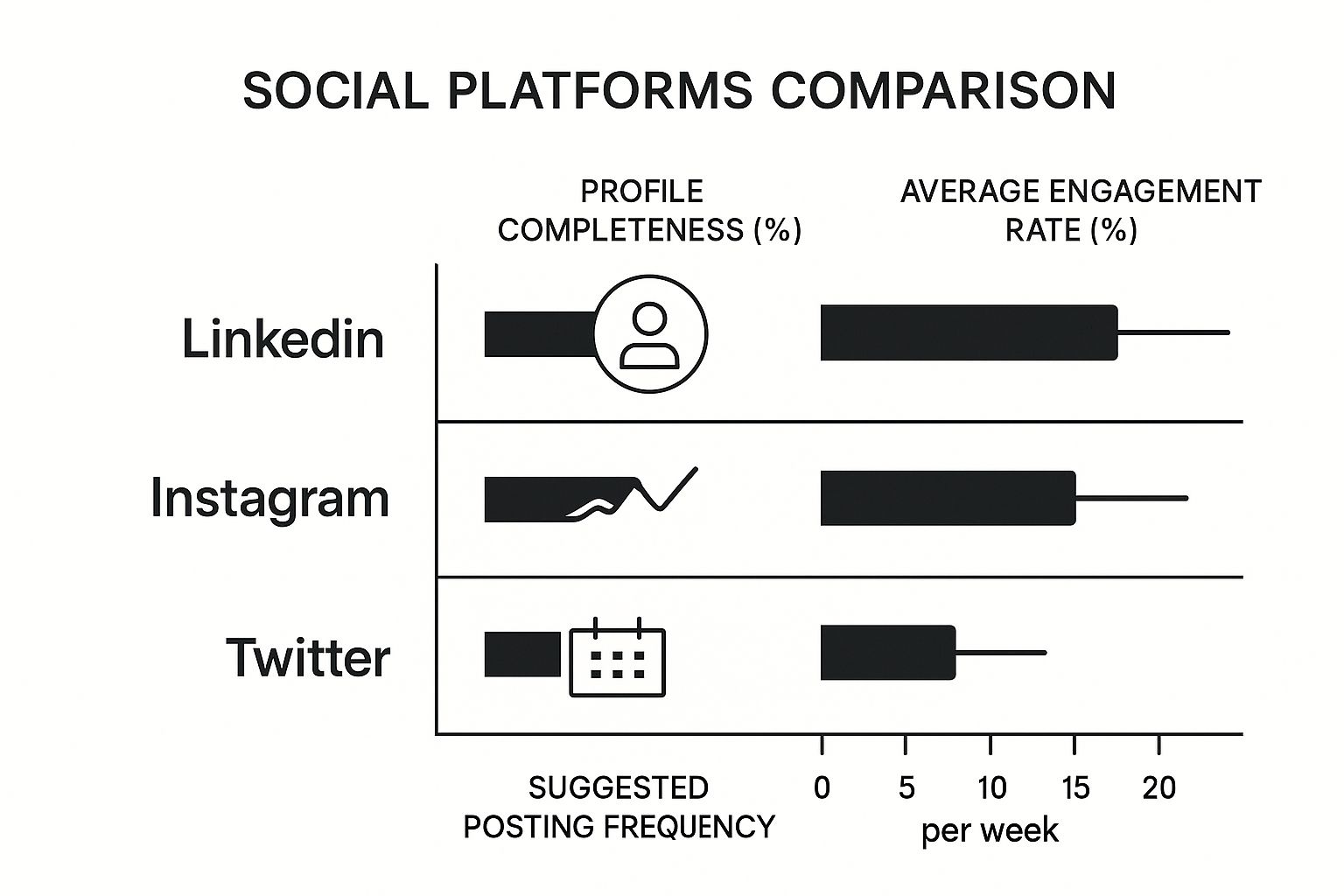
As you can see, a platform like LinkedIn might require less frequent posting, but its power comes from having a robust profile and making every interaction count.
To build a thriving community, you can't use a one-size-fits-all approach. What works on a professional network like LinkedIn will fall flat on a visually-driven platform like Instagram. Here's a quick cheat sheet to guide your efforts.
Platform Engagement Strategies at a Glance
| Platform | Primary Engagement Tactic | Best Practice Example |
|---|---|---|
| Thoughtful Commenting | Find a post by an industry leader and add a new perspective or a follow-up question in the comments to spark a deeper conversation. | |
| X (Twitter) | Quick, Relevant Replies & Retweets | Jump into a trending industry conversation with a witty or insightful reply. Retweet a follower’s great content with your own commentary. |
| Engaging with Stories & DMs | Reply to someone's Story poll with a direct message, or share a post you love to your own Story, tagging the original creator with praise. | |
| Facebook Groups | Answering Questions & Sharing Expertise | In a niche group, find a member's question you can answer thoroughly. Offer advice without pitching your own services directly. |
Remember, the goal across all platforms is to be authentic and add value. Genuine interaction will always outperform automated or generic responses.
Network Like a Human, Not a Salesbot
Finally, engagement isn't just about your audience—it's also about your peers. Don't network with the goal of getting something. Focus on building real professional relationships.
Be a giver first. Share another person's article, praise their work publicly on X, or send a quick, personalized email about how something they wrote helped you.
Think of it as making professional friends, not just collecting contacts. It feels better, and honestly, it works better. When it's time for collaborations or new opportunities, they'll happen naturally because you’ve already laid a foundation of goodwill and mutual respect. This is how you turn competitors into collaborators and open doors you didn’t even know were there.
Turning Your Brand Into a Business

So you've put in the work. You've been creating valuable content, showing up consistently, and building a genuine community. At some point, the question of monetization is going to come up. This isn't about suddenly slapping a price tag on everything or becoming a walking advertisement.
Authentic monetization flows naturally from the trust and authority you've worked so hard to build. It's about creating products or services that serve your audience on a deeper level than your free content can. When you get this right, making money doesn't just feel good—it actually strengthens your brand by proving the real-world value of your expertise.
Find Your Money-Making Mission
Before you even think about what to sell, you need to revisit your "why." What's the core mission of your brand? What's the transformation you help people achieve? Every single thing you sell has to tie back to that purpose.
A productivity expert who starts pushing the latest fashion trends is going to raise some eyebrows and lose trust fast. The same goes for any offer that feels out of left field.
Instead, listen to what your audience is already telling you. What questions do they ask over and over? Do they want to pick your brain one-on-one? Are they looking for a step-by-step system to implement your advice? Your best-selling products are often hiding in your DMs and comment sections.
When your paid offers are perfectly aligned with your purpose and your audience's needs, they don't feel like a sales pitch. They feel like the logical next step for your biggest fans.
Creating Your Value Ladder
Making the leap from free to paid can be intimidating. The smoothest way to do it is by creating a clear "value ladder" that guides your audience from casual follower to paying customer.
Your free content—all those blog posts, social media updates, and newsletters—is the foundation. It’s what brings people into your world and proves you know what you’re talking about. From there, you can introduce a series of paid offers.
-
Consulting or Coaching: This is often the quickest path to revenue. You offer personalized, one-on-one guidance to solve specific problems for clients. It’s a high-touch service that commands a premium price, and it gives you invaluable insight into your audience’s biggest challenges.
-
Digital Products: Think ebooks, online courses, or templates. You create them once, and you can sell them over and over. This is where you package your expertise into a scalable format that lets people get results on their own schedule.
-
Affiliate Marketing: This is all about recommending products and services you actually use and believe in. When someone buys through your unique link, you get a small commission. Honesty is everything here. Only promote things that have genuinely helped you and that make sense for your audience.
Launching Your First Product
That first paid offer is a huge milestone. To make sure it lands, think "minimum viable product." Don't disappear for six months to build a massive, 20-module course. Instead, why not pre-sell a 90-minute workshop or a handful of coaching spots?
This strategy lets you validate the idea before you pour tons of time and money into it. Even better, you get to co-create the final product with your first customers, guaranteeing it’s exactly what they need.
When it's time to launch, don't just post a link and hope for the best. Tell a story. Share why you created it, who it's for, and the specific transformation it provides. The trust you've built is your most powerful marketing tool.
Monetization isn't the goal. It's the result. When you focus on genuinely serving your community, revenue becomes a natural and sustainable byproduct of your impact.
Partnering with Brands
As your audience and influence grow, brands will start noticing you. Partnerships and sponsorships can be a great income stream, but you have to be incredibly selective. One bad partnership can undo years of trust-building.
Before you say yes to anything, ask yourself: do their values match mine? Would I recommend this product if I wasn't being paid? The best collaborations always feel authentic and seamless. If you want to dive deeper, our guide on how to get brand deals breaks down the entire process for landing partnerships that feel right.
Ultimately, every decision about monetization reflects back on your brand. Choose opportunities that serve your audience and extend your value, and you'll build a business that doesn't just make money—it makes a difference.
Got Questions About Personal Branding? We've Got Answers.
Stepping into the world of personal branding can feel like you're learning a new language. It’s exciting, sure, but it also comes with a lot of questions and a healthy dose of "Am I doing this right?" That’s completely normal.
Let's cut through the noise and tackle some of the most common hurdles I see people face. From shaking off self-doubt to figuring out what to even measure, these are the real-world sticking points that can kill your momentum. We’ll clear them up, one by one.
"How Do I Get Over Imposter Syndrome?"
Ah, imposter syndrome. That little voice in your head whispering, "Who are you to be an expert?" It's a classic, and nearly everyone deals with it.
The secret isn’t to become the world’s foremost authority on your topic. You just need to be a few steps ahead of the people you want to help. Think of it less like lecturing from a stage and more like documenting your journey—the wins, the mistakes, and the lessons learned along the way. That’s not just more authentic, it’s often far more valuable to your audience.
Here are a few practical things you can do when that feeling creeps in:
- Celebrate the small wins. Seriously. Did you post consistently for a week? Write it down. Every bit of progress counts.
- Keep a "hype" file. Screenshot every nice comment, DM, and piece of positive feedback you get. When you're feeling low, open it up and remind yourself of the impact you're already making.
- Go back to your "why." Remember who you're trying to help. When you focus on serving others, it takes the pressure off of you to be perfect.
"What Metrics Should I Actually Be Tracking?"
It’s incredibly easy to get obsessed with vanity metrics. Follower count, likes, views… they look good on paper, but they don’t pay the bills or build real relationships. To get a true sense of your brand's health, you need to look deeper.
The numbers that matter most are the ones that measure connection, not just consumption. I'd take a small, deeply engaged audience over a massive, silent one any day of the week.
So, instead of just chasing a bigger follower number, start paying attention to these:
- Comment Quality: Forget the fire emojis. Are people asking real questions? Are they starting conversations with each other in your comments? That's gold.
- Direct Messages (DMs): When people take the time to slide into your DMs for advice or to tell you how your content helped them, you know you're building a real connection.
- Shares & Saves: These are huge indicators of value. A share means someone found your content so good they put their own reputation on the line to pass it on. A save means it was so useful they want to come back to it later.
- Click-Through Rate (CTR): If you're sharing links—to your blog, newsletter, or services—are people actually clicking them? This tells you if your audience trusts you enough to take action.
These data points paint a much clearer picture. They show you're not just shouting into the void; you're building a community.
"Realistically, How Much Time Does This Take?"
Let’s be honest: building a brand is a marathon, not a sprint. Consistency will always beat intensity. Going hard for two weeks and then burning out gets you nowhere.
For most people just starting out, committing 3-5 hours per week is a fantastic, and sustainable, goal. You can break this down into chunks for creating content, engaging with your audience, and connecting with others in your space.
A pro tip? Try "batching." Set aside one block of time to write all your posts or film all your videos for the week. This is a game-changer for staying consistent without letting it take over your life. The goal is to build a habit you can stick with for the long haul.
At ReachLabs.ai, we know that building a strong personal brand is foundational to professional growth. Our experts can help you develop a strategy that amplifies your voice and opens doors to new opportunities. See how we can guide your journey at https://www.reachlabs.ai.