

Every powerful personal brand starts with a solid foundation. Before you ever hit 'publish' or 'post,' you need to get crystal clear on your niche, your audience, and what makes you uniquely valuable. This is the behind-the-scenes work that makes everything else click.
Laying the Foundation for Your Brand
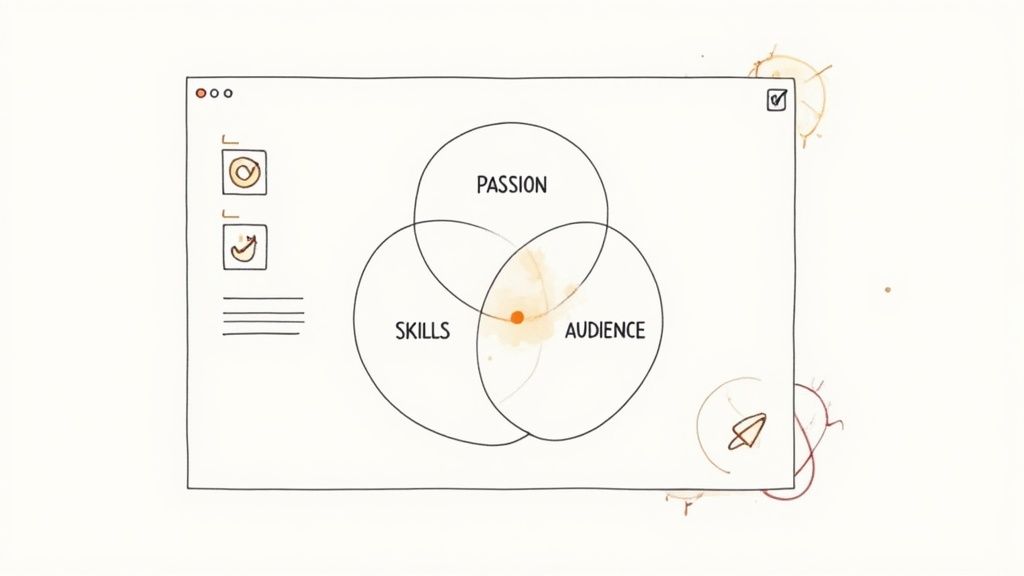
Think of it like building a house. You wouldn't just start throwing up walls, right? You'd need a blueprint. A great personal brand isn't built on random acts of content; it's a deliberate construction based on a strategic, authentic plan. Getting this part right makes all the other steps easier and far more effective.
This initial phase is all about introspection. It's about knowing yourself and knowing who you want to serve. To get a handle on the fundamentals, it helps to understand the core principles of how to create a brand that truly connects with people on a human level.
Define Your Unique Niche
Your niche is that perfect sweet spot where your passions, skills, and your audience's needs all overlap. It's the specific territory you want to own in people's minds.
"Marketing expert" is way too broad. But what about being the go-to person for "SEO for e-commerce startups"? Now that is a powerful, specific niche.
To nail yours down, ask yourself a few honest questions:
- What do I genuinely love? What could I talk about for hours without getting bored? This is what will keep you going.
- What am I actually good at? Where do my skills lie? What problems can I solve better than most?
- What do people need help with? Where's a clear gap in the market that my skills can fill?
The answer lies right in the middle of that Venn diagram. That's your home base. It’s where you can provide massive value without burning out.
Understand Your Target Audience
You can't be everything to everyone. If you try to talk to a general audience, you end up resonating with no one. The real magic happens when you define a specific group of people you want to serve and get to know them inside and out.
Go beyond basic demographics like age or job title. Dig into their psychographics:
- What are their goals and aspirations? What's the future they're trying to build?
- What are their biggest pain points? What's keeping them up at night?
- How do they consume content? Are they podcast listeners, article readers, or short-form video scrollers?
Try creating a simple "audience persona"—a fictional character who represents your ideal follower. Give them a name, a job, and a list of their biggest headaches. From now on, every piece of content you create is for them.
When you focus on a specific audience, your message stops being a broadcast and starts feeling like a one-on-one conversation. This is how you build a loyal community that feels seen and understood.
Articulate Your Core Values and Mission
Your values are the non-negotiables—the guiding principles for everything your brand does. They're your compass. Are you all about transparency, relentless innovation, or building community? Take a minute and write down three to five core values that truly represent who you are.
These values become the bedrock of your mission statement, which is just a clear, simple answer to the question, "Why do you do what you do?"
For example, your mission might be: "To empower small business owners with simple, actionable marketing strategies to help them grow sustainably."
This mission is your north star. It keeps you on track and ensures every action you take is aligned with your purpose. This kind of authentic alignment is what people connect with on a deeper level. The data backs this up, too—86% of shoppers say they prefer brands that are transparent and genuine. You can dive deeper into how authenticity shapes consumer behavior in this report on personal branding statistics.
Crafting a Memorable Brand Identity
Once you’ve nailed down your mission, it's time to bring it to life. This is where you translate those core values and big ideas into a tangible, recognizable experience for your audience. You're essentially giving your brand a distinct face and a unique voice.
A strong identity means people know it’s you the second they see your work, whether it’s your profile picture popping up in their feed, an email landing in their inbox, or a video you’ve published. This goes way beyond just picking a few colors you like; it's about building a cohesive system that communicates who you are without you having to say a single word.
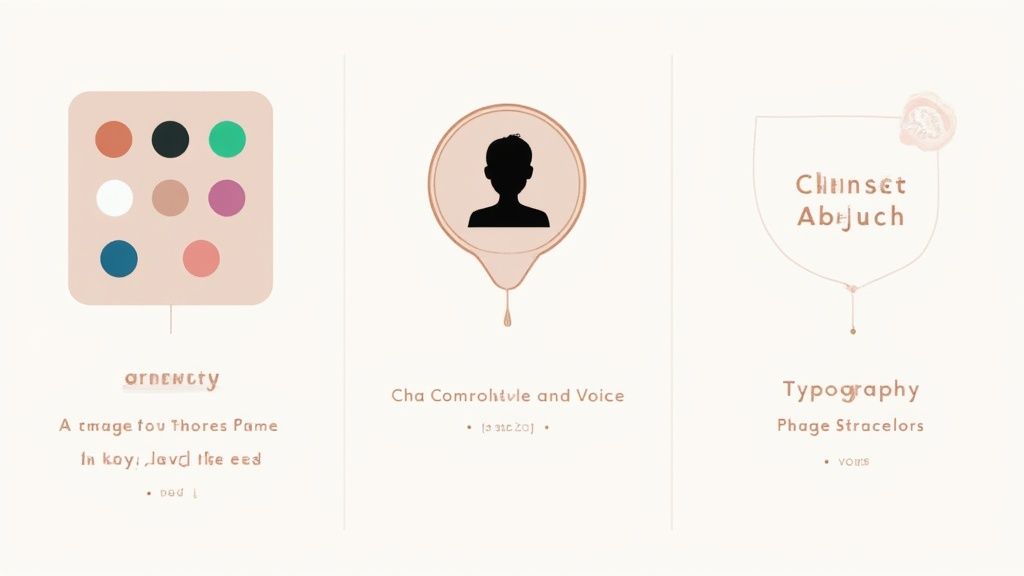
Developing Your Visual Style
First up, let’s talk aesthetics. Your visual identity is what people see. The goal here is relentless consistency, especially since 90% of information sent to our brains is visual. The good news? You don’t need to be a professional designer to pull this off.
Focus on getting these core elements right:
- Color Palette: Stick to two or three primary colors that feel authentic to your brand's personality. Are you energetic and bold? Maybe a bright orange or yellow is your speed. If you're building a brand around trust and calm, a deep blue might be a better fit.
- Typography: Pick two fonts that work well together—one for headings, one for body text. Make sure they’re easy to read and match the vibe you’re going for. Google Fonts is a fantastic resource with a massive library of free, high-quality options.
- Professional Headshot: This is non-negotiable. Invest in a high-quality, professional photo of yourself. Use that exact same photo everywhere—LinkedIn, your website, your guest post bios. It creates instant recognition.
These pieces come together to form your visual signature. Think of it as your brand’s uniform; it makes you immediately identifiable in a sea of digital noise.
Your personal brand is what you stand for—the package of character traits and capabilities that make you who you are, expressed in a way that others can understand right away. Your visual and verbal identity are the tools you use to express it.
Finding Your Unique Brand Voice
Just as important as how your brand looks is how it sounds. Your brand voice is the personality that shines through in all your communication. It’s the difference between sounding like a stuffy academic journal and a helpful, approachable friend.
To pin down your voice, start brainstorming adjectives. How do you want people to perceive you when they read your words? Witty and informal? Authoritative and direct? Thoughtful and inquisitive? This personality should flow directly from your core mission and values. For a deeper dive into this, check out this great resource on what is brand voice and how it shapes the way your audience feels about you.
Once you find that voice, use it everywhere—from a quick caption on a social post to the way you sign off your emails.
Crafting Your Core Messages
With your voice dialed in, you can start shaping your core messages. These are the key talking points that clearly and concisely communicate your value. A great place to start is by creating a powerful, adaptable bio.
Your bio should be a lightning-fast answer to three simple questions:
- Who are you? (e.g., "A content strategist…")
- Who do you help? (e.g., "…for early-stage tech startups…")
- How do you help them? (e.g., "…by creating clear, compelling narratives that attract investors and early adopters.")
This simple framework isn't just for your social profiles. It becomes the foundation for your elevator pitch and the "About Me" page on your website. It’s a versatile little tool that helps you talk about what you do with confidence and clarity, making sure your message doesn't just get heard—it gets remembered.
Creating Content That Builds Authority
You’ve laid the groundwork for your personal brand—you know who you are and who you’re talking to. But a brand is just an empty shell until you start proving your value. This is where your content strategy kicks in. It’s the engine that powers your reputation and builds real trust.
Think of it this way: every single post, video, or article is a chance to deliver on the promise your brand makes. When you do it right, your content stops being noise and starts being a magnet, pulling in the right people and opportunities. It’s how you become the go-to expert in your space.
Define Your Core Content Pillars
You can’t be the expert on everything. It’s a classic mistake. Trying to cover too much ground just waters down your message and leaves people confused about what you actually do. The secret is to focus.
Pick three to five core content pillars—these are the big-picture topics you want to own.
These pillars should be a direct reflection of your niche and the problems you solve for your audience. For instance, if your personal brand is all about helping freelance writers grow their business, your pillars might look something like this:
- Finding Great Clients: Actionable strategies for landing high-paying, long-term work.
- Productivity & Workflows: The tools, systems, and habits needed to manage projects without going insane.
- The Business of Writing: Nitty-gritty advice on pricing, contracts, and managing your finances.
- Leveling Up Your Craft: Tips for expanding your skills beyond just writing, like SEO or content strategy.
Every piece of content you create should tie back to one of these pillars. This keeps you focused, reinforces your expertise, and makes it incredibly clear to your audience why they should stick around.
Your content pillars are the load-bearing walls of your personal brand. They provide structure, support your authority, and give your audience a clear reason to follow you.
Map Out a Realistic Content Calendar
Consistency is everything in personal branding. If you only show up sporadically, you’ll kill your momentum before it even starts. The fix is a content calendar—a simple roadmap for what you'll post, where you’ll post it, and when.
This doesn't have to be some beast of a spreadsheet. Seriously, a weekly schedule in your notes app works just fine. The goal is to create a rhythm that you can actually stick to. Burnout is the number one enemy of a strong personal brand, so be realistic.
Here’s what a sustainable weekly rhythm might look like:
- Monday: Publish a deep-dive blog post on a Pillar 1 topic.
- Tuesday: Pull a key insight from that article and share it on LinkedIn with a sharp visual.
- Wednesday: Film a quick video for Instagram Reels summarizing a single, powerful tip from the post.
- Thursday: Jump into a relevant conversation on X (formerly Twitter) related to a Pillar 2 topic.
- Friday: Send out your newsletter with a personal story tied to the week's theme, linking back to the full article.
This approach creates a cohesive experience for your audience and gives you a masterclass in how to create engaging content by showing up on different platforms with formats people actually enjoy.
Tailor Your Content for Each Platform
While your core message stays the same, how you deliver it has to change. A post that crushes it on LinkedIn will probably get crickets on Instagram. Why? Every platform has its own unwritten rules, audience expectations, and content styles.
The trick is to adapt, not just copy and paste. Ask yourself why someone is scrolling on that specific app. Are they looking for professional development, a quick laugh, or a detailed tutorial? Your content needs to match that intent.
The table below breaks down a simple strategy for the main platforms. Think of it as a starting point for customizing your approach.
Platform-Specific Content Strategy
| Platform | Primary Content Format | Recommended Frequency | Key Goal |
|---|---|---|---|
| Text-based posts, articles, carousels | 2-3 times per week | Establish professional authority, network with peers | |
| X (Twitter) | Short-form text, threads, memes, quick insights | 3-5 times per day | Join real-time conversations, share timely thoughts |
| High-quality visuals, Reels, Stories | 3-5 times per week | Showcase personality, build community visually | |
| Blog/Website | In-depth articles, case studies, guides | 1-2 times per month | Build SEO authority, provide deep value |
Adapting your content shows you understand the culture of each platform, which is a small detail that makes a huge difference in how your brand is perceived.
Maximize Your Reach Through Repurposing
Creating truly great content is hard work. It takes time, energy, and a lot of brainpower. So don't let a fantastic idea be a one-hit wonder.
Repurposing is the art of taking one big piece of content and slicing and dicing it into smaller formats for all your different channels. This is how you work smarter, not harder. It maximizes the return on your effort and hammers your message home across your entire digital footprint.
A single, well-researched blog post can easily fuel an entire week's worth of content.
Here’s how a 1,500-word blog post can be repurposed:
- It becomes a 10-slide carousel for LinkedIn that highlights the key takeaways.
- You can pull out quotes to create five unique graphics for X or Instagram Stories.
- It serves as the script for a 60-second video on Instagram Reels or TikTok.
- You can expand on one specific section to create a deeply personal email newsletter.
When you adopt a repurposing mindset, you stop feeling the pressure to constantly be "on" and inventing new things from scratch. You create a system that allows you to show up consistently and efficiently, which is the real key to building a brand that lasts.
Establishing Your Digital Footprint
Now that you’ve defined your mission and brand identity, it’s time to actually show up online. A powerful personal brand requires a strong, intentional presence—this is your digital footprint. Think of it as the sum of all your online activities: your social profiles, the content you share, and every interaction you have. It all adds up to tell the world who you are.
This isn't just about posting randomly on social media. It's about strategically carving out your space on the platforms that matter most for your goals and your audience. Before you start, it’s worth taking a moment to understand what exactly is a digital footprint and all the pieces that go into it.
Choosing Your Core Platforms
Here’s a secret: you don't need to be everywhere. Trying to maintain an active presence on every single platform is a surefire recipe for burnout and mediocre results. The real key is to pick one or two "home base" platforms where you'll focus most of your energy, and maybe another one or two for lighter engagement.
Your choice should come down to two simple questions:
- Where is my audience? If you're trying to reach C-suite executives, LinkedIn is non-negotiable. If you're a designer connecting with other creatives, Instagram or Pinterest is probably where you need to be.
- What format fits me best? If you love writing in-depth articles, a personal blog and LinkedIn are a perfect match. If you come alive on camera, YouTube should be your top priority.
For most professionals, the winning combination is a personal website and a primary social channel like LinkedIn. Your website is your owned real estate—the one place where you have total control. Social platforms are more like rented space; they're fantastic for discovery and building community, but you're always at the mercy of their algorithms.
Your digital footprint is your modern-day resume, business card, and reputation all rolled into one. Owning the first page of Google for your name isn't a vanity metric; it's a fundamental part of professional credibility.
Optimizing Your Profiles for Discovery
Once you've picked your platforms, the next job is to make sure people can actually find you. Your profiles are often the very first impression someone has of your brand, so they need to be sharp, consistent, and immediately communicate your value.
Start by grabbing a consistent username or handle across all your channels. This makes it dead simple for people to find you everywhere. Then, write a bio that clearly states who you are, who you help, and how you do it. This is no time for vague jargon—be direct and focus on the value you provide.
Most importantly, sprinkle in the keywords your ideal audience would use to find someone like you. Think from their perspective. If you're a "leadership coach for first-time managers," those exact words should be in your LinkedIn headline, your website's meta description, and your social media bios. This basic SEO helps the right people and opportunities come to you. For a much deeper dive, our guide on how to build a personal brand on LinkedIn has a ton of specific tips.
Taking Control of Your Search Results
Owning your name on Google is a massive part of managing your reputation. The data here is pretty eye-opening: one billion names are Googled every day, yet only about half of all people own the top search result for their own name. Even worse, around 25% of people have zero positive content on the first page of their search results.
This is precisely why having optimized profiles on authoritative sites is so critical. A polished LinkedIn profile, a personal website, and even a guest post on a respected industry blog can quickly climb the ranks and dominate the first page of Google for your name, pushing down anything irrelevant or negative.
A strong digital presence is built on a solid content strategy that brings together core pillars, a consistent calendar, and smart repurposing.
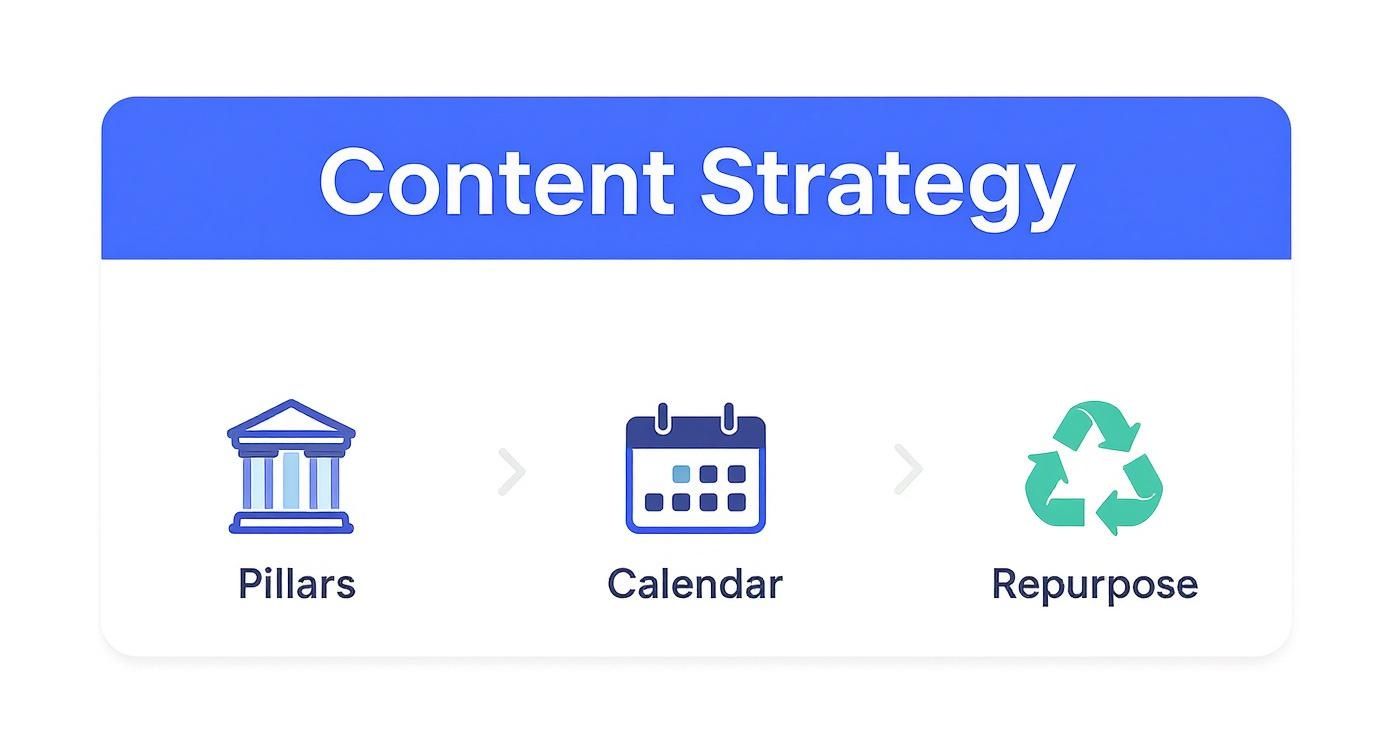
As you can see, a successful content engine relies on foundational topics (pillars), a structured plan (calendar), and efficient reuse of your best ideas (repurpose). When you thoughtfully establish your digital footprint across the right channels and optimize it for discovery, you build a powerful online presence that works for you 24/7.
Growing an Engaged Community
Your personal brand doesn't truly come alive until you stop just broadcasting and start building a real community. Pushing out content is only half the job. The real leverage comes from creating a tribe of people who are genuinely invested in what you do. This is the big shift from simply collecting followers to cultivating advocates.
It all comes down to creating a space where people feel seen, heard, and valued. You have to move past one-way communication and actually build relationships. An engaged community doesn’t just consume what you create—they share it, defend it, and champion it.
Join the Right Conversations
Look, the fastest way to get in the game is to go where people are already talking. Don't sit back and wait for them to discover you. You need to actively find the communities and discussions happening in your niche. This isn't about shameless self-promotion; it's about being generous with your time and knowledge.
Start by mapping out the key hashtags, the big players, and the active groups on your chosen platforms. On LinkedIn, this might mean jumping into industry-specific groups. Over on X (formerly Twitter), it's about following relevant lists and getting involved in trending chats.
Your only goal should be to show up and add value. Answer a question. Offer a perspective no one else has. Share a resource that genuinely helps. When you do this consistently without asking for anything, you naturally build credibility, and the right people will start finding their way to you.
Engaging thoughtfully in existing communities isn't just networking. It's a live demonstration of your expertise. This is how you earn the reputation as the go-to person in your field.
Master the Art of Outreach
Strategic outreach is about building bridges, not just spamming inboxes. A single, well-crafted message to a peer, a potential mentor, or someone you look up to can open doors you never thought possible. The whole trick is to make it personal, specific, and centered on them, not you.
For the love of all that is good, avoid generic templates. Your outreach has to prove you've actually done your homework and engaged with their work.
Here are a few ways to approach this that actually work:
- The Compliment & Question: "Hi [Name], I loved your recent article on [Topic]. The point you made about [Specific Insight] really clicked for me. I was curious, have you considered how [Related Concept] might play into that?"
- The Value-First Offer: "Hi [Name], I've been following your work on [Project] and saw you're exploring [Area]. I just stumbled on this resource about [Specific Tool] and thought it might be genuinely useful for your team. Here’s the link, no strings attached."
- The Collaborative Idea: "Hi [Name], your take on [Niche] is fantastic. I'm putting together a piece on [Overlapping Topic] and would be honored to feature a quote from you. Would you be open to a quick 5-minute chat about it?"
This kind of thoughtful approach respects their time and instantly cuts through the noise.
Turn Followers into Advocates
Engagement is a two-way street. Simple as that. Once people start trickling in, your focus has to shift to nurturing those connections. This is how you turn passive followers into a loyal community that actively amplifies your brand for you.
It's all about small, consistent actions that prove you're listening. When someone leaves a thoughtful comment, don't just hit "like"—write back with an equally thoughtful reply. Ask a follow-up question. Spark a real conversation. It signals that you actually value what they have to say.
Another powerful move? Just ask your audience what they want. Ask them what they need help with or what challenges they're wrestling with. When you create content that directly solves their problems, you build a kind of loyalty that can't be bought. Every single interaction is a chance to strengthen a relationship and make your brand more solid.
Got Questions About Personal Branding? Let's Talk.
Building a personal brand is a marathon, not a sprint, and it's totally normal to have questions pop up. I’ve been there. This is your no-fluff FAQ section, where I'll tackle the common hang-ups and mental roadblocks I see all the time. The goal here is to give you clear, practical advice to keep you moving.
"How Much Time Does This Actually Take?"
This is the big one, right? The honest answer is: it depends, but what really matters is consistency. You don't need to dedicate eight hours a day to this. In fact, that's a recipe for burnout. The real secret is finding a sustainable rhythm you can stick with for the long haul.
For most people just starting out, a focused 30-60 minutes per day is more than enough to build serious momentum. This isn't about mindlessly scrolling your feed; it’s about intentional, focused action.
Here's what that could look like:
- 15 minutes on engagement: Jump into the conversation. Respond to comments on your posts, answer DMs, and leave thoughtful replies on content from others in your space.
- 30 minutes on content creation: This is your core activity. Draft a post for tomorrow, outline a video script, or break down a bigger piece of content into smaller, bite-sized formats.
- 15 minutes on outreach: Find one new, interesting person to connect with. Share a resource with someone who might find it helpful. Follow up on a conversation you started yesterday.
The key is to block this time on your calendar. Treat it like a meeting you can't miss. Consistency will always, always beat short bursts of intense effort.
Building a personal brand is less about massive, one-off efforts and more about the small, daily deposits of value you make over time. It’s a compound interest game.
"But What if I Feel Like a Total Imposter?"
Welcome to the club. Seriously. Imposter syndrome is practically a rite of passage when you start putting yourself out there. It’s that nagging voice in your head asking, "Who am I to talk about this stuff?"
The best way I've found to shut that voice down is to reframe your role. Stop trying to be an "expert" and start thinking of yourself as a "guide." You don't need to have all the answers. You just need to be one or two steps ahead of the people you want to help.
Remember, your unique experiences and your specific point of view are incredibly valuable. Just document your journey. Share what you're learning as you're learning it. Focus on the real-world problems you're solving for people. Your audience isn't looking for a flawless guru on a mountaintop; they're looking for someone relatable who can help them take the next step.
"Can I Even Do This With a Full-Time Job?"
Absolutely. In fact, having a 9-to-5 can be a huge advantage. Your job is a real-world lab where you can test ideas, gather insights, and find an endless stream of relevant stories for your content.
You just have to be smart and efficient with your time.
- Pick One Playground: Don't try to be everywhere at once. Get really good at one channel first. If you're in a professional field, LinkedIn is probably your best bet.
- Batch Your Work: Set aside a couple of hours on a Sunday afternoon to plan, write, and schedule all of your content for the week ahead. Game changer.
- Repurpose Everything: That one insightful post you wrote? It can also become a short video, a few key takeaways for a Twitter thread, and a talking point for your next networking call. Squeeze every drop of value out of your ideas.
Think of your personal brand as a powerful complement to your career. It can open doors to promotions, speaking gigs, and side projects you never would have found otherwise.
"What if My Niche Is Already Way Too Crowded?"
It’s easy to look at a popular space and think, "It's all been said before." But that's looking at it all wrong. A crowded niche is just proof that people care about this topic. It's proof of high demand.
Your job isn't to be the only voice; it's to be a unique one. Nobody on earth has your specific blend of skills, personal stories, and personality. That's your unfair advantage.
So, instead of trying to out-expert the established names, lean into what makes you different. Maybe it’s your quirky sense of humor. Maybe you're amazing at creating simple visuals to explain complex topics. Or maybe you can serve a tiny, overlooked sub-group within that bigger audience. Your personality is the one thing no one else can ever copy, so use it.
At ReachLabs.ai, we help professionals and businesses build influential brands that cut through the noise. Our team works together, blending smart strategy with creative execution to build a voice that gets heard. Find out more about how we can help you build your personal brand.