

When you’re searching for the right micro-influencers, it’s about much more than just follower counts. The real gold is in their engagement, their authenticity, and the genuine connection they have with their audience. You’re looking for creators who have built actual trust within a niche community—that’s what leads to higher engagement rates and a return on investment you can actually see.
Why Micro-Influencers Are a Smarter Investment
Let’s get one thing straight: the old idea that a massive follower count is the only metric that matters is dead. The game has completely changed. Smart brands are quickly realizing that micro-influencers (those with followings between 10,000 and 100,000) are more than just a budget-friendly choice; they’re a powerful strategic weapon.
Their real power comes from their authenticity. When a micro-influencer talks about a product, it doesn’t feel like a polished ad. It feels like a genuine recommendation from a friend you trust. That kind of rapport translates directly into much higher engagement. While celebrities and macro-influencers are broadcasting to millions, micro-influencers are starting conversations within tight-knit communities. This means more comments, more shares, and way more meaningful interactions.
This image really drives home the key differences in follower counts versus the all-important average engagement rates.
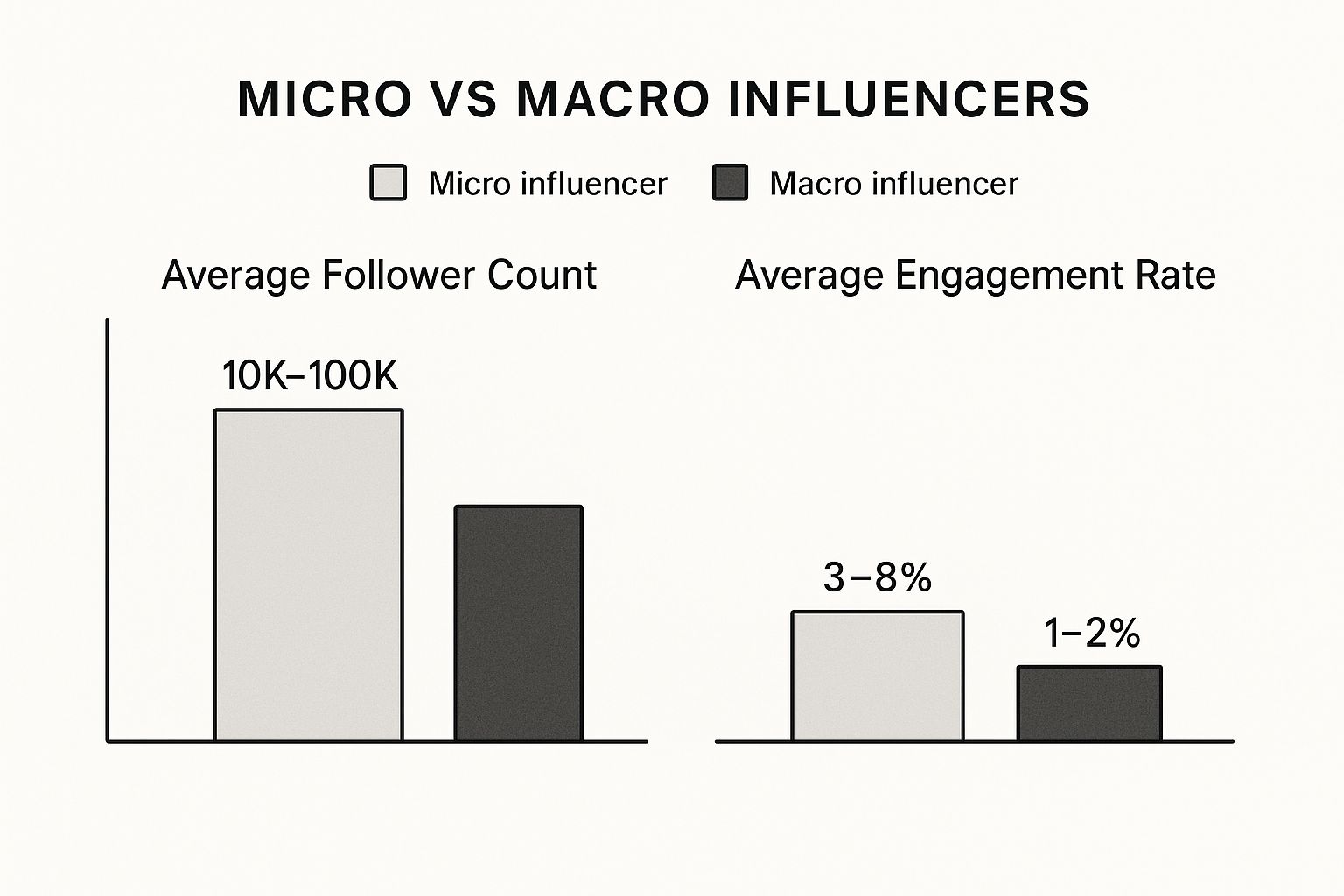
The data doesn’t lie. While the big names have a wider reach, micro-influencers consistently deliver more bang for your buck in terms of engagement per follower.
To make this even clearer, let’s break down the key differences in a quick comparison.
Micro-Influencers vs. Macro-Influencers at a Glance
| Attribute | Micro-Influencers (10k-100k Followers) | Macro-Influencers (100k-1M+ Followers) |
|---|---|---|
| Engagement Rate | Typically much higher (2-5% or more) | Often lower (1-2%) |
| Audience Connection | Strong, personal, and community-focused | Broader, more distant, and less personal |
| Authenticity | Perceived as highly authentic and relatable | Can feel more commercial and polished |
| Niche Authority | Deep expertise in very specific topics | General appeal across a wider category |
| Cost | More affordable and budget-friendly | Significantly more expensive |
| Reach | Targeted and focused | Massive and broad |
This table shows that it’s not about which one is “better,” but which one is right for your goals. If you’re after deep, targeted engagement and trust, micro-influencers are often the smarter play.
The Business Case for Niche Authority
Micro-influencers are usually true experts in a specific niche, whether that’s sustainable fashion, vegan cooking, or retro gaming. They live and breathe their topic. This intense focus means their followers are incredibly invested and passionate, making them the perfect audience for brands in that same space. When you partner with them, you’re tapping directly into a pre-qualified and enthusiastic group of consumers.
This targeted approach can be a game-changer, especially for smaller companies trying to make a real impact. If you want to dive deeper, our guide on influencer marketing for small business has more strategies you can put into action.
The real value of micro-influencers isn’t just that they cost less. It’s their power to drive high-quality engagement within a specific demographic. Their recommendations simply carry more weight because they’re seen as peers, not untouchable celebrities.
The market data backs this up completely. The global influencer marketing industry is expected to hit a staggering $32.55 billion in 2025, a huge leap from 2024. This growth is fueled by pure confidence, with over 80% of marketers confirming that influencer marketing is a highly effective strategy for their brands, according to the latest benchmark report from Influencer Marketing Hub.
Finding Authentic Creators in Your Niche

Going beyond a simple hashtag search is where you’ll find the real gems. The aim isn’t just to find accounts with a decent follower count; it’s to discover creators who are already genuinely into your industry. This is how you find partnerships that feel right and actually connect with an audience.
The best way to start? Think like your ideal customer. Where do they spend their time online? What forums, groups, or communities are they part of? The answers to these questions will point you straight to the creators they already listen to and trust.
Dive Into Your Competitors’ Community
A brilliant, and often overlooked, starting point is to see who your competitors are working with—but maybe not in the way you’d expect. Forget their official sponsored posts for a minute. Instead, go look at their tagged photos on Instagram.
This is an absolute goldmine. You’ll find creators who are talking about brands in your space without being paid to do it. These are the real fans, the people who are already passionate about the kinds of products you offer, making them perfect potential partners. It’s a completely unfiltered look at who’s really engaged in your niche.
While you’re there, take a look at your competitors’ follower lists. Who’s commenting and liking their posts? You’ll often find smaller creators who are super active and influential within that specific crowd.
Master Advanced Search and Discovery Techniques
Searching manually helps you uncover creators that automated tools might completely miss. It’s all about being clever and knowing where to find genuine conversations happening. Here are a few solid, organic methods you can try today:
- Follow the “People Also Follow” Trail: Find one creator who feels like a good fit and head to their profile. Instagram will often suggest similar accounts, which can lead you down a rabbit hole of perfectly relevant influencers.
- Check Out Niche Communities: Don’t just stick to the big social media platforms. Places like Reddit (in specific subreddits), Discord servers, or private Facebook Groups are where the most passionate discussions happen. Find out who the key voices are in those spaces.
- Use Location and Event Tags: This is a must if your business is local. Search for location tags in your city or hashtags from relevant local conferences, festivals, and events. It’s a direct way to find creators with real regional pull.
The most authentic partnerships often come from creators who would have used your product even without a sponsorship. Finding these individuals should be your primary objective during the discovery phase.
Uncovering Hidden Gems on TikTok and Beyond
These hands-on discovery methods work everywhere, not just on Instagram. TikTok’s ‘For You’ page, for instance, is an incredible discovery tool. If you start engaging with content related to your niche, the algorithm will begin serving up more and more creators who align with your brand.
Pay attention to consistency in their content and look for real interaction in the comments. Are they actually replying to their followers and building a community? Answering that question helps you sort the one-hit wonders from creators with genuine, lasting influence. Yes, these methods take more time, but the reward is a hand-picked list of creators who are a perfect, authentic match for your brand.
Using Tools to Discover Influencers at Scale
Manual searching is a great way to find your first few high-quality creators, but it just doesn’t scale. When you need to build a solid list of potential partners, you’ll hit a wall pretty fast. This is where dedicated tools come in—they save a massive amount of time and give you data you could never find just by scrolling through feeds.
These platforms let you move beyond gut feelings and start making decisions based on real numbers. Instead of just looking at follower counts, you can instantly filter creators by the metrics that actually matter, like engagement rates, audience demographics, and even their history of brand collaborations. It’s the difference between guessing and building a targeted strategy.
The Power of Audience Intelligence Platforms
Some of the best tools on the market aren’t just influencer databases; they’re full-blown audience intelligence platforms. A fantastic example of this is SparkToro, which helps you figure out what your target audience actually reads, watches, and listens to online. It completely flips the script on how you find people.
Instead of starting your search by looking for influencers, you start with your ideal customer. You can plug in criteria like “people who talk about sustainable fashion” or “frequently visit websites about vegan skincare.” The platform then spits out the social accounts, websites, and podcasts that hold the most sway with that specific group.
Here’s a real-world example from SparkToro showing the social sources that influence an audience interested in “sustainable fashion.”
This kind of data is gold. It points you directly to the Instagram accounts and YouTube channels where your target audience is most concentrated, making your outreach efforts infinitely more effective.
Key Platforms for Influencer Discovery
The market for influencer tools is huge, with options for pretty much any need or budget. Knowing the main categories will help you pick the right one.
- Comprehensive Suites: Platforms like Upfluence or Grin are the all-in-one solution. They cover everything from discovery and vetting to outreach, campaign management, and even payments. They’re a great fit for teams running multiple campaigns at once.
- Discovery-Focused Tools: If your main goal is finding and analyzing creators, tools like HypeAuditor are perfect. They offer a deep dive into an influencer’s audience quality, helping you spot fake followers and get reliable engagement benchmarks.
- Social Listening Software: Tools like Brandwatch or Talkwalker aren’t built just for influencer marketing, but they’re incredibly good at it. You can set them up to find creators who are already talking about your brand or relevant keywords organically.
The best tool is simply the one that fits your workflow. If you’re just trying to build a high-quality prospect list, a discovery-focused platform will do the trick. But if you need to manage the entire partnership from start to finish, a comprehensive suite is a much better investment.
Finding the right micro-influencers is a mix of art and science. This has become even more true now that 42% of brands are working with nano and micro creators, showing a clear shift toward smaller, more authentic communities. And while Instagram remains the go-to platform for 93% of marketers, using the right tools helps you uncover hidden gems across every channel. You can dig deeper into these trends in this report on international influencer marketing.
Looking Past the Follower Count: How to Really Vet an Influencer
So, you’ve got a list of potential creators. That’s a great start, but now the real work begins. Vetting is where you separate the true partners from the budget-wasters, and it’s so much more than just looking at follower numbers.
Think of it less like a quick glance and more like a deep dive. A massive follower count can easily hide a ghost town of an audience, full of bots and unengaged users. We’re going to look at the stuff that actually matters: the quality of their engagement, the authenticity of their audience, and how well they actually align with your brand.
Are People Actually Listening? A Look at Engagement Quality
First things first, let’s talk about the engagement-to-follower ratio. I’d much rather work with a micro-influencer who has 20,000 followers and gets 1,000 likes on a post (that’s 5% engagement) than someone with 100,000 followers who only pulls in 2,000 likes (a measly 2%). The math is simple, and it often points to a more dedicated community.
But don’t just stop at the numbers. You have to scroll down and read the comments. Seriously. Are they just a wall of fire emojis and “Great post!” from other influencers? Or are people asking genuine questions, sharing their own stories, and tagging their friends? That’s the gold you’re looking for—an active, breathing community, not just a passive audience.
A lively, conversational comment section is one of the strongest signs of a healthy community. It tells you the creator has built a real connection, and that’s the kind of environment where your brand can actually thrive.
Spotting Fakes and Keeping It Real
Let’s be honest: the influencer world has a problem with fake followers and inflated engagement. It’s on you to develop a good eye for spotting the red flags so you don’t end up paying for a phantom audience.
Here’s a quick mental checklist I run through:
- Weird Follower Spikes: Pop their handle into a social media analytics tool and look at their growth history. If you see a massive, vertical jump out of nowhere, there’s a good chance they paid for a follower boost.
- Bot-Filled Comments: You know the type—generic comments from accounts with no profile picture and a bizarre username. This is a huge red flag.
- Sketchy Ratios: Be wary of accounts that follow 7,000 people but only have 1,500 followers themselves, yet they’re commenting everywhere. They might be part of an “engagement pod,” which is just a way to game the algorithm.
This kind of diligence is precisely why the industry is shifting. A recent report showed that a staggering 86% of U.S. brand marketers are planning to work with micro-influencers this year. In fact, they’re choosing them 10 times more than mega-celebrities. Why? Because they know authenticity drives results. You can read more about this trend in this in-depth 2025 report.
Is It a Good Match? Assessing Brand Alignment
This last part is all about feel. Does this person’s vibe match your brand? A mismatch here can be awkward at best and brand-damaging at worst. Go back and scroll through their feed—not just the sponsored posts, but their everyday content, too.
Look for consistency in their voice, their visual style, and the overall quality of their work. How do they handle negative comments? Do they seem professional? Have they recently worked with one of your direct competitors?
Answering these questions helps you find someone who won’t just post about your product but will represent your brand well. Getting this right is what lets you accurately forecast your influencer marketing ROI and turns a decent partnership into a fantastic one.
Crafting Outreach That Actually Gets a Reply
You’ve done the hard work of finding and vetting the perfect micro-influencers. Now comes the final, and often most fumbled, step: actually reaching out. This is where so many brands drop the ball.
Think about it from their perspective. Micro-influencers are bombarded with dozens of generic, copy-pasted emails every single week. They’ve developed a sixth sense for spotting a low-effort pitch, and their finger hovers instinctively over the delete button.
Your job isn’t to just send another email. It’s to start a real conversation with a potential business partner. This requires a completely different mindset. You’re not just “buying a post”; you’re proposing a creative collaboration with someone who has painstakingly built a loyal community.
Treating them with respect from that very first message is non-negotiable. That means doing your homework and showing them they’re more than just another name on your spreadsheet.
The Anatomy of a Standout Outreach Message
A successful pitch really boils down to two things: genuine personalization and a crystal-clear value proposition. If you miss the mark on either one, your email is almost certainly destined for the trash folder. Vague flattery is transparent, so you need to prove you’ve actually paid attention to their work.
So, what does a compelling first message actually look like?
- A Hyper-Personalized Subject Line: Ditch the generic “Collaboration Opportunity.” Instead, reference something specific. Try something like, “Loved your recent post on sustainable coffee brands!” It immediately stands out.
- A Genuine Compliment: Kick things off by mentioning something specific you truly enjoyed about their content. This simple act shows you’ve done more than just glance at their profile.
- A Clear ‘Why’: Briefly connect the dots for them. Why do you think they are the perfect fit for your brand? Link their content style, audience demographics, or values directly to your product.
- The Value Proposition: This is the make-or-break moment. Be upfront and clear about what’s in it for them. Is it a paid partnership? A free product they can test and keep? An affiliate commission? Don’t be vague.
- A Simple Call-to-Action: End with a low-friction next step. Asking “Are you open to hearing more?” is much more approachable than demanding a media kit or rate sheet in the first email.
Your outreach email is your first impression. Make it count by proving you’re a potential partner who values their work, not just another brand looking for a cheap shoutout.
From Template to Genuine Connection
Sure, a template can be a decent starting point, but it should never be the final product. A message that feels even slightly automated is the kiss of death. The real magic happens when you customize every single email to reflect the individual creator you’re contacting.
Let’s say you’re a skincare brand reaching out to a beauty influencer. Don’t just say, “I love your content.”
Instead, reference a specific video where they reviewed a moisturizer and explain how your product addresses a particular concern they brought up. This small detail proves you’re paying attention and instantly makes your pitch 10x more powerful.
This kind of personalized approach is a cornerstone of any effective social media strategy for small business because it’s how you build the authentic relationships that lead to real results. The goal is to make the influencer feel seen and respected, which paves the way for a partnership built on mutual benefit—not just a one-off transaction.
Got Questions About Micro-Influencers? We’ve Got Answers.
Jumping into the world of micro-influencers often brings up a ton of questions, especially when you’re just getting your feet wet. Let’s tackle some of the most common ones I hear from brands, so you can move forward with confidence.
What’s the Right Way to Pay Micro-Influencers?
This is probably the number one question, and the honest answer is: it depends. There’s no universal rate card. Compensation really hinges on the creator’s experience, their audience engagement, and exactly what you’re asking them to do.
But don’t worry, the payment models are pretty flexible. Here are the most common approaches:
- Flat Fee: Simple and clean. You agree on a set price for specific deliverables, like one in-feed post and a few stories. Everyone knows what to expect.
- Product Gifting: This can work well, especially for creators who are just starting out or for smaller campaigns where the product has a high perceived value. The key is to be crystal clear about what you expect in return.
- Affiliate/Commission: This is a pure performance play. The influencer gets a cut of every sale they drive using their unique link or discount code. It’s low-risk for you, but can be a tough sell for established creators.
- Hybrid Model: This is often the sweet spot. You offer a smaller flat fee for their time and effort, plus a commission on sales. It gives the creator some guaranteed income while motivating them to push for conversions.
At the end of the day, treat your creators like the professional partners they are. Be upfront and fair about compensation. A clear value exchange is the bedrock of any strong, long-lasting partnership.
Do I Really Need a Contract?
Yes. 100% yes. Even if it’s just a “product for post” deal, a simple agreement is non-negotiable. It protects your brand, it protects the creator, and it sets the stage for a professional collaboration.
Think of it less as a scary legal document and more as a roadmap for your project. A solid agreement is your best defense against misunderstandings and ensures everyone is on the same page from day one.
What Absolutely Must Go in an Influencer Agreement?
Keep it clear and to the point. Your goal isn’t to confuse anyone with legal jargon; it’s to outline the partnership so there are no surprises.
Make sure your agreement always covers these key points:
- The Deliverables: What are they creating? Be specific (e.g., 1 Instagram Reel, 3 Instagram Stories with a link sticker).
- The Timeline: When are drafts due? When does the content go live? Put dates on the calendar.
- Content Rights: This is a big one. Who owns the content? Clearly state how and where you can repurpose their work (e.g., on your website, in email newsletters, for social ads).
- Exclusivity: Do you need them to avoid working with direct competitors for a while? Define that period clearly (e.g., for 30 days after the campaign ends).
- Compensation: Spell out the payment amount, how you’ll pay (e.g., PayPal, bank transfer), and when they can expect to receive it.
At ReachLabs.ai, we’re all about building influencer strategies that are backed by data and focused on connecting brands with truly authentic creators. If you’re ready to find partners who can drive real results, see how our team can make it happen.