

Trying to outspend real estate giants like Zillow is a losing battle. Let’s face it, their marketing budgets are colossal. But what if you could sidestep the shouting match and connect directly with genuinely motivated clients? This is where a smart PPC strategy gives you a serious competitive advantage.
Instead of fighting for broad attention, PPC allows you to target specific search terms and demographics. It’s a precision tool that lets individual agents and smaller firms punch well above their weight.
Why PPC Is Your Secret Weapon in Real Estate

Competing with platforms like Zillow and Realtor.com can feel impossible. They dominate search results and have advertising budgets that are simply out of reach for most of us. So, how do you carve out your own territory? The answer is to focus on precision, not just raw firepower.
This is exactly where Pay-Per-Click (PPC) advertising becomes your strategic equalizer. Forget casting a wide, expensive net. PPC is like fishing with a spear. You can zero in on motivated buyers and sellers the exact moment they show their hand—like when they search for “homes for sale in downtown Austin” or “how much is my house worth in Scottsdale.”
Gaining a Competitive Edge
While Zillow wins on brand recognition, you can win on local expertise. A well-crafted PPC campaign lets you compete head-to-head with the big players by focusing on what they often overlook: niche markets, specific property types, or hyper-local neighborhoods.
This targeted approach gives you some game-changing benefits:
- You Own the Lead: Leads from your PPC ads come straight to you. No more sharing with a half-dozen other agents.
- Smarter Spending: You only pay when someone interested enough to click actually engages with your ad. Every dollar works harder.
- Build Your Brand: Every ad and landing page promotes your name and expertise, not a massive third-party portal.
PPC puts you in control. You get to be in front of the right people, at the right time, with the exact right message. It’s about being the most relevant answer to a potential client’s immediate need.
Think about it this way: real estate Google Search ads have an average cost-per-click of just $2.37 and a respectable conversion rate of 2.47%. That data shows how even a modest, focused budget can deliver real, tangible results when you get the targeting right.
This level of efficiency is how you make sure your marketing efforts are laser-focused on generating high-quality leads and conversions. To get a better handle on the numbers, you can explore why pay-per-click done right is the answer for real estate professionals in our detailed guide.
Your PPC Advantage Against Portals
Here’s a quick breakdown of how a targeted PPC strategy directly counters the common challenges you face when relying on the major real estate platforms.
| Challenge | PPC Solution |
|---|---|
| Shared, Low-Quality Leads | Leads are exclusive to you, generated from users with specific, high-intent search queries. |
| No Brand Recognition | Your ads and landing pages build your personal or brokerage brand, establishing you as the local expert. |
| High, Unpredictable Costs | You set the budget and only pay for clicks, giving you full control over your ad spend. |
| Intense Agent Competition | You bypass the portal’s agent pool and appear directly in search results, often ahead of them. |
Ultimately, PPC isn’t just about buying clicks. It’s about strategically inserting yourself into the conversation at the most critical moment and proving you’re the expert they need.
Building a High-Intent Keyword Blueprint
Successful PPC advertising comes down to speaking your client’s language the moment they’re ready to make a move. Keywords like “homes for sale” might seem like a good idea, but they cast such a wide net that you end up paying for a lot of window shoppers. You get a mix of casual browsers and serious buyers, which drives up costs without delivering quality leads.
To really get an edge, you have to build your keyword strategy around user intent.
Your goal is to get past those generic, broad terms and create a blueprint that attracts motivated, ready-to-act inquiries. This means zeroing in on long-tail keywords—those longer, much more specific search phrases that people use when they’re further along in their buying journey.
Mastering Long-Tail Keywords
Think about the difference in mindset. Someone searching for “Phoenix real estate” is just starting their search. But someone typing in “four-bedroom home with pool in Chandler AZ”? That person knows exactly what they want.
Targeting these detailed phrases connects you with prospects who have already done the heavy lifting of defining their needs. You’re not just another agent; you’re the one with the answer to their very specific question.
Here’s how different long-tail keywords can reveal what a searcher is really after:
- Urgency: “relocating to Austin need to buy a house”
- Specific Features: “waterfront property for sale in Lake Tahoe”
- Financial Situation: “first-time homebuyer programs in Denver CO”
Building a solid list of these keywords is the first real step to focusing your marketing efforts on generating high-quality leads and conversions. This kind of precision is how you can effectively compete against the massive ad budgets of Zillow and Realtor.com—by owning specific, high-value niches they often overlook.
The Critical Role of Negative Keywords
Just as crucial as the keywords you bid on are the ones you tell Google to ignore. Negative keywords are terms you add to your campaign to stop your ads from showing up for totally irrelevant searches. Honestly, this is one of the fastest ways to eliminate wasted ad spend.
If you’re a real estate agent, you definitely don’t want to pay for clicks from people looking for:
- “real estate agent jobs”
- “apartments for rent”
- “real estate classes”
By adding terms like -jobs, -rent, and -classes as negatives, you immediately filter out that unqualified traffic. Your budget is then saved for clicks that can actually turn into commissions.
A strong negative keyword list is your first line of defense against low-quality traffic. I make it a habit to regularly check my search term reports to find and exclude irrelevant queries that are burning through my budget. This simple maintenance routine can radically improve your return on investment.
Niche-Specific Keyword Sets
A generic, one-size-fits-all keyword list just won’t cut it. Your blueprint needs to be customized to your specific market and your specialty. The key is to think like your ideal client.
Here’s how you could break down keyword sets for different real estate niches:
| Real Estate Niche | Example Long-Tail Keywords | Potential Negative Keywords |
|---|---|---|
| Luxury Properties | “luxury condos downtown Miami ocean view” | -cheap, -foreclosure, -mobile home |
| First-Time Buyers | “FHA-approved homes in Orlando FL” | -investment, -luxury, -rent to own |
| Relocation | “moving to Dallas best family neighborhoods” | -rentals, -apartments, -commercial |
When you create distinct ad groups for each niche, you can perfectly align your ad copy and landing pages with what the searcher is looking for. This alignment doesn’t just improve your Quality Score in Google’s eyes; it creates a much better experience for the user, dramatically boosting your chances of turning that click into a client.
Creating Ads and Landing Pages That Actually Convert
Let’s be honest, a click is just a click. It doesn’t pay the bills. The real magic happens when that click turns into a real conversation with a potential client. This is where the art and science of crafting compelling ad copy and dedicated landing pages come in, transforming a casual browser into a genuine opportunity.
Think of your ad as the first handshake. On a crowded search results page, it has to do more than just exist—it needs to grab attention and spark action. Forget bland, generic headlines. Your focus should be on what makes you or a specific listing stand out. A great ad zeros in on a specific pain point or highlights a killer feature that truly connects with your target audience.
Writing Ad Copy That Drives Clicks
The best ad copy doesn’t just list features; it speaks directly to a client’s dreams or solves their problems. Instead of simply stating “3 Bed, 2 Bath,” you need to showcase the value behind the facts. Craft headlines and descriptions that promise a clear, immediate benefit.
Here are a few examples I’ve seen work wonders:
- For Sellers: “Get a Certified Market Analysis in 24 Hours” or “Top Negotiator for Sellers in [Your Neighborhood].”
- For Buyers: “Exclusive Access to Off-Market Listings” or “Virtual 3D Tours Available for All Properties.”
- For a Niche: “VA Loan Specialists for Military Families.”
These examples instantly communicate your unique selling proposition. This specific, benefit-driven approach is how you ensure that their marketing efforts remain focused on generating high-quality leads and conversions, setting you apart from the sea of generic ads.
The data backs this up. The real estate industry boasts an impressive average click-through rate (CTR) of 9.09% on Google Ads, with a surprisingly low average cost-per-click of $1.55. This tells us one thing: when your message hits the mark, potential clients are ready and willing to engage.
The Anatomy of a High-Converting Landing Page
So, you’ve earned the click. Now what? The single biggest—and most expensive—mistake I see agents make is sending that hard-won traffic to their generic homepage. This forces visitors to hunt for information, and frankly, most won’t put in the effort. They’ll just leave.
Instead, every single ad campaign needs its own dedicated landing page. This page has one job and one job only: turn that visitor into a lead. The message must be a direct, seamless continuation of the promise you made in your ad.
A great landing page is focused. It removes all distractions—like navigation bars or links to other parts of your site—and guides the user toward a single, clear action.
An effective landing page isn’t just a pretty picture; it’s a strategic tool. It needs a few key components working together to build trust and drive action.
- A Powerful Headline: This should mirror your ad copy and instantly confirm the visitor is in the right place.
- Stunning Visuals: High-resolution photos or a sleek video tour aren’t just nice to have; they’re non-negotiable in real estate.
- A Simple Lead-Capture Form: Ask only for the essentials. Name, email, and phone number are usually enough. Remember, the fewer fields you have, the higher your conversion rate will be.
- Trust-Building Elements: This is your chance to show off. Add client testimonials, industry awards, or “As Seen In” logos to build instant credibility.
By creating a seamless journey from ad to landing page, you are improving the likelihood of converting clicks into leads. This cohesive experience respects the user’s time and intent, making them far more likely to trust you with their contact information.
Using Advanced Targeting to Find Your Ideal Client
Keyword targeting is the foundation of any solid PPC campaign, but it’s really just the price of entry. If you want to build a truly profitable lead-generation machine, you have to dig deeper. It’s not just about what people search for; it’s about who they are and where they’re searching from.
This is where the real magic happens. By layering on more specific targeting criteria, you can stop spraying your budget across a broad, uninterested audience. Instead, every dollar goes toward reaching people who actually fit your ideal client profile. This is how you stop competing on volume and start winning on quality.
Moving Beyond Keywords With Demographic Targeting
Think about your ideal client. Are they a certain age? A first-time buyer? Looking for a luxury property? Demographic targeting lets you zero in on these exact attributes. For real estate, this is a game-changer.
If you specialize in high-end downtown condos, you can focus your ads on people Google identifies in the top 10% of household income. If you’re the go-to agent for young families, you can narrow your audience to specific age brackets or people who have recently gotten married.
You can get incredibly specific here:
- Income Targeting: Perfect for agents in the luxury space or those who work within specific price brackets.
- Life Events: Platforms like Google Ads let you target users based on major life changes, like “likely to move soon” or “recently married.” These are massive buying signals.
Using these filters is a proactive way to weed out people who can’t afford your listings or just aren’t at the right stage of life to make a move. You’re making sure your message and your money are focused squarely on high-quality leads.
Hyper-Local Targeting With Geofencing and Geotargeting
One of the biggest advantages you have over massive portals like Zillow and Realtor.com is your local expertise. PPC lets you weaponize that knowledge through surgical geographic targeting.
Geotargeting is your bread and butter here. It allows you to serve ads only to people in specific zip codes, cities, or even within a one-mile radius of a particular school. This is fantastic for farming a neighborhood or promoting a new listing.
Geofencing is the next level. Imagine drawing a virtual perimeter around a competitor’s open house. You can then serve ads directly to the smartphones of everyone who walks inside. You can do the same for new construction sales offices, home and garden shows, or popular local spots. You’re reaching potential clients right at their moment of highest intent.
I once ran a geofencing campaign for a buyer’s agent, targeting the sales office of a huge new-build community. The leads were incredible—not just qualified, but actively looking for an agent to represent them. The ROI was off the charts.
Re-Engaging Warm Leads With Remarketing
What happens to all those people who click your ad, browse a few listings on your site, and then leave without filling out a form? Don’t just let them walk away.
Remarketing (or retargeting) is your secret weapon for bringing them back. It lets you show follow-up ads to those exact users as they browse other sites, scroll through social media, or watch videos on YouTube. They already know who you are; sometimes, they just need a gentle nudge to come back and take the next step.
When setting up these advanced campaigns, you’ll need to align your targeting with the right bidding strategy.
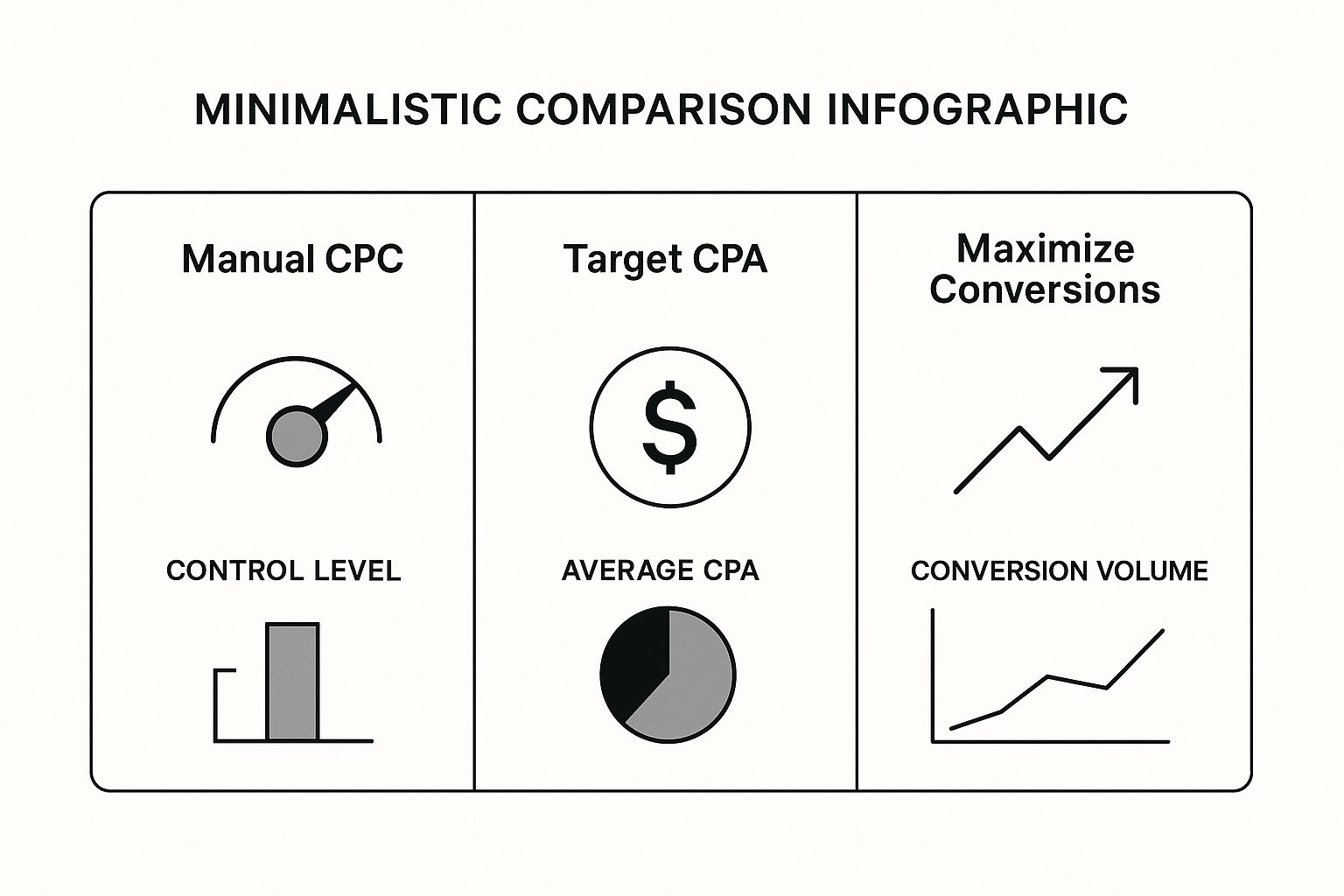
This chart helps visualize the trade-offs. For a broad geofencing campaign, you might start with a “Maximize Clicks” bid to gather data. For a highly-focused remarketing campaign, switching to “Maximize Conversions” tells Google to aggressively go after those returning visitors who are most likely to convert.
To help you decide where to focus your budget, here’s a quick breakdown of these advanced targeting options.
Choosing the Right Targeting Method
| Targeting Method | Best Use Case | Example |
|---|---|---|
| Demographics | Reaching clients with specific life or financial profiles. | Target users aged 28-40 in the top 20% of household income for a “move-up buyer” campaign. |
| Geotargeting | Establishing yourself as a neighborhood expert or promoting local listings. | Run ads for a new listing only within a 5-mile radius or specific zip codes. |
| Geofencing | Capturing high-intent leads from specific physical locations in real time. | Serve ads to people who visit a competitor’s open house or a local mortgage lender’s office. |
| Remarketing | Re-engaging past website visitors who didn’t convert. | Show a video testimonial ad on YouTube to anyone who viewed 3+ listings on your site last week. |
Ultimately, the most powerful PPC campaigns don’t rely on just one of these methods. They layer them together—for example, remarketing to users in a specific high-income zip code who have visited your website. This is how you build a system that consistently delivers high-quality, exclusive leads.
How to Measure and Maximize Your PPC ROI
Anyone who tells you PPC advertising is a “set it and forget it” channel is either lying or wasting money. Launching a campaign is just firing the starting gun. The real race—and the real profit—is won by constantly listening to your data and making smart, strategic adjustments.
It’s easy to get caught up in vanity metrics like clicks and impressions. They look impressive on a report, but they don’t pay the bills. If you want to build a truly successful PPC machine, you have to focus relentlessly on the numbers that directly impact your bottom line.
Key Metrics That Actually Matter
To get a clear, honest look at your campaign’s health, you need to track a few essential key performance indicators (KPIs). These are the metrics that cut through the noise and tell you what’s really working.
Here are the absolute must-haves:
- Cost Per Lead (CPL): This is your efficiency score. It tells you exactly how much you’re paying to get a single person to raise their hand. The formula is simple: Total Ad Spend ÷ Total Leads. The lower, the better.
- Lead-to-Client Conversion Rate: This is where marketing hands off to sales. It measures how many of those leads you generated actually become paying customers.
- Return on Ad Spend (ROAS): This is the big one—the ultimate measure of profitability. For every dollar you put into your ads, how many dollars in revenue came back out? A high ROAS means you’ve built a money-making engine.
Keeping a close eye on these KPIs is the only way to ensure your marketing efforts stay locked on generating high-quality leads and conversions. This is how you gain a real competitive edge over those who are just burning cash on ads without a clear strategy for measuring success.
Turning Data Into Decisions
Once you’re tracking the right numbers, you can start making data-backed decisions. This is the part where you graduate from simply running ads to actively optimizing them. Think of it like a mechanic fine-tuning a high-performance engine—small, precise tweaks can unlock massive gains.
The goal is to create a constant feedback loop. You run your ads, dive into the data, make an informed change, and then measure the result. This cycle of testing and refining is what separates struggling campaigns from wildly successful ones.
Start by digging into your Google Ads reports. Which keywords and ad groups are your top performers? If you spot a keyword with a sky-high CPL, it might be time to pause it and reallocate that budget. If an ad has a stellar click-through rate but nobody converts, the problem probably isn’t the ad—it’s your landing page.
One of the best ways to get clear, actionable insights is through A/B testing. It’s a straightforward concept: run two slightly different versions of an ad or landing page to see which one performs better. You can test anything—headlines, button colors, calls to action, images. I’ve seen tiny changes, like tweaking a single word in a headline, lead to significant bumps in conversion rates.
The payoff for this diligence can be huge. On average, businesses can earn $2 for every $1 spent on PPC, with some campaigns seeing returns as high as 800%. You can explore the numbers behind PPC ROI to see just how powerful this can be when managed correctly.
Ultimately, by consistently measuring performance and making improvements, you maximize your results. If you’re ready to go deeper, check out our guide on how PPC provides measurable results to track and analyze campaign performance. This data-driven approach is how you transform your ad budget from a simple expense into a powerful, profit-generating investment.
Your Top Real Estate PPC Questions, Answered
Jumping into pay-per-click advertising can feel like a big leap, especially if your background is in more traditional real estate marketing. It’s completely normal to have questions about how much to spend, when you’ll see a return, and how this all stacks up against the big listing sites. Let’s dig into the questions I hear most often from agents.
What’s a Realistic PPC Budget for a Real Estate Agent?
There isn’t a one-size-fits-all answer, but thinking of PPC as an investment is the right place to start. Most agents getting their feet wet will set a monthly budget somewhere between $500 and $2,000. That said, the right number for you really boils down to how competitive your local market is and what you’re trying to achieve.
A much smarter way to set your budget is to work backward from your income goals. Figure out your average commission and your typical lead-to-close rate. Once you know that, you can calculate what a good lead is actually worth to your business. This gives you a target Cost Per Lead (CPL) and helps you build a budget that’s designed for profit from the get-go.
My Two Cents: Don’t try to be everywhere at once. You’ll get much better results by focusing your budget to dominate a specific zip code or a niche, like “condos for sale,” than by spreading it thinly across an entire county. Concentrate your firepower to make a real dent.
How Long Until I Actually See Results from My Campaigns?
You’ll see clicks and website traffic almost instantly, but closing a deal from a brand new campaign in the first week is highly unlikely. Think of the first few months as a necessary learning and optimization period.
Here’s a more realistic timeline of what to expect:
- The First 30 Days: This is all about gathering data. You’re finding out which keywords drive traffic, what ad copy gets clicks, and, just as importantly, what search terms to block with negative keywords to stop wasting money.
- Days 30-90: Now the real work begins. You’ll use that initial data to refine everything—adjusting your bids, testing new ad headlines, and making landing page improvements. You should see your cost per lead start to drop and the quality of your leads go up.
- After 90 Days: By this point, your campaign should be humming along. You’ll have a solid grasp on your return on investment and can confidently start scaling up the parts of your campaign that are proven winners.
This steady, patient approach is what separates the pros from the amateurs. It’s the key to ensuring your marketing efforts consistently deliver high-quality leads and, ultimately, more closed deals. PPC is a marathon, not a sprint.
Is PPC a Better Choice Than Zillow or Realtor.com?
It’s not really an “either/or” situation; they serve different purposes. Portals like Zillow and Realtor.com give you access to a huge audience, but the leads are expensive and you’re usually just one of several agents they send that lead to. The competition is fierce.
PPC gives you a powerful competitive advantage: you own the entire lead generation process. The lead is 100% exclusive to you. This direct-to-consumer model puts you in complete control of your brand, your message, and your follow-up. While portal leads might be further down the funnel, PPC lets you build your own pipeline by connecting with people earlier in their search. You can nurture these prospects over time and establish yourself as their trusted expert long before they’re ready to sign on the dotted line.
At ReachLabs.ai, we build data-driven PPC campaigns that deliver exclusive, high-quality leads directly to you. Our team handles the complexities of digital marketing so you can focus on what you do best—closing deals. See how we can elevate your lead generation strategy at https://www.reachlabs.ai.