Building a powerful marketing engine doesn't happen by accident; it's the result of a meticulously crafted plan. Too often, businesses chase fleeting trends or execute disconnected tactics, only to wonder why their efforts fall flat. The secret lies not in random acts of marketing but in a foundational document that aligns every action, every dollar spent, and every team member with a clear, unified objective. This document is your marketing plan, and its strength determines the predictability of your success.
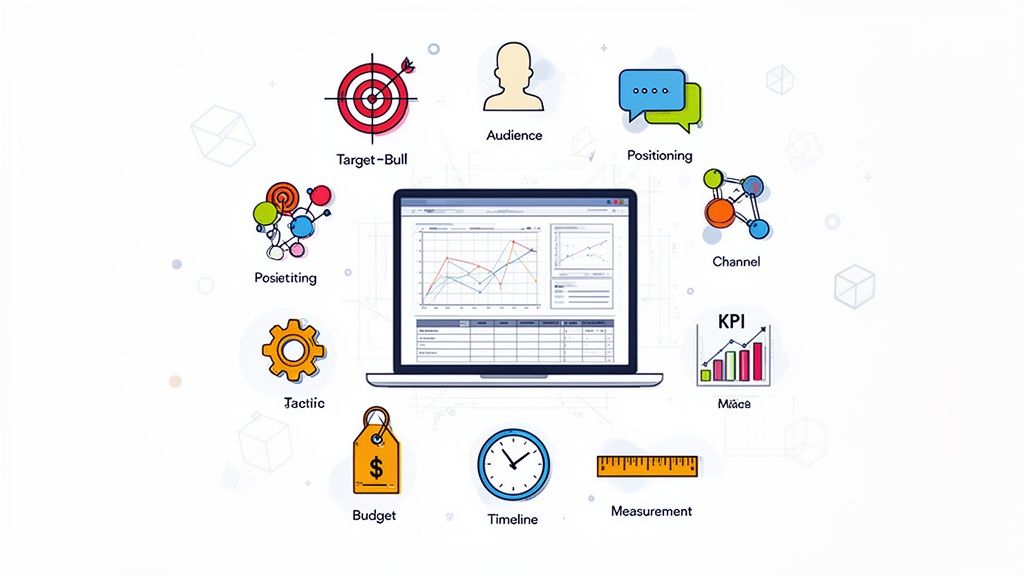
This guide moves beyond theory to provide a complete, actionable inventory of the core elements of marketing plans. We will break down the 10 indispensable components that form the backbone of any effective strategy, from defining your market position to measuring your return on investment. You will learn not just what these elements are, but how to develop them with practical guidance, mini-templates, and real-world examples.
Think of this article as your blueprint. Whether you're a startup founder seeking investment, a marketing leader scaling your department, or a business owner aiming for consistent growth, mastering these components is non-negotiable. It’s the difference between a strategy built on hope and one engineered for results. By understanding how to properly structure and integrate these key sections, you will transform your marketing from a guessing game into a reliable driver of revenue and brand equity. Let's build the framework for your predictable marketing success.
1. Executive Summary
The Executive Summary is the first and, arguably, most crucial of all the elements of marketing plans. It's a high-level, condensed overview of your entire strategy, designed to be read and understood in minutes. Think of it as the "elevator pitch" for your marketing plan, providing a snapshot of your goals, key strategies, expected outcomes, and necessary resources for stakeholders who may not have time to read the full document.
Its purpose is to provide context and secure buy-in from leadership, investors, or other department heads. While it appears first, it should always be written last, after every other section is finalized. This ensures it accurately reflects the comprehensive plan, from target audience analysis to budget allocation and KPI measurement.
Why It's a Critical Element
A well-crafted summary aligns everyone on the plan's core purpose. It highlights the business problem you’re solving and frames the marketing initiative as the solution. For example, Dropbox's early investor decks famously included a concise one-page summary that clearly articulated their go-to-market strategy, which was instrumental in securing crucial funding rounds. Similarly, an internal summary at an agency like ReachLabs.ai might showcase how AI-driven insights will be used to achieve specific campaign goals, justifying the technological investment.
How to Implement It Effectively
To create a powerful executive summary, focus on clarity and brevity. Avoid jargon and distill your plan into its most impactful components.
- Keep it to one page: Whether it's a document or a single presentation slide, strict length constraints force you to focus only on what truly matters.
- Use visual aids: Incorporate bullet points, bold text, and simple charts or infographics to make the information easily digestible.
- Highlight key numbers: Feature the most important metrics, such as projected ROI, budget total, and primary KPIs, to ground your plan in tangible outcomes.
- Update it regularly: The summary should be a living document. As your marketing plan evolves, update the summary to ensure stakeholders always have an accurate, up-to-date reference.
2. Situation Analysis
A Situation Analysis is the foundational research phase of your marketing plan, providing a clear and objective assessment of your current business environment. It’s an in-depth examination of both internal and external factors that can influence your success. This analysis sets the stage for all subsequent strategic decisions, ensuring your plan is grounded in reality, not assumptions.
Its purpose is to identify your organization's strengths and weaknesses while also uncovering external opportunities and threats. By understanding the complete picture, from industry trends and customer behavior to the competitive landscape, you can build a strategy that leverages your advantages and mitigates potential risks. This is one of the most critical elements of marketing plans because it prevents you from operating in a vacuum.
Why It's a Critical Element
A thorough situation analysis provides the "why" behind your marketing strategy. For example, when Spotify's 2020 analysis identified a significant surge in podcast listening, it directly informed their massive investment and acquisition strategy in that space. Similarly, a thorough situation analysis also involves understanding your competitive landscape, including your share of voice in marketing compared to competitors. An agency like ReachLabs.ai might use Google Trends and social listening tools to analyze client verticals, uncovering niche audiences and emerging trends that competitors have missed.
How to Implement It Effectively
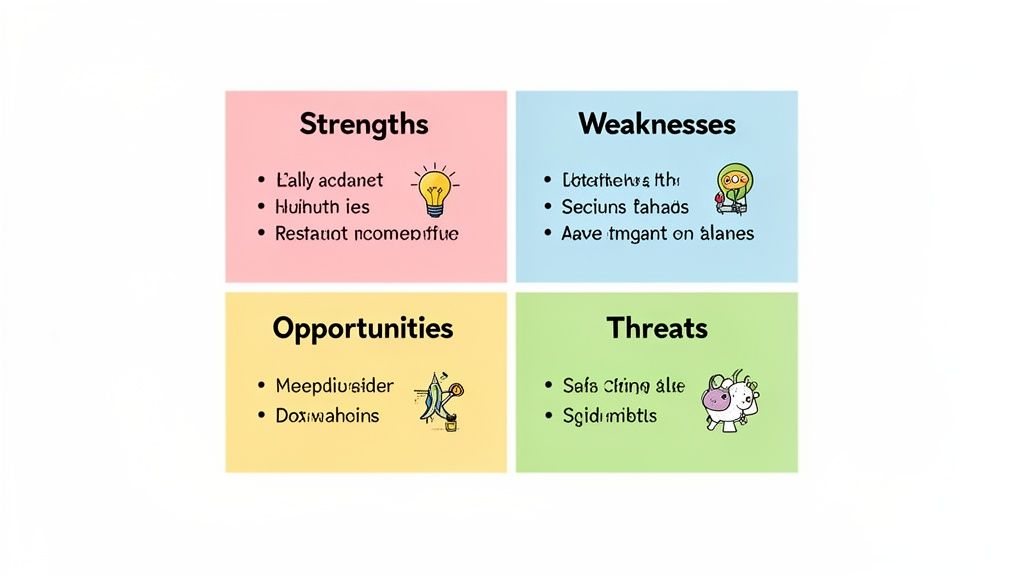
To conduct a powerful situation analysis, combine various research methods and tools to get a 360-degree view of the market. The SWOT (Strengths, Weaknesses, Opportunities, Threats) framework is a classic and highly effective tool for organizing your findings.
- Use mixed research methods: Combine primary research like customer surveys and interviews with secondary research from industry reports and market data to get a comprehensive view.
- Leverage data dashboards: Utilize tools like Tableau or Google Data Studio to visualize market data, track competitor performance, and identify customer behavior patterns in real time.
- Conduct quarterly refreshes: The market is constantly changing. Revisit and update your analysis every quarter to stay current with new trends, competitive moves, and shifts in consumer sentiment.
- Analyze your competitors: Go beyond surface-level observations. Analyze their messaging, channel strategy, pricing, and customer reviews to identify gaps you can exploit.
3. SWOT Analysis
A SWOT Analysis is a foundational strategic planning framework that helps you identify your competitive position before committing to a course of action. It's an organized list of your business's greatest Strengths, Weaknesses, Opportunities, and Threats. This analysis is one of the most vital elements of marketing plans because it forces a realistic, data-driven look at both internal capabilities and the external market landscape.
The purpose is to provide a clear, 360-degree view that informs strategic decisions. Strengths and Weaknesses are internal factors you can control (like brand reputation or budget limitations), while Opportunities and Threats are external factors you cannot (like market trends or competitor actions). By mapping these out, you can build a plan that leverages your advantages and proactively addresses your vulnerabilities.

Why It's a Critical Element
A thorough SWOT analysis prevents you from building a marketing plan on assumptions. It grounds your strategy in reality, ensuring you allocate resources effectively. For example, Nike’s strategic planning often highlights its immense brand loyalty (Strength) while acknowledging external supply chain disruptions (Threat), leading them to diversify manufacturing and marketing channels. Similarly, at an agency like ReachLabs.ai, a SWOT might reveal strong proprietary AI technology (Strength) but a limited influencer network (Weakness), prompting a strategic push to form new partnerships to capitalize on market opportunities.
How to Implement It Effectively
To move a SWOT analysis from a simple exercise to a powerful strategic tool, you must be honest, specific, and action-oriented.
- Base entries on validated data: Don't rely on gut feelings. Use customer feedback, market research, and performance analytics to support each point in your analysis.
- Prioritize the top three items: Avoid creating a laundry list. Focus on the top three most impactful items in each of the four quadrants to maintain clarity and strategic direction.
- Use the SWOT to derive initiatives: The goal isn't just to list points, but to connect them. Develop strategies that use your Strengths to seize Opportunities, and create contingency plans to minimize Threats to your Weaknesses.
- Involve multiple departments: Get input from sales, product, and customer service teams to create a more comprehensive and accurate picture of the business landscape.
4. Target Market & Segmentation
Target Market & Segmentation is the process of defining who your ideal customers are and dividing the broader market into distinct, manageable groups. These segments are based on shared characteristics like demographics, psychographics, behaviors, or needs. This foundational step is one of the most critical elements of marketing plans because it ensures your messaging, budget, and efforts are focused on the people most likely to convert, maximizing efficiency and ROI.
Rather than broadcasting a generic message to everyone, segmentation allows you to speak directly to the specific pain points and desires of each group. Its purpose is to move from a one-size-fits-all approach to a tailored strategy that resonates deeply with your audience. This precision prevents wasted resources and significantly increases the effectiveness of your campaigns.
Why It's a Critical Element
Effective segmentation directly correlates with higher engagement and conversion rates. When a potential customer feels like you understand their unique problem, they are far more likely to listen. For instance, Amazon attributes as much as 35% of its revenue to its recommendation engine, a system built on sophisticated behavioral segmentation. Similarly, at ReachLabs.ai, we build hyper-targeted LinkedIn outreach campaigns by segmenting audiences by industry, job function, and recent online activity, resulting in dramatically higher response rates for our clients. For a deeper dive, you can learn more about how to identify your target audience with our detailed guide.
How to Implement It Effectively
To successfully define and segment your target market, you must move beyond basic demographics and uncover the "why" behind customer actions.
- Develop detailed buyer personas: Create 3–5 key personas representing your ideal customer segments. Give them names, job titles, goals, and pain points to make them feel real and relatable for your team.
- Use data to inform segments: Leverage your CRM, website analytics, and customer surveys to identify patterns in behavior, purchase history, and engagement. This data provides an objective foundation for your segments.
- Test and refine messaging: Run A/B tests on your ad copy, email subject lines, and landing pages for different segments to see what resonates most. Use the results to continuously refine your approach.
- Prioritize high-value segments: Not all segments are created equal. Focus your primary efforts and a larger portion of your budget on the segments that have the highest potential lifetime value (LTV).
5. Positioning & Messaging
Positioning and Messaging are the elements of marketing plans that define your brand's unique place in the market and how you communicate it. Positioning is the strategic act of carving out a distinct identity in the consumer's mind, while messaging is the tactical execution of that identity through consistent, compelling language. This section articulates your unique value proposition (UVP) and establishes core communication pillars that guide all content creation.
Its purpose is to ensure every piece of communication, from a social media post to a sales deck, reinforces the same core idea about your brand. This consistency builds brand equity, differentiates you from competitors, and creates a clear, memorable narrative that resonates with your target audience. It's the bridge between your market research and your creative execution.
Why It's a Critical Element
Strong positioning and messaging prevent your brand from becoming a commodity. It’s how you answer the fundamental question, "Why should I choose you?" Slack’s brilliant positioning as the place “Where work happens” successfully framed it not just as a chat app but as a central collaboration hub, unifying its product, marketing, and sales content under one powerful idea. Similarly, an agency like ReachLabs.ai uses messaging that emphasizes its collective talent model powered by AI, positioning itself as a more efficient and growth-oriented alternative to traditional agencies.
How to Implement It Effectively
To develop impactful positioning and messaging, you must translate your brand's value into your audience's language.
- Create a messaging matrix: Develop a grid that outlines key messages, proof points, and tone of voice for each of your target personas. This ensures relevance and consistency across different segments.
- Test your UVP: Before a full rollout, validate your unique value proposition with focus groups, A/B tests on landing pages, or surveys to ensure it resonates and is easily understood.
- Develop a style and tone guide: Document the specific words, phrases, and personality your brand should use. This guide becomes an essential tool for all content creators, ensuring every touchpoint feels cohesive.
- Focus on benefits, not just features: Instead of listing what your product does, frame your messaging around the problems it solves and the value it delivers to the customer.
6. Marketing Goals & Objectives
Marketing Goals & Objectives are the specific, measurable targets that guide your entire strategy. This is where broad business ambitions transform into actionable marketing milestones. By defining clear goals, you establish a benchmark for success and ensure that every tactic, from a social media post to a major ad campaign, serves a larger purpose. This element is the foundation upon which all other elements of marketing plans are built.
The purpose of this section is to set direction and create accountability. It translates your company's mission into tangible outcomes like lead generation, revenue growth, or enhanced brand awareness. This is most effectively done using the SMART framework: ensuring goals are Specific, Measurable, Achievable, Relevant, and Time-bound. Without SMART objectives, a marketing plan is just a collection of activities with no clear finish line.
Why It's a Critical Element
Clearly defined objectives align your marketing team with broader business outcomes, justifying budgets and demonstrating ROI. They prevent "busy work" by forcing you to prioritize activities that directly contribute to success. For instance, HubSpot’s well-documented goal to increase monthly inbound leads by 20% within six months focused their entire content team on creating valuable, lead-generating assets. Similarly, at an agency like ReachLabs.ai, a core objective might be to generate 150 MQLs per quarter through targeted outreach, giving the team a precise target to hit.
How to Implement It Effectively
To set powerful goals, you must connect them directly to business needs while ensuring they are realistic and clearly communicated.
- Limit to 3–5 core objectives: Focusing on a few key goals prevents your team from becoming overwhelmed and ensures resources are concentrated where they will have the most impact.
- Assign clear ownership: Every objective needs a designated owner who is responsible for tracking progress and reporting on outcomes. This creates accountability.
- Use a tiered structure: Set a high-level goal (e.g., increase market share) and then break it down into smaller marketing objectives (e.g., generate 1,000 new leads in Q3).
- Review progress regularly: Don't just set and forget your goals. Conduct monthly or quarterly reviews to assess progress, identify roadblocks, and adjust your tactics as needed.
7. Marketing Strategies
Marketing Strategies are the high-level, overarching approaches you will use to achieve your defined objectives. This element of your marketing plan bridges the gap between your goals and your on-the-ground tactics. It outlines the primary channels and methodologies, such as inbound content marketing, paid advertising, influencer partnerships, or account-based marketing, that will form the backbone of your efforts.
The purpose of defining your strategies is to create a cohesive and focused roadmap. Instead of randomly executing tactics, this section ensures every action is part of a deliberate, integrated plan designed to reach your target audience where they are most active. It’s the "how" that follows the "why" (your objectives) and "who" (your target audience), providing a clear direction for resource allocation and campaign development.
Why It's a Critical Element
Clearly defined strategies prevent wasted effort and ensure all marketing activities work in harmony. They provide the framework for consistent messaging and a unified customer experience across multiple touchpoints. For example, Coca-Cola’s “Share a Coke” campaign was a brilliant strategy that combined personalization, user-generated content (UGC) via social media, and traditional out-of-home advertising. This integrated approach didn't just sell a product; it created a viral cultural moment, boosting sales significantly.
Similarly, an agency like ReachLabs.ai might devise a hybrid strategy for a B2B client that blends automated LinkedIn outreach to identify warm leads with hyper-targeted influencer activations to build brand authority within a specific industry niche. This strategic combination is far more effective than pursuing either channel in isolation, making it a vital component among the elements of marketing plans.
How to Implement It Effectively
To build robust marketing strategies, you must align your approach with your audience’s behavior and your business goals.
- Map strategies to the customer journey: Align specific channels with different stages of the funnel. Use SEO and content for awareness, targeted social ads for consideration, and email marketing for conversion and retention.
- Pilot test new channels: Before committing significant budget, run small-scale pilot tests on promising new channels to gather performance data and validate their potential.
- Use a data-driven channel mix: Don't rely on assumptions. Continuously analyze performance data to understand which strategies and channels deliver the highest ROI, and rebalance your budget quarterly to optimize results.
- Integrate online and offline efforts: Ensure your digital strategies (like PPC and social media) complement and reinforce any offline activities (like events or print ads) for a seamless brand experience.
8. Tactics & Action Plan
The Tactics & Action Plan is where high-level strategy meets ground-level execution. This is one of the most granular elements of marketing plans, breaking down broad strategies into specific, assignable tasks with clear timelines. It operationalizes your goals, transforming concepts like "increase brand awareness" into a concrete schedule of content calendars, ad creative development, event logistics, and campaign workflows.
Its purpose is to provide a day-to-day, week-to-week roadmap for the marketing team, ensuring everyone knows what they are responsible for and when it is due. This section bridges the gap between the "what" (your objectives) and the "how" (the specific activities that will achieve them). It's the detailed blueprint that makes the entire marketing plan actionable rather than just aspirational.
Why It's a Critical Element
A detailed action plan prevents ambiguity and ensures accountability. It aligns team members, manages resources effectively, and makes progress measurable. For example, Airbnb's successful content marketing relies on a meticulously planned editorial calendar that aligns destination guides and blog posts with seasonal travel trends and paid ad buys. Similarly, an agency like ReachLabs.ai would detail a client's action plan with weekly LinkedIn message cadences, specific content deliverables, and scheduled performance check-ins, leaving no room for confusion.
How to Implement It Effectively
To build a robust action plan, focus on clarity, detail, and flexibility. The goal is to create a living guide for your team.
- Use project management tools: Platforms like Asana, Trello, or Monday.com are essential for assigning tasks, setting deadlines, and tracking progress in a collaborative environment.
- Break down tasks: Deconstruct large initiatives into smaller, manageable steps. For a "product launch campaign," tasks might include "Draft press release," "Design ad creative," and "Schedule social media posts."
- Assign clear ownership: Every task must have a designated owner responsible for its completion. This eliminates confusion and fosters a culture of accountability.
- Build in contingencies: Projects rarely go exactly as planned. Incorporate buffer time into your timelines to account for potential delays or unexpected challenges, a core principle borrowed from Agile and PMP methodologies.
9. Budget & Resource Allocation
Budget and Resource Allocation is where your strategic vision meets financial reality. It’s a detailed breakdown of the costs associated with every tactic in your marketing plan, ensuring that every dollar is accounted for and strategically invested. This element covers everything from media spend and content production costs to personnel hours, agency fees, and technology subscriptions, providing a clear roadmap for cost-effective execution.
Its purpose is to translate your marketing objectives into a tangible financial plan. This section demonstrates fiscal responsibility and provides the framework for measuring return on investment (ROI). By meticulously planning where every dollar goes, you can justify expenditures to stakeholders and ensure that resources are directed toward the most impactful activities, making it one of the most critical elements of marketing plans.
Why It's a Critical Element
A well-defined budget prevents overspending, aligns marketing activities with financial goals, and enables agility. It forces you to prioritize tactics and make data-driven decisions rather than relying on guesswork. For instance, Procter & Gamble’s shift to zero-based budgeting required every department to justify its spending from scratch, leading them to reallocate significant funds to digital channels and ultimately increase their return on ad spend (ROAS) by 25%. At an agency like ReachLabs.ai, a typical allocation might be 60% for paid social campaigns, 25% for content creation, and 15% for influencer fees, ensuring a balanced, multi-channel approach.
How to Implement It Effectively
To build a robust budget, you must be comprehensive and forward-thinking. Detail every anticipated cost and create a system for tracking expenses.
- Categorize all expenses: Break down your budget into clear categories like advertising, content, software, personnel, and events to easily track spending and performance.
- Include a contingency buffer: Set aside 10-15% of your total budget for unforeseen opportunities or challenges. This provides the flexibility to pivot without derailing your entire plan.
- Review actual vs. planned spend: Conduct monthly or quarterly budget reviews to compare your planned expenditures with actual costs. This helps you identify variances and reallocate funds as needed. For more guidance on this process, you can find a deeper dive into marketing budget allocation best practices.
- Negotiate bundled rates: When working with vendors or media partners, seek opportunities to negotiate bundled services or long-term contracts to secure better rates and maximize your budget’s impact.
10. Performance Measurement & KPIs
Performance Measurement and Key Performance Indicators (KPIs) are the systems you use to track, analyze, and report on the effectiveness of your marketing initiatives. This element moves your plan from theory to practice by defining exactly what success looks like in measurable terms. It involves selecting the right metrics and creating dashboards to monitor progress, optimize campaigns in real-time, and ultimately prove your impact on business goals.
The purpose is to create a feedback loop that informs decision-making. By tracking both leading indicators (like website traffic, click-through rates, and social engagement) and lagging indicators (like customer acquisition cost, revenue, and lifetime value), you can understand not just what is happening, but why. This data-driven approach allows you to justify your budget, pivot strategies when needed, and demonstrate the value of your marketing efforts to the entire organization.
Why It's a Critical Element
Without measurement, marketing is just guesswork. A strong KPI framework provides clarity, accountability, and the insights needed for continuous improvement. For instance, Google's internal marketing teams famously used a dashboard tracking over 20 distinct metrics, which reportedly led to a 30% uplift in their paid search efficiency. At ReachLabs.ai, we often build clients a unified dashboard in Looker Studio that visualizes MQLs, cost per lead, and influencer engagement, providing a single source of truth for campaign performance.
How to Implement It Effectively
To build a meaningful measurement system, you must connect your metrics directly to your business objectives. To truly understand the impact of your marketing efforts and justify your investments, it's essential to know how to calculate marketing ROI effectively.
- Focus on 5–7 core KPIs: Avoid "vanity metrics" and concentrate on the few indicators that are most critical to your primary goals.
- Automate your data collection: Use APIs and integrations from tools like Google Analytics, your CRM, and social media platforms to pull data into a central dashboard, saving time and reducing errors.
- Establish a reporting cadence: Set a regular schedule (weekly, monthly, or quarterly) to review your KPIs with stakeholders and discuss insights and adjustments.
- Use a mix of metrics: Combine leading and lagging indicators to get a holistic view. Explore these marketing performance metrics examples to find the right mix for your plan.
10-Element Marketing Plan Comparison
| Item | 🔄 Implementation Complexity | ⚡ Resource Requirements | 📊 Expected Outcomes | 💡 Ideal Use Cases | ⭐ Key Advantages |
|---|---|---|---|---|---|
| Executive Summary | Low — concise synthesis, quick to draft | Low — senior time, slide design | Alignment, faster approvals, clear roadmap | Stakeholder briefings, investor updates | Facilitates buy-in, simplifies decisions |
| Situation Analysis | High — extensive research & synthesis | High — market data, analysts, tools | Informed strategy, opportunity & threat ID | Market entry, competitive reassessment | Deep market insight for decisions |
| SWOT Analysis | Medium — structured workshops, validation | Medium — cross‑functional input, data checks | Clear strengths/weaknesses, prioritized risks | Strategic planning, quick diagnostics | Simple, communicable strategic starter |
| Target Market & Segmentation | Medium–High — data modeling and persona work | Medium–High — CRM, analytics, research | Higher engagement, improved conversion rates | Audience targeting, personalization tests | Enables tailored messaging, better ROI |
| Positioning & Messaging | Medium — iterative testing and alignment | Medium — creative resources, research | Stronger brand recall, clearer UVP | Rebranding, product launches, sales enablement | Differentiation and consistent communication |
| Marketing Goals & Objectives | Low–Medium — SMART framing and alignment | Low–Medium — stakeholder time, tracking tools | Measurable targets, focused team effort | Quarterly planning, KPI setting | Clarity of purpose, measurable accountability |
| Marketing Strategies | Medium–High — multi‑channel planning | High — channel specialists, budget allocation | Cohesive reach, optimized channel mix | Campaign planning, integrated launches | Strategic cohesion, spend optimization |
| Tactics & Action Plan | High — detailed timelines and RACI | High — execution teams, project tools | Execution-ready tasks, clear timelines | Campaign rollouts, cross-team coordination | Accountability, operational clarity |
| Budget & Resource Allocation | Medium — financial modeling & approvals | High — media budgets, production, staffing | Controlled spend, ROI forecasts, prioritized funding | Annual planning, campaign funding requests | Financial control, justified investments |
| Performance Measurement & KPIs | Medium–High — attribution & dashboarding | Medium–High — analytics, dashboards, analysts | Real-time insights, optimized ROI, trend signals | Ongoing optimization, executive reporting | Data-driven decisions, visibility into impact |
From Planning to Performance: Activating Your Strategy
We've journeyed through the ten foundational elements of marketing plans, from the high-level executive summary and in-depth situation analysis to the granular details of tactics, budgets, and KPIs. Deconstructing each component reveals a clear truth: a marketing plan is far more than a static document. It is a dynamic blueprint for growth, a strategic compass that guides every campaign, content piece, and customer interaction toward a unified, measurable goal.
Simply understanding these elements is the first step. The real transformation begins when you activate this knowledge, turning abstract concepts into a living, breathing strategy that propels your business forward. Each piece you've built, from your SWOT analysis to your target market segmentation, is a critical cog in a larger machine designed to create momentum and deliver tangible results.
The Interconnectedness of Your Marketing Ecosystem
One of the most critical takeaways is the deep interconnectedness of these components. Your situation analysis directly informs your SWOT. Your SWOT, in turn, shapes your marketing objectives. These objectives dictate your strategies, which then determine your specific tactics and the budget required to execute them. Finally, your KPIs close the loop, measuring the effectiveness of your tactics against the original objectives.
Think of it like building a house. You wouldn't pour the foundation without architectural plans, or install windows before the walls are framed. Each step logically follows the last, and skipping one compromises the integrity of the entire structure. A strong marketing plan operates on the same principle of strategic cohesion. When your messaging is perfectly aligned with your target audience’s needs, and your channels are chosen to meet that audience where they are, your efforts become exponentially more powerful.
Key Insight: The true power of a marketing plan doesn't lie in any single element, but in the synergy created when all elements work together. A misaligned budget can cripple a brilliant strategy, just as a poorly defined target audience can render the most creative messaging ineffective.
Turning Your Plan into a Living Document
The greatest pitfall for any marketing plan is becoming a "shelf-document", meticulously crafted only to be filed away and forgotten. To avoid this, your plan must be a central tool in your operational rhythm. It should be the foundation for your weekly team meetings, the benchmark for your monthly performance reviews, and the guidepost for your quarterly strategic planning sessions.
Here are actionable steps to ensure your plan remains relevant and drives performance:
- Schedule Regular Reviews: Set recurring calendar invites (monthly or quarterly) dedicated to reviewing your marketing plan’s progress. Assess your KPIs, discuss what's working and what isn't, and be prepared to pivot.
- Assign Clear Ownership: Every tactic and KPI within your plan should have a designated owner. This fosters accountability and ensures that every part of the strategy is actively managed.
- Embrace Agile Adaptation: Markets change, competitors evolve, and customer behaviors shift. Your plan should be flexible enough to adapt. Use your performance data to make informed decisions about reallocating your budget or adjusting your tactics mid-cycle.
Mastering these elements of marketing plans is not just an academic exercise; it is the fundamental discipline of modern marketing. It empowers you to move beyond reactive, "random acts of marketing" and adopt a proactive, strategic approach. This structured methodology ensures that every dollar spent and every hour invested is a deliberate step toward achieving your most ambitious business goals. Your plan is the definitive bridge between your brand's current reality and its future potential.
Ready to transform your meticulously crafted plan into a high-performing marketing engine? The experts at ReachLabs.ai specialize in activating strategy, connecting your brand with a collective of world-class talent to execute on every element of your marketing plan with precision and creativity. Visit ReachLabs.ai to discover how our data-driven approach and elite network can help you turn your strategic blueprint into measurable, needle-moving results.