
In a competitive market, a well-crafted marketing plan is not just a document; it’s your strategic blueprint for navigating the industry, connecting with customers, and achieving sustainable growth. Without one, marketing efforts become a series of disjointed tactics, wasting resources and missing critical opportunities. A comprehensive plan provides direction, aligns your team, and creates a clear, measurable path from your current position to your ultimate business goals.
This guide moves beyond generic advice to deconstruct the essential elements of a marketing plan, transforming abstract objectives into an actionable roadmap for success. We will provide the specific insights and frameworks needed to build a strategy that not only works but excels.
You will learn how to:
- Analyze your market and competitors effectively.
- Define and segment your ideal customer with precision.
- Set clear, measurable marketing objectives.
- Develop a powerful marketing mix strategy.
- Allocate your budget and resources for maximum impact.
- Select the most effective channels for your brand.
- Measure performance and use data to refine your approach.
By mastering these seven foundational components, you’ll be equipped to make smarter decisions, optimize your budget, and drive predictable, powerful results. This is your guide to building a robust marketing engine that fuels unstoppable growth.
1. Market Research & Analysis
Market research and analysis is the bedrock upon which all effective marketing strategies are built. It is the systematic process of gathering, interpreting, and analyzing data about a specific market, including its size, trends, customer demographics, and competitive landscape. This foundational element of a marketing plan ensures that your decisions are not based on assumptions but on concrete evidence, dramatically increasing your chances of success. It provides the essential context needed to identify opportunities, mitigate risks, and understand the “why” behind consumer behavior.

Without this critical step, a marketing plan is merely a collection of guesses. By investing time in research, you align your products, messaging, and channels with what your audience actually wants and needs, rather than what you think they want.
Why It’s a Core Element
This initial stage informs every subsequent part of your plan, from setting realistic objectives to crafting compelling messaging. It helps you define a clear value proposition, identify untapped market segments, and anticipate competitive moves.
- Identifies Opportunities: Research can uncover underserved niches or growing consumer needs that your business can fulfill.
- Minimizes Risk: Understanding market demand and potential challenges helps prevent costly mistakes, such as launching a product no one wants or entering an oversaturated market.
- Customer-Centric Strategy: It forces you to look outside your own organization and focus on the problems and desires of your target audience.
Actionable Implementation & Best Practices
To integrate this into your planning, adopt a multi-faceted approach that blends different data types for a holistic view.
- Combine Methodologies: Use both qualitative research (like focus groups, interviews) to understand motivations and quantitative research (surveys, analytics) to gather statistical data. This provides a complete picture of your market.
- Leverage Free & Paid Tools: Start with accessible resources like Google Trends, social media listening tools, and government census data. For deeper insights, consider investing in industry reports or survey platforms like SurveyMonkey.
- Create Detailed Customer Personas: Don’t just list demographics. Use your research to build fictional representations of your ideal customers, complete with goals, pain points, and motivations. This makes your target audience tangible for your entire team.
- Conduct Regular Competitive Analysis: Continuously monitor your competitors’ strategies, pricing, and customer feedback. Tools like SEMrush or Ahrefs can reveal their digital marketing tactics, giving you a competitive edge.
A prime example is Starbucks, which uses sophisticated location analytics and demographic research to determine the optimal placement for new stores, ensuring high foot traffic and aligning with local consumer preferences. Similarly, Airbnb conducted extensive market research to identify the needs of business travelers, leading to the successful launch of Airbnb for Work.
2. Target Audience & Customer Segmentation
Identifying your target audience and performing customer segmentation is the art of moving from a megaphone to a meaningful conversation. It involves dividing a broad market into distinct subsets of consumers who share similar characteristics, needs, or behaviors. This crucial element of a marketing plan allows you to stop shouting into the void and start tailoring your message, product, and services to the specific groups most likely to become loyal customers, dramatically improving marketing efficiency and overall effectiveness.

Without clear segmentation, you risk creating generic marketing that resonates with no one. By understanding the unique nuances of different customer groups, you can craft highly relevant campaigns that speak directly to their pain points and aspirations, making them feel seen and understood.
Why It’s a Core Element
This step directly follows market research and translates its broad findings into actionable groups. It’s the bridge between knowing the market and knowing your customer. It ensures your marketing budget is spent engaging high-potential prospects rather than being wasted on uninterested audiences.
- Enhances Personalization: Segmentation is the foundation of personalized marketing, allowing you to deliver the right message to the right person at the right time.
- Improves ROI: Focusing resources on well-defined segments leads to higher conversion rates and a more efficient allocation of your marketing budget.
- Boosts Customer Loyalty: When customers feel that a brand understands their specific needs, they are more likely to develop a strong, lasting relationship with it.
Actionable Implementation & Best Practices
To effectively define and segment your audience, you must go beyond basic demographics and dive into the psychographics and behaviors that drive decision-making.
- Create Detailed Buyer Personas: Move beyond simple descriptions. Develop comprehensive buyer personas with names, photos, backstories, goals, and challenges. These semi-fictional representations make your segments tangible. You can learn how to create detailed buyer personas to bring your audience to life.
- Use Data to Identify Patterns: Leverage tools like Google Analytics, CRM data, and social media insights to uncover behavioral patterns. Segment based on purchase history, online behavior, engagement levels, or geographic location.
- Focus on Primary Segments: Avoid spreading your resources too thin. Start by identifying and focusing on 2-3 primary segments that represent your most valuable customers before expanding your efforts.
- Test and Refine Continuously: Markets and consumer behaviors change. Regularly review your segments’ performance and be prepared to update your personas and segmentation strategy based on new data and evolving trends.
A powerful example is Spotify, which segments users based on their listening habits to power its hyper-personalized “Discover Weekly” playlists. Similarly, Nike successfully targets distinct segments like professional athletes, fitness enthusiasts, and fashion-conscious consumers with separate product lines and marketing campaigns tailored to each group’s unique values and interests.
3. Marketing Objectives & Goals
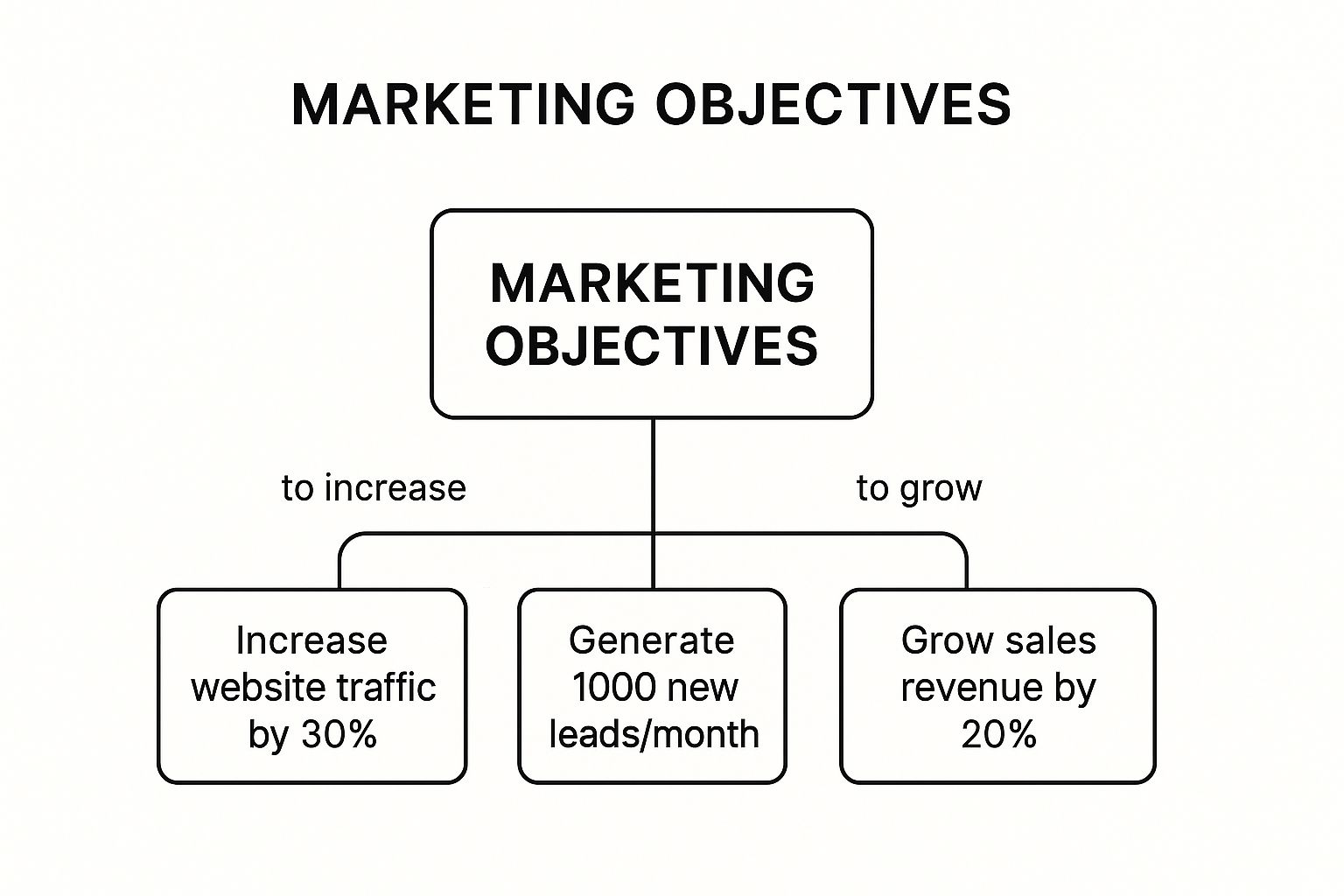
Marketing objectives and goals are the specific, measurable targets that provide direction and purpose for all your marketing efforts. They translate your high-level business vision into actionable steps, bridging the gap between broad ambition and day-to-day execution. This critical element of a marketing plan acts as a compass, ensuring every campaign, piece of content, and dollar spent moves you closer to a defined outcome. These goals serve as the ultimate benchmark for measuring success and demonstrating marketing’s impact on the bottom line.
Without clear objectives, marketing activities become disjointed and reactive. By establishing precise targets, you empower your team to prioritize resources effectively, make data-driven decisions, and maintain strategic focus, transforming marketing from a cost center into a predictable growth engine.
Why It’s a Core Element
Well-defined objectives are the foundation of accountability and strategic alignment in any marketing plan. They provide clarity on what success looks like and ensure that marketing activities are directly contributing to broader business growth, a key consideration for demonstrating ROI.
- Drives Strategic Alignment: Ensures that marketing efforts are not performed in a silo but are directly tied to overall company goals, like revenue growth or market expansion.
- Enables Measurement & ROI: Clear goals make it possible to track progress and calculate the return on investment for your marketing spend, justifying budgets and strategies.
- Improves Team Focus & Motivation: Specific targets give your team a clear finish line to work towards, fostering a sense of purpose and improving efficiency.
Actionable Implementation & Best Practices
To integrate this into your planning, adopt a structured framework that connects high-level goals with specific, measurable outcomes. The SMART (Specific, Measurable, Achievable, Relevant, Time-bound) criteria is an excellent starting point for this process.
- Align with Sales & Revenue: Your marketing goals should directly support sales team needs. If the business needs to increase revenue by 20%, set marketing objectives for lead generation and conversion rates that support this target.
- Use the SMART Framework: Ensure every goal is Specific (e.g., “increase organic website traffic”), Measurable (by 25%), Achievable (based on past performance), Relevant (to business growth), and Time-bound (within the next quarter).
- Create Dashboards for Tracking: Use tools like Google Analytics, HubSpot, or a CRM to build real-time dashboards. This visual representation of progress keeps the team aligned and allows for quick adjustments if you fall off track.
- Break Down Large Goals: Deconstruct an annual goal, like “generate 1,200 new leads,” into smaller monthly (100 leads/month) or weekly milestones. This makes the objective less intimidating and easier to manage.
A classic example is HubSpot, which famously sets clear monthly and quarterly goals for website traffic and lead generation, driving its entire content marketing machine. Similarly, Coca-Cola might set a specific objective to increase brand awareness among a new demographic, like Gen Z, by 15% within a fiscal year, guiding its social media and influencer marketing campaigns.
4. Marketing Mix Strategy (4Ps/7Ps)
The Marketing Mix Strategy provides a classic, indispensable framework for bringing a product or service to market. It is the tactical toolkit businesses use to execute their broader strategy, comprising the core levers you can pull to influence customer perception and drive sales. This foundational element of a marketing plan ensures a holistic approach, moving beyond a single focus like advertising to consider every critical touchpoint that impacts a customer’s purchasing decision. The framework organizes your tactical decisions into a cohesive and logical structure.
Originally conceived as the 4Ps (Product, Price, Place, Promotion) by Jerome McCarthy, it has since been expanded to the 7Ps (adding People, Process, and Physical Evidence) to better accommodate service-based industries. A well-defined marketing mix ensures all your tactical efforts are aligned and working in harmony to achieve your marketing objectives.
Why It’s a Core Element
The marketing mix translates your high-level strategy into tangible actions. It forces you to make concrete decisions about what you are selling, how much you are charging, where customers can find it, and how you will tell them about it. This framework ensures no critical component is overlooked.
- Creates Synergy: It ensures all tactical elements are aligned and mutually reinforcing, creating a stronger and more consistent brand message.
- Provides a Practical Checklist: It acts as a comprehensive guide, prompting you to consider all key aspects required for a successful market launch and ongoing management.
- Facilitates Adaptation: The framework allows you to systematically adjust individual components in response to market changes, competitive pressures, or customer feedback.
Actionable Implementation & Best Practices
To effectively integrate this into your planning, treat each “P” as an interconnected variable that must be balanced for optimal results.
- Ensure All Elements Are Aligned: Your pricing strategy must reflect your product’s perceived quality, your distribution channels (Place) must be accessible to your target audience, and your promotional messaging must highlight the value proposition consistently. A premium product with discount pricing and poor distribution is a recipe for failure.
- Use the 7Ps for Service-Based Businesses: For services, the intangible aspects are crucial. Consider the People (your staff), the Process (how the service is delivered), and the Physical Evidence (the environment or digital interface) to build a complete customer experience.
- Regularly Review and Adjust the Mix: The market is not static. Continuously monitor performance metrics and gather customer feedback to identify which elements of your mix need optimization. Test different pricing models, promotional offers, or delivery channels.
- Analyze from the Customer’s Perspective: When evaluating each element, step into your customers’ shoes. Is the price fair for the value received? Is the product easy to find and purchase? Is the promotion relevant and compelling?
A classic example is Apple’s integrated 4Ps strategy. Its premium Products are matched with premium Pricing, sold in selective Places (Apple Stores, authorized resellers), and supported by lifestyle-focused Promotion. Similarly, Uber’s 7Ps model relies on a seamless digital Process, dynamic Pricing, and a vast network of People (drivers), all experienced through the Physical Evidence of the app and the vehicle.
5. Budget & Resource Allocation
Budget and resource allocation is the strategic process of assigning financial capital, personnel, and tools to various marketing activities to achieve specific goals. This critical element translates your marketing strategy into a financially viable action plan, ensuring that every dollar spent is an intentional investment toward growth. It’s the framework that governs how you fund your campaigns, from digital advertising and content creation to events and public relations, maximizing your return on investment (ROI).
Without a well-defined budget, even the most brilliant marketing ideas will fail due to a lack of funding or inefficient spending. A clear allocation plan provides the discipline needed to prioritize high-impact initiatives and make data-driven decisions about where to invest for the best results.
Why It’s a Core Element
This component is the engine that powers your marketing plan, turning abstract objectives into tangible outcomes. It forces a realistic assessment of what is achievable and promotes accountability across the marketing team. A thoughtful budget ensures sustainability and prevents the common pitfall of overspending on underperforming channels.
- Maximizes ROI: It directs funds toward the channels and tactics that deliver the highest returns, eliminating wasteful spending.
- Enables Prioritization: A finite budget requires you to make strategic choices, focusing resources on activities that most directly support your primary business goals.
- Promotes Accountability: A clear budget makes it easier to track performance against spending, holding teams accountable for their results and justifying marketing’s value to the organization.
Actionable Implementation & Best Practices
To effectively allocate your resources, you need a system that is both structured and flexible, allowing for optimization based on real-time performance data.
- Use Data-Driven Allocation: Base your initial budget on historical performance data, industry benchmarks, and your defined marketing objectives. Allocate more significant funds to proven channels while earmarking a smaller portion for experimentation.
- Implement Robust Tracking: Utilize analytics platforms and financial software to monitor spending and measure the ROI of each campaign in real-time. This allows you to quickly identify what’s working and what isn’t. For a deeper dive, you can learn more about marketing resource management on reachlabs.ai.
- Maintain a Contingency Fund: Set aside 10-15% of your total budget for unexpected opportunities or to double down on a campaign that is performing exceptionally well. This agility can provide a significant competitive advantage.
- Review and Adjust Regularly: Your budget should not be static. Conduct quarterly reviews to re-evaluate performance against goals and reallocate funds from underperforming initiatives to more successful ones.
A powerful example is Procter & Gamble, which strategically shifted a significant portion of its marketing budget from traditional media to digital channels to better reach modern consumers. Similarly, HubSpot champions an inbound marketing budget model, prioritizing investment in content creation, SEO tools, and marketing automation platforms that generate long-term, sustainable lead flow.
6. Marketing Channels & Distribution Strategy
Your marketing channels and distribution strategy define the pathways you use to deliver your message and your product to the end customer. This crucial element of a marketing plan is not just about choosing where to advertise; it’s about creating an integrated system where your brand, message, and product are accessible to your target audience at the right time and in the right place. It encompasses everything from the social media platforms you use to engage customers to the retail, e-commerce, or direct sales models you use to close a sale.

A well-defined strategy ensures a seamless customer journey, moving prospects from awareness to purchase with minimal friction. Without it, even the most brilliant marketing message can fail to reach its intended audience, and an excellent product may remain undiscovered on the shelf.
Why It’s a Core Element
This component bridges the gap between your marketing message and the actual transaction. It dictates how customers interact with your brand and ultimately access your offerings, directly impacting sales, customer experience, and brand perception.
- Maximizes Reach: A multi-channel approach helps you connect with different audience segments where they are most active, whether online or offline.
- Enhances Customer Experience: An integrated strategy provides a consistent and convenient experience, allowing customers to engage and purchase on their preferred platforms.
- Improves Efficiency: By understanding which channels deliver the best results, you can allocate your marketing budget more effectively and optimize your return on investment.
Actionable Implementation & Best Practices
To build a robust channel and distribution strategy, you must align your choices with your target audience’s behavior and your business goals.
- Map the Customer Journey: Trace the typical path your customers take from discovery to purchase. This helps identify key touchpoints and determine the most effective channels for each stage, such as using social media for awareness and email marketing for nurturing leads.
- Maintain Brand Consistency: Ensure your messaging, branding, and tone of voice are uniform across all channels. A customer’s experience on your mobile app should feel consistent with their interaction in a physical store.
- Use Analytics to Prioritize Channels: Leverage tools like Google Analytics and social media insights to identify which channels drive the most traffic, engagement, and conversions. Focus your resources on these high-performing platforms.
- Test and Iterate: The digital landscape is always changing. Allocate a small portion of your budget to experiment with new channels. If a new platform shows promise with a small-scale test, you can then invest more significantly.
A powerful example is Nike’s omnichannel strategy, which seamlessly integrates its retail stores, e-commerce site, and mobile apps like Nike Run Club. Customers can browse online, try products in-store, and engage with the brand through community-focused apps, creating a holistic and cohesive brand ecosystem that drives both sales and loyalty.
7. Performance Measurement & Analytics
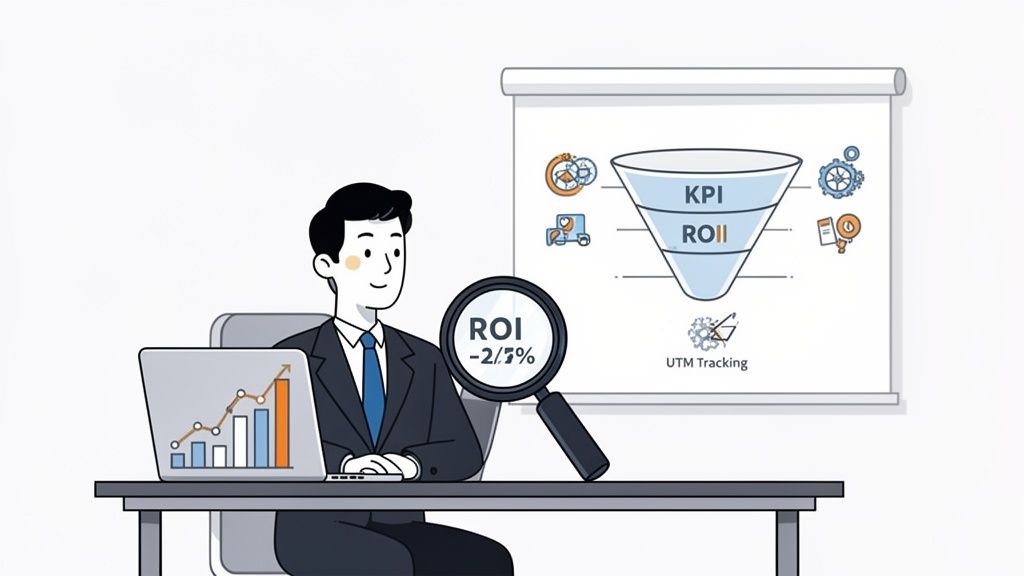
Performance measurement and analytics is the engine of marketing optimization. It is the systematic process of tracking, analyzing, and reporting on the effectiveness of your marketing activities to understand their impact on business objectives. This vital element of a marketing plan establishes key performance indicators (KPIs), analytical frameworks, and reporting processes to evaluate success, identify opportunities for improvement, and demonstrate marketing’s return on investment (ROI) to stakeholders.
Without this feedback loop, marketing efforts operate in a vacuum, making it impossible to distinguish between what works and what doesn’t. By embedding measurement into your strategy, you transform your marketing from an art based on intuition into a science driven by data, enabling continuous, iterative improvement.
Why It’s a Core Element
This element closes the loop on your marketing plan, providing the data needed to justify budgets, refine strategies, and prove value. It connects your daily activities directly to high-level business goals, ensuring every effort is accountable and contributes to growth.
- Proves ROI: It provides concrete evidence of marketing’s financial contribution, moving the conversation from costs to revenue generation.
- Enables Optimization: By identifying underperforming channels or campaigns, you can reallocate resources to what is most effective, maximizing your budget.
- Informs Future Strategy: Insights from past performance are the most reliable predictors of future success, guiding your next strategic plan with validated learning.
Actionable Implementation & Best Practices
To effectively integrate analytics, you must go beyond simply collecting data and focus on extracting actionable insights that drive decisions.
- Focus on Business-Centric KPIs: Don’t get lost in vanity metrics like “likes” or “impressions.” Prioritize metrics that directly link to business objectives, such as Customer Acquisition Cost (CAC), Customer Lifetime Value (CLV), and conversion rates.
- Implement Tracking Before Launch: Ensure all tracking systems, like Google Analytics goals, UTM parameters, and conversion pixels, are correctly set up and tested before a campaign goes live. Proactive setup prevents data loss and ensures accuracy from day one. To dive deeper, explore the fundamentals of effective marketing campaign tracking on reachlabs.ai.
- Automate Reporting: Use tools like Google Data Studio or specialized dashboards to create automated reports. This saves significant time, ensures consistency, and provides stakeholders with real-time access to performance data.
- Audit Data Regularly: Periodically check your data sources for accuracy. Discrepancies between your CRM, analytics platform, and ad networks can lead to flawed conclusions, so regular audits are crucial for maintaining data integrity.
A leading example is Netflix, which uses a sophisticated A/B testing framework to measure everything from thumbnail effectiveness to algorithm changes, directly tying these micro-experiments to user retention. Similarly, Amazon’s success is built on a culture of detailed performance measurement, meticulously tracking CAC and CLV to optimize every part of its marketing funnel and e-commerce experience.
7 Key Elements Comparison
| Item | Implementation Complexity 🔄 | Resource Requirements ⚡ | Expected Outcomes 📊 | Ideal Use Cases 💡 | Key Advantages ⭐ |
|---|---|---|---|---|---|
| Market Research & Analysis | Moderate to High 🔄 | High (time, cost, expertise) ⚡ | Informed strategic decisions, risk reduction 📊 | New market entry, competitive analysis, strategy validation | Data-driven insights, opportunity identification ⭐ |
| Target Audience & Customer Segmentation | Moderate 🔄 | Moderate (data analytics tools) ⚡ | Improved targeting, personalized marketing 📊 | Customer-centric campaigns, product development | Higher engagement, ROI through focus ⭐ |
| Marketing Objectives & Goals | Low to Moderate 🔄 | Low to Moderate ⚡ | Clear focus, performance tracking 📊 | All marketing planning and execution | Direction, accountability, measurable success ⭐ |
| Marketing Mix Strategy (4Ps/7Ps) | Moderate 🔄 | Moderate (cross-functional input) ⚡ | Comprehensive customer experience management 📊 | Product launches, integrated marketing strategy | Holistic framework, alignment across functions ⭐ |
| Budget & Resource Allocation | Moderate 🔄 | Moderate to High ⚡ | Optimized spend, ROI maximization 📊 | Marketing planning, financial control | Efficient resource use, ROI focus ⭐ |
| Marketing Channels & Distribution Strategy | High 🔄 | High (multichannel management) ⚡ | Broad reach, multi-touch engagement 📊 | Omnichannel marketing, audience expansion | Market reach, flexibility, engagement ⭐ |
| Performance Measurement & Analytics | High 🔄 | High (analytics tools, expertise) ⚡ | Data-driven optimization, ROI evidence 📊 | Campaign monitoring, continuous improvement | Clear impact measurement, decision support ⭐ |
From Plan to Performance: Activating Your Marketing Strategy
We’ve journeyed through the seven core elements of a marketing plan, from the foundational bedrock of Market Research to the crucial feedback loop of Performance Analytics. Viewing these components as a mere checklist is a common mistake. Instead, you should see them as interconnected gears in a dynamic engine designed for sustainable growth. A plan that sits on a shelf is worthless; a plan that breathes, adapts, and guides daily decisions is invaluable.
The power of a well-crafted marketing plan lies not in its initial perfection, but in its strategic cohesion. Your meticulous Target Audience Segmentation directly informs your Marketing Mix Strategy. Your clearly defined Objectives and Goals dictate how you approach your Budget and Resource Allocation. Each element builds upon the last, creating a powerful synergy that amplifies your efforts and minimizes wasted resources.
Turning Your Document into a Dynamic Tool
The transition from a static document to a living strategy is where most businesses falter. The key is to treat your marketing plan as an active roadmap, not a historical artifact. This requires a commitment to continuous engagement with its core principles.
Here are actionable steps to ensure your plan drives performance:
- Schedule Regular Reviews: Don’t wait until the end of the year. Set quarterly or even monthly check-ins to review your progress against the KPIs and objectives you established. Is your chosen Marketing Channel Strategy delivering the expected results? If not, why?
- Foster Cross-Functional Collaboration: Your marketing plan shouldn’t exist in a silo. Share key insights and goals with your sales, product development, and customer service teams. This alignment ensures a consistent customer experience and can uncover new opportunities.
- Embrace Iterative Optimization: The insights gleaned from your Performance Measurement are not just for reporting; they are fuel for optimization. Use this data to refine your messaging, reallocate your budget to higher-performing channels, and A/B test elements of your campaigns. This creates a powerful cycle of learning and improvement.
The True Value of a Comprehensive Plan
Mastering these seven elements of a marketing plan does more than just organize your marketing activities. It instills a culture of strategic thinking, data-driven decision-making, and proactive adaptation. It transforms your team from being reactive to market changes to anticipating and shaping them.
When your team understands the ‘why’ behind the ‘what’ – why you’re targeting a specific segment, why a certain channel was chosen, why a particular metric matters – they become more invested, innovative, and effective. This strategic clarity is the ultimate competitive advantage, allowing you to navigate market complexities with confidence and purpose.
Your marketing plan is your blueprint for success. It’s the architectural drawing that ensures every brick you lay, every campaign you launch, and every dollar you spend contributes to building a stronger, more profitable brand. Don’t just write a plan; build a living, evolving strategy that guides your business toward its ultimate vision.
Ready to transform your strategic blueprint into measurable market success? The specialists at ReachLabs.ai excel at implementing data-driven digital strategies, ensuring every element of your marketing plan is executed with precision. Visit us at ReachLabs.ai to see how our expertise can activate your plan and accelerate your growth.