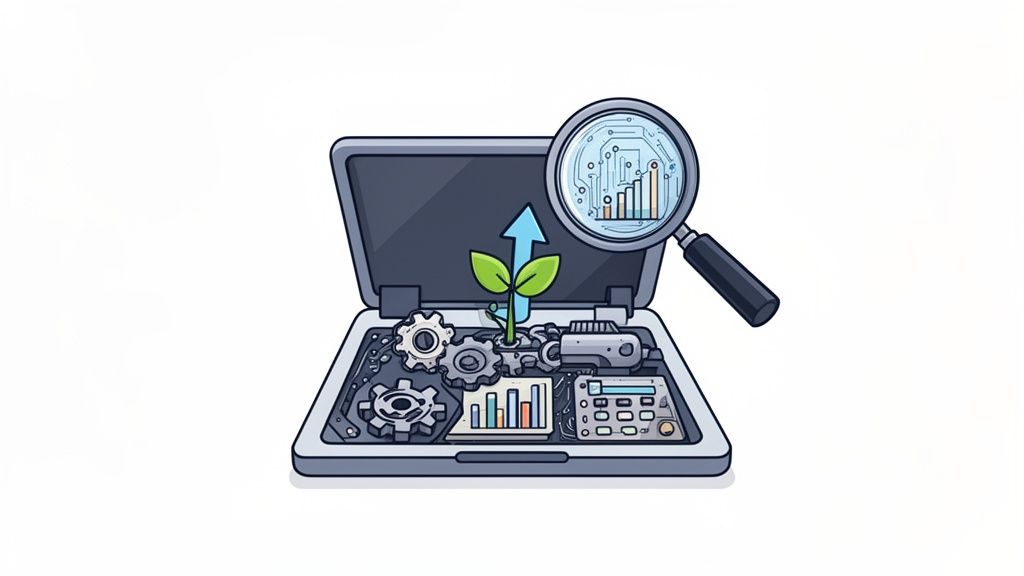
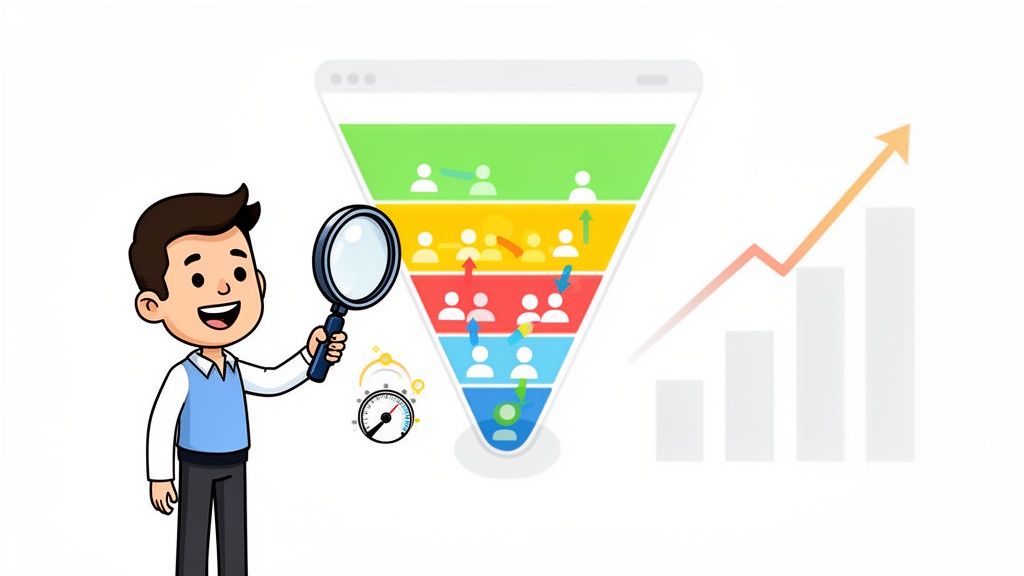
So, what exactly does a conversion optimization consultant do? In short, they’re specialists who dig into your website’s performance data to figure out how to turn more of your visitors into actual customers.
Think of them as digital detectives. Their job is to find out why people aren't buying, signing up, or taking that next step, and then to roll out strategic fixes that solve the problem. The best part? This often leads to a major revenue boost without spending another dime on acquiring new traffic.
Turning Website Visitors Into Loyal Customers
Let’s use an analogy. Imagine your website is a busy brick-and-mortar store. You have plenty of people walking in the door (your website traffic), browsing the aisles, and even putting things in their shopping carts. But for some reason, a huge number of them walk out without buying a single thing.
A conversion optimization consultant is the expert you'd hire to fix this. They would analyze your store's layout, the clarity of your signs, and the friction in your checkout line to figure out what’s stopping people from completing their purchase.
It’s the exact same principle in the digital world. Consultants don't just guess what might work; they follow a rigorous, methodical process to diagnose the real issues and prove that their solutions work. This is a blend of deep data analysis, an understanding of user psychology, and structured, scientific experimentation.
The Role of a Digital Detective
A consultant’s main goal is to investigate every step of the user journey to find the "leaks" in your sales funnel. They focus on answering the tough questions that often stump business owners:
- Where are we losing people? Is there a major drop-off on a specific product page, or is the checkout process itself the problem?
- Why are they bouncing? Is the site navigation a mess? Is the call-to-action button invisible? Or is there a frustrating technical bug?
- What fix will give us the biggest bang for our buck? They don’t just find problems; they prioritize the solutions that will deliver the most significant results first.
To get these answers, they use a whole toolkit of techniques. This includes deep dives into your analytics, using heatmaps to see where users are actually clicking, and running A/B tests to scientifically compare different versions of a page. This data-first approach is what makes professional CRO so much more effective than just redesigning a website based on gut feelings or aesthetics.
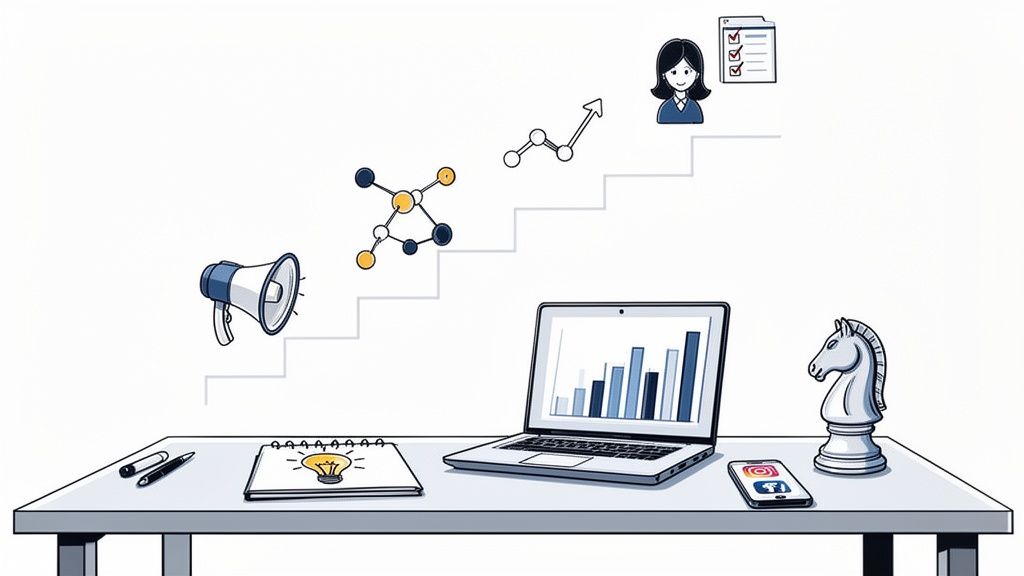
The process is a continuous cycle of observing, hypothesizing, and testing, as illustrated below.
This cycle shows how a consultant moves from observing user behavior and gathering data to forming a smart hypothesis, creating a new version of a page, and running a live test to see which one performs better.
The impact of this work can be massive. Businesses that partner with top CRO agencies often see conversion rate lifts of 15-40%, and some even achieve an incredible 2.5x return on their investment within the first year. For any business, that means transforming the traffic you already have into a powerful, predictable revenue engine.
To dive deeper into the nuts and bolts of CRO, check out The Ultimate Guide to Shopify CRO. It's an excellent resource, especially if you're running an ecommerce store.
The Core Services That Drive Results
A conversion optimization consultant worth their salt doesn't operate on guesswork or tired "best practices." Their work is a structured, scientific process designed to systematically uncover why your visitors aren't converting and then prove out solutions with real user data.
Think of them like a doctor running a full diagnostic before writing a prescription. Every service in their toolkit is a specific test to understand the health of your customer journey and pinpoint exactly where things are going wrong.
While the exact approach can vary, the work almost always revolves around a few core offerings. These aren't just technical busywork; they're designed to answer critical business questions like, "Why are so many people abandoning their shopping carts?" or "Which of these headlines will actually get more demo requests?"
Ultimately, the goal is simple: to help you increase ecommerce conversion rate and boost sales by finding and fixing the hidden friction points on your site. It's a continuous cycle of analysis, hypothesizing, and testing.
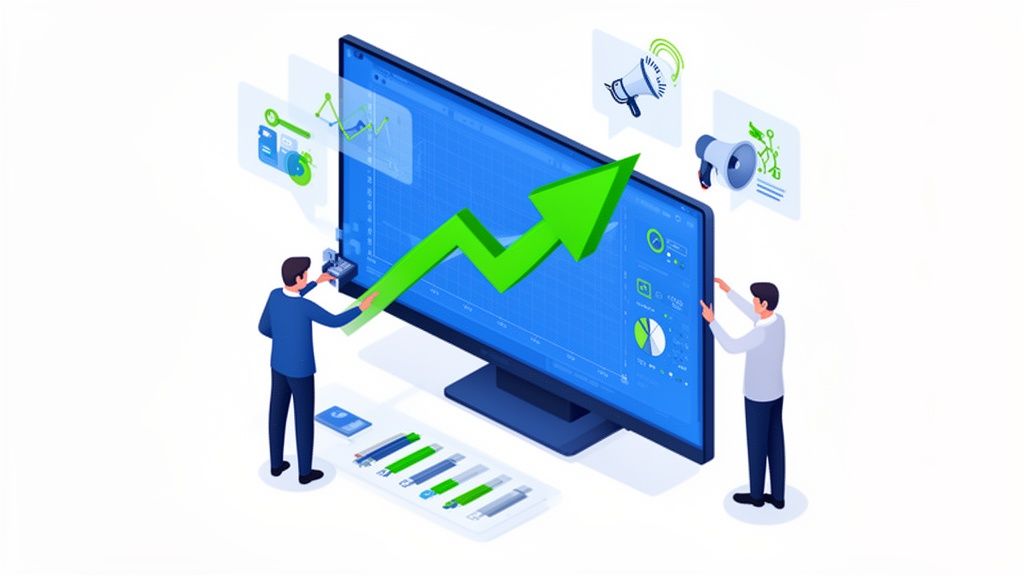
This whole process—from digging into data to identifying friction and shipping solutions—is what a consultant lives and breathes.

As the visual shows, their true value comes from connecting deep analysis with tangible fixes that make the user's journey smoother and, in turn, drive up your conversion rates.
To get a clearer picture of what a CRO consultant actually does, here’s a breakdown of the most common services they offer and the business problems they’re built to solve.
Common CRO Services and Their Business Impact
| CRO Service | What It Is | Typical Business Impact |
|---|---|---|
| CRO & Website Audits | A deep-dive analysis of analytics, user behavior (heatmaps, recordings), and usability principles. | Uncovers "leaks" in the funnel and prioritizes the biggest opportunities for growth. |
| A/B & Multivariate Testing | A scientific method of comparing two or more versions of a page to see which one performs better. | Provides data-backed proof for changes, eliminating guesswork and ensuring a positive ROI. |
| User Experience (UX) Research | Qualitative methods like surveys, user testing, and interviews to understand why users behave the way they do. | Reveals the root cause of friction and provides insights for creating truly user-centric solutions. |
| Landing Page Optimization | A focused effort to improve the performance of key entry pages for marketing campaigns. | Maximizes return on ad spend (ROAS) by converting more paid traffic into leads or customers. |
| Analytics & Data Implementation | Setting up and configuring analytics tools to ensure data is accurate, reliable, and tracks key business goals. | Creates a solid foundation for all optimization efforts by guaranteeing trustworthy data. |
These services form a powerful, interconnected system. Audits find the problems, UX research explains them, and A/B testing proves the solutions work. Let's look at a few of these in more detail.
Comprehensive Website Audits
Before you can fix anything, you need a crystal-clear picture of what's broken. A comprehensive CRO audit is that picture—a complete health check-up for your website’s conversion performance that goes way beyond a quick glance at your analytics dashboard.
During an audit, a consultant will get their hands dirty by:
- Digging into Analytics Data: They'll live in platforms like Google Analytics, hunting for drop-off points in your funnel, pages with suspiciously high bounce rates, and the traffic sources that actually bring you valuable customers.
- Watching Real User Behavior: Using tools like Hotjar or FullStory, they become digital detectives. Heatmaps show them where people are clicking and scrolling, while session recordings let them watch an entire user's journey, often revealing frustrating bugs or confusing design flaws.
- Performing a Heuristic Analysis: They walk through your site in your customers' shoes, evaluating every step against proven usability principles. They're looking for anything that creates confusion, friction, or kills a user's motivation to move forward.
The result of all this work is a prioritized list of conversion roadblocks. It’s a strategic roadmap that tells you exactly where to focus your efforts for the biggest impact.
Scientific A/B and Multivariate Testing
Once you have a list of potential improvements from the audit, how do you know which ones will actually work? You test them. This is where A/B testing, the absolute heart of CRO, comes in. It’s the scientific method applied to your website, and it's all about replacing opinions with cold, hard data.
Let's say you have a hunch that a clearer call-to-action on your pricing page will get more people to sign up.
In an A/B test, you’d create two versions of that page. Version A is your current page (the "control"). Version B is the new one with the clearer button (the "variant"). A consultant then uses testing software to split your traffic, showing 50% of visitors Version A and 50% Version B.
By tracking which version gets more sign-ups, you get a definitive answer. This disciplined process prevents you from making costly changes based on a gut feeling and ensures every update is a step forward. Multivariate testing is just a more complex version of this, allowing you to test multiple changes at once (like a new headline and a new button color) to find the winning combination.
Deep User Experience Research
Analytics and A/B tests are fantastic for telling you what is happening on your site. But they often can't tell you why. That's where qualitative user experience (UX) research comes in, helping you get inside your customers' heads.
A consultant might use several methods to uncover that "why":
- On-Site Surveys & Polls: Deploying short, simple questions on key pages to ask visitors directly what’s stopping them. A quick poll on a checkout page asking, "Have any questions before you complete your purchase?" can be incredibly revealing.
- Usability Testing: This is gold. It involves watching real people try to accomplish a task on your site while they think out loud. You get a raw, unfiltered look at every point of confusion and frustration they encounter.
- Customer Interviews: Sometimes the best way to understand your customers is just to talk to them. A good consultant will interview recent buyers to learn about their motivations, their buying journey, and what they really value about your company.
By combining the "what" from analytics with the "why" from UX research, a consultant can build a complete, 360-degree view of the customer experience. This is what leads to powerful, user-centric solutions that truly move the needle. If you want to try some of these tactics on your own, our guide on how to increase website conversions is a great place to start.
How to Calculate the ROI of a CRO Consultant
Bringing on a conversion optimization consultant might feel like a big leap, but it's one of the few marketing expenses you can tie directly to the bottom line. Unlike a brand awareness campaign, CRO success is measured in cold, hard numbers—revenue, leads, and profit. Calculating the potential return on investment (ROI) isn't just a nice-to-have; it's the core of the business case.
Think about it this way: a consultant's fee is a direct investment in your website's performance. You aren't just paying for their time. You're paying for a system that turns more of your existing traffic into customers. Suddenly, every dollar you’re already spending on ads, SEO, and content starts working much harder for you.
So, let's get out of the abstract and into a practical framework you can use to see the financial impact for yourself.
A Simple Framework for Projecting ROI
The math behind CRO’s value is surprisingly simple. It really just comes down to a few key metrics you’re probably already tracking. By forecasting a realistic bump in your conversion rate, you can see just how fast this kind of investment pays for itself and starts generating pure profit.
Let’s walk through a realistic scenario with a fictional e-commerce store.
Scenario: A Fictional E-commerce Store
- Monthly Website Visitors: 50,000
- Average Order Value (AOV): $80
- Current Conversion Rate: 1.5%
First, let's figure out their current monthly revenue:
50,000 visitors * 1.5% conversion rate = 750 sales750 sales * $80 AOV = $60,000 in monthly revenue
Now, let's say a good CRO consultant believes they can lift the conversion rate from 1.5% to 2.0% over a six-month engagement. That 0.5 percentage point increase might sound small, but its impact is huge.
Here's the new math:
50,000 visitors * 2.0% conversion rate = 1,000 sales1,000 sales * $80 AOV = $80,000 in new monthly revenue
The result? An extra $20,000 in revenue every single month. If the consultant’s fee is $5,000 per month, your ROI on that fee is 300% month after month—long after the initial project is over. For a deeper dive into these kinds of projections, check out our guide on how to calculate marketing ROI.
Understanding Common Pricing Models
When you start looking for a CRO consultant, you’ll run into a few different ways they structure their fees. Getting familiar with these models will help you find a partner whose incentives actually line up with your goals.
- Monthly Retainer: This is the most common setup. You pay a fixed fee each month for ongoing optimization work—research, testing, analysis, and reporting. It's predictable and ensures your site is getting continuous attention.
- Project-Based Fee: Got a specific, one-time job in mind, like a full website audit or a major landing page redesign? You’ll pay a flat fee for that defined scope. This works great when you have a very clear problem you need to solve.
- Performance-Based Pricing: This model ties the consultant’s pay directly to their results. They might take a percentage of the new revenue they generate or only charge when they hit a pre-agreed lift in conversions.
As more companies zero in on efficiency, the demand for expert help has exploded. The average eCommerce conversion rate in B2B is a mere 1.8%, which highlights a massive opportunity for growth. This has spurred new engagement models, with performance-based pricing becoming a hot trend as agencies put their money where their mouth is, guaranteeing results or charging only for wins.
Real-World Examples of CRO Success Stories
All the theory and methodology in the world doesn't mean much until you see it in action. That’s where the rubber really meets the road. The work of a conversion optimization consultant isn't just about making small tweaks for the sake of it; it's about driving real, measurable growth for the business.
To show you what this looks like, let's walk through a few scenarios where smart, data-driven testing led to some major wins. I'll break down each case using a simple "Problem → Test → Result" framework so you can see exactly how a well-formed hypothesis solves a genuine business challenge.

These examples are perfect illustrations of how a consultant goes from spotting a problem to delivering a solution that actually makes money.
Slashing Cart Abandonment for an Ecommerce Brand
The Problem: A direct-to-consumer brand selling custom phone cases was bleeding money at checkout. A quick look at their analytics revealed a painful truth: 68% of users who added an item to their cart were bailing before paying. Their checkout was a clunky, multi-page ordeal that forced every single user to create an account.
The Test: A CRO consultant came in and immediately flagged the mandatory account creation as a major point of friction. Their hypothesis was simple: let people buy without the commitment. They set up an A/B test. Version A was the original, painful checkout. Version B introduced a slick, single-page checkout with a big, friendly "Guest Checkout" button, making the account sign-up totally optional.
The Result: The impact was immediate and pretty stunning. The guest checkout option (Version B) boosted the checkout completion rate by 22%. That single change added a five-figure lift to their monthly revenue and proved just how much growth can be unlocked by removing one simple barrier.
Doubling Demo Requests for a SaaS Company
The Problem: A B2B SaaS company was pouring ad spend into a landing page for their new project management tool. The traffic was there, but the results weren't. Their demo request conversion rate was a dismal 1.2%. The page itself was a wall of text, full of jargon and generic stock photos that did nothing to build trust or excitement.
The Test: The consultant started by talking to actual users. After running a few surveys, they found that visitors had no idea what made the software special. The hypothesis? Swapping out generic fluff for clear benefits and real social proof would get people to convert. The team designed and tested a new landing page with a powerful value proposition, glowing customer testimonials, and a short video showing the product in action.
This is especially crucial on mobile. While mobile landing pages get a whopping 82.9% of traffic, they only convert at 1.53%, compared to 4.14% on desktop. This gap is a massive opportunity, and clear messaging is the key to closing it. You can find more insights on this in the 2026 CRO trends on WebFX.com.
The Result: The redesigned page crushed it. It more than doubled the demo request conversion rate to 2.9%, effectively cutting the company's cost per acquisition in half. It was a powerful lesson: talking about your customers' problems is always more effective than just listing your features.
Boosting Lead Quality for a B2B Service
The Problem: An IT consulting firm was using a standard, one-size-fits-all "Contact Us" form to get leads. The form was a beast, demanding 11 fields of information right off the bat, including budget and project timelines. Unsurprisingly, almost no one filled it out, and those who did were often unqualified tire-kickers.
The Test: A conversion consultant figured the long form was scaring everyone away. They proposed a less intimidating, two-step process. The new initial form only asked for a name and an email—that's it. After someone submitted that, they were taken to a second, optional page where they could provide all the extra details.
The Result: The change worked beautifully. The new two-step form increased initial lead submissions by an incredible 74%. Sure, not everyone filled out the second part, but the company suddenly had a much larger pool of top-of-funnel leads to nurture. Even better, the prospects who did complete the second form were highly motivated, allowing the sales team to stop chasing dead ends and focus on closing high-quality deals.
How to Choose the Right CRO Consultant
Picking the right conversion optimization consultant is a make-or-break decision for your digital growth. This isn't just about hiring another vendor; you're bringing on a strategic partner who will directly influence your bottom line. A great consultant feels like an extension of your team, while a bad one can burn through your budget, your time, and your hard-won website traffic.
So, how do you get it right? It all comes down to knowing what to look for and what to ask. You need to get past the polished portfolio and really understand their process, how they communicate, and whether they live and breathe data. This is your playbook for finding a true partner who delivers results you can actually measure.
Key Questions to Ask Any Potential Consultant
When you’re vetting consultants, your goal is to get a look under the hood at how they think. Generic answers are a huge red flag. You're looking for someone with a structured, repeatable process built on data—not someone who just plans to throw a bunch of "best practices" at your website and see what sticks.
Here are the five essential questions you need to ask to tell the pros from the pretenders:
Walk me through your typical CRO process from day one. A sharp consultant won't hesitate. They should be able to clearly outline their entire workflow, from initial research and data dives to forming a hypothesis, prioritizing tests, and analyzing the results. If they can't map out a clear process, they probably don't have one.
How do you decide what to test first? This question cuts right to their strategic mindset. A top-tier consultant will immediately start talking about a prioritization framework they use, like P.I.E. (Potential, Importance, Ease) or I.C.E. (Impact, Confidence, Ease). These frameworks are crucial for focusing on experiments that have the best shot at moving the needle. Be wary of anyone who just says, "We'll start with the homepage," without a data-backed reason.
What’s in your toolkit for research and A/B testing? The specific tools they mention—like Google Analytics, Hotjar, VWO, or Optimizely—are less important than why they use them. A real pro can explain their go-to tech stack and justify each tool's purpose, whether it's using heatmaps to decode user behavior or diving into analytics to find where a funnel is leaking.
How will we stay in the loop on progress and results? Communication is non-negotiable. A great partner will propose a clear reporting schedule (think weekly check-ins or monthly performance deep-dives) and deliver dashboards that connect test outcomes directly to your business goals, like revenue and qualified leads. A vague promise to "keep you updated" just doesn't cut it.
Tell me about a time an experiment failed. This is my favorite question. Anyone can brag about their wins, but failure is where the real learning happens in CRO. An experienced, confident consultant won't be afraid to talk about a hypothesis that bombed. They’ll explain what they learned from the data and how that "failure" actually helped them get smarter for the next test. It’s a huge sign of transparency and a genuine commitment to the craft.
Red Flags vs. Green Flags
As you talk to different consultants, you'll start to notice patterns. Being able to spot the warning signs early can save you from a very expensive mistake. This quick-reference guide will help you sort the promising partners from the ones to avoid.
Consultant Evaluation Checklist: Red Flags vs. Green Flags
When vetting a potential CRO partner, it's easy to get sidetracked by a slick presentation. This checklist helps you focus on what really matters—distinguishing the signs of a true expert from the warning signs of someone who can't deliver.
| Evaluation Area | Green Flag (What to Look For) | Red Flag (What to Avoid) |
|---|---|---|
| Guarantees | They focus on a proven, data-driven process and their commitment to continuous improvement. | They guarantee specific uplifts, like "doubling your conversion rate in 90 days." |
| Methodology | They emphasize a custom research and testing plan based on your specific data and audience. | They lean on generic "best practices" or want to copy-paste what worked for another client. |
| Transparency | They are completely open about their process, pricing, and are happy to share what they learned from past failures. | They're cagey about their methods or hesitate to provide detailed, unedited case studies. |
| Focus | They ask deep, thoughtful questions about your business goals, customer pain points, and revenue model. | They're fixated on vanity metrics like website traffic or the color of a button. |
| Tools | They have a clear rationale for their preferred tools and can explain how each one generates valuable insights. | They're a "one-trick pony" who only knows a single tool or pushes one specific technique for every problem. |
The single biggest red flag is a consultant who promises results without first promising a rigorous process. Real optimization isn't about quick fixes or magic bullets; it's a marathon built on a foundation of methodical discovery and validated learning.
Ultimately, choosing the right conversion optimization consultants means finding a partner who is as obsessed with your business outcomes as you are. They should be endlessly curious, deeply analytical, and focused on using data to find answers to your biggest growth challenges. By asking these questions and keeping an eye out for red flags, you can confidently find a pro who will become a true engine for your company's success.
The Future of Conversion Optimization

The world of conversion optimization is changing fast, and the next few years will look very different. While the core ideas of testing, learning, and putting the user first will always be important, the tools we use are getting smarter. For any business leader, finding a consultant who gets this isn't just a good idea—it's how you stay competitive.
The biggest shift? It's all about Artificial Intelligence (AI). For years, good consultants have dug through analytics and stared at heatmaps to find out what makes people tick. AI doesn't replace that; it supercharges it. It can sift through enormous amounts of user data, spotting tiny patterns and predicting outcomes in ways no human analyst ever could.
This means a consultant’s job is evolving. It’s no longer just about figuring out why people leave your site. Now, they can start predicting which visitors are about to convert and what specific tweak will give them the final push they need.
The Rise of Hyper-Personalization
This new level of insight is what makes hyper-personalization possible. Classic A/B testing is great, but it’s designed to find one "winner" that works best for the average visitor. The problem is, there’s no such thing as an "average" visitor. The future is about creating dynamic, one-of-a-kind experiences for every single person who lands on your site.
Think about it this way: someone visits your pricing page. An AI system, set up by an expert consultant, could instantly size them up based on their behavior and other data points to:
- Display the features that matter most to someone in their industry.
- Show them a case study from a company that’s just like theirs.
- Change the call-to-action to reflect what they’re trying to accomplish.
We’re not talking about just dropping someone's first name into a headline. This is about building a completely different journey for each person, in real-time.
This shift moves optimization from a one-size-fits-all model to a one-to-one conversation at scale. The goal is no longer just to find the best page but to deliver the right page to the right person at the right moment.
This is why hiring conversion optimization consultants who are fluent in these new technologies is so important. They aren't just running tests anymore; they're becoming architects for smarter, more adaptive websites. Getting a handle on these trends is the first step to building a site that not only converts today but is ready for whatever comes next. For more foundational strategies, explore our guide to essential conversion optimization tips.
Frequently Asked Questions
It’s completely normal to have a lot of questions when you're thinking about hiring a conversion optimization consultant. It's a big step. To help clear things up, here are some straight answers to the questions we hear most often.
How Long Does It Take to See Results?
This is probably the number one question we get, and the honest answer is: it’s a process. Think of it as building a high-performance engine, not just flipping a switch. The first 30 to 60 days are all about laying the groundwork—deep audits, user research, and digging into your data. This isn't busy work; it's the critical foundation for every test we'll run later.
Generally, you can expect to see statistically significant results from the first round of A/B tests within about 3 to 6 months. The real magic, though, happens when you see CRO as a continuous cycle of improvement. It’s not a one-and-done project. It’s about building momentum that delivers bigger and bigger returns over time.
What Is the Difference Between CRO and SEO?
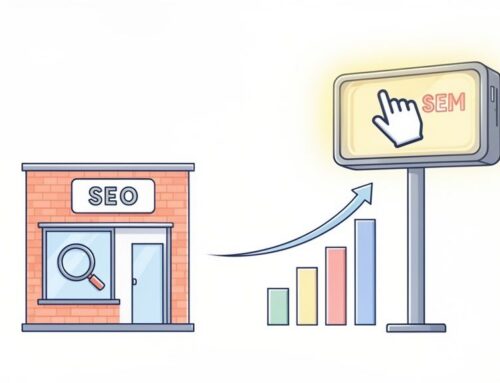
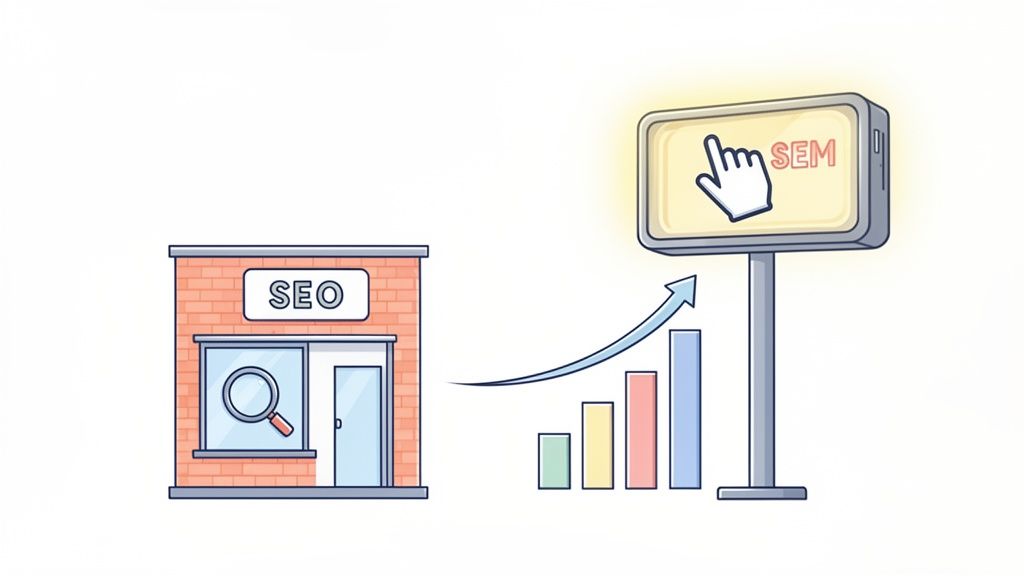
It’s easy to mix these two up, but they play very different, yet complementary, roles. Let’s use a retail store analogy:
- SEO (Search Engine Optimization) is your marketing and advertising. It's everything you do to get more people to find your store and walk through the front door. It’s about boosting traffic from places like Google.
- CRO (Conversion Rate Optimization) is what happens once they're inside your store. It’s about the layout, the helpful signs, the product displays, and the smooth checkout experience—all designed to convince visitors to buy something.
In a nutshell, SEO brings in the traffic, and CRO turns that traffic into customers. They are two halves of the same coin. A site with great SEO but poor CRO is like a popular store where no one buys anything. You need both to actually grow your revenue.
Can I Do Conversion Optimization Myself?
Of course! There are tons of great resources and tools out there that can help you learn the basics and run simple tests. Getting started on your own can definitely be a good first step.
But bringing in a professional consultant is like hiring a master mechanic instead of just tinkering in your garage. A seasoned pro comes with years of experience across different industries, access to sophisticated tools, and an objective eye that you simply can't have when you're so close to your own business.
They know how to design complex tests, interpret subtle user behavior, and avoid common mistakes that can waste months of your time and traffic. It’s an investment, but it’s an investment in getting bigger results, faster.
At ReachLabs.ai, we live and breathe this stuff. We combine rigorous data analysis with smart, creative strategies to build marketing programs that don't just look good—they deliver real, measurable results. We skip the guesswork and use proven optimization methods to turn your visitors into valuable customers.
Discover how our expert team can elevate your conversion rates and drive sustainable growth.