

Think of your content marketing team structure as the master plan for your entire content operation. It’s the blueprint that lays out who does what, how they work together, and how all their efforts ladder up to real business goals. This isn’t just about a fancy org chart; it’s the engine that turns great ideas into tangible results like more traffic, qualified leads, and actual sales. A solid structure is what separates a chaotic, “let’s throw stuff at the wall” approach from a well-oiled content machine.
Why Your Team Structure Is Your Content Blueprint

Imagine trying to build a house without a blueprint. The plumber might show up before the foundation is even poured, and the electrician would have no idea where to run the wires. It would be a mess. The same is true for your content team.
Your team structure is that essential blueprint. It ensures your writer, SEO specialist, designer, and social media manager are all building the same “house” together. Without that plan, you get silos, duplicated work, and crucial tasks falling through the cracks. The end result is almost always inconsistent content and wasted money.
A well-thought-out structure gives everyone clarity and a shared purpose. It transforms a collection of talented people into a single, cohesive unit. This is the foundation you need to scale your content and unlock the real benefits of content marketing.
The Foundation of Strategic Success
A smart content team structure does way more than just hand out job titles. It’s directly tied to hitting your biggest business goals. By setting up clear roles and a logical chain of command, you create a system of accountability and smooth communication.
This kind of setup helps you:
- Align Content with Goals: Every blog post, video, or case study is created for a reason—to build brand awareness, capture leads, or help the sales team close deals.
- Maximize Efficiency: When everyone knows their job, you stop seeing redundant work. People can focus on what they do best, making the whole process faster and more effective.
- Improve Content Quality: With dedicated roles for editing, SEO, and design, the quality and consistency of your content go way up. No more rushing and cutting corners.
This isn’t just a nice idea; it’s how successful companies operate. Data shows that around 76% of B2B organizations have a dedicated person or team for content marketing. And interestingly, more than half of these teams are small, with just 2 to 5 members, often because they’re using AI tools to help with the heavy lifting. You can find more stats on how AI is shaping content teams on typeface.ai.
Ultimately, getting the structure right is what turns your content from a business expense into a predictable source of revenue.
Meet the Key Players on Your Content Team

A top-tier content marketing team structure isn’t just a list of names on an org chart. It’s a dynamic, collaborative unit where every person plays a critical part. Think of it like a championship sports team: you need talented players in specific positions, all executing the same game plan to win.
Let’s walk through the essential roles that form the backbone of any high-performing content team. These are the core players who take an idea and turn it into a real, revenue-driving asset.
The Strategic Leadership Roles
Every successful team needs a coach—someone to set the direction and keep everyone focused on the main goal. In content marketing, this usually starts with one multi-talented strategist who juggles multiple responsibilities. As the team grows, that role often splits into more specialized leadership positions.
- Content Strategist or Manager: This is the architect of your entire content program. They dive deep into audience research, map out the customer journey, and decide which content formats will actually move the needle. They own the editorial calendar and are the ones translating big-picture business objectives into tangible content campaigns.
- Head of Content: In a larger company, this senior leader is the general manager of the whole content operation. They’re accountable for the overarching content vision, managing the budget, and making sure every content initiative supports top-level company goals. They spend less time on day-to-day creation and more time on high-level strategy and leading the team.
A great Content Strategist doesn’t just ask, “What should we write about?” They ask, “What problems can we solve for our audience that will naturally lead them to our solution?” This shift in perspective is the difference between creating noise and creating value.
The Core Creation and Optimization Roles
Once the game plan is in place, you need the players on the field to execute it and make sure it connects with the fans. These are the hands-on roles that manage the quality and visibility of everything you publish. They are the engine of your content machine.
These specialists are the ones who do the heavy lifting:
- Content Writer or Creator: This is your team’s storyteller-in-chief. They’re responsible for writing compelling, insightful, and thoroughly researched content, whether it’s a blog post, a detailed white paper, or a video script. Their words are the fuel for all your marketing.
- SEO Specialist: This person’s job is to make sure your content actually gets found. They handle keyword research, on-page optimization, backlink strategies, and keep an eye on the technical health of the site. They collaborate with writers from the get-go, weaving search visibility into the fabric of the content itself.
- Content Editor: The editor is your ultimate guardian of quality. They meticulously review every piece of content to ensure it’s grammatically flawless, consistent with the brand’s voice, and easy to read. They are the ones who uphold the high standards that build credibility and trust with your audience.
- Graphic Designer: Let’s face it, we live in a visual world. A good designer is non-negotiable. They transform text-based ideas into stunning infographics, social media visuals, and custom blog images that stop people from scrolling. Their work makes content far more engaging and shareable, massively amplifying its impact.
How to Structure Your Team as Your Company Grows
One of the biggest mistakes I see is businesses treating their content team structure as a “set it and forget it” project. What works for a scrappy five-person startup will absolutely choke a 100-person scale-up. It just won’t work.
Think of your team as a living thing. It has to evolve. The key is to anticipate the next stage of growth and build the team you will need, not just the one you need today. This saves you from the frantic, chaotic scramble to hire when things inevitably start breaking.
Let’s walk through three practical models that map to different company growth stages.
This simple hierarchy shows how the best content operations function: strategy leads to creation, which then powers distribution. It’s a foundational concept for any team you build.
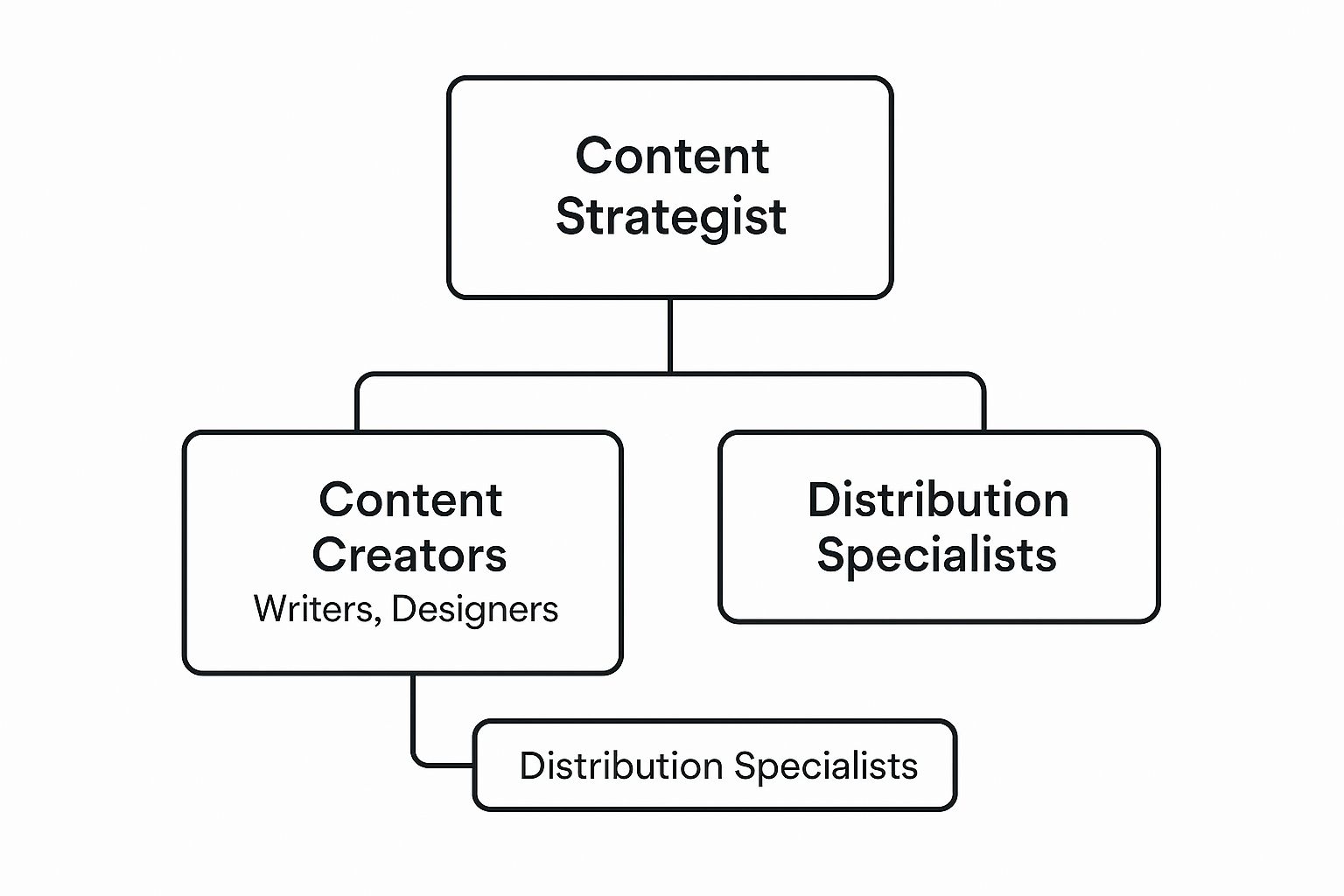
Each layer depends on the others. Without a solid strategy, your creation efforts are aimless. Without distribution, even the best content goes unseen.
To see how these models differ in the real world, let’s compare them side-by-side. The table below breaks down the typical setup, focus, and common headaches at each stage of company growth.
Comparing Content Team Structures by Company Size
| Attribute | Startup (1-50 Employees) | Mid-Size (50-200 Employees) | Enterprise (200+ Employees) |
|---|---|---|---|
| Team Composition | 1-2 Generalists (e.g., Content Manager) + Freelancers | Small, specialized team (e.g., SEO, Writer, Social Media) | Large, hierarchical team with specialized pods |
| Primary Focus | Brand awareness, lead generation, foundational content | Scaling content production, SEO optimization, lead nurturing | ROI, market dominance, sales enablement, global reach |
| Biggest Challenge | Limited resources, “wearing too many hats,” burnout risk | Maintaining quality at scale, managing new workflows | Silos between teams, ensuring brand consistency, agility |
This table is a great cheat sheet, but remember that these are flexible frameworks, not rigid rules. Your company’s specific goals and market will always be the most important factor in deciding who to hire and when.
The Lean Startup Model (1-50 Employees)
In the early days, it’s all about speed and flexibility. Your “team” is often just one person, or maybe a tiny duo. The mission isn’t perfection; it’s about getting quality content out the door fast with what you have. This is the era of the generalist.
- Core Player: The Content Marketing Manager is the hero here. They’re part strategist, part writer, part editor, and part social media guru.
- Support System: This person relies heavily on a trusted network of freelance writers and designers to get the work done without the cost of full-time hires.
- Primary Focus: The goal is simple: get the brand on the map and start bringing in some early leads. Think foundational blog posts and building a social media presence.
The Growing Mid-Size Business Model (50-200 Employees)
Once your company finds its footing, the “do-it-all” approach starts to buckle. The workload is too heavy for one person, and you start seeing the need for real, dedicated expertise in areas like SEO or video. This is your cue to start building a team of specialists.
This transition from generalists to specialists is a huge milestone. It’s the point where you have to get serious about creating clear workflows and giving people ownership over their specific domains.
The structure of content marketing teams varies significantly based on company size. For startups, a Content Marketing Manager often manages everything, coordinating with freelancers. As companies grow, they add specialized roles like SEO Managers, multiple Content Writers, and Outreach Specialists to deepen their capabilities. You can explore more about these evolving team structures on MarketerHire’s blog.
The Scaled Enterprise Model (200+ Employees)
At the enterprise level, content isn’t just marketing—it’s a core business function with a hefty budget and serious ROI expectations. The team structure naturally becomes more complex and layered to support different products, regions, or customer segments.
The name of the game here is efficiency and control. Teams are often broken down into smaller, specialized “pods” that focus on specific goals, like top-of-funnel acquisition or sales enablement. This pod structure helps a massive organization stay nimble.
Here’s what sets an enterprise team apart:
- Senior Leadership: You’ll see roles like a Chief Content Officer (CCO) or VP of Content. Their job is to steer the ship and make sure the entire content program aligns with C-suite business objectives.
- Specialized Pods: You might have one pod dedicated to product marketing content, another cranking out thought leadership blogs, and a third creating materials for the sales team.
- Deep Specialization: Roles get hyper-focused. Think of a Digital PR Specialist who only does outreach or a Video Producer who lives and breathes video content.
In-House, Agency, or a Hybrid Mix? Choosing Your Sourcing Model

Once you’ve thought about the roles you need, the next big question is: who is actually going to do the work? Will you build a dedicated team of employees, bring in outside experts, or find a sweet spot in the middle? There’s no single right answer here. It all comes down to a classic balancing act between cost, control, scalability, and getting true, deep expertise.
Let’s break down the three main ways you can source your content creation. Each one has its own vibe, its own strengths, and its own trade-offs, so picking the right one is key to making sure your content engine fits your company’s budget, culture, and long-term goals.
The Full In-House Team Model
Going fully in-house means your team is made up entirely of full-time employees. Think of it like building a custom workshop from scratch. You get to hand-pick every tool and train every artisan to your exact specifications.
The number one advantage here is unmatched brand immersion. Your team lives and breathes your company culture every day. That translates into content that feels genuinely authentic and perfectly nails your brand voice. Of course, this model also comes with the highest overhead—salaries, benefits, training, you name it.
- Pros: You get deep brand knowledge, complete creative control, and seamless collaboration with other departments like sales and product development.
- Cons: This route has higher fixed costs, a longer ramp-up time to hire and train people, and you risk creating skill gaps if you don’t have outside perspectives.
The Fully Outsourced Agency Model
On the other end of the spectrum is outsourcing everything to a marketing agency. This is like hiring a team of master builders who show up with their own blueprints and a truck full of top-of-the-line equipment. Almost overnight, you have access to a huge range of specialized skills, from high-level SEO to video production, all without the long-term commitment of hiring.
Agencies bring a ton of industry experience and time-tested processes to the table, which can really kickstart your results. The trade-off? You usually have less day-to-day control and they won’t have the same intimate, insider’s view of your company’s culture.
For companies that need specialized expertise right now without the overhead of full-time hires, an agency offers a scalable way to launch and manage sophisticated content campaigns quickly.
This approach is incredibly efficient if you need to scale up fast or simply don’t have the resources to build a team from the ground up. If you’re weighing this option, it’s worth exploring the pros and cons of a marketing agency vs in-house team in more detail.
The Flexible Hybrid Model
For many, the hybrid model is the perfect compromise. It gives you the best of both worlds by combining a core in-house team for strategy and brand consistency with a curated network of freelancers and agencies for specialized tasks.
Imagine having your own trusted project manager who knows exactly when to call in an expert plumber or a master electrician for a specific job. That’s the hybrid model in a nutshell. It gives you the brand stewardship of an in-house team and the on-demand skills of outside experts.
- In-House Core: Your Content Strategist and Editor are the guardians of the brand, making sure everything is consistent and high-quality.
- External Specialists: You might hire a freelance writer with deep subject matter expertise for a blog series or bring in an agency to produce a major video project.
This approach keeps your fixed costs down while giving you the flexibility to tap into world-class talent for specific, high-impact projects whenever you need them. It’s a smart, adaptable way to grow.
How AI Is Redefining Content Team Roles
Let’s get one thing straight: AI isn’t here to replace your content team. It’s here to make them better. The smartest marketing leaders I know are thinking of generative AI less as a threat and more as a super-powered new colleague—a tireless assistant who can handle the repetitive, heavy-lifting parts of the job.
This frees up your human talent to double down on what they do best: high-level strategy, genuine creativity, and building real connections with your audience.
No matter your content marketing team structure, bringing AI into the fold creates some pretty amazing efficiencies. Small teams can suddenly punch way above their weight, scaling their output without burning out. Larger, more established teams can automate the routine stuff, giving them more breathing room to focus on big-picture planning and creative breakthroughs.
The Evolution of Core Content Roles
The rise of AI doesn’t mean jobs are disappearing. It means they’re changing. Roles are naturally shifting from pure, from-scratch creation to more of a strategic oversight and refinement function.
I like to think of it as moving from being the bricklayer to being the architect. You’re still in charge of the vision, but now you have powerful tools to help execute that vision with incredible speed and precision. Of course, this requires a new focus on critical thinking and sharp editing skills.
Here’s a look at how some key roles are changing on the ground:
- Writers as AI Editors: The terror of the blank page is becoming a thing of the past. Writers now often start with a solid AI-generated draft. Their role then becomes that of an expert editor—they fact-check everything, dial in the tone, weave in unique human insights, and make sure the final piece resonates.
- Strategists as Data Interpreters: AI tools can crunch massive datasets in seconds, spotting content gaps, keyword opportunities, and what’s trending right now. This lets strategists move faster and make smarter, data-backed decisions about their content calendar and campaign direction.
- Creators as Idea Accelerators: Stuck for ideas? AI is like having a brainstorming partner who never needs a coffee break. It can spit out dozens of blog titles, video concepts, or social media angles in minutes. This frees up your creators to focus their energy on picking the winning ideas and bringing them to life.
AI handles the “what” and “how” of content creation—generating drafts and pulling data—so that human marketers can focus on the “why.” It’s about spending less time on the mundane and more time on the strategic thinking that actually moves the needle.
Practical AI Applications for Your Team
Integrating AI goes way beyond just drafting articles. It can smooth out the entire content lifecycle.
For example, a single, well-researched blog post can be instantly repurposed by AI into a dozen social media snippets, a script for a short video, and a summary for your email newsletter. This isn’t just about working faster; it’s about multiplying the value of every single asset you create.
This kind of efficiency is a cornerstone of modern content marketing best practices, where impact is everything. By using AI for research, first drafts, and repurposing, you build a more agile and effective content engine. This shift doesn’t make your team less human—it makes them more strategically human, focused on the creativity and connection that AI can’t replicate.
Your Top Questions About Building a Content Team, Answered
Once you’ve got a plan for your content marketing team structure, you’ll inevitably hit some practical roadblocks. That’s perfectly normal. This is where the theory meets reality, and the questions start flying.
Let’s walk through the most common ones I hear from leaders. Think of this as your field guide for turning that organizational chart into a living, breathing, high-performing team.
What Is the First Role I Should Hire?
If you’re starting with a blank slate, your first hire should almost always be a Content Marketing Manager or a sharp Content Strategist. Don’t just hire a writer. You need someone who can build the entire machine, not just one of its parts.
This person is your strategic anchor. They’re responsible for laying the groundwork:
- Sketching out the initial content strategy and building the editorial calendar.
- Digging into audience research and finding keyword opportunities.
- Actually writing the first pieces or finding and managing good freelancers to get things moving.
- Setting up the basic analytics to see what’s hitting the mark and what isn’t.
Think of them as a “strategic generalist.” By bringing this person in first, you ensure every piece of content has a purpose. You can start specializing with other hires once you’ve proven the concept and have a better sense of your specific needs.
How Should I Measure My Content Team’s Success?
This is the big one. To justify your team’s existence and get more budget, you have to prove its worth. The key is to avoid getting bogged down in “vanity metrics” and connect your work directly to business goals.
I like to think about measurement in three tiers, moving from attention to revenue.
The real trick to proving content’s value is showing how it guides a person from being a stranger to a customer. You start by measuring engagement, sure, but you should always be pushing to connect your team’s work to the numbers the C-suite actually cares about: leads, sales, and the cost to acquire a customer.
Here’s a simple way to frame it:
- Engagement Metrics: Are we even reaching people? This is your top-of-funnel reality check. Look at things like organic traffic, time on page, social shares, and how many other sites are linking back to you.
- Conversion Metrics: Is our content compelling people to act? Here, you’re tracking things like newsletter sign-ups, downloads of your ebooks and whitepapers, or demo requests that came from a blog post.
- Revenue Impact: Is our content actually making the company money? This is the ultimate goal. You’ll need to work with your sales team to track Marketing-Qualified Leads (MQLs), how much sales pipeline your content influenced, and, the holy grail, actual deals closed that started with your content.
Where Does the Content Team Fit in the Organization?
Most of the time, the content team lives inside the larger marketing department. This makes sense—it keeps everything aligned with brand messaging, demand generation, and product marketing. Usually, the team reports up to a VP of Marketing or a CMO.
But honestly, who the team reports to is less important than who they collaborate with. The best content teams I’ve seen act like a central resource for the entire company, working hand-in-glove with:
- Sales: Creating sales sheets, case studies, and email templates that help reps close more deals.
- Product: Getting the inside scoop on new features so they can turn technical specs into great stories.
- Customer Success: Finding out what customers are struggling with and creating content that helps them succeed (which boosts retention!).
When you set up your team to work this way, content stops being just a “top-of-funnel” activity. It becomes a growth engine that supports the entire customer journey, making the whole business stronger.
Ready to build a high-performance content team without the guesswork? ReachLabs.ai provides the strategic expertise and world-class talent to design and execute a content program that drives real results. Learn how we build marketing engines that move the needle.