
Imagine trying to build a house without a blueprint. You might have the best materials and a top-notch crew, but without a clear plan, you're just guessing. The same goes for your business—the components of a marketing plan are the blueprint you need to build sustainable growth.
Your Marketing Plan Is a Blueprint for Growth
A marketing plan is far more than just a document; it's a living roadmap that gets your entire team on the same page and points your resources in the right direction. It takes a fuzzy goal like "grow the business" and breaks it down into a series of concrete, measurable steps. Each piece builds on the last, creating a powerful engine for real progress.
Think of it like conducting an orchestra. Each section of your plan, from market research to budget, is a different instrument. When they all play from the same sheet music, you get a powerful symphony. But when they play on their own, you just get noise. A solid plan ensures every single marketing effort—whether it’s a quick social media post or a massive product launch—works together in perfect harmony.
Why Every Business Needs This Structure
When you operate without a formal plan, marketing tends to become a series of reactive, disconnected tactics. You end up chasing shiny objects or constantly putting out fires instead of making strategic moves toward your long-term goals. A well-defined structure brings much-needed clarity and purpose.
Here’s what a good plan helps you do:
- Secure Buy-In: A clear, data-driven plan makes it much easier to get the green light and the necessary resources from leadership. It shows you’ve done your homework.
- Align Your Team: It makes sure everyone, from your content writers to your sales team, knows exactly what the goals are and how their work contributes.
- Justify Your Budget: By tying every dollar to specific actions and expected results, you can confidently explain and defend your marketing spend.
A great marketing plan isn't a "set it and forget it" document. It’s a dynamic guide that you should revisit and adjust regularly based on what the data is telling you and how the market is shifting.
Ultimately, understanding the core components of a marketing plan is about being intentional. It’s the difference between crossing your fingers and hoping for results, and actually engineering them. Let’s break down each essential element so you can build a blueprint that steers your brand exactly where it needs to go.
2. Laying the Foundation: A Deep-Dive Market Analysis

Before you can even think about where you're going, you have to know exactly where you stand. In marketing, we call this the situation analysis, and it's the bedrock of any solid marketing plan. This isn't just about filling out a template; it's about taking a brutally honest look in the mirror and understanding your place in the wider market.
Think of it like an architect surveying a piece of land before designing a building. You wouldn't break ground without understanding the soil composition, local building codes, and the surrounding neighborhood, right? A market analysis does the same for your business, ensuring your marketing efforts are built on solid ground, not just guesswork.
This initial deep dive provides the essential context for every single decision that follows. Top-tier companies often dedicate a significant 15-20% of their total planning time to this phase alone. Why? Because they know that a well-researched analysis is the difference between a strategy that hits the mark and one that misses it completely.
Taking an Internal Inventory with a SWOT Analysis
The most trusted tool for getting started is the classic SWOT framework. It’s a simple but powerful way to organize your thoughts and get a balanced view of your business from the inside out. It forces you to look at the good, the bad, and the ugly, giving you a realistic snapshot of what you’re working with.
Here’s the breakdown:
- Strengths (Internal): What are you genuinely great at? This could be anything from a unique piece of tech you’ve patented to a rockstar team, a beloved brand, or customer service that people rave about.
- Weaknesses (Internal): Where are you falling short? Be real about your limitations. Maybe it's a tight budget, gaps in your team's skills, an outdated website, or a shaky supply chain.
- Opportunities (External): What's happening out in the world that you could jump on? Think about new market trends, emerging tech, an underserved customer niche, or even new regulations that play to your advantage.
- Threats (External): What’s on the horizon that could cause trouble? This includes new competitors popping up, a downturn in the economy, shifting consumer tastes, or disruptions that could break your business model.
Think of a SWOT analysis as your business's GPS. It pinpoints your exact location, shows you the open highways (Opportunities), and flags potential road closures or accidents ahead (Threats), so you can chart the best course forward.
Scanning the Horizon with a PESTEL Analysis
While SWOT looks inward, a PESTEL analysis forces you to look outward at the big-picture forces shaping your entire industry. These are the macro-environmental factors that are way outside your control but can have a massive impact on your success or failure. This framework is your early-warning system, helping you spot long-term trends and potential tidal waves before they reach the shore.
PESTEL is an acronym that covers six key areas:
- Political: How could government policies, trade agreements, or political instability rock your boat?
- Economic: What’s the bigger financial picture? Think inflation, interest rates, and how much money your customers have to spend.
- Social: What are the cultural shifts, demographic changes, and lifestyle trends influencing your audience?
- Technological: What new innovations are on the scene? How are things like AI and automation changing the game in your sector?
- Environmental: What’s the impact of sustainability concerns, climate change, or green regulations on your operations?
- Legal: Are there new data privacy laws, consumer protection rules, or employment regulations you need to comply with?
Sizing Up the Competition
Finally, no market analysis is complete without putting your competitors under the microscope. This isn't just about listing their names. You need to dig deep into their strategies, figure out their market share, and understand what their customers really think of them.
A thorough competitor analysis is how you find the gaps—the unmet needs you can swoop in and fill. It helps you define what makes you different and better. If you need help structuring this process, you can find the right competitor analysis framework to guide you. By understanding your rivals' weaknesses, you can strategically position your strengths and give their customers a compelling reason to switch.
2. Who Are You Talking To? Defining Your Ideal Customer and Goals

Now that you have a solid grasp of the market, it’s time to zoom in. The next step is to get crystal clear on two things: exactly who you’re trying to reach and what you want to achieve. Getting this right is everything.
Without a well-defined audience and clear goals, you’re just throwing money and effort into the wind. You’ll end up marketing to people who will never buy and launching campaigns that don’t move the needle.
Think of it like this: trying to market to "everyone" is like shouting into a packed football stadium hoping to have a meaningful conversation. It’s just noise. To make a real connection, you need to walk into the stands, find your small group of fans, and speak directly to them in a way they understand. This is where buyer personas come in.
Crafting Your Buyer Personas
A buyer persona is a profile of your ideal customer—a semi-fictional character you create based on real research and data. It goes way beyond basic demographics like age and gender. A truly useful persona gets into the nitty-gritty of what makes your ideal customer tick: their goals, their biggest challenges, and what keeps them up at night.
A good persona takes your target audience from a spreadsheet of data points and turns it into a person you can almost picture. For instance, instead of targeting "small business owners," you might create a persona called "Startup Sarah."
- Who is she? A 32-year-old founder of a B2B tech startup. She has a small team of 10 people.
- What does she want? To secure Series A funding and grow her customer base without hiring a massive marketing team.
- What’s stopping her? She’s a product genius but feels completely lost when it comes to lead generation. She’s overwhelmed by all the marketing tools out there and just needs something effective that her team can actually use.
See the difference? This level of detail is a game-changer. It helps your entire team—from marketing to product development—create messaging and solutions that speak directly to Sarah’s problems. If you're struggling to get started, using a structured customer persona template can keep you on track and make sure you don’t miss any crucial details.
A strong buyer persona isn’t just a fun creative exercise. It's a strategic tool that aligns your entire company around the real-world needs of the people you exist to serve.
Setting Goals That Actually Drive Action
Once you know exactly who you’re talking to, you need to decide what you want them to do. This is where you set your goals. But vague ambitions like "increase sales" or "get more followers" just won't cut it. Your goals have to be sharp, measurable, and anchored to a timeline.
This is where the SMART goal framework becomes one of the most valuable tools in your marketing plan. It’s a simple but powerful checklist to make sure your objectives are concrete and actionable.
A SMART goal is:
- Specific: What, exactly, do you want to accomplish? Who is involved?
- Measurable: How will you track progress? What are the key numbers?
- Achievable: Is the goal ambitious but still realistic with your time and resources?
- Relevant: Does this actually align with your bigger business objectives? Will it make a real impact?
- Time-bound: What’s the deadline? This creates focus and a healthy sense of urgency.
Let's see this in action. We'll turn a fuzzy goal into a powerful one.
- Weak Goal: "We need to get more leads from our content."
- SMART Goal: "Increase the number of marketing qualified leads (MQLs) from our blog by 25% in Q4. We will do this by publishing four new, in-depth guides and promoting them through a targeted email campaign to our 'Startup Sarah' persona."
The second goal leaves no room for confusion. You know the target (MQLs from the blog), the metric (25% increase), the plan (four new guides), the audience (Startup Sarah), and the deadline (Q4). This kind of clarity empowers your team to focus their efforts and gives you a clear benchmark to know if you've succeeded.
Translating Your Goals into Strategy and Tactics
Alright, so you’ve done the foundational work. You know exactly who your ideal customer is, and you’ve set some solid, measurable goals. You've nailed down the "who" and the "what."
Now it's time for the "how." This is where the rubber meets the road—where you connect your big-picture vision to a concrete action plan. We’re talking about translating those ambitious goals into the day-to-day work that actually moves the needle.
To do this right, we need to get crystal clear on two words that are often thrown around and confused: strategy and tactics. Getting this relationship right is what separates a truly effective marketing plan from a glorified to-do list.
Think of it like planning a cross-country road trip.
Your strategy is the overall route you decide to take. Maybe you choose the scenic coastal highway because your goal is to maximize sightseeing. That's the high-level plan.
Your tactics, on the other hand, are the specific, individual actions you take along the way: the turns you make, the gas stations you stop at, and the hotels you book each night. The strategy guides the entire journey, while the tactics are the steps that move you forward.
Distinguishing Strategy From Tactics
In marketing, your strategy is your long-term game plan for achieving a goal. It’s the big idea. It answers the question, "How will we position ourselves to win?" It’s a guiding philosophy that informs every decision you make.
Tactics are the specific, concrete actions you take to bring that strategy to life. They are the individual campaigns, blog posts, ads, and events you run. They're tangible, measurable, and usually have shorter timeframes.
Let's look at an example. A strategy to establish your brand as an industry thought leader might be executed through a series of very specific tactics.
Here’s a breakdown of how that looks in the real world:
- Goal: Increase market share by 15% within the next fiscal year.
- Strategy: Position the company as the leading expert and innovator in the sustainable packaging niche.
- Tactics:
- Publish a comprehensive, data-backed industry report on sustainable packaging trends.
- Host a quarterly webinar series featuring interviews with sustainability experts.
- Secure speaking engagements for company leaders at three major industry conferences.
- Launch a targeted LinkedIn ad campaign promoting the industry report to decision-makers.
See how that works? The tactics are all distinct actions, but they aren't random. They work together, all pulling in the same direction to support that single, unifying strategy.
Here is a quick reference table to help visualize the difference.
Strategy vs Tactics Example
| Goal | Strategy | Example Tactics |
|---|---|---|
| Increase qualified leads by 25% in Q3 | Become the go-to educational resource for first-time homebuyers in our region. | – Create a downloadable "First-Time Homebuyer's Checklist." – Run targeted Facebook ads to people showing interest in real estate. – Host a free monthly webinar on "Navigating Your First Mortgage." |
| Boost customer retention by 10% this year | Build a vibrant, supportive user community to foster loyalty and engagement. | – Launch an exclusive Slack or Discord channel for paying customers. – Start a "Customer of the Month" spotlight in the monthly newsletter. – Offer early access to new features for long-term users. |
Without a guiding strategy, your tactics become a scattershot effort that's far less impactful. With a strategy, they become a coordinated, powerful force.
Choosing the Right Marketing Channels
A huge part of your strategic planning is deciding where to execute your tactics. This means picking the right marketing channels—the platforms and methods you'll use to reach your target audience. The golden rule here is simple: meet your buyer personas where they already are.
If you’re trying to reach "Startup Sarah," burning your budget on traditional print ads is probably a waste of money. Your strategy should point you toward the channels where she actively hangs out online, looking for information and solutions.
Think about which of these channels make the most sense for your audience and goals:
- Content Marketing: Creating genuinely helpful blog posts, guides, and reports to attract and educate your audience. This is fantastic for building authority and trust.
- Social Media Marketing: Engaging with communities on platforms like LinkedIn, Instagram, or TikTok to build brand awareness and real relationships.
- Email Marketing: Nurturing leads and keeping existing customers happy with targeted newsletters and automated campaigns.
- Search Engine Optimization (SEO): Optimizing your website so you show up in search results right when potential customers are looking for what you offer.
- Paid Advertising (PPC): Running highly targeted ads on search engines and social media to drive immediate traffic and leads.
Your marketing channels should never be chosen at random. They are a strategic decision based on your persona research. Go where your customers are, not just where you're most comfortable.
The infographic below shows how different marketing objectives—like brand awareness, lead generation, and customer retention—can be translated into measurable targets for your plan.
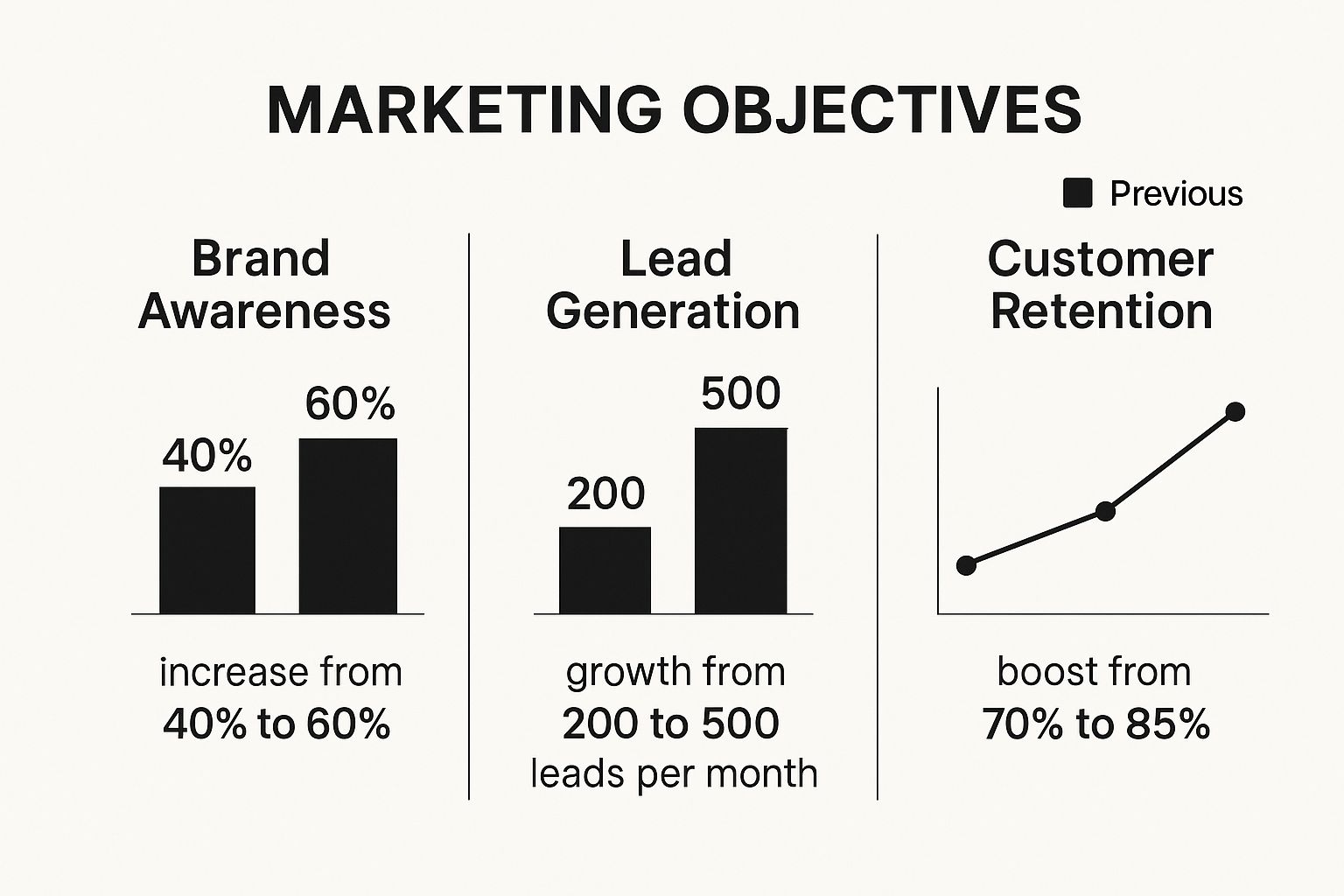
This really drives home how specific, time-bound goals form the backbone of a successful marketing strategy, giving you clear benchmarks for success across the board.
Integrating Brand and Demand for Maximum Impact
Ultimately, a winning strategy doesn't treat marketing efforts as separate, siloed activities. It weaves them all together into a seamless experience for the customer.
More and more, the sharpest marketing leaders are unifying two critical functions: brand building (creating a strong, positive reputation) and demand generation (driving direct sales and leads).
This integrated approach is incredibly powerful. Organizations that successfully merge their brand and demand marketing efforts are three times more likely to gain a competitive edge and achieve superior business growth. Recent data shows that around 40% of Chief Marketing Officers now prioritize combining brand storytelling with direct sales tactics. It’s no surprise, as companies that adopt this unified method often report a 25-30% improvement in their return on marketing investment. To see where the industry is heading, you can discover more insights about 2025 marketing planning trends and see how top leaders are preparing.
This means making sure your top-of-funnel content (like a thought-leadership blog post) aligns perfectly with your bottom-of-funnel tactics (like a product demo request). The story you tell in a brand awareness video should be the same one your sales team tells on a call. This consistency builds trust, strengthens your brand, and makes the entire customer journey smoother and more effective.
Creating a Realistic Marketing Budget
So you've hammered out your strategy and picked your tactics. Now what? Well, you have to fuel the engine. This is where your marketing budget comes in, and honestly, it’s one of the most make-or-break parts of any marketing plan.
Don't think of a budget as just a spreadsheet filled with numbers. It's the strategic document that brings your vision to life by assigning real dollars to your goals. Without a solid budget, even the most brilliant strategy is just a nice idea that will eventually run out of steam.
Think of it this way: your budget is the recipe for your marketing success. Your tactics are the ingredients, and your goals are the final dish. The budget tells you exactly how much of each ingredient you can actually afford to use to get the best possible result. It provides the financial guardrails that keep your work focused, sustainable, and accountable.
Common Budgeting Methods for Your Plan
There’s no single "right" way to set a marketing budget. The best method for you really depends on your company’s size, industry, and what you’re trying to achieve. Let’s walk through a few of the most common approaches so you can figure out which one fits your situation.
Here are a few popular models:
-
Percentage of Revenue: This one is pretty straightforward. You simply dedicate a set percentage of your company's total sales revenue to marketing. A common benchmark is 5-10% of projected annual revenue. It's easy to calculate, but it can feel a bit restrictive when you’re in a growth spurt and need to invest more aggressively.
-
Objective-and-Task Method: This is my personal favorite because it's so strategic. You start with your specific goals (like "increase qualified leads by 25%") and then list every single task needed to get there. From there, you cost out each task and build your budget from the ground up. It forces you to connect every dollar to a direct outcome.
-
Competitive Parity: With this method, you essentially try to match what your direct competitors are spending. While it can help you keep pace, it’s a risky game. It assumes your competitors have a brilliant strategy and that your goals are identical to theirs—which is rarely the case.
A well-structured budget is more than just a list of costs. It's a statement of priorities that reflects your strategic focus, ensuring you invest your resources where they will generate the greatest return.
Allocating Funds Across Channels and Activities
Once you've landed on a total number, the real fun begins: breaking it down. You need to decide how much to spend on each marketing channel and activity. This is where all that hard work you did on your strategy and buyer personas really pays off.
If you know your ideal customer, "Startup Sarah," lives on LinkedIn and reads industry blogs, you’ll naturally put more of your budget into LinkedIn ads and content creation instead of, say, TikTok.
Here’s a simplified look at how you might slice up the pie:
| Category | Description | Sample Allocation |
|---|---|---|
| Content Creation | All costs tied to making things: blog posts, videos, graphics, case studies, etc. | 25% |
| Paid Advertising | The money for your PPC campaigns on platforms like Google, LinkedIn, or Meta. | 35% |
| Marketing Technology | Your budget for essential software—think CRM, email marketing platforms, and analytics tools. | 15% |
| Team & Overhead | Salaries for your in-house marketers or the fees for freelancers and agencies. | 20% |
| Contingency | A rainy-day fund. Set aside a small buffer (5-10%) for unexpected opportunities or to double down on a campaign that’s crushing it. | 5% |
Thinking Beyond the Dollars and Cents
A truly effective marketing budget considers more than just cash. Two of your most precious resources are your team’s time and skills. When you're planning, you have to be brutally honest about what your team can actually handle.
Do you have someone in-house who can run a complex Google Ads campaign, or do you need to budget for an agency? Can your current team realistically produce four high-quality videos every month without burning out?
Factoring in these non-financial resources is what makes a plan achievable, not just funded. It's this holistic view that separates a powerful, practical marketing plan from one that just looks good on paper.
Measuring Performance and Adapting Your Plan

Think of your marketing plan not as a finished blueprint but as a living, breathing thing. Just like a plant, it needs consistent attention and care to grow strong. Without regular check-ins, you won't spot the problems until they've already stunted your growth.
This is where continuous measurement comes in. It’s about building a culture where data doesn't just report on the past—it actively guides your next move.
So, where do you start? The first step is to pinpoint the Key Performance Indicators (KPIs) that truly matter to your goals. If you're running a campaign to drive sales, you’ll be watching your cost per acquisition like a hawk. If the goal is to build brand awareness, then your focus might shift to monitoring your share of voice in the market.
Choosing the right KPIs doesn't have to be complicated. Just make sure they are directly tied to your objectives, you have the means to track them, and they are easy for everyone to understand.
Key Performance Indicators and Tracking
Before you can measure progress, you need a starting line. This means establishing a baseline by collecting your initial data. For instance, you might find your current cost per acquisition is $120.
From there, you can set a realistic target. Maybe the goal is to get that CPA down to $100 within the next three months. Now you have a clear destination.
The final piece is deciding how often you’ll check the map—weekly, monthly, or quarterly. Regular reviews are non-negotiable.
Teams that consistently review their KPIs and make data-driven adjustments often see their campaign ROI jump by 20% or more.
You'll also need the right tools for the job. Smaller teams can often get by with spreadsheets and free analytics platforms. As you scale, dedicated marketing dashboards become invaluable for visualizing trends and spotting opportunities in real time.
| KPI Metric | When to Use |
|---|---|
| Cost per Acquisition (CPA) | When your campaigns are focused on driving direct sales. |
| Share of Voice (SOV) | When you want to measure brand awareness and see how you stack up against competitors. |
Interpreting Data for Agile Decisions
With your tracking in place, the real work begins: making sense of the numbers. Look for the stories the data is telling you through patterns, spikes, and dips.
A sudden climb in your CPA, for example, could be a red flag for ad fatigue or a sign that your targeting is off. On the flip side, a jump in your share of voice might mean your latest content is really hitting the mark.
To stay nimble and react effectively, follow a few best practices:
- Hold quick, regular check-ins with your team to discuss what the data is showing.
- A/B test one variable at a time—like a headline or a call-to-action—and carefully document the results.
- Adjust your budget in small increments to test a hypothesis before making a major shift.
This approach lets you fine-tune your strategy without risking your entire budget on an unproven change. Every small tweak, like moving funds from an underperforming channel to one with higher engagement, adds up to significant gains over time.
For a deeper look into specific metrics and how to apply them, check out our guide on Marketing Performance Metrics Examples. It’s packed with real-world cases and templates to get you started.
The key takeaway is this: a good plan points you in the right direction, but a great plan evolves. By tracking the right KPIs and staying agile, you ensure your marketing efforts don't just launch, they learn, adapt, and grow stronger with every cycle.
Got Questions About Your Marketing Plan? We've Got Answers.
Even the best roadmaps can leave you with a few questions at the crossroads. Let's clear up some of the most common ones that pop up when putting a marketing plan together.
How Often Should I Update My Plan?
Think of your marketing plan less like a stone tablet and more like a living, breathing guide for your business. You’ll want to give it a complete, top-to-bottom review at least annually, usually when you're doing your main business and financial planning for the year ahead.
But don't just set it and forget it. I always recommend checking in on it quarterly. This is your chance to look at your KPIs, see what's working (and what isn't), and tweak your tactics on the fly.
Of course, if something big happens—a new competitor muscles into your space, or your customers suddenly start behaving differently—you need to pull that plan out immediately and re-evaluate, no matter where you are in the calendar.
What If My Budget Is Tiny?
A shoestring budget isn't a dealbreaker; it just means you have to be smarter and more focused with your efforts. Instead of trying to do everything, you need to zero in on low-cost tactics that punch well above their weight.
Here are a few of my go-to's for tight budgets:
- Content Marketing: A genuinely helpful blog post or a well-researched guide can pull in organic traffic for years to come. It's the gift that keeps on giving.
- SEO: Simply optimizing the website you already have is one of the highest-return activities you can do, and it costs more time than money.
- Email Marketing: Building an email list gives you a direct line to your audience that you own. No algorithm changes can take that away from you.
The key is to pick one or two channels and absolutely own them. Don't spread a small budget so thin that it makes no impact anywhere.
A small budget forces strategic clarity. It makes you focus intensely on the tactics that deliver the highest possible return, cutting out any activities that don't directly contribute to your core goals.
This laser-focused approach means every single dollar and every minute of your time is working as hard as possible to grow your business.
Ready to build a marketing plan that actually gets results? The team of specialists at ReachLabs.ai can help you craft and execute a data-driven strategy that moves the needle. Learn how we can elevate your brand.