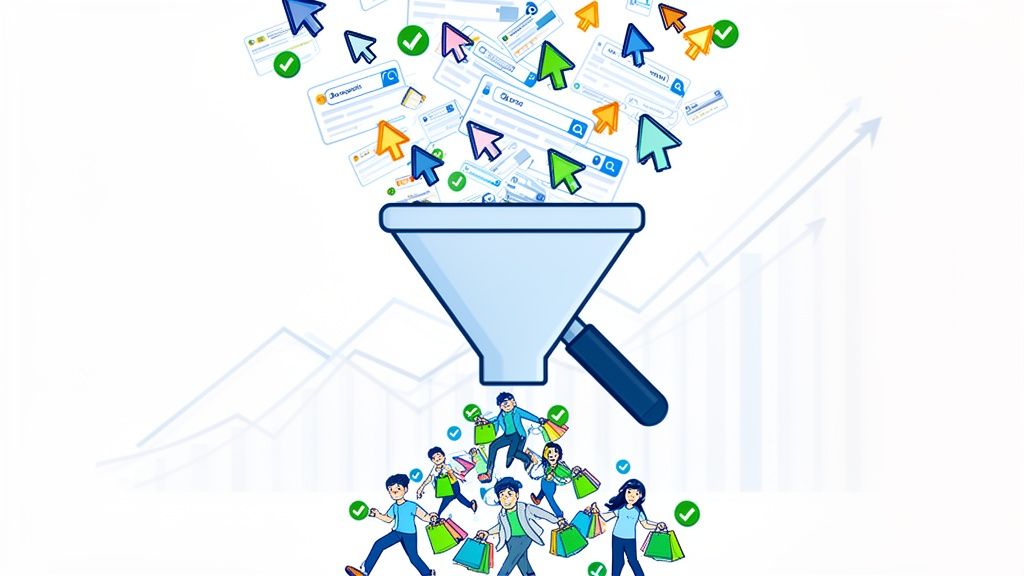
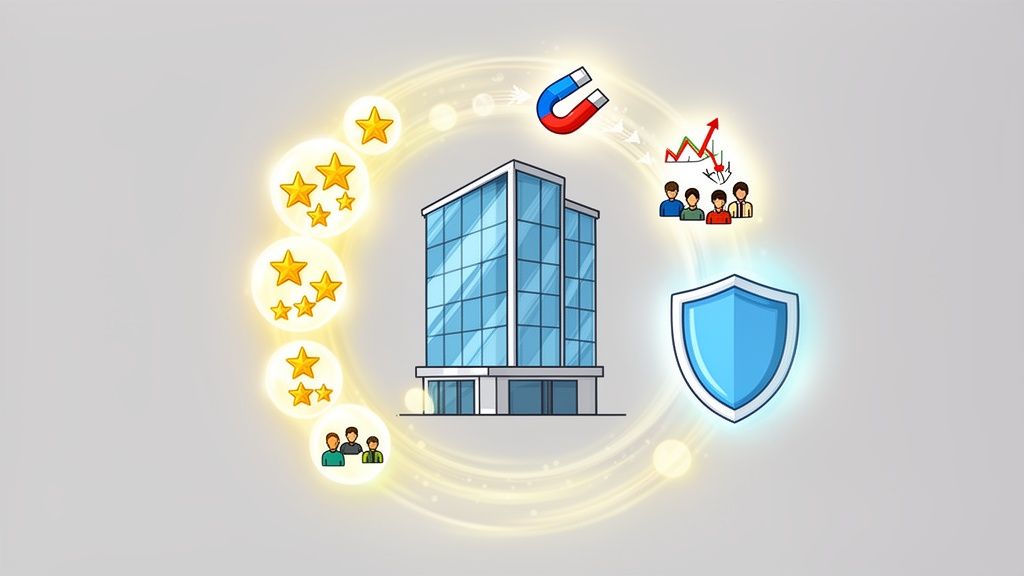
The real value of online reputation management boils down to a few core things: building rock-solid customer trust, turning more browsers into buyers, and protecting the very essence of your brand. Think of it as both a shield against the inevitable negative comment and a powerful engine for growth, letting you actively shape how the world sees your business online.
Your Reputation Is Your New Homepage

Here's a thought: your company's reputation has become its true homepage. Before anyone even thinks about clicking on your website, what do they do? They Google you. They look at your star ratings. They skim the first few reviews.
That collection of search results, social media chatter, and review site scores is their first handshake with your brand. It forms an instant impression, for better or worse.
Online Reputation Management (ORM) is all about making sure that first handshake is a firm and confident one. It's the craft of shaping that digital narrative, not just waiting around to put out fires. This isn't just a marketing task; it's a fundamental business strategy that hits your bottom line, hard.
Why Your Digital Presence Matters More Than Ever
We live in an age of instant information, where your customers are just a few taps away from knowing everything about you. In this environment, you can't afford to be passive about your online image. A strong, positive reputation becomes a massive asset that fuels growth across the board.
- Customer Trust: When new prospects see a steady flow of positive reviews and feedback, it’s powerful social proof. It tells them, "Hey, people like us had a great experience here," making them far more comfortable choosing you.
- Lead Generation: It's no secret that higher star ratings and positive mentions directly impact how you show up in search results. This visibility drives more clicks and brings better-qualified leads right to your doorstep.
- Brand Value: Your reputation is a tangible financial asset. In fact, some analyses suggest that a company's reputation can make up 30–40% of its total enterprise value.
Ultimately, ORM is about taking control. It shifts your brand perception from something that just happens to you into a strategic advantage you actively build and protect.
Getting a handle on this concept is the first real step. To see how a great online presence creates measurable wins, you can explore the key benefits of online reputation management for business growth. In the sections ahead, we’ll break down exactly how you can put these benefits to work for you.
Build Deeper Trust and Drive More Conversions
In business, trust isn't just a feel-good metric; it's the currency that powers every single transaction. Think of it this way: your online reputation is how you earn that trust before you ever speak to a customer, turning a skeptical browser into a confident buyer. There’s a straight, undeniable line connecting a positive brand perception to higher conversion rates.
Your collection of online reviews is like having a digital army of salespeople working for you 24/7. Every positive review, every star rating, serves as powerful social proof—a psychological shortcut that reassures potential customers they’re making a smart, safe choice. It’s no surprise that nearly 9 out of 10 consumers read reviews before buying something. They're actively looking for validation from people just like them.
This validation has a real, measurable impact on your bottom line. Research shows that just displaying verified reviews on a website can boost conversion rates by an astonishing 270%. That single statistic proves that reputation management isn't a "soft" marketing activity; it's a direct driver of serious revenue growth. You can dive deeper into reputation insights that highlight this powerful connection.
From Sentiment To Sales
So, how do you turn warm, fuzzy feelings into cold, hard cash? It's actually a pretty straightforward process. A well-managed reputation builds a foundation of credibility that greases the wheels of the entire buying journey. When a potential customer sees dozens of authentic, glowing experiences from others, their natural skepticism fades, and their confidence to click "buy" skyrockets.
This effect gets even stronger when you stop passively waiting for people to find your reviews and start actively showcasing them. Don't let your best feedback just sit on third-party sites; put it to work.
- Website Testimonials: Weave your best quotes and highest star ratings directly into your homepage, service pages, and product descriptions.
- Case Studies: Go deep and tell a story. Develop detailed narratives showing exactly how you solved a real customer's problem, offering concrete proof of your value.
- Social Media Highlights: Make it a habit to share screenshots of great reviews or customer shout-outs across your social media channels.
By strategically curating and promoting this user-generated content, you kickstart a self-perpetuating cycle of trust. Positive experiences bring in new customers, who then leave their own positive reviews, further cementing your brand’s credibility for the next wave of buyers.
Quantifying The Conversion Lift
One of the most compelling aspects of online reputation management is that its impact isn't just theoretical—it's measurable. You can directly track how improvements in your online standing move the needle on your most important key performance indicators (KPIs).
For example, an e-commerce store can run a simple A/B test on a product page, comparing conversion rates on a version with customer reviews versus one without. The results will almost always show a clear lift.
A great way to visualize this cause-and-effect relationship is to map specific ORM activities to their direct business outcomes.
How ORM Activities Translate to Business Impact
| ORM Activity | Potential Business Impact | Supporting Statistic |
|---|---|---|
| Proactively Collecting and Displaying Reviews | Increased Lead & Sales Conversion Rates | Displaying reviews can increase conversions by 270%. |
| Responding to Negative Feedback Professionally | Improved Customer Retention & Trust | 45% of consumers are more likely to visit a business that responds to negative reviews. |
| Showcasing Positive Testimonials on Key Pages | Reduced Friction in the Buyer's Journey | 72% of consumers say positive reviews make them trust a local business more. |
| Monitoring and Managing Brand Mentions | Enhanced Brand Equity & Pricing Power | A 1-star increase in Yelp rating can lead to a 5-9% increase in revenue. |
Similarly, a local service business can track the conversion rate on its contact forms or its inbound call volume. As its average star rating on platforms like Google or Yelp climbs, a corresponding increase in qualified leads is almost guaranteed to follow.
This kind of data gives you undeniable proof that a stellar reputation doesn't just feel good—it performs. It turns positive public perception into a predictable and powerful engine for business growth.
Turn Your Reputation into a Search Engine Magnet
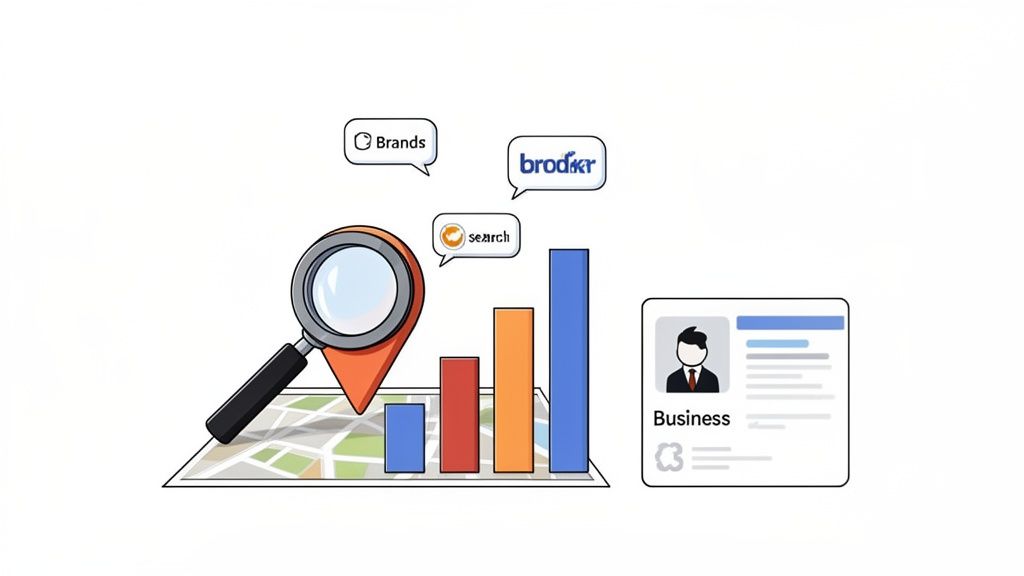
You might think of your online reputation and your search engine optimization (SEO) as two separate jobs. In reality, they're completely connected.
Imagine Google is a recommendation engine trying to find the most trustworthy and authoritative answers for its users. What's one of the clearest signals of trust? What other people are saying about you.
When your business consistently gets positive reviews, maintains a high star rating, and gets mentioned favorably online, you're sending strong signals to search engines. You're telling them that your business is legitimate, people value what you do, and you deliver on your promises. This is a huge, often overlooked, benefit of reputation management—it's a direct pipeline to better SEO.
Essentially, a strong reputation works like a vote of confidence in Google's eyes. That digital seal of approval helps your website climb the rankings for your most important keywords, bringing in more qualified traffic without you having to pour more money into ads.
How Your Reputation Boosts Local SEO
This link between reputation and visibility is even more critical for businesses that rely on local customers.
Think about a search like "best plumber near me." Google's algorithm doesn't just look at websites; it heavily factors in signals from your Google Business Profile (GBP). Your average star rating, the total number of reviews you have, and the freshness of that feedback are all major ranking factors.
It’s simple math. A business with a 4.8-star rating and 200 recent, glowing reviews will almost always show up higher than a competitor stuck with a 3.5-star rating and 50 reviews from last year. By making it a habit to ask happy customers for feedback, you’re actively building a stronger digital presence that dominates local search results and gets you into that coveted map pack.
A well-managed online reputation is a sustainable competitive advantage. It builds a moat around your brand that competitors can’t easily replicate with ad dollars alone, creating a foundation for long-term organic growth.
Turning Good Buzz into a Real SEO Asset
To get the most out of this, you need to start treating customer feedback—all that user-generated content—as a core piece of your marketing strategy. Every review isn't just a comment; it's a unique, keyword-rich piece of content about your business.
Here’s how to make your reputation work harder for your SEO:
- Ask for Keyword-Rich Reviews: When you prompt customers for feedback, gently encourage them to mention the specific product they bought or the service they received. This naturally fills your online profiles with the exact long-tail keywords potential customers are searching for.
- Reply to Every Single Review: Responding to both the good and the bad shows Google that your profile is active and that you care about your customers. This engagement is a positive signal that can help your rankings.
- Weave Reviews into Your Website: Don't let your best testimonials just sit on third-party sites. Showcase them on your homepage, service pages, and in case studies. This user-generated content bolsters your on-page SEO and gives search engines fresh, relevant material to index.
This approach isn't just about managing perception; it's about building a powerful, self-sustaining engine for search visibility. To understand how this fits into a broader strategy, check out our guide to content marketing for business growth, which shows how great content amplifies these efforts.
Protect Your Brand from Crisis and Negative Feedback
In our hyper-connected world, bad news travels fast. A single angry review, a poorly timed social media post, or an unexpected event can spiral into a full-blown brand crisis in a matter of hours. This is where a solid reputation management strategy stops being a "nice-to-have" marketing task and becomes an essential insurance policy for your brand.
It’s not about trying to erase every negative comment—that's an impossible goal. The real strategy is building such a strong foundation of positive sentiment that when a crisis does hit, the damage is contained.
Think of it as a "reputational buffer." When you’ve already got a mountain of glowing reviews and positive stories, one negative comment doesn't define you. It’s just a blip on the radar, an outlier, not the main story.
Turning Down the Volume on Negativity
Without a proactive plan, one scathing review can feel like the only thing customers see. But by consistently encouraging and showcasing positive feedback, you control the narrative. A potential PR headache is met with overwhelming proof of your quality and your commitment to doing right by your customers.
Getting prepared really comes down to two things:
- Monitoring Systems: You need to have your ear to the ground. Using tools to track brand mentions lets you know the second something is brewing on review sites, social media, or forums, so you can get ahead of it.
- Response Protocols: Don't improvise in a crisis. A clear, pre-planned system for handling negative feedback ensures your team responds quickly, professionally, and with a consistent voice every single time.
By facing complaints head-on with transparency and a genuine will to make things right, you can often flip the script. A negative experience can become a public display of incredible customer service, sometimes even turning a detractor into a loyal fan.
Ignoring this isn't cheap. Poor customer experiences that end up as negative online reviews contribute to an estimated $3.7 trillion in lost revenue for businesses globally each year. When you consider that 70% of consumers admit they’d jump ship to a competitor after just one bad experience, a fast, thoughtful response becomes absolutely critical. You can see more data on how customer experiences impact business on wiserreview.com.
Having a battle-tested plan for crisis management is simply non-negotiable today. To get started, you can explore our guide to reputation management on social media to build a stronger defense on these crucial platforms. This benefit is all about protecting the brand equity you've worked so hard to build from sudden shocks, ensuring your business remains stable and poised for growth.
Attract Top Talent and Justify Premium Pricing
The benefits of a great online reputation ripple out, touching far more than just customer acquisition. Two of the most powerful, yet often overlooked, advantages are how your reputation impacts who wants to work for you and what you can charge for your services.
Get these right, and you're not just winning new business—you're building a fortress.
Become a Magnet for A-Players
Think about it: top-tier professionals are just as savvy as your customers. Before they even think about hitting "apply," they're doing their homework. They're digging into employee reviews on Glassdoor and Indeed, trying to get the real story on your company culture, leadership, and day-to-day work environment.
A stellar reputation essentially does your recruiting for you. When a potential hire sees a workplace praised for its culture and growth opportunities, you become a destination employer. This isn't just a nice-to-have; it delivers real, tangible benefits.
- Slash Recruitment Costs: The best people start coming to you, which means you spend a lot less on job board promotions and pricey headhunters.
- Speed Up Hiring: With a ready pipeline of interested, high-quality candidates, you can fill open roles in a fraction of the time.
- Keep Your Best People: A great external reputation is almost always a mirror of a healthy internal culture. That kind of environment makes the talent you fought so hard to hire want to stick around.
Your public brand and your employer brand are two sides of the same coin. A business that's known for excellence and integrity will naturally attract professionals who hold themselves to the same high standards.
Command Premium Pricing with Confidence
Your reputation doesn't just attract better people; it gives you the leverage to charge a premium. When customers see your brand as the most trusted and reliable choice in the market, price becomes less of an issue. They're not just buying a product; they're buying peace of mind.
A strong online reputation fundamentally de-risks the customer's decision. They see a long track record of glowing reviews and happy clients, and it proves your value before they ever spend a dime. The conversation shifts from "why does this cost so much?" to "I'm paying for a guaranteed great outcome."
This is what we call pricing power. It’s one of the clearest financial wins from managing your reputation well, directly converting all that positive sentiment into healthier, more sustainable profit margins.
Putting Your Reputation Strategy into Action
Understanding why online reputation matters is a great start, but turning that knowledge into tangible results requires a solid game plan. A reputation strategy can't be an afterthought or a side project; it has to be woven into the very fabric of how you do business.
Think of it this way: your reputation strategy should inform everything from your customer service responses to the content you post on social media. The goal is to stop being a passive spectator to your brand's narrative and become its active author. It's about building a proactive system, not just reacting to whatever comes your way.
This shift starts by consistently encouraging your happiest customers to share their stories, which builds an invaluable foundation of positive proof.
From Theory to Practice
So, how do you make that happen? Transforming your reputation into a real, revenue-driving asset comes down to a few core, ongoing activities. These aren't just one-and-done tasks, but consistent processes that build momentum and keep your brand shining.
- Build a Review Funnel: Create a simple, automated process to ask for feedback right after a customer has a great experience. This could be a follow-up email, a quick text message, or even a QR code on your product packaging.
- Monitor Your Brand Mentions: You can't manage what you don't measure. Use monitoring tools to keep a close eye on what people are saying about you online—on review sites, social media, and forums. This lets you amplify the good stuff and quickly handle negative feedback before it snowballs.
- Turn Positive Feedback into Marketing Gold: Don't let five-star reviews just sit there! Repurpose your best testimonials as powerful marketing assets. Feature them on your website, turn them into eye-catching social media posts, and even use them in your ad campaigns to build instant credibility.
For a deeper dive, check out these actionable online reputation management tips to help you build a more commanding online presence.
This isn't just about managing reviews; it's a strategic loop where a great reputation directly fuels your ability to attract top talent and command higher prices.
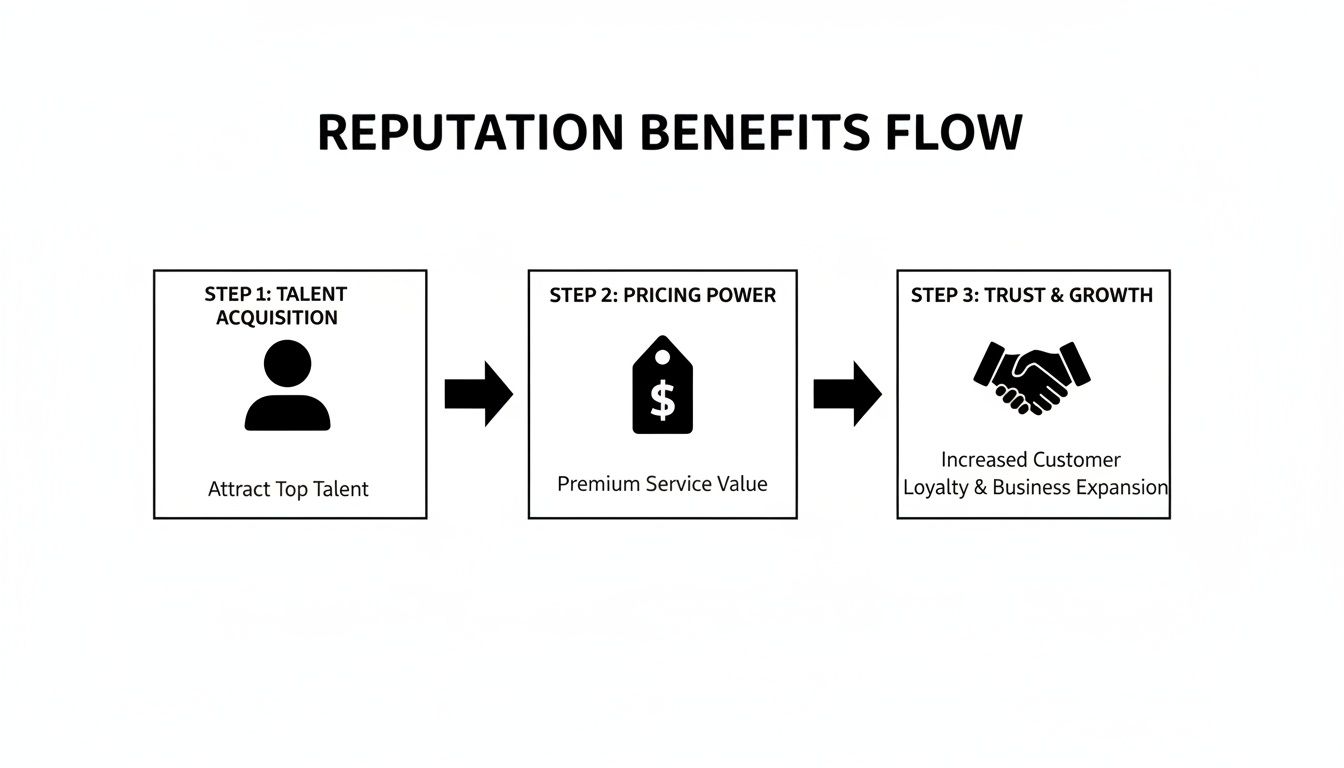
As you can see, a stellar reputation makes you an employer of choice while building the kind of deep-seated trust that justifies premium pricing. At ReachLabs.ai, we help integrate these practices into your overall digital strategy, turning your brand's reputation from a defensive necessity into a powerful, predictable engine for growth.
A Few Common Questions About ORM
Jumping into online reputation management can feel a bit overwhelming, and you probably have a few questions. Let's clear up some of the most common ones so you can get a better handle on how this all works in practice.
How Long Does It Take to See Results?
This is the big one, and the honest answer is: it varies. You can get some immediate wins right out of the gate. Simply starting to respond thoughtfully to new reviews shows potential customers you're listening and engaged, which builds a little trust from day one.
But for the bigger, more impactful changes—like a real shift in public perception or seeing your star ratings climb—you're typically looking at 3-6 months of consistent work. Think of it less like a quick fix and more like planting a garden. The positive effects build on each other and grow stronger over time.
Can We Just Delete Bad Reviews?
If only it were that simple. The short answer is no; you can't just zap a legitimate negative review off of major sites like Google or Yelp. The real goal isn't to pretend criticism doesn't exist, but to make it irrelevant by burying it under a mountain of positivity.
So, what can you do? Your game plan has two main parts:
- Flag genuine violations. You absolutely should flag reviews that break the rules—things like spam, hate speech, or clear personal attacks. Platforms have policies for a reason.
- Go on the offense with positivity. The single best strategy is to launch a proactive campaign to generate a steady stream of authentic, positive reviews. This pushes the occasional negative comment so far down the page that it loses all its power.
The best defense against a bad review is a flood of good ones. When you build a deep well of positive feedback, a single negative comment just looks like an outlier, not the whole story.
What’s the Difference Between Proactive and Reactive ORM?
This distinction is crucial. While you need both, one is infinitely more powerful.
Reactive ORM is basically playing defense. It's damage control. This is what you do after something bad has already happened, like scrambling to respond to a one-star review or trying to contain a social media firestorm. It’s necessary, but it means you’re always a step behind.
Proactive ORM, on the other hand, is about building a fortress of positivity before a crisis ever hits. This means actively asking happy customers for reviews, publishing great content that showcases your brand, and keeping an eye on what people are saying about you. This proactive approach creates a "reputational buffer" that can absorb the occasional hit without crumbling, keeping your good name your best asset.
At ReachLabs.ai, we don't just react to problems; we build proactive strategies into your entire digital marketing plan. We turn your reputation from a liability into a reliable engine for growth. See how our specialists can help your brand shine at https://www.reachlabs.ai.