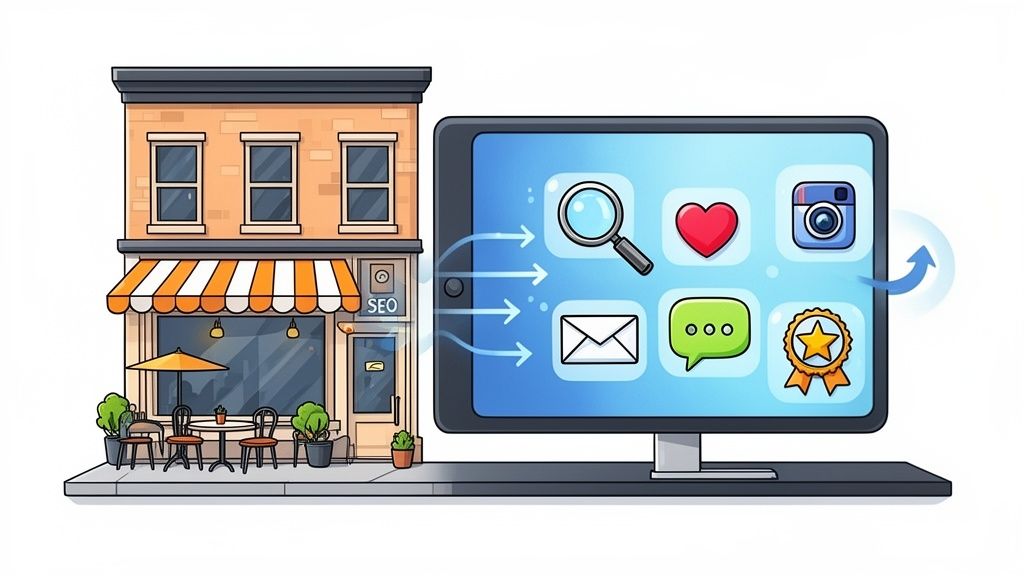
Let’s be honest—great food isn't enough anymore. Restaurant digital marketing is how you turn a hungry person scrolling on their phone into a happy customer sitting at your table. It’s your 24/7 digital host, guiding new diners through your virtual front door and keeping your regulars coming back for more.
Why Digital Marketing Is Your Restaurant's New Main Course
Think of your digital marketing strategy like you would your menu. Each channel—your local search presence, your Instagram feed, your email list—is a dish crafted to appeal to a specific taste. A cohesive strategy is the difference between an empty dining room and a packed house, turning "restaurants near me" searches into actual reservations and first-time visitors into loyal fans.
This isn't just a trend; it's where the industry is putting its money. In 2025, digital marketing became the #1 tech priority for restaurants. A huge 46% of operators now plan to focus their tech budgets on marketing efforts, specifically to increase visit frequency and drive foot traffic.
This guide is your playbook. We're going to break down exactly how to build a digital presence that doesn't just look good, but actually grows your business.
Attract, Engage, and Grow: The Three Pillars of Your Strategy
At its core, all effective restaurant marketing boils down to three simple stages: attracting new customers, engaging them to build a real connection, and growing your business by making them want to return.
This flowchart lays it all out visually.

As you can see, success isn’t about just one thing. It's a connected system. You first need to get on people's radar, then make them feel like part of your community, and finally, give them a reason to come back. For any restaurant that wants to do more than just survive, a smart approach to online local business marketing is the key to connecting with your community.
Key Goals of Your Digital Strategy
Your digital marketing efforts need a purpose. Instead of just "being online," every action should be tied to a clear business goal.
Here are the primary objectives your strategy should be built around:
- Increase Foot Traffic and Reservations: The goal is simple: when someone searches "best tacos near me," your restaurant needs to pop up first. This is where local SEO and targeted ads work their magic.
- Build a Strong Brand Identity: Your social media should do more than just post food pics. It should tell your story, show off your unique vibe, and make people feel like they know you before they even walk in.
- Drive Repeat Business: This is where you turn a one-time guest into a regular. Well-timed email and SMS campaigns with exclusive offers are perfect for reminding people why they loved their first visit.
- Boost Online Orders: Make it ridiculously easy for people to order from you. That means optimizing your website for direct orders and ensuring your profiles on third-party apps are polished and persuasive.
These aren't just big-chain strategies; they're fundamentals that work for any restaurant, from a single food truck to a fine-dining establishment. For a deeper dive into these concepts, check out our complete guide on digital marketing for small businesses.
Who Are You Cooking For? Finding Your Audience and Angle

Before you spend a single dollar on ads or post your first photo, we need to answer two core questions: Who are you trying to feed, and what makes your restaurant the best choice for them? Get this right, and every marketing decision you make from here on out will have a clear purpose.
Think about it like a chef building a new menu. You don't just throw random ingredients together and hope for the best. You meticulously source specific items that complement each other to create a signature dish. Your digital marketing strategy needs that same deliberate recipe, one built on a real understanding of your customers and what makes you special.
Crafting Your Ideal Diner Personas
Let's get one thing straight: you don't serve "everyone." The key to effective marketing is getting specific about your ideal customer. That’s where diner personas come in—they’re detailed, almost fictional profiles of your perfect guests.
These aren't just fuzzy demographic labels. They are rich character sketches that bring your audience to life. With a staggering 90% of Americans now using the internet to choose where to eat, knowing exactly who you're talking to is non-negotiable.
Try to sketch out a few distinct personas for your restaurant. For example:
- The Weekday Lunch Warrior: A professional working in the neighborhood who needs a meal that's fast, delicious, and won't break the bank. They live on their phone, so they value easy online ordering and a loyalty program that rewards them for coming back.
- The Weekend Celebration Crew: This is a group of friends or family out for a birthday or special occasion. They're looking for a memorable experience—a fun atmosphere, shareable plates, an impressive drink menu, and something worth posting on Instagram.
- The Health-Conscious Foodie: This diner scrutinizes menus online before even thinking about visiting. They’re looking for specific dietary options (vegan, gluten-free, organic) and are drawn to restaurants that are transparent about where their ingredients come from.
When you have these personas clearly defined, you can shape everything from your ad targeting to your social media voice. You’re no longer shouting into the void; you’re having a direct conversation with the people most likely to become your regulars.
Defining Your Unique Selling Proposition
Once you know who you're talking to, you need to figure out what to say. This is your Unique Selling Proposition (USP)—the one thing that makes your restaurant the only logical choice. And let's be clear: "Great food" isn't a USP. That's just the price of entry.
Your USP is the singular, compelling reason a diner should choose you over the place next door. It’s the heart of your brand story and the true foundation of your marketing.
To nail down your USP, you have to look beyond the plate. What is the one thing you do that nobody else in your area can touch? This is your secret weapon in a crowded market.
Finding Your "Secret Ingredient"
- Atmosphere: Are you the cozy, candlelit spot for a romantic date night? Or are you the loud, high-energy hub with live music on Fridays?
- Sourcing: Do you get your produce from a specific local farm that no one else has access to? Is that the secret to your incredible freshness?
- Service: Is your staff famous for remembering a regular's name and favorite drink? Does your service make people feel like family?
- Niche: Are you the only place in town serving authentic Neapolitan pizza? Or the best spot for late-night vegan junk food?
For instance, a coffee shop’s real USP might not be its espresso but its huge, dog-friendly patio and custom "puppuccino" menu. A pizzeria could set itself apart with a 72-hour fermented sourdough crust that gives its pizza a distinctive tang. That unique angle is what you'll build your entire marketing story around.
When someone in your neighborhood decides they’re hungry, what’s the first thing they do? They grab their phone. Your restaurant needs to be front and center in that moment of decision. That’s the entire game of local search marketing: showing up right when and where hungry customers are looking.
Think of it like this: mastering local search is like having a permanent, magnetic sign on your town’s main street, drawing people in day after day. Paid ads, on the other hand, are like hiring someone to hand out flyers during a busy festival—great for a quick rush, but local search is what builds your long-term, walk-in business.
Your Digital Storefront: The Google Business Profile
Before a diner ever sees your host stand, they see your Google Business Profile (GBP). This is, without a doubt, your most critical piece of online real estate. It’s what pops up in Google Maps and local search results, serving as your digital first impression. With 90% of diners now researching restaurants online before visiting, you can't afford to neglect it.
Leaving your profile unclaimed is like having a storefront with peeling paint and a flickering sign—it tells people you aren’t paying attention. A well-tended profile, however, is inviting and full of life, convincing customers to come in before they’ve even left their couch.
A complete and active Google Business Profile does more than just look good. It builds trust with potential customers and, just as importantly, signals to Google that you're a legitimate, popular spot worth showing in "near me" searches.
To get your GBP working for you, dial in these essentials:
- Core Info Accuracy: Your Name, Address, and Phone number (NAP) must be 100% consistent everywhere online. Even a small mistake can confuse Google and cost you customers.
- Mouth-Watering Photos: Get professional, vibrant photos of your food, your atmosphere, and your staff. People eat with their eyes first, so show them something they can’t resist.
- Timely Google Posts: Use the "Posts" feature to announce daily specials, promote happy hour, or highlight a weekend event. Think of them as free, temporary billboards right on your search listing.
Optimizing Your Website for Local Searches
While your Google profile is the introduction, your website is your home base. It’s the one space online that you own completely. To make it a true asset, you need to tune it for local search.
If you have multiple locations, creating a unique page for each one is non-negotiable. Each page should be filled with the kinds of terms people actually use, like "best tacos in South Austin" or "kid-friendly dinner in Park Slope." This is a cornerstone of any effective local marketing strategy because it tells search engines exactly who you serve and where you are.
Your Reputation Is Your Ranking
Online reviews are the new word-of-mouth, and they directly influence how you rank on Google. The number of reviews you have, your overall rating, and how recently you’ve gotten them are all powerful ranking signals.
A steady flow of fresh, positive reviews is a clear sign to Google that you’re a local favorite. You can encourage this by simply asking happy customers or even placing a small QR code on your tables that links directly to your review page.
Just as crucial is how you manage those reviews. Responding to all of them—good and bad—shows you’re listening. A thoughtful reply to a negative comment can turn a bad experience around and shows everyone else that you truly care about service.
Capture Immediate Hunger with Paid Ads
Local SEO builds your foundation, but sometimes you just need to fill seats tonight. That’s the job of paid search ads, also known as Search Engine Advertising (SEA). With a targeted Google Ads campaign, you can jump straight to the top of the search results for the most valuable, high-intent keywords.
Here are a few smart ways to use paid ads:
- Own the "Near Me" Moment: Bid on phrases like "pizza near me" or "bars open now." You’ll connect with people who are out, phone in hand, ready to make a decision.
- Draw a Digital Line: Use geofencing to show your ads only to people within a few miles of your restaurant. This stops you from wasting money on clicks from people who are too far away to visit.
- Promote Timely Deals: Run an ad for your happy hour special on weekdays from 3-5 PM. Or, target your "Bottomless Brunch" ad to run on Friday evenings and Saturday mornings. It creates urgency and drives immediate foot traffic.
By combining the long-term pull of local SEO with the short-term punch of paid ads, you build a powerful marketing engine that makes sure hungry locals always find their way to your tables.
Creating Social Media That Makes People Hungry

Think of your Google Business Profile as the digital sign above your door. It tells people where you are and what you do. Your social media, on the other hand, is the music, the lighting, and the buzz you can hear from the sidewalk—it’s your digital ambiance. It’s the place you go beyond logistics and start creating a vibe so compelling that people have to come inside.
Social media has completely reshaped how we discover new places to eat. In fact, it’s now the deciding factor for 74% of consumers when choosing a restaurant. People are constantly scrolling through Instagram and TikTok, finding new spots based almost entirely on what they see. These 2025 restaurant marketing trends show just how much a strong visual game can fuel growth.
A great social media presence isn’t just about posting food pics. It's about building a feed so enticing it makes people hungry for the entire experience you’ve worked so hard to create.
Choosing Your Platforms Wisely
Don't spread yourself too thin. The smartest approach is to dominate the platforms where your target diners are already scrolling. For the vast majority of restaurants, that means putting your energy into the visual-heavy hitters.
- Instagram: This is the undisputed champion for restaurants. Its entire format is built for drool-worthy food photography, behind-the-scenes video Reels, and capturing the unique feel of your dining space.
- TikTok: As the king of short-form video, TikTok is perfect for injecting personality into your brand. Think quick-cut recipe videos, fun "day-in-the-life" clips with your staff, or user-generated content showing off your lively atmosphere.
- Facebook: It may not have the same trendy gloss as the others, but Facebook is a powerhouse for building community and running targeted ads. It’s fantastic for promoting events, sharing detailed updates, and engaging with a local audience.
Content That Creates Cravings and Community
Your social media content has two critical jobs: make people hungry and make them feel like part of your crew. A smart content mix is what keeps your audience hooked without feeling like you're constantly pushing a sale.
Your social feed is a conversation. Sometimes you’ll talk about tonight’s specials, but other times you’ll share a funny kitchen moment, ask a question, or celebrate a regular customer. That variety is what turns followers into friends.
Here’s a breakdown of the content that consistently hits the mark:
Showcasing the Food
- High-Quality Dish Photos: This is table stakes. You absolutely need bright, clear, and mouthwatering photos that do your signature dishes justice.
- Behind-the-Scenes Videos: A Reel of your chef artfully plating a dish or your pizzaiolo tossing dough shows the craft and care that goes into your food. People connect with that.
- Menu Spotlights: Dedicate a post to one menu item. Tell the story behind its ingredients or how the recipe was developed. Give it a personality.
Building Your Brand
- Atmosphere and Ambiance: Post photos and videos that sell the feeling of being in your restaurant. Is it cozy and romantic? Bustling and energetic? Show, don't just tell.
- Meet the Team: Put your people front and center! A quick "meet the chef" post or a Q&A with your star bartender makes your restaurant feel human and welcoming. Our guide on different types of social media content has even more ideas.
Turning Customers Into Your Best Marketers
One of your most powerful social media assets is user-generated content (UGC). When a happy customer posts a photo from their table and tags your restaurant, they’re giving you their authentic stamp of approval. It’s no surprise that UGC can generate 4x higher conversions than your own branded posts.
You can encourage this by creating "Instagrammable" moments in your space—a funky neon sign, a beautifully garnished cocktail, or unique wall art. Make a habit of resharing customer posts to your Stories and feed (always with credit!). It’s a win-win: you get fantastic, free content, and your customers feel seen and appreciated, which builds an incredible sense of community around your brand.
Turning First-Time Visitors Into Loyal Regulars

Getting a new customer in the door is a win, no doubt. But the real, sustainable profit in this business doesn't come from one-time visits. It comes from turning that first-timer into a regular—the person you see every other Friday night. That’s how you shift from just finding customers to building a true community.
Think of it this way: your social media pages are like rented land. You have to constantly play by the algorithm's rules to reach even your own followers. Your email and SMS lists, on the other hand, are property you own. They are a direct, private line to your most valuable customers.
Building Your Most Valuable Asset
Your customer list is hands-down one of the most powerful marketing tools you have. It's a curated list of people who’ve already said "yes" to your food and given you permission to reach out. The trick is getting them to sign up in the first place, and that means offering something they actually want.
A simple "Join our mailing list" sign just won't cut it. You need to give them a real reason to hand over their contact info.
- An Instant Win: The easiest way is with an immediate reward. Think 15% off their next entree or a free appetizer for signing up. It’s a classic for a reason—it works.
- The Birthday Club: Ask for their birthday and set up an automated email that sends a free dessert or special treat during their birthday month. It feels personal and encourages a celebratory visit.
- VIP Access: Position your list as an insider's club. Subscribers get first dibs on new menu items, special event tickets, or last-minute table openings.
These direct channels are absolute game-changers for building loyalty. In fact, nearly one-third of Americans say that getting personalized deals makes them more faithful to a brand. Restaurants that take this to heart see more frequent orders and higher average tickets.
Crafting Emails That Feel Personal
Once you have their email, your job is to make your messages feel less like a marketing blast and more like a note from a friend. This is where segmentation and automation become your secret weapons, letting you send the right message to the right person at just the right time.
Don't just sell; connect. An email that says, "We noticed it's been a while, here's a little something to welcome you back," is infinitely more powerful than a generic weekly newsletter.
A great loyalty program isn't just about discounts; it's about making customers feel seen and appreciated. If you want to see a masterclass in this, look at how the Starbucks Rewards Program brilliantly builds ordering habits and turns casual coffee drinkers into devoted fans.
Using SMS for Time-Sensitive Action
While email is your go-to for building relationships and telling stories, SMS is your tool for immediate impact. With open rates that are often over 90%, text messages are perfect for a quick call to action.
The key is to use it sparingly but with purpose. Save it for time-sensitive promotions that need a fast response.
- "Rainy Day Special": Is the weather keeping people home? A quick text offering 20% off all takeout orders for the next three hours can turn a slow night around.
- "Last-Minute Table Alert": Did a large reservation just cancel on a busy Friday? Text your VIPs and let them know a prime table just opened up.
- "Flash Happy Hour": Surprise your subscribers with an unannounced happy hour that's only good for tonight. It creates a sense of spontaneous fun.
By mastering both email and SMS, you take back control of your customer relationships. You're no longer at the mercy of social media algorithms, and you can directly drive repeat business and watch your customer lifetime value soar.
Measuring Your Marketing and Planning for Growth
All the marketing in the world doesn't mean a thing if you can't tell what’s actually working. If you're not measuring your efforts, you're not marketing—you're just guessing. This is the step where we turn abstract data into tangible results, like more reservations and a healthier bottom line.
Think about it this way: you wouldn't run your kitchen without meticulously tracking food costs, right? You do it to protect your margins. Your marketing deserves the same discipline. Without a clear view of its performance, you’re just throwing money around and hoping for the best.
Identifying the Metrics That Actually Matter
It’s easy to get distracted by "vanity metrics" like a high number of likes on a social media post. While they feel good, they don't directly pay the bills. A smart restaurant owner focuses on Key Performance Indicators (KPIs) that connect directly to revenue. These are the numbers that tell you the real story.
Here are the essential KPIs you should have on your dashboard:
- Cost Per Acquisition (CPA): This is your all-in cost to bring in a new customer, whether they walk through the door or place an order online. When you track CPA by channel (like Instagram Ads vs. Google Ads), you quickly see which one is giving you the most bang for your buck.
- Customer Lifetime Value (CLV): This is an estimate of how much total profit a single customer will bring you over time. A rising CLV is a fantastic sign that your food, service, and loyalty programs are creating regulars.
- Reservation/Order Source: You need to know exactly where your customers are coming from. Is it Google? Yelp? A link in your email newsletter? Knowing that 70% of reservations originate from your Google Business Profile, while only 10% come from a paid social campaign, tells you precisely where to focus your energy and budget.
- Conversion Rate: This is the percentage of people who take an action you want them to take. For example, how many people who saw your "Book Now" email actually clicked the link and completed a reservation? A low conversion rate often points to a problem, like a confusing website or a broken link.
Measuring your marketing isn't about becoming a data scientist. It’s about being a savvy business owner who makes decisions based on facts, not feelings, to ensure every dollar you spend comes back with a few friends.
Setting a Realistic Budget and Plan
Once you know which numbers to watch, you can build a budget and a calendar that make sense for your goals. For most small and mid-sized restaurants, a good rule of thumb is to dedicate 3-6% of your total revenue to marketing.
Here’s one way you could strategically divide that budget:
| Marketing Area | Budget Allocation | Purpose |
|---|---|---|
| Paid Ads | 40% | To capture people actively searching for restaurants "near me." |
| Social Media & Content | 30% | For building your brand story and engaging your community. |
| SEO & Website | 20% | To secure your long-term visibility in local search results. |
| Email/SMS Tools | 10% | To drive repeat business from your most loyal customers. |
Finally, lay everything out on a 12-month marketing calendar. This lets you get ahead of the game by planning campaigns around major holidays like Valentine's Day and Mother's Day, as well as local events or seasonal menu changes.
When you combine smart measurement with thoughtful planning, your marketing stops being an expense. It becomes your restaurant's most powerful engine for growth.
Answering Your Top Marketing Questions
Stepping into digital marketing can feel overwhelming, especially when you're already juggling a thousand things to keep your restaurant running. Let's tackle some of the most common questions I hear from owners just like you, with straightforward answers to get you on the right track.
How Much Should a Small Restaurant Spend on Marketing?
For most small restaurants, a good budget benchmark is 3-6% of your total revenue. If you're launching a grand opening, a new location, or really trying to accelerate growth, you might push that up to 8-12% for a short period.
The real secret isn't the starting number, though. It's about being smart with your first dollars. Start with a budget that feels comfortable, and pour it into the highest-impact areas first—like your Google Business Profile and a few well-targeted social media ads. Then, watch the results like a hawk. If you see that every $100 you spend on Instagram ads brings in $500 worth of online orders, you've found a winner. That’s when you can confidently reinvest your profits and scale up.
Which Is More Important: SEO or Social Media?
That's a bit like asking what's more important in a kitchen, the oven or the stove. They're both essential, but they do very different jobs.
Think of it this way: Local SEO is for the customer who is hungry right now. They’re searching "tacos near me" or "best brunch spot" and are ready to buy. Your Google Business Profile is your tool to capture that immediate demand. Social media is for creating future customers. It's how you build a vibe, show off your incredible food, and make someone think, "We have to try that place for date night."
One gets you found by people looking to eat, and the other makes people want to eat at your place specifically. A solid strategy needs both to truly work.
Can I Handle Marketing Myself, or Should I Hire an Agency?
You can, and absolutely should, get your hands dirty at the beginning! It's the best way to understand your customers. Start by completely owning your Google Business Profile—fill out every section and add photos weekly. Pick one or two social media channels where your customers actually hang out and post consistently. And don't forget to start collecting customer emails at the counter.
But there will come a point where your time is simply more valuable spent running the restaurant. That’s the sign it might be time to bring in help. An agency isn't just about saving time; it's about bringing in specialized expertise to manage complex ad campaigns or create professional-level content that you just don't have the bandwidth for. When you find yourself pulled away from the floor or the kitchen to mess with an ad campaign, it's time to consider hiring a pro.
Feeling your way through digital marketing can be a challenge, but you don't have to figure it all out alone. The team at ReachLabs.ai lives and breathes restaurant marketing, and we build custom plans that actually fill tables. Schedule a free consultation today, and let's talk about how to grow your business.