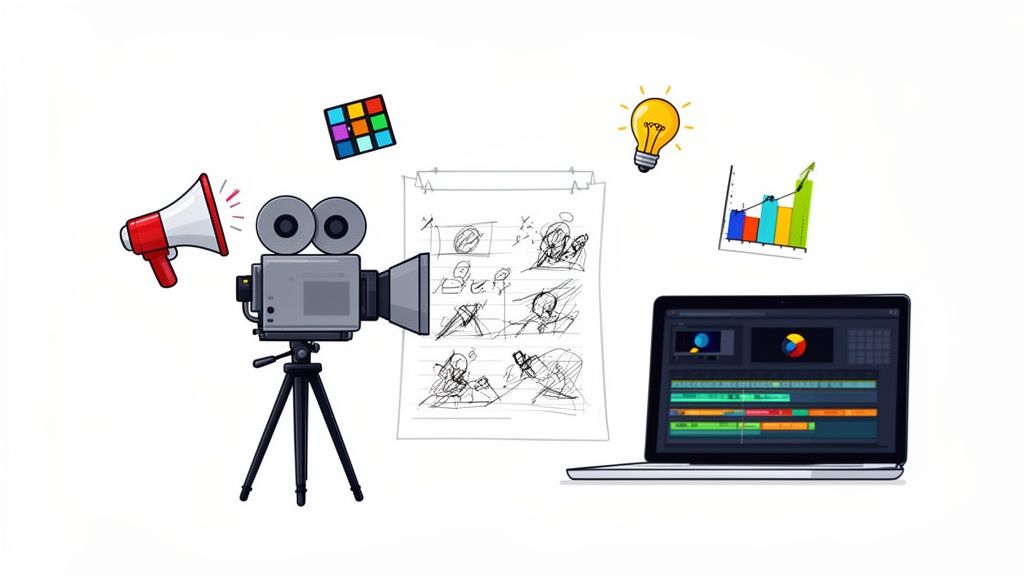
So, what exactly is branding video production? It’s all about creating video content that tells the world who you are—your identity, your values, and your story. It’s a move away from the hard-sell commercials of the past and toward building a genuine, emotional connection with your audience. The goal is to build trust and long-term loyalty, turning people who just watch into people who believe in your brand.
Why Branding Video Production Is Essential for Growth
Let's be honest, we're all swimming in a sea of content. A strong brand video is your best shot at standing out and making a real impact. It’s no longer just a nice-to-have marketing asset; it's a fundamental part of how a business grows, shaping perception, driving engagement, and ultimately, boosting revenue.
Unlike a static image or a block of text, video is immersive. It pulls together visuals, sound, and storytelling to create an experience that people remember. This is what makes it so powerful for brand recall. When someone sees your company's values in action or hears an authentic story from a happy client, it forges a connection that a spec sheet or a blog post just can't match. This is the magic of great brand video production: turning abstract ideas like "trust" and "innovation" into something real and relatable.
Forging Real Customer Connections
Think about the last ad or video that actually stuck with you. I’m willing to bet it told a story that resonated with you on a human level. Brand videos do exactly this by putting a face to your company. They let your audience see the real people and the passion behind the products or services you’re selling.
Imagine a local coffee shop. They could create a short film showing their journey to source beans directly from a small, family-owned farm. Suddenly, they aren't just another place to get a latte; they're a business with a purpose and a story you want to be a part of. Or take a B2B tech company—instead of a boring feature list, they could produce a video showing their engineers excitedly solving a frustrating industry problem. This shows off their expertise and customer-first attitude far better than any sales pitch ever could.
The goal isn't just to be seen, but to be remembered. A well-executed brand video makes your company unforgettable by tapping into shared human emotions and values, creating a bond that transcends a single transaction.
Driving Tangible Business Outcomes
The impact of a strategic brand video isn't just about warm, fuzzy feelings. It directly translates into measurable business results. A powerful brand film can actually shorten the sales cycle by clearly and quickly communicating your value. It helps attract leads who are already aligned with your mission before they even speak to a salesperson.
Branded video also becomes the fuel for your entire marketing engine. It’s no surprise that 91% of companies were using video as a key marketing tool in 2026. Why? Because people are far more likely to share a great video, amplifying your reach exponentially. You can dive deeper into the latest video marketing trends on 336productions.com.
This natural shareability is what turns every viewer into a potential ambassador for your brand. In the rest of this guide, we’ll walk through the practical steps to create videos that don’t just rack up views, but build a truly loyal community around your brand.
Building a Winning Video Strategy from Scratch
A great branding video isn’t born on set—it’s forged long before a camera ever starts rolling. I’ve seen it time and again: even the most visually stunning video will fall flat if it’s built on a shaky strategic foundation. This initial planning stage is where you get brutally honest about what you want to achieve and map out exactly how you'll get there. Every creative decision from here on out has to serve a clear business purpose.
It all boils down to one simple question: What do you want this video to do? Without a specific, measurable goal, you’re just making noise. Are you trying to get your name out there and boost brand awareness? Or are you focused on generating qualified leads? Maybe the goal is to build a stronger connection with the customers you already have. Each objective demands a completely different creative playbook.
A brand awareness video, for example, might lean into powerful, emotional storytelling that shows what your company is all about. On the other hand, a lead generation video needs to cut to the chase, solve a problem, and have an unmissable call-to-action. Nailing this down first is non-negotiable.
Defining Your Target Audience for Video
Once you've got your "why," you have to lock in your "who." And a generic audience description just won't cut it for video. You need to build a detailed video persona that digs into their actual viewing habits.
- Where do they watch? Are they scrolling Instagram Reels on their commute, diving deep into YouTube tutorials at their desk, or seeing your ad on Hulu?
- What grabs their attention? Do they go for quick, punchy edits, or are they more likely to engage with slower, more cinematic storytelling?
- What's their mindset? A viewer on LinkedIn is in a professional headspace. Someone on TikTok is looking for a quick hit of entertainment. The tone of your video absolutely must match their context.
Imagine a fintech startup trying to connect with young professionals. Their whole brand is built on "financial empowerment." The generic approach? A bland explainer video. A winning strategy, though, would be to create a short, documentary-style piece for YouTube featuring a real customer who used the app to fund their side hustle. That approach doesn't just explain; it connects the product to their audience's real-life goals on a platform they already trust.
A great video strategy isn't about reaching everyone; it's about deeply connecting with the right people. By understanding their world, their habits, and their motivations, you can create content that feels like it was made just for them.
This process really comes down to telling a compelling visual story that builds trust, which in turn drives real growth for your business.

As you can see, it all starts with that narrative. A strong story is the bedrock of genuine audience trust, and trust is what ultimately delivers measurable results.
Crafting the Creative Brief
Think of the creative brief as your project's North Star. It’s the one document that gets your entire team—from marketing to the crew on set—on the same page about the goals, message, and creative direction. It’s your best defense against misunderstandings and scope creep. As you pull your brief together, it's worth exploring how AI script-to-video tools can help you quickly prototype ideas and bring concepts to life.
Your brief should be tight, but packed with detail. Here are the absolute must-haves:
- The Objective: What is the single most important thing this video has to do? (e.g., "Increase sign-ups for our free trial by 20%.")
- Target Audience: Lay out your detailed video persona, including their pain points and where they hang out online.
- Core Message: If the viewer remembers only one thing, what should it be? Boil it down to a single, powerful sentence.
- Brand Voice & Tone: How should this video feel? Inspiring, witty, authoritative, or warm and empathetic?
- Call to Action (CTA): What, exactly, do you want them to do after watching?
- Distribution Channels: Where will this video live? Be specific (e.g., YouTube pre-roll ads, organic Instagram feed, website homepage).
This document is so much more than paperwork; it’s a strategic weapon. A well-crafted brief is what separates a video that just looks good from one that actually moves the needle. If you want to dive deeper into how strategy shapes visual identity, you might find our guide on https://www.reachlabs.ai/branding-and-design/ helpful. Getting this groundwork right ensures your branding video production is set up for success from the very first day.
4. Translating Your Vision into a Concrete Plan

Okay, you've got your strategy locked down. Now for the fun part: turning those big ideas into a real, shoot-ready plan. This is the pre-production phase, and frankly, it's where the magic really happens. Getting these details right is what separates a polished, professional video from something that feels… well, amateur.
Think of this stage as building the foundation for a house. It might not be the most glamorous part, but a solid foundation prevents everything else from falling apart later. We’re going to walk through scripting, storyboarding, and the nitty-gritty logistics that make a shoot day go smoothly.
Writing a Script That Connects
Everything starts with the script. And let me be clear: this is not the place for corporate-speak or sentences packed with buzzwords. A great video script should sound like a real person talking to another real person. It needs to feel natural.
Here's the best trick I know for testing a script: read every single line out loud. Does it flow? Or does it sound stiff and clunky? If you find yourself stumbling over a phrase, you can bet your audience will feel it too. Keep the language simple, direct, and focused on landing your core message with a bit of heart.
Another pro tip is to "write for the edit." This just means thinking visually as you write the words. It’s a simple way to make sure your visuals and your narration are telling the same story.
For example, instead of just writing a block of text, structure it like this:
- V.O. (Voiceover): Our journey started in a tiny garage…
- Visual: Quick, grainy shot of a cluttered garage, a single bare lightbulb hanging down.
- V.O. (Voiceover): …with one big idea and an even bigger belief in what we could build.
- Visual: Tight close-up on a founder's face, focused and determined, sketching on a whiteboard.
See how that works? You’re weaving the words and pictures together from the very start, which makes for a much more powerful final product.
Visualizing the Narrative with Storyboards
Once the script feels right, it’s time to see what it looks like. That's where storyboarding comes in. And no, you absolutely do not need to be a professional artist to pull this off. A storyboard is just a sequence of rough sketches—think comic book panels—that map out each shot.
Stick figures are your best friend here. Seriously. The goal isn't to create a masterpiece; it’s to figure out the visual flow and catch problems before they happen. It forces you to think through camera angles, where people will be in the frame, and how you’ll transition from one scene to the next.
A storyboard is your cheapest insurance policy against costly mistakes. It lets you solve creative problems on paper, not on a busy and expensive film set where every minute costs money.
Even a crude storyboard gets everyone—from the director to the camera operator to the editor—on the same page. It’s a universal language for the entire production team.
Tackling Production Logistics Head-On
With your script and storyboard as your roadmap, you can start digging into the practical stuff. This means building out your budget, finding locations, and figuring out what crew and gear you'll need.
Your budget needs to be realistic, covering everything from renting cameras and lights to paying talent, securing location permits, and setting aside funds for post-production. Don't forget the small stuff; it adds up fast.
When you're scouting locations, remember that it's about more than just finding a pretty backdrop. The environment is part of the story. A forward-thinking tech brand shooting in a sleek, modern office sends a completely different message than a sustainable CPG brand filming in a sun-drenched national park. Your location is a character.
This whole process inevitably leads to a huge question for any company: do we try to do this ourselves, or do we bring in the experts?
Choosing Your Production Path: In-House vs. Agency
Deciding whether to produce your video in-house or partner with an agency is a major strategic choice. There's no single "right" answer—it all comes down to your budget, timeline, internal skills, and the level of quality you're aiming for. An in-house team brings deep brand knowledge and total control, but they might lack the specialized gear or experience for a complex project. An agency, on the other hand, brings a ton of experience and efficiency but requires a bigger upfront investment.
To help you decide, here’s a practical comparison of what to expect from each path.
| Factor | In-House Production | Agency Production |
|---|---|---|
| Cost | Lower initial cash outlay, but be wary of hidden costs in staff time and potential re-shoots. | Higher upfront investment, but the budget is typically fixed and inclusive, preventing surprise costs. |
| Expertise | You're limited to the skills of your current team. Great for scrappy projects, tougher for high-end concepts. | You get instant access to a team of specialists: directors, cinematographers, sound designers, editors, etc. |
| Speed | Can be faster for very simple projects, but often gets bogged down by learning curves and competing internal priorities. | Much faster for complex productions. Agencies have proven workflows and dedicated teams to keep things moving. |
| Control | You have 100% creative control over every single decision, for better or worse. | It's a collaborative partnership. You set the vision, but you delegate the creative execution to seasoned pros. |
| Quality | The final quality is entirely dependent on your team's skill and the gear you can get your hands on. | Professional-grade equipment and years of industry experience almost always result in a more polished, high-end look. |
Ultimately, choosing between in-house and agency production is about balancing your resources with your ambitions. Carefully weigh these factors against your project's specific needs to make sure you're setting yourself up for a flawless execution of your vision.
Capturing Your Brand Story on Camera

This is it—shoot day. After all the planning and strategizing, the time has come to finally get behind the camera. This is where your brand’s story transforms from words on a page into living, breathing visual moments. A smooth shoot is born from solid preparation, but it also demands the flexibility to capture that unscripted magic when it appears.
The technical stuff—lighting, sound, and camera work—forms the foundation of any professional video. You don’t need a Hollywood-sized budget to nail the basics, but you absolutely need to pay attention to them. These details signal quality and credibility to your audience before anyone even says a word.
Mastering the Technical Essentials
Think of lighting as a tool for shaping emotion. Are you going for a bright, optimistic vibe or something more focused and dramatic? A simple three-point lighting setup (a key light, a fill light, and a back light) can make your subject pop and give your footage an immediate professional sheen. Even just using a large window for soft, natural light can work wonders.
Sound, on the other hand, is completely non-negotiable. Viewers might forgive slightly grainy footage, but they will click away from a video with bad audio in a heartbeat. Trust me on this one. Investing in a decent external microphone—like a lavalier mic for interviews or a shotgun mic on the camera—is one of the smartest moves you can make.
When it comes to your camera work, stability is everything. Shaky, handheld footage just feels amateurish and can be incredibly distracting. A sturdy tripod is your best friend for static shots. If you want to add some dynamic energy, a gimbal can create that smooth, cinematic motion that really elevates your production value.
Directing for Authenticity
Beyond all the gear, your most important job on set is to connect with the people on camera. Whether you're working with seasoned actors or interviewing your own CEO, the goal is the same: capture genuine emotion and make them comfortable enough to just be themselves.
An anxious or stiff subject instantly creates a barrier with the audience. Here are a few tried-and-true tips I use to help anyone shine on camera:
- Warm up with a real conversation. Don't just jump into filming. Chat for a few minutes about anything but the video to help them relax and settle in.
- Ask open-ended questions. Instead of, "Do you like this feature?" try something like, "Tell me about the moment you realized this feature would solve a real problem for a customer." This encourages storytelling, not just one-word answers.
- Give constant positive feedback. A simple, "That was great, let's just get one more for safety" builds confidence and keeps the energy positive on set.
The camera has an uncanny ability to sniff out inauthenticity. Your primary role as a director is to create an environment of trust where people feel safe enough to share their real stories. That honesty is what will ultimately connect with your viewers.
The Rise of AI in Video Creation
The tools we have at our disposal are changing the game, making professional-grade video more accessible than ever before. Artificial intelligence isn't some far-off concept anymore; it's a practical tool that helps smaller teams punch well above their weight.
From AI-powered editing software that can automatically sift through footage to find the best takes, to tools that clean up background noise with a single click, technology is breaking down so many traditional barriers. This shift is democratizing the entire field. In fact, 51% of video marketers now report using AI for video creation, a huge jump from just 18% in 2023, as highlighted in recent video marketing statistics on SellersCommerce.
This allows teams to spend less time on tedious technical tasks and more time on what really matters: the creative heart of the project. For anyone looking to see how this all comes together, understanding the scope of a modern video production service can show you how these new tools fit into a broader strategy. The bottom line is clear: creating a powerful branding video is more achievable today than at any other time.
Shaping Your Narrative in Post-Production
The shoot is a wrap. Your memory cards are loaded with raw footage, and the real work is about to begin. This is post-production, the alchemical phase of branding video production where hours of separate clips are woven into a story that connects with your audience.
It’s so much more than just stitching scenes together. Post-production is where you find the video’s heartbeat. Every single cut, transition, and sound effect shapes how your audience feels. A rapid-fire sequence of cuts can inject a jolt of energy, while letting a shot breathe for a few extra seconds can create a moment of quiet reflection. This is how you find the rhythm that keeps viewers hooked from start to finish.
Polishing the Visuals with Color Grading
Color is a language all its own, and color grading is how you speak it. This is the process of adjusting the hue, saturation, and contrast to nail down a specific mood and ensure every shot feels like it belongs in the same world. It’s a vital step that brings the video in line with your brand’s visual identity.
Think about it: a wellness brand will probably lean into bright, natural tones to feel fresh and clean. On the other hand, a high-end fashion label might go for deep, moody colors and sharp contrast to give off an air of exclusivity and sophistication.
Color grading is the final layer of your visual language. It’s what makes your footage feel less like a collection of random clips and more like a signature piece of content that could only have come from your brand.
This obsessive attention to detail reinforces who you are without you having to say a thing. When your color palette is consistent across all your videos, people start to recognize your work instantly.
Crafting an Immersive Audio Experience
Visuals might be the star of the show, but sound is the unsung hero that keeps people from clicking away. Nothing screams "amateur" faster than bad audio. Clean, crisp sound isn't a bonus; it’s a must-have.
A great audio mix is a careful balancing act between a few key elements:
- Dialogue and Voiceover: Every word needs to be perfectly clear and balanced. This often means surgically removing background noise and meticulously adjusting levels so nothing gets lost.
- Sound Effects (SFX): Well-placed, subtle sound effects are what make a scene feel real and lived-in. They pull the viewer deeper into the experience.
- Music: The right track can completely transform a scene. It’s the emotional tour guide, telling the viewer how to feel and setting the entire tone of the video.
Getting the sound right is just as important as the visual edit. For those looking to really master this, learning about the post production of voice overs is a great place to start. A polished audio mix shows you respect your audience's time and attention.
Adding Clarity with Motion Graphics
The final flourish comes from motion graphics and text overlays. These aren’t just fancy decorations; they’re powerful tools for highlighting key takeaways and guiding your viewer to the next step. When used well, they can break down complex ideas, call out an impressive statistic, or present a clear call-to-action that doesn't feel intrusive.
Imagine a customer testimonial. A simple, clean graphic with the speaker’s name and title instantly adds a layer of authority. Or in a product demo, an animated arrow pointing out a key feature is way more engaging than just hearing about it. The trick is to keep these graphics on-brand, purposeful, and clean.
When you're telling your company's story, every little piece matters. If you're looking for ideas on how to weave a stronger narrative, you can get some great insights from our brand storytelling framework.
Getting Your Video Seen: Distribution and Measuring Success
You've done the hard work. The planning, the shooting, the editing—it's all led to a brand video you're incredibly proud of. But here's a tough truth I've learned over the years: a great video is only half the battle. Without a smart distribution plan, even the most beautiful film is just a file sitting on a server.
This is where the rubber meets the road. It's time to get your masterpiece in front of the right people, prove it worked, and turn that creative investment into a real business asset.
One Video, Many Platforms
Think about how you use social media. You're in a completely different headspace when you're scrolling through LinkedIn on your lunch break versus watching YouTube tutorials on a Sunday afternoon. A one-size-fits-all approach to distribution just doesn't work because your audience isn't in a one-size-fits-all mindset.
The trick is to treat your main brand film as the "hero" asset. From there, you slice and dice it into smaller, context-aware pieces for different channels.
- YouTube: This is the natural home for your full-length video. Go all-in on a great title, a detailed description packed with keywords, and a custom thumbnail that screams "click me."
- Instagram & TikTok: You've got about three seconds to grab someone. Create a punchy, vertical 30-second cut for Reels or Shorts. Assume the sound is off and use bold, on-screen text to carry the message.
- LinkedIn: People are here for business. A 60-second edit that gets straight to the point—the problem you solve, your company's mission—is perfect. Keep it professional with clean subtitles and end with a question to get a conversation started.
- Your Website: This is your home turf. Embedding the full video on your homepage or "About Us" page is a powerful way to immediately connect with new visitors and tell them what you're all about.
When you tailor the content to the platform, you're not just posting a video; you're starting a conversation in a language your audience already understands.
Organic vs. Paid: The One-Two Punch
So, how do you get these different versions out there? You really have two levers to pull: organic and paid. The best strategies I've seen always use a mix of both.
Organic distribution is all about earning your views. It's sharing the video on your social channels, sending it to your email list, and having your team post it on their own profiles. The big win here is that it's cost-effective and helps build a genuine community. The downside? It can be slow, and you're often at the mercy of platform algorithms.
Paid distribution, on the other hand, is about buying attention. You're running your video as a targeted ad on YouTube, Meta, or LinkedIn. This is where you can get incredibly specific, targeting people by job title, interests, or online behavior to guarantee you're reaching your ideal customer. It delivers fast, measurable results, but it obviously requires a budget.
Think of it this way: Organic reach is like building a loyal local following for your band. Paid amplification is like buying a radio spot to hit the entire city at once. You need both to really make it big.
A simple but effective tactic is to let the video run organically for about a week. See where it's getting the most natural traction—maybe it's really resonating on LinkedIn—and then put your paid budget there to pour gas on the fire.
Measuring What Actually Matters
It’s easy to get excited about a high view count, but "vanity metrics" don't pay the bills. To really understand the ROI of your video, you have to connect your data back to the business goals you set in the very beginning.
Don't drown yourself in spreadsheets. Just focus on a few key performance indicators (KPIs) that tell you the real story.
| Metric | What It Tells You | Why It Matters |
|---|---|---|
| Audience Retention | The percentage of people still watching at any given point in the video. | If you see a massive drop-off in the first 10 seconds, your intro isn't working. High retention means you've hooked them. |
| Click-Through Rate (CTR) | The percentage of viewers who clicked your call-to-action (CTA). | This is the clearest sign that your video successfully motivated someone to take the next step. |
| Conversion Rate | The percentage of viewers who actually completed your goal (e.g., booked a demo, bought a product). | This is the bottom-line number. It ties your video directly to revenue and leads. |
| Engagement Rate | The total likes, comments, and shares divided by your total views. | This shows you if your video truly connected with people on an emotional level and made them want to participate. |
Tracking these metrics moves you from "I feel like the video did well" to "I know the video drove X number of leads." That's how you justify the budget for your next project and build a smarter strategy for the future.
At ReachLabs.ai, we blend creative storytelling with data-driven strategy to ensure your branding videos don't just get seen—they get results. Ready to create a video that moves the needle? Learn more about how we can help.