
Think of your marketing plan as the master blueprint for your business's growth. It's the strategic document that spells out exactly how you'll win over customers over a set period. It takes your big-picture business objectives and breaks them down into tangible actions, answering the crucial questions: who are we talking to, how are we going to reach them, and how will we know if we've succeeded?
Why Your Business Needs a Strategic Marketing Blueprint

Picture trying to build a house without architectural drawings. You could have the finest timber and the best builders in town, but without a plan, you're just nailing boards together hoping for the best. That’s exactly what marketing without a plan feels like—a surefire way to burn through cash, send mixed signals, and see your growth grind to a halt.
A good marketing blueprint isn't some dusty document you write once and file away. It's a living, breathing guide that gives your entire team a clear sense of direction and purpose. It’s the answer to some of the most common headaches businesses run into.
Moving from Guesswork to Growth
When there's no documented plan, marketing teams often get stuck in a reactive loop. They jump on the latest trend or launch one-off campaigns that don't connect to a bigger picture, failing to build any real momentum.
A well-thought-out plan forces you to stop and think critically about where you stand in the market. To do this right, you need a solid grasp of your branding strategy and market positioning.
This disciplined approach is what turns marketing from a random expense into a predictable engine for revenue. It delivers:
- Clear Direction: Every piece of content, social media post, and ad spend is intentionally tied to a larger business goal. No more wasted effort.
- Resource Justification: A plan built on data is your best argument for getting the budget you need to actually make things happen.
- Enhanced Coordination: It syncs up everyone—from marketing and sales to the product and customer support teams—so they're all rowing in the same direction with a unified message.
A marketing plan is the single most important tool for any business. It aligns your team, justifies your budget, and steers your business toward sustainable growth.
The Foundation of Every Successful Campaign
As we go through this guide, we'll unpack each critical piece of a marketing plan, one by one. You'll see how a situation analysis is like your "you are here" map, your goals become the destination, and your budget is the fuel for the journey. We'll cover it all, from pinpointing your ideal customer to picking the right channels and tracking the metrics that actually matter.
By the time you're done, you won't just know what the components are; you'll understand how they all lock together to create a powerful, cohesive strategy. The whole process will feel less like a chore and more like a clear, achievable roadmap for turning your biggest ambitions into real-world results.
1. Laying the Groundwork: The Situation Analysis
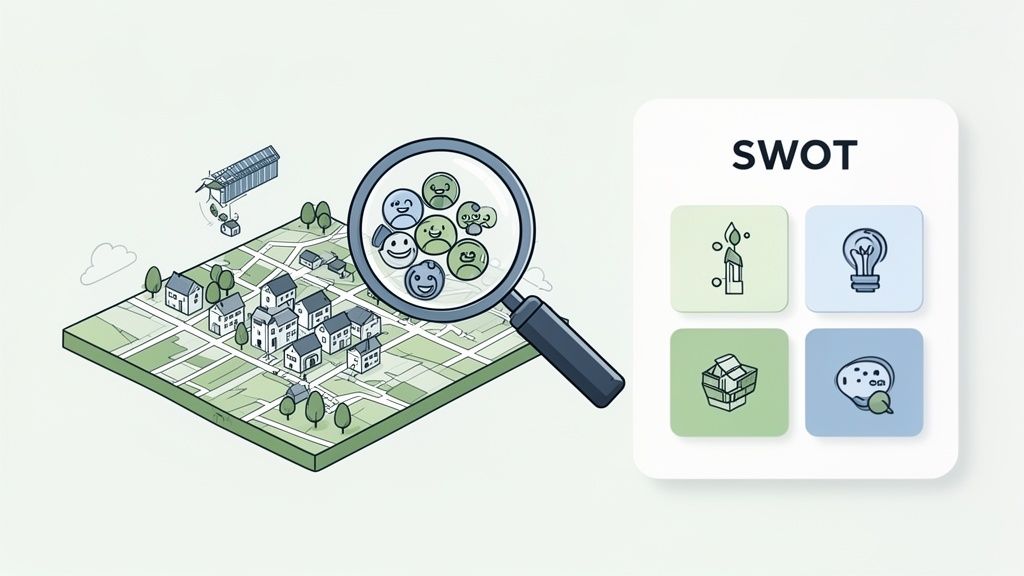
Before you can map out a route to where you want to go, you have to know exactly where you’re starting from. This is what a situation analysis does. It’s the honest, clear-eyed assessment of your current position and is the first, and most critical, of the core components of the marketing plan.
Think of it as the "You Are Here" marker on a mall map. It’s not just a point on a grid; it shows you what’s immediately around you—the stores, the escalators, the exits. In business terms, this analysis grounds your entire plan in reality, preventing you from chasing ambitious goals based on pure guesswork. Without it, you’re just driving in the dark.
Getting a 360-Degree View with SWOT
One of the best and most timeless tools for this is the SWOT framework. It’s a simple but powerful way to organize your thinking around four key areas, giving you a balanced perspective on what’s happening inside your company and out in the market.
It forces you to be brutally honest about where you stand.
- Strengths (Internal): What are you genuinely good at? Maybe it's a stellar brand reputation, a patented piece of tech, or a team that’s second to none.
- Weaknesses (Internal): Where do you fall short? Be real about things like a shoestring budget, gaps in your product features, or low brand awareness.
- Opportunities (External): What market shifts can you jump on? This could be anything from a competitor dropping the ball to a new technology you can adopt or an underserved niche you’ve spotted.
- Threats (External): What’s on the horizon that could cause trouble? Think new rivals, changing customer tastes, or a shaky economy.
A situation analysis gives your entire plan context. It answers the simple question, "Where are we now?" so you can intelligently decide, "Where are we going next?"
Once you map these out, you’ll start seeing the connections. For instance, a key strength (like a brilliant in-house video producer) might be the perfect answer to an opportunity (the rising demand for short-form video content).
Sizing Up the Competition
A huge piece of this puzzle involves looking over your shoulder at the competition. You don’t need a spy kit or expensive software to start. Simply dig into their websites, social media feeds, and customer reviews. You'll quickly get a feel for their messaging, how they position themselves, and what their customers really think.
Our guide on using a competitor analysis framework can give you a structured way to tackle this.
This kind of research is where you find the gaps. Maybe your biggest competitor has a great product but is notorious for terrible customer service. That’s not just their weakness; it’s your opportunity to become the responsive, customer-first choice.
Don't forget to look at broader market trends, too. Today’s marketing is all about personalization—we know that personalized calls-to-action convert 202% better than generic ones. At the same time, video is non-negotiable, with 92% of marketers calling it a vital part of their strategy. These are the kinds of external opportunities you want to capture in your analysis.
In the end, a solid situation analysis is your strategic compass. It points you toward the most promising routes and warns you of the dead ends, ensuring the rest of your marketing plan is built to win.
Setting Your Sights: How to Define Clear Marketing Goals
Once your situation analysis has given you a solid "You Are Here" marker on the map, the next move is figuring out where you're actually going. A marketing plan without goals is just a collection of random activities. It lacks focus and, more importantly, a finish line. This is where we turn broad ambitions into sharp, actionable objectives that guide every decision you make.
Simply saying "we want more sales" isn't a goal; it's a wish. To give your objectives real power, you need a framework that forces clarity and precision. The best tool for the job is the SMART framework, a classic for a reason.
Breaking Down The SMART Framework
The SMART framework acts as a checklist to ensure every goal you set is solid enough to build a strategy around. It’s a simple acronym that stands for Specific, Measurable, Achievable, Relevant, and Time-bound. Let's look at what each part really means.
Specific: Your goal needs to be laser-focused. Instead of "get better at social media," a specific goal is "grow our Instagram follower count." You know exactly what you're aiming for.
Measurable: If you can't measure it, you can't manage it. "Grow our Instagram follower count by 2,000" is measurable. Now you have a number to track against.
Achievable: Goals should stretch you, not break you. If you typically gain 100 followers a month, aiming for 2,000 in the next 30 days is probably a fantasy. It has to be realistic.
Relevant: Does this goal actually move the needle for the business? Growing Instagram followers only matters if that audience is a good fit and can eventually become customers. It has to connect to the bigger picture.
Time-bound: A deadline creates urgency and prevents goals from drifting forever. "Grow our Instagram follower count by 2,000 in Q3" gives you a clear timeframe to work within.
When you put it all together, a vague wish like "increase sales" transforms into a real, powerful objective: "Increase online sales by 15% in Q3 by implementing a targeted social media ad campaign and an email marketing promotion." See the difference? Now you have a clear target, a deadline, and even a hint at the tactics you’ll use to get there.
From Goals To Signposts With KPIs
With your SMART goals in place, you need a way to check your progress along the way. That's where Key Performance Indicators (KPIs) come in. Think of your goal as the destination. Your KPIs are the road signs and mile markers telling you if you’re on the right path and moving at the right speed.
Every goal should have a few primary KPIs that directly measure its success. For a goal centered on generating leads, your KPIs would be things like the number of form submissions, your website's conversion rate, and your cost per lead.
Watching these KPIs allows you to make smart decisions on the fly. If you're halfway through the quarter and your lead numbers are flat, your KPIs will sound the alarm, telling you it’s time to adjust your strategy. You can go even deeper by learning how to calculate marketing ROI to directly connect your spending to bottom-line results.
KPIs are the vital signs of your marketing plan. They provide the objective data needed to track progress, justify your budget, and prove the value of your marketing efforts to the rest of the organization.
To make this crystal clear, let's look at how common marketing goals connect directly to the KPIs that measure them.
Matching Marketing Goals To Key Performance Indicators
This table pairs common marketing objectives with the specific KPIs used to measure their success, helping businesses track progress effectively.
| Marketing Goal | Primary KPIs | Example Metric |
|---|---|---|
| Increase Brand Awareness | Social Media Reach, Website Traffic, Brand Mentions | Impressions |
| Generate More Leads | Conversion Rate, Cost Per Lead (CPL), Form Submissions | MQLs/month |
| Improve Customer Loyalty | Customer Lifetime Value (CLV), Churn Rate, Repeat Purchase Rate | Repeat Purchases |
| Boost Website Engagement | Time on Page, Bounce Rate, Pages Per Session | Avg. Session Duration |
By linking every goal to a handful of specific metrics, you’re no longer just hoping for success—you’re actively tracking your journey toward it. This simple step is what separates a plan that works from one that just sits on a shelf.
3. Pinpointing Your Ideal Customer

Alright, you’ve set your goals. Now for the million-dollar question: Who are you actually talking to? You can have a world-changing product and some really ambitious goals, but if your message isn't reaching the right people, it’s just shouting into the void. This step is where you get laser-focused on your ideal customer.
Trying to market to "everyone" is a surefire way to burn through your budget with nothing to show for it. It forces you into bland, generic messaging that fails to connect with anyone. This is why you must clearly define your audience. To dig deeper, check out this guide on how to identify your target audience. Taking the time to do this ensures every dollar and every minute you spend is as effective as possible.
Go Beyond Demographics with Buyer Personas
The best way to truly get inside your audience’s head is by creating buyer personas. A persona isn't just a sterile collection of data points; it’s a semi-fictional character who represents your ideal customer. Think of it as putting a human face on all that market research.
A truly useful persona goes way past the surface-level details. It uncovers the real motivations behind their behavior.
- Demographics: Start with the basics—age, job title, income. This sets the stage.
- Psychographics: Now for the good stuff. What are their goals and values? What keeps them up at night?
- Pain Points: What specific, frustrating problems are they dealing with that you can solve?
- Motivations: What really drives their decisions? Are they chasing efficiency, higher status, or better security?
This is where the magic happens. Knowing your target is a "35-year-old project manager" is fine. But knowing she's "drowning in manual reporting and desperate for a way to prove her team's ROI to her boss"—that's a game-changer. Now you know exactly what to talk about. For a more detailed walkthrough, see our guide on how to create buyer personas.
Carve Out Your Space with Brand Positioning
Once you know who you’re talking to, you have to decide what you want them to think about you. This is brand positioning. It’s about claiming a unique, valuable piece of real estate in your customer's mind, especially compared to your competitors.
Picture a crowded movie theater where all the obvious "best seats" are taken. Your goal isn't to elbow someone out of their seat. It's to find that one amazing, empty seat that's perfectly suited for you. That's your market position.
Your positioning statement is your internal North Star. It's a short, sharp description of your target market and the unique value you bring to the table. It guides every single thing you do.
A classic, effective formula for a positioning statement looks like this:
For [Your Target Audience], [Your Brand Name] is the only [Your Market Category] that [Your Unique Value Proposition].
Let’s put it into practice. Volvo, a brand that has absolutely nailed its positioning, might have something like this: "For safety-conscious families, Volvo is the only premium automaker that delivers peace of mind through industry-leading safety innovations."
That one sentence tells their entire team who they serve, what they are, and why they’re different. It ensures every ad, every social post, and every piece of website copy reinforces that core message of safety. This kind of clarity is what makes a brand unforgettable and the obvious choice for the right customer.
7. Choosing Your Marketing Channels and Budget
So, you’ve nailed down your goals and you know exactly who you’re talking to. Now it’s time to get your hands dirty. This is the point where your marketing plan transitions from a high-level vision into a real, boots-on-the-ground action plan. We’re finally picking the tools for the job—the specific channels you’ll use to reach your audience—and figuring out how much fuel you need in the tank, your budget.
Think of it this way: your goals are the destination, and your target audience is your passengers. Your marketing channels are the vehicles you’ll use to get there. You wouldn’t take a speedboat to cross a desert, right? And you probably wouldn't try to reach retirement-age financial planners on TikTok. The whole game is about picking the channels where your ideal customers are already hanging out.
Selecting the Right Channels for Maximum Impact
One of the most common mistakes I see is businesses trying to be everywhere at once. It’s a surefire way to stretch your resources too thin and get mediocre results across the board. The goal here isn't to be omnipresent; it's to be smart and focused.
A B2B software company trying to land enterprise clients will get way more bang for their buck on LinkedIn and with a solid SEO strategy. On the other hand, a direct-to-consumer fashion brand is going to live and breathe on Instagram and through influencer collaborations.
Your choices here shouldn't be a gut feeling. They should be a direct result of the homework you’ve already done.
- Audience Behavior: Where do your buyer personas actually "live" online? Are they scrolling social feeds, reading niche industry blogs, or are they people who go straight to Google when they have a problem?
- Content Alignment: What are you genuinely good at creating? If you and your team have a knack for sharp, compelling video, then YouTube should be a top contender.
- Goal-Oriented: If you need to generate leads right now, paid search ads are probably your best bet. If you're playing the long game and building a brand that lasts, content marketing and SEO are non-negotiable.
Demystifying Your Marketing Budget
Your budget isn’t just a number on a spreadsheet—it's the engine that powers this entire machine. Without a realistic, well-allocated budget, even the most brilliant strategy will sputter and die before it ever gets going. It's one of the most practical components of the marketing plan because it forces you to be ruthless about your priorities.
There are a few classic ways to approach setting a marketing budget, each with its own upsides and downsides.
- Percentage of Revenue: This is the most straightforward method. You simply allocate a set percentage of your revenue (a common range is 5-12%) to marketing. It’s easy to calculate and scales with your business.
- Objective-Based Budgeting: Honestly, this is the best way to do it. You start with your SMART goals and work backward, calculating exactly what it will cost to execute the activities needed to hit them.
- Competitor Parity: This is exactly what it sounds like. You essentially try to match what your main competitors are spending to maintain your share of voice in the market. It can be reactive, but it keeps you in the game.
A well-planned budget does more than just cover costs. It acts as a roadmap for your spending, ensuring that every dollar is strategically invested in activities that are most likely to deliver a measurable return.
No matter which method you lean toward, the key is to get granular. Break down your total budget by channel (e.g., Google Ads, content creation, social media tools) and map it out over the year, probably by quarter. This detail is what allows you to track spending, measure the ROI of each activity, and make smart decisions on the fly—doubling down on what works and cutting what doesn't.
The world has moved online, and marketing budgets have followed suit. The global digital advertising and marketing market is on track to hit a staggering $786.2 billion by 2026, which is a massive leap from $350 billion back in 2020. This isn't just a trend; it's a fundamental shift. Digital's slice of the total global ad spend pie rocketed from 57.4% in 2019 to 73.3% in 2022.
This data is telling a very clear story. To reach people today and get the best return on your investment, you have to prioritize your digital channels. If you're curious about where things are heading, you can discover other insightful 2023 digital marketing statistics to help guide your planning.
Putting Your Marketing Plan Into Action
A brilliant strategy is just a collection of great ideas until you actually do something with it. This is where the rubber meets the road—turning your carefully crafted vision into a real-world action plan. It's all about creating a clear roadmap for who does what, and when.
Without this step, even the best plans tend to fall apart. Deadlines get missed, roles become unclear, and accountability goes out the window. A detailed action plan turns your strategy into a well-orchestrated effort instead of a chaotic scramble.
Building Your Marketing Timeline
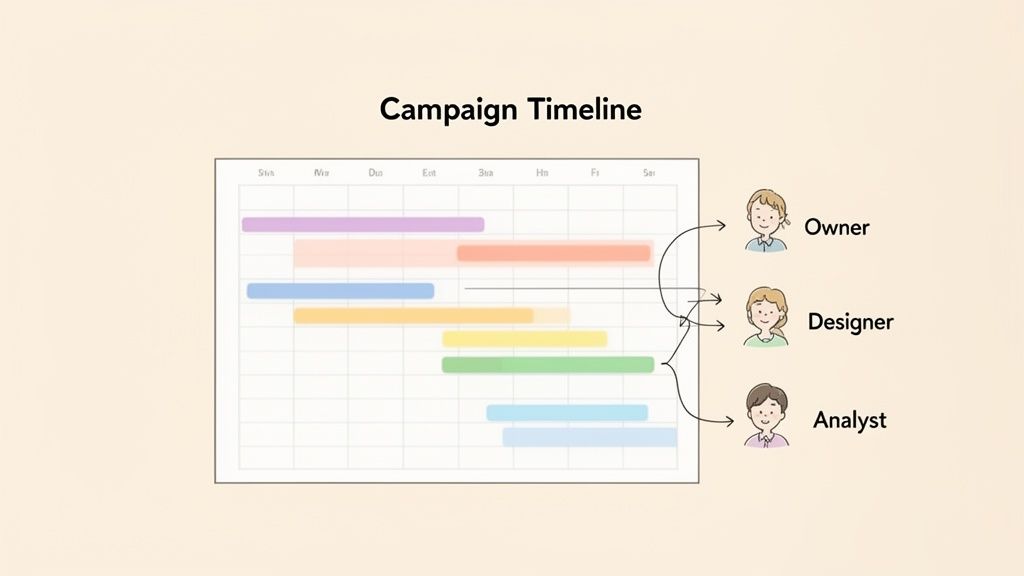
The foundation of your action plan is a realistic timeline, often called a marketing calendar. This tool simply maps out all your planned activities over a set period, like a quarter or a full year. It helps prevent teams from getting overwhelmed and makes sure campaigns are launched in a logical order.
A Gantt chart is one of the best ways to visualize this. It’s a simple bar chart that illustrates your project schedule, showing the start and end dates of every task and how they depend on each other.
For instance, mapping out a three-month product launch might look something like this:
- Month 1: Finalize all messaging, create the ad visuals, and get the blog content written.
- Month 2: Kick off the social media teaser campaign, schedule email announcements, and publish the SEO-optimized blog posts.
- Month 3: Go live with paid ad campaigns, host the launch webinar, and start tracking the initial performance data.
This kind of visual layout makes it instantly clear how different activities overlap and which tasks need to be finished before others can even start. It keeps everyone perfectly in sync.
Establishing Clear Governance And Roles
Once your timeline is set, you need to define governance. It’s just a straightforward way of saying you need to assign clear responsibilities. Every single task on that timeline should have a designated owner. This simple act is one of the most powerful things you can do to guarantee execution.
When everyone knows exactly what they’re responsible for, there’s no room for ambiguity. Productivity goes up, and you get rid of the finger-pointing or last-minute panic when a critical task gets dropped.
A marketing plan is not a static document you file away. It is a living, breathing guide that requires constant attention, analysis, and adaptation to succeed.
Making It a Living Document
Finally, the most important part of bringing your plan to life is to treat it as a dynamic guide, not a stone tablet. The market will change, competitors will make moves, and some of your initial assumptions might be flat-out wrong. Your success hinges on your ability to adapt.
Schedule regular review meetings—weekly or bi-weekly—to dive into your KPI data. This is your chance to ask the tough questions:
- Are we hitting our lead generation targets?
- Is the cost per acquisition for our ad campaign staying within budget?
- Which pieces of content are actually driving the most engagement?
These check-ins are your feedback loop. They give you the hard data you need to double down on what’s working and quickly pivot away from what isn’t. This commitment to continuous, data-informed improvement is what separates a plan that just gets executed from one that drives exceptional results.
Got Questions About Marketing Plans? We’ve Got Answers.
Even after you've nailed down all the core components, a few practical questions always seem to pop up. Let's tackle some of the most common ones I hear from clients so you can move forward with confidence.
How Often Should You Update Your Marketing Plan?
A marketing plan isn't a "set it and forget it" document. If you just file it away after creating it, you're missing the point. Think of it as a living, breathing guide for your business.
As a best practice, you should give your plan a major review and update annually. This is your chance to look back at the previous year's performance, account for any big market shifts, and set fresh, overarching goals.
But you can't just look at it once a year. A quarterly refresh is perfect for fine-tuning your tactics, shifting budget around, and making sure your day-to-day activities are still getting you closer to those big annual goals. Honestly, don't be afraid to make small tweaks monthly or even weekly as new performance data rolls in.
How Long Should a Marketing Plan Be?
There’s no magic number here. I've seen effective plans for small startups that were a lean 10-15 pages, and I've worked on corporate plans that pushed past 50 pages. The right length really just depends on how complex your business is and what you’re trying to achieve.
The goal isn't to create a long document; it's to create a useful one. Focus on clarity and actionability over page count. A plan that is clear, concise, and actually guides your team is far more valuable than a novel that just collects dust on a shelf.
What Are Some Helpful Tools for Creating a Marketing Plan?
You can absolutely build a solid plan with a simple word processor and a spreadsheet. But if you want to streamline the process and make collaboration easier, a few tools can make a world of difference. Here are the types of tools that really help with the different components of the marketing plan:
- Project Management Tools: Platforms like Asana, Trello, or Monday.com are fantastic for turning your strategy into an actionable workflow. They help you build timelines, assign tasks, and track execution so everyone knows what they're supposed to be doing and when.
- Analytics and Data Platforms: You can't build a good plan without good data. Tools like Google Analytics and the native analytics in your social media platforms are non-negotiable for pulling the numbers you need for your situation analysis and, later, for tracking your KPIs.
- Collaboration Software: When you need to get the team together for a brainstorm, visual tools like Mural or Miro are a game-changer. They let you map out ideas, build a SWOT analysis, or sketch out customer journeys in a shared digital space, even if your team is remote.
Using the right tools makes the entire planning process smoother, more data-driven, and a heck of a lot easier for your team to follow.
At ReachLabs.ai, we transform your marketing blueprint into measurable success. Our team of specialists builds and executes data-driven strategies that elevate your brand and drive real growth. Discover how our collective approach can move the needle for your business at https://www.reachlabs.ai.