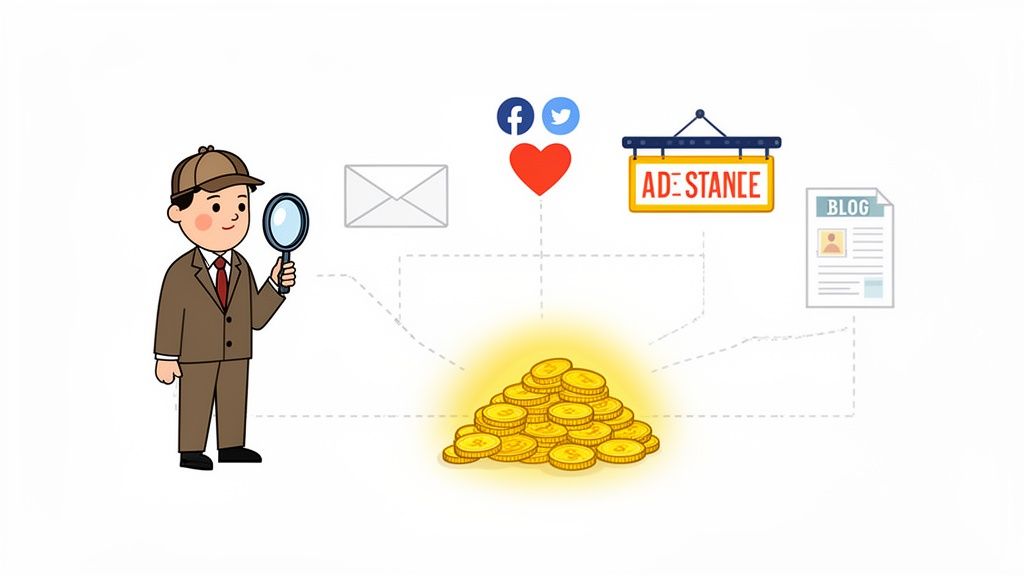
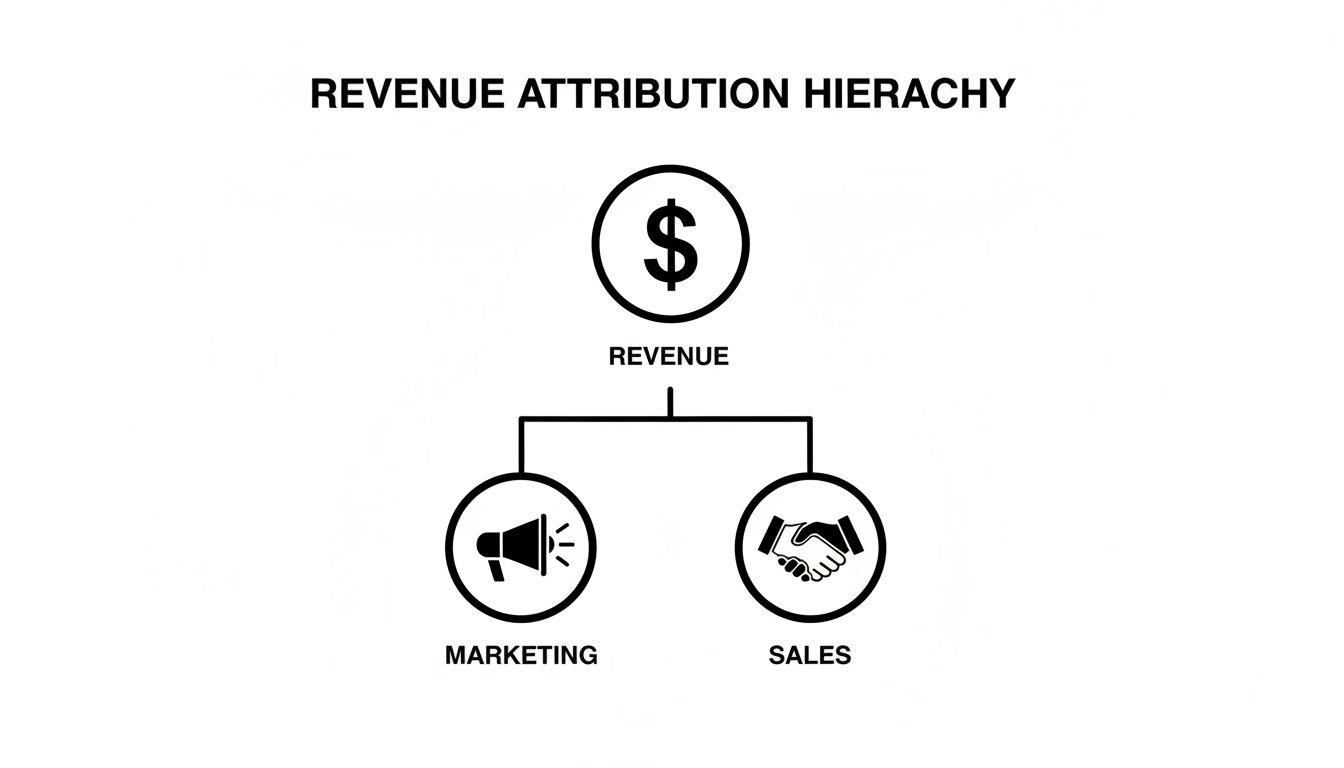
Think of revenue attribution as the process of connecting the dots between your marketing and sales efforts and the actual money they bring in. It's about looking past surface-level metrics like clicks and social media likes to figure out which specific actions—an ad, a blog post, a webinar, or a sales call—actually contributed to a closed deal.
This shift in thinking transforms marketing from a simple cost center into a predictable engine for growth.
What Is Revenue Attribution and Why Does It Matter?
Imagine a customer’s journey to making a purchase is like a relay race. The first runner gets the team out of the blocks, the middle runners maintain the pace, and the final runner crosses the finish line. Who gets the most credit for the win? Was it the explosive start, the steady middle, or the final push?
Revenue attribution is like the race official who reviews the tape to see how each runner contributed to the final time. Without it, marketers are essentially guessing, throwing money at different channels and hoping something sticks. You know you made money, but you don't really know why. Was it that new LinkedIn ad campaign, the weekly email newsletter, or the SEO improvements you made last quarter?
Attribution gives you the answer by assigning a specific value to each touchpoint along that customer journey. It provides a clear, data-backed picture of what’s actually working. For a closer look at the fundamentals, this guide on What Is Revenue Attribution and How Does It Work? is a fantastic resource.
The Core Purpose of Attribution
Ultimately, revenue attribution is all about gaining insights you can actually act on to make smarter decisions. When you know which channels and campaigns deliver the best return on investment (ROI), you can finally optimize your marketing strategy with confidence.
Here’s what it helps you do:
- Justify Your Marketing Budget: It gives you the hard data to show leadership exactly how marketing dollars are turning into sales.
- Tune Up Campaign Performance: By spotting your top-performing channels, you can double down on what works and cut the dead weight.
- Smooth Out the Customer Journey: Understanding the typical path to purchase shows you where you can improve the experience and remove friction.
- Unite Sales and Marketing: When both teams see how their combined efforts lead to revenue, it naturally fosters better teamwork and shared goals.
The old saying holds true: if you can’t measure it, you can’t improve it. Revenue attribution provides the framework to stop guessing and start making informed, data-driven decisions that grow your business.
This isn't just a niche idea anymore; it's becoming the standard. A recent report found that 76% of marketers either have or are planning to implement marketing attribution in the next year. It’s a clear signal that the industry is moving toward accountability and performance-driven marketing.
To help you get a handle on the key ideas, here’s a quick breakdown of the core concepts.
Key Concepts in Revenue Attribution at a Glance
This table breaks down the core components of revenue attribution into easily digestible concepts for readers to quickly grasp.
| Concept | What It Is | Why It Matters |
|---|---|---|
| Touchpoint | Any interaction a customer has with your brand, like seeing an ad, reading a blog, or attending a webinar. | These are the individual "dots" you need to connect to understand the full customer journey. |
| Attribution Model | A set of rules that determines how credit for a sale is distributed among different touchpoints. | The model you choose directly impacts your insights and how you value each marketing channel. |
| Customer Journey | The complete path a customer takes from initial awareness to making a final purchase. | Mapping this journey reveals how different touchpoints work together to influence a decision. |
| Return on Investment (ROI) | The financial return you get from the money you spend on marketing activities. | This is the ultimate measure of success, showing which efforts are most profitable for the business. |
Understanding these elements is the first step toward building a marketing strategy that's not just creative, but also demonstrably effective.
Exploring Common Revenue Attribution Models
Imagine your marketing funnel as a soccer match where every pass counts. Each touchpoint is a player moving the ball closer to the goal. Understanding who sets up the play and who finishes it is key to scoring more revenue.
Basic Attribution Models
At their core, rule-based models assign credit based on a fixed logic. Here’s a quick rundown:
- First Touch credits the initial interaction, perfect for measuring brand awareness.
- Last Touch awards 100% credit to the final engagement, ideal for closing tactics.
- Linear spreads credit evenly across all interactions, giving you a balanced overview.
- Time Decay weights recent touchpoints more heavily, useful when sales cycles are longer.
Each of these has a sweet spot—and a blind spot. First Touch can miss how later content nurtures leads, while Last Touch overlooks early influences. Linear is fair but may dilute critical touches. Time Decay favors recent plays yet might underappreciate that first spark.
The table below contrasts these four popular models:
Comparing Popular Revenue Attribution Models
The table highlights strengths, weaknesses, and best-fit scenarios for each approach.
| Attribution Model | How It Works | Best For | Main Drawback |
|---|---|---|---|
| First Touch | Credits the first interaction | Brand awareness | Ignores later nurturing |
| Last Touch | Credits the final interaction | Closing tactics | Overlooks early-stage influence |
| Linear | Splits credit equally | Balanced performance | Can dilute key touchpoints |
| Time Decay | Weights recent interactions more | Lengthy sales cycles | May undervalue initial contact |
Use this side-by-side view to see which model aligns with your goals. Test with small campaigns before committing fully.
Multi-Touch And Algorithmic Models
Once you’ve mastered the basics, multi-touch and machine-learning options take you further:
- U-Shaped: Allocates 40% to both the first and conversion interactions, with the remainder in between.
- W-Shaped: Shares 30% each among the top, middle, and bottom stages, spotlighting key milestones.
- Algorithmic Attribution: Leverages statistical models to analyze thousands of touchpoints and assign credit dynamically.
These advanced models give a full-funnel perspective but require more data and technical setup. They’re especially powerful for complex B2B cycles or high-volume ecommerce funnels.
Putting Models Into Practice
Implementing attribution is part art, part science. Follow these steps:
- Clean up your tagging: enforce consistent UTMs and naming conventions.
- Integrate systems: connect CRM, analytics platform, and ad channels.
- Define clear KPIs and reporting cadences: schedule regular check-ins to spot anomalies.
- Run pilot tests: validate model choices with small budgets before scaling.
With reliable data and continuous iteration, you’ll sharpen your insights and refine budget allocations.
Only 39% of companies apply revenue attribution comprehensively, despite 76% being technically ready and 41% still relying on last-click. This oversight can leave 23% of revenue insights on the table. In B2B, multi-touch models enjoy 44–73% adoption, while inbound and content touchpoints capture 25–44% of credit. North America leads with 39.8% of global revenue driven by programmatic and CTV investments.
For a deeper dive, read the full research from Grandview Research. You might also explore our guide on cross-channel attribution for practical examples.
Holistic attribution builds transparency between marketing and sales, aligns teams around shared goals, and turns scattered data into a winning playbook. Continuous testing and strategic tweaks ensure you’re always primed to score.
Moving Beyond Basic Rules: The Power of Algorithmic Attribution
Think of the simple, rule-based attribution models we've discussed so far. They’re like using a basic road map—helpful, for sure, but they only show one fixed route to your destination. Now, imagine upgrading to a sophisticated, real-time GPS. That's the leap you make with advanced and algorithmic attribution.
This isn’t about following a pre-set formula. Powered by machine learning, these data-driven models act like that GPS, analyzing every possible path a customer takes. They sift through thousands of touchpoints, from the first ad click to the final webinar, looking for the subtle patterns and hidden connections that a human analyst could easily miss. The result? A much clearer, more accurate picture of what's actually driving your revenue.
Ultimately, algorithmic models replace rigid assumptions with dynamic, data-backed insights. Instead of guessing which touchpoints matter, you get reliable conclusions about what’s truly moving the needle on your campaigns.
How Does an Algorithmic Model Actually Work?
So, what's happening under the hood? At its core, an algorithmic model uses statistical analysis to compare the complete journey of customers who converted against the journey of those who didn't. By spotting the key differences between these two groups, the model can calculate the probabilistic impact of each and every touchpoint along the way.
This sophisticated approach goes way beyond simply assigning credit. It starts to answer the deeper, more strategic questions every marketer has:
- What's the real incremental value of each channel? It can figure out if a specific touchpoint genuinely influenced the final decision or was just a stop along the way.
- Which sequences of interactions are most powerful? The model can pinpoint the combinations and orders of touchpoints that are most likely to result in a sale.
- Where does a channel shine brightest? You can see if a platform is better for building initial awareness or for closing the deal at the end of the funnel.
This is where things get really interesting. This level of detail allows you to make predictive, intelligent optimizations. For instance, if the model reveals that customers who view a specific case study right after attending a webinar are 50% more likely to convert, you can start building campaigns designed to encourage that exact sequence of events.
The Clear Advantage of a Data-Driven Approach
The marketing world is already shifting in this direction. A full 43% of marketers now consider data-driven attribution the most important model because of its accuracy in crediting revenue across multiple channels. Digging deeper, 56% of those marketers see it as critical to their success, with another 33% calling it essential.
For B2B marketers, this precision is a total game-changer. More than half can now directly connect their content marketing efforts to actual sales revenue when they have the right tracking in place. The ROI speaks for itself, too—these advanced methods deliver a median return of 4.33:1, blowing traditional outbound marketing out of the water. You can explore more of these trends in Mordor Intelligence's latest report.
The true power of algorithmic attribution is that it learns and adapts. As customer behavior evolves and new marketing channels pop up, the model adjusts its weighting on the fly, ensuring your insights are always relevant and actionable.
Of course, there's a catch. These powerful benefits come with a big requirement: data. To work properly, algorithmic models need a high volume of clean, connected data from all your systems—your CRM, marketing automation tools, and ad platforms. Without enough data, the model can't find statistically significant patterns, and its conclusions will be shaky at best. But for businesses with the right data infrastructure in place, this is the future of truly understanding and optimizing revenue.
Gathering Your Data: The Fuel for Your Attribution Engine
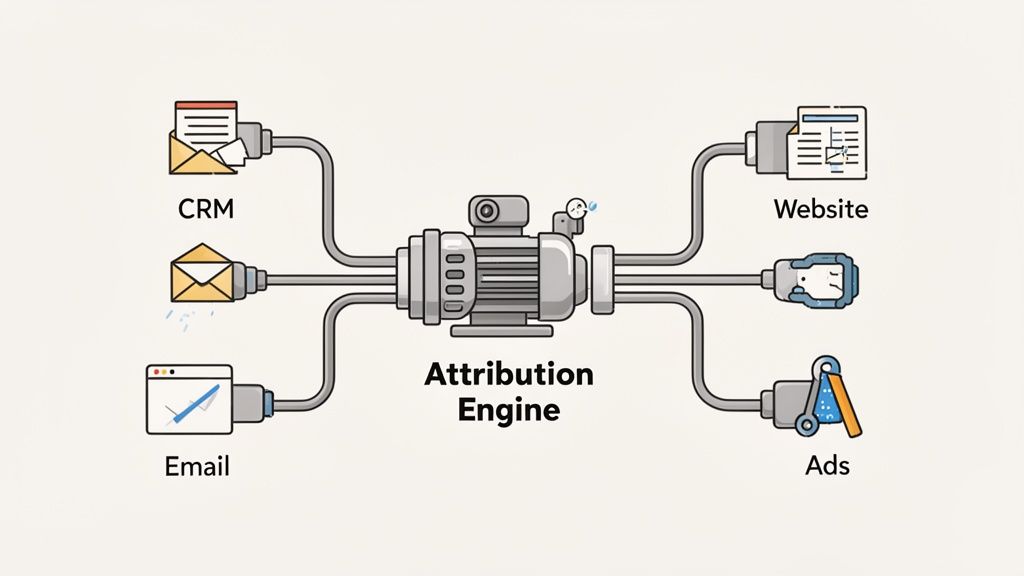
Any attribution model, no matter how sophisticated, is only as good as the data you feed it. Think of your revenue attribution system as a high-performance engine; the data you collect is its fuel. Bad fuel will cause sputtering, breakdowns, and unreliable performance. High-quality, clean fuel, on the other hand, makes sure the engine runs smoothly and gets you exactly where you need to go.
To build an attribution system you can actually trust, you have to systematically gather, clean, and connect data from all over your business. This isn't just a setup task—it’s the foundational work that determines the accuracy of every single insight you’ll generate. Without it, you’ll get misleading results and risk pouring money into the wrong channels.
Core Data Sources for Attribution
Your customer's journey is scattered across a dozen different platforms. To see the full picture, you need to pull information from each of these systems and stitch it all together. The goal is to follow a customer from their very first interaction all the way to a closed-won deal.
Here are the essential data sources you'll need to integrate:
- Customer Relationship Management (CRM): This is your source of truth for all things sales. It holds the crucial info on leads, contacts, deals, and most importantly, revenue. This is where you find the final outcome you're measuring against.
- Marketing Automation Platform: This is where you track how leads are nurtured. You'll get key data points like email opens, link clicks, and webinar attendance, which show you exactly how prospects are engaging with your content.
- Website Analytics: Tools like Google Analytics open a window into user behavior on your site. Here, you'll collect data on page views, session duration, form submissions, and the specific content that grabs a prospect's attention.
- Advertising Platforms: Your ad platforms (Google Ads, LinkedIn Ads, etc.) are a goldmine of performance data. You need to pull metrics like ad clicks, impressions, cost-per-click (CPC), and total campaign spend to get a real handle on your ROI.
Connecting these sources creates a unified view of the customer journey, making accurate revenue attribution possible. You can get a better handle on this by learning more about effective marketing campaign tracking to ensure no touchpoint gets lost.
Key Metrics That Drive Insight
Once your data sources are connected, you have to focus on the metrics that actually matter. While vanity metrics like page views are interesting, revenue attribution zeroes in on the KPIs that directly tie to business growth.
Your analysis should center around these critical metrics:
- Customer Lifetime Value (CLV): This tells you the total revenue you can expect from a single customer over time. Knowing your CLV helps you spot which marketing channels are bringing in the most profitable customers, not just the most customers.
- Customer Acquisition Cost (CAC): This is the total sales and marketing cost required to land a new customer. When you compare CAC to CLV, you finally get to see which acquisition channels are truly profitable.
- Deal Velocity: This measures how quickly leads move through your sales pipeline. Attribution can reveal which touchpoints speed up this process, helping you shorten your sales cycle and close deals faster.
- MQLs & SQLs: Tracking the volume and conversion rates of Marketing Qualified Leads and Sales Qualified Leads by channel shows you which sources are generating the highest-quality leads for your sales team.
Clean data is non-negotiable. Inaccurate, incomplete, or duplicate data will corrupt your attribution results, leading to flawed conclusions. It's essential to establish a process for regularly cleaning and validating your inputs.
Ensuring the accuracy of your inputs is paramount for reliable revenue attribution, and understanding how to improve data quality is a critical first step. A real commitment to data hygiene is what protects the integrity of your entire attribution strategy.
A Practical Blueprint for Implementing Revenue Attribution
Knowing the theory behind attribution models is one thing; actually putting one to work is another beast entirely. To get this right, you need a clear, actionable plan. This blueprint is designed to help you launch a successful revenue attribution program and turn those abstract concepts into real business results.
Think of it like building a house. You wouldn't just start laying bricks without a solid architectural plan. In the same way, a strong attribution strategy needs careful planning—from defining your goals all the way to creating a repeatable process for analysis.
Define Your Business Goals and KPIs
Before you get lost in a sea of data and tools, you have to answer one simple question: what does success actually look like? What are you trying to figure out with revenue attribution? If your objectives are vague, your insights will be just as confusing and completely useless.
Start by nailing down your core business goals. Are you trying to generate brand-new leads? Or maybe you want to shorten your sales cycle or get customers to stick around longer? The goals you set will directly shape the Key Performance Indicators (KPIs) you track.
Let’s look at a couple of examples:
- A B2B SaaS company's goal: Shorten the sales cycle.
- KPIs to watch: Deal Velocity, Time to Close, and the MQL-to-SQL Conversion Rate.
- An e-commerce brand's goal: Increase repeat purchases.
- KPIs to watch: Customer Lifetime Value (CLV), Repeat Purchase Rate, and Average Order Value (AOV).
When you have these metrics clearly defined, they become the north star for your entire project. Every decision you make from here on out will be guided by these ultimate business objectives.
Audit Your Tech Stack and Data Sources
Okay, goals are set. Now it’s time to take a hard look at your existing technology and data infrastructure. An attribution model is only as good as the data feeding it, so a thorough audit is crucial for capturing every touchpoint along the customer journey.
Your main job here is to figure out where all your customer interaction data lives and how you can connect the dots. Key systems to audit include your CRM (for deal and revenue data), your marketing automation platform (for email and nurture activity), website analytics (for on-site behavior), and your ad platforms (for campaign performance and spend).
A common roadblock is siloed data. When your sales and marketing platforms don't communicate, it's impossible to connect early marketing interactions with final sales outcomes. Prioritizing integration is a non-negotiable step.
This audit will almost certainly uncover some gaps. Maybe you aren’t tracking webinar attendance properly, or your team’s use of UTM parameters is a mess. Fixing these issues early will save you from a world of inaccurate reporting down the line. A huge part of this is getting your teams on the same page, and our guide on aligning sales and marketing offers practical strategies to get it done.
Select the Right Attribution Model and Tools
Now for the fun part: choosing the model that actually mirrors your customer’s journey. As we talked about earlier, a B2B company with a long, complex sales cycle will probably get more value from a multi-touch model like Time Decay or W-Shaped, which gives proper credit to all those nurturing activities. On the flip side, an e-commerce business with a quick path to purchase might find that Last Touch or First Touch gives them all the insight they need.
Once you’ve picked a model, you need the right tool to make it happen. Your options are pretty broad:
- Built-in Analytics Tools: Platforms like HubSpot or Google Analytics have their own attribution reporting. These are fantastic starting points, though they can be limited to the data living inside their own ecosystem.
- Specialized Attribution Platforms: This is dedicated software that pulls in data from multiple sources to give you advanced, cross-channel analysis. These tools are where you'll often find sophisticated algorithmic models for much deeper insights.
- Custom-Built Solutions: For large companies with truly unique needs, building a custom solution on a data warehouse might be the best path, but be warned—it requires a heavy lift from your technical resources.
My advice? Start with what’s accessible. A basic model running in your existing analytics platform is infinitely better than no model at all. You can always level up to more sophisticated tools as your needs and data maturity grow. The most important thing is to just start tracking and build a repeatable process for turning your new insights into action.
Common Pitfalls and How to Navigate Them
Getting revenue attribution right is a game-changer, but the road is littered with common mistakes that can completely undermine your results. Knowing what these traps are ahead of time is the best way to build a system that gives you clarity, not just more confusing spreadsheets.
One of the biggest blunders we see is working with bad data. If your CRM doesn't talk to your ad platforms, or your team is just winging it with UTM parameters, your entire model is built on sand. This is how you end up with skewed results that make you over-invest in some channels while totally missing the value of others.
Another classic mistake is picking an attribution model that just doesn't fit your business. Think about a B2B company with a six-month sales cycle using a Last Touch model—they're completely ignoring every blog post, webinar, and sales call that warmed up the lead. On the flip side, a simple online store probably doesn't need to overcomplicate things with a super-complex algorithmic model.
The point of revenue attribution isn't just to hoard data. The real failure is collecting a mountain of information and then doing absolutely nothing with it. It has to lead to action.
Sidestepping Common Attribution Roadblocks
Getting around these challenges is all about being proactive. You’re not going to build the perfect system overnight. It’s a process of constant refinement and staying aware of where your blind spots might be. When you get this right, you can finally trust the numbers you're seeing.
Here are a few practical ways to keep your strategy on the right path:
- Clean Up Your Data: Seriously. Get disciplined about your data hygiene. Set up and enforce strict rules for things like campaign naming conventions. A bit of order now will save you from massive headaches down the road.
- Don't Forget the Real World: Did a prospect sign up right after meeting your team at a trade show? Did a sales dinner seal the deal? These offline touchpoints are gold. Make it easy for your sales team to log these interactions in your CRM so they become part of the full customer story.
- Start Simple, Then Grow: You don't need a custom, AI-driven model on day one. Begin with a basic model that’s already built into your analytics tools. Learn from it, see where it falls short, and then you can upgrade your approach as you get more sophisticated.
- Have a "So What?" Plan: For every report you pull, ask yourself, "So what do we do now?" Define clear next steps based on what you find. If a channel is underperforming, decide if you're going to fix it or cut the budget.
By keeping an eye out for these common pitfalls, you can build a what is revenue attribution framework that’s far more effective and trustworthy from the get-go.
Your Revenue Attribution Questions, Answered
As you start wrapping your head around revenue attribution, a few practical questions always pop up. Let's tackle some of the most common ones to help you move from theory to action.
Is Revenue Attribution Only for Big Companies?
Not at all. While the term might sound intimidating, you don't need a massive data science team or a six-figure budget to get started. Many small businesses can begin right away with the tools they already have.
Platforms like Google Analytics or your existing CRM often have built-in attribution features that are perfect for a starting point. The trick is to keep it simple. Begin by tracking your most important touchpoints using consistent UTM parameters. Even a basic Last Touch model can give you powerful insights to make smarter budget choices.
What’s the Difference Between Marketing Attribution and Revenue Attribution?
This is a really important distinction. Think of it this way: marketing attribution focuses on marketing-specific goals, like generating a lead or getting someone to fill out a form. It answers the question, "Which ad or email brought us this lead?"
Revenue attribution goes all the way. It connects every marketing and sales touchpoint directly to a closed deal and the actual money it generated. It answers the much bigger question, "Which efforts are actually making us money?" This complete view is how marketing proves its true financial contribution.
The real difference is where you draw the finish line. Marketing attribution stops when a lead is created. Revenue attribution follows the journey until the invoice is paid.
How Do I Track Offline Touchpoints?
Tracking things like trade show conversations, phone calls, or direct mail isn't as hard as it sounds. The solution almost always comes down to having a disciplined process for logging everything in your CRM.
Your sales team is your best asset here. They need to be consistent about recording these offline interactions. For instance:
- A lead from a conference booth should get a specific "lead source" in the CRM.
- Important sales calls or face-to-face meetings should be logged as activities linked to the contact or deal.
When you capture this information reliably in your CRM, you can pull it into your attribution model. This ensures those high-value, real-world interactions get the credit they’re due.
How Long Does It Take to See Results?
This is a marathon, not a sprint. You won't have game-changing data in the first week. The time it takes to get meaningful insights really depends on the length of your sales cycle.
If you’re in e-commerce with a sales cycle of just a few days, you might spot useful patterns in a matter of weeks. But for a B2B company with a 6-month sales cycle, you'll need to wait for at least one full cycle to pass before you can trust the data. The goal is to gather enough information to see real trends emerge, which usually takes a few months at the very least.
Ready to stop guessing and start proving your marketing's impact? ReachLabs.ai integrates data-driven insights with world-class talent to deliver digital strategies that drive real growth. Discover how our team can connect your marketing efforts directly to revenue. Learn more at ReachLabs.ai.