

Think of your company's offerings—all its products, services, and sub-brands. How do they all fit together? That’s where brand architecture comes in. It’s essentially the organizational chart for your brands, a strategic framework that defines the relationships between your main corporate brand and everything else you sell.
Simply put, it’s your brand’s family tree. A well-thought-out architecture ensures everyone, from your customers to your internal teams, understands how each piece of your business connects to the whole.
Understanding Your Brand's Family Tree
Without a clear system, a company's portfolio can quickly become a chaotic mess. Customers get confused, the core brand's message gets diluted, and marketing efforts become disjointed. A solid brand architecture prevents this by creating a logical structure that makes it easy for people to navigate your offerings and grasp the value behind each one.
This isn't just about corporate tidiness; it's a powerful engine for growth. Getting your brand architecture right allows you to:
- Reach diverse customer segments without weakening your core identity.
- Launch new products or acquire businesses with a clear roadmap for integration.
- Allocate marketing dollars more effectively by knowing which brand to spotlight.
- Build and protect brand equity across your entire portfolio.
Why A Clear Structure Matters More Than Ever
A messy brand portfolio often leads to internal turf wars, wasted ad spend, and missed growth opportunities. That’s why so many companies are getting serious about formalizing their brand architecture. In fact, the global market for brand architecture services is expected to grow at a CAGR of 9.1% between 2024 and 2032 as businesses realize its direct link to customer loyalty and efficiency.
A strong brand architecture isn't just a corporate chart; it's a strategic narrative that explains your company's vision and value to the world. It ensures every part of your business works together to build something greater than the sum of its parts.
Before you can build this structure, you first need to understand your current brand landscape. This process almost always starts with a thorough review, which you can learn more about in our guide on what is a brand audit. Once you’ve mapped out your brand's family tree, the next step is often to consider effective strategies for building brand awareness across your newly organized portfolio.
A Look at the Four Main Brand Architecture Models
Once you've got a handle on the "what" of brand architecture, the next logical step is to dive into the "how." How do companies actually organize their brands? It really boils down to four foundational models, each offering a different blueprint for managing the relationship between the parent company and its various products, services, or divisions.
Think of these less as rigid, unbreakable rules and more as strategic starting points. The real magic happens when you adapt them to fit your specific business goals. Let's break down the four primary models with some simple analogies to make sense of them all. Getting a feel for their unique strengths and weaknesses is the first step toward figuring out which path is right for you.
The Branded House Model
Picture a family where everyone shares a famous, well-respected last name. That's the essence of a Branded House. In this model, one powerful master brand is the star of the show, and all products and services live under its roof. They usually just get a simple, descriptive name attached.
Google is the textbook example. You’ve got Google Maps, Google Drive, and Google Calendar. That "Google" name instantly signals what you’re getting in terms of quality and usability, while the second word tells you exactly what the product does. This creates an incredibly unified and efficient system. Every marketing dollar you spend on the master brand lifts the entire portfolio. It’s all about consistency and leveraging the parent's reputation to give new products a running start.
The House of Brands Model
Now, imagine a property developer who owns a diverse collection of buildings—a sleek downtown skyscraper, a quiet suburban apartment complex, and a quirky boutique hotel. Each has its own name, its own vibe, and attracts a different kind of tenant. This is the House of Brands model in action. The parent company often stays completely behind the scenes, letting each individual brand stand on its own two feet.
The master of this strategy is Procter & Gamble (P&G). Everyone knows Tide, Gillette, and Pampers, but far fewer could tell you they all belong to P&G. Each brand is its own little empire with a unique identity, a specific target audience, and a dedicated marketing strategy. This allows P&G to dominate multiple, sometimes competing, market segments.
The real power here is market saturation. A House of Brands lets a company own multiple products in the same category and protects the parent company’s reputation if one of the brands takes a hit.
The major downside? It’s expensive. Every brand needs its own budget, its own team, and its own marketing campaigns.
The Endorsed Brand Model
The Endorsed Brand model is the happy medium, kind of like having a credible expert vouch for you. In this setup, a product has its own unique brand identity, but it gets a clear stamp of approval from the parent brand. This "endorsement" signals trust, quality, and reliability.
Marriott has this down to a science. You have hotel brands like Courtyard, Residence Inn, and Fairfield Inn—each offering a distinct experience. But they are all clearly presented as "by Marriott." That little phrase reassures travelers they can expect a certain standard of quality, while the individual brand name sets a specific expectation for their stay. It's the best of both worlds: targeted marketing with the safety net of a big, trusted name.
This approach strikes a great balance between building individual brand personalities and sharing corporate equity. The benefits are pretty clear:
- Lowering the Bar for Trial: Customers are more willing to try a new sub-brand when it's backed by a name they already trust.
- Shared Marketing Value: The parent brand gains visibility every time the sub-brand is promoted.
- Niche Targeting: It allows sub-brands to zero in on very specific customer segments without alienating the parent brand's broader audience.
The Hybrid Model
Finally, we have the Hybrid Model, which you can think of as the "blended family" of brand architecture. It’s a pragmatic mix-and-match of the other models. This structure often develops over time, especially when companies grow through mergers and acquisitions. A business might operate as a Branded House for its homegrown products but decide to keep a newly acquired, powerful brand as a standalone entity.
The Coca-Cola Company is a perfect example. On one hand, you have Coke, Diet Coke, and Coke Zero, which are classic Branded House players. But the company also owns brands like Minute Maid and Dasani, which operate independently, more like a House of Brands. This flexibility allows them to manage a massive and diverse portfolio effectively.
Picking the right brand architecture isn’t just a marketing exercise; it's a foundational business decision with ripple effects that will last for years. Each model comes with its own set of strengths and weaknesses, and what works wonders for one company could be a complete disaster for another. It's all about finding the right fit for your business goals, your market, and your budget.
Let's break down the trade-offs. A Branded House is fantastic for building a powerful master brand and getting the most bang for your marketing buck. The downside? It's an "all eggs in one basket" situation. One bad product review or a PR nightmare can tarnish the reputation of every single thing you sell. The potential rewards are huge, but so are the risks.
On the other side of the spectrum, a House of Brands lets you insulate the parent company while you go out and dominate different market segments with targeted brands. If one brand stumbles, the others carry on just fine. The major catch is the staggering amount of money and effort it takes to build and market each brand as its own separate empire.
This image really helps to see how these different structures organize a company's offerings.
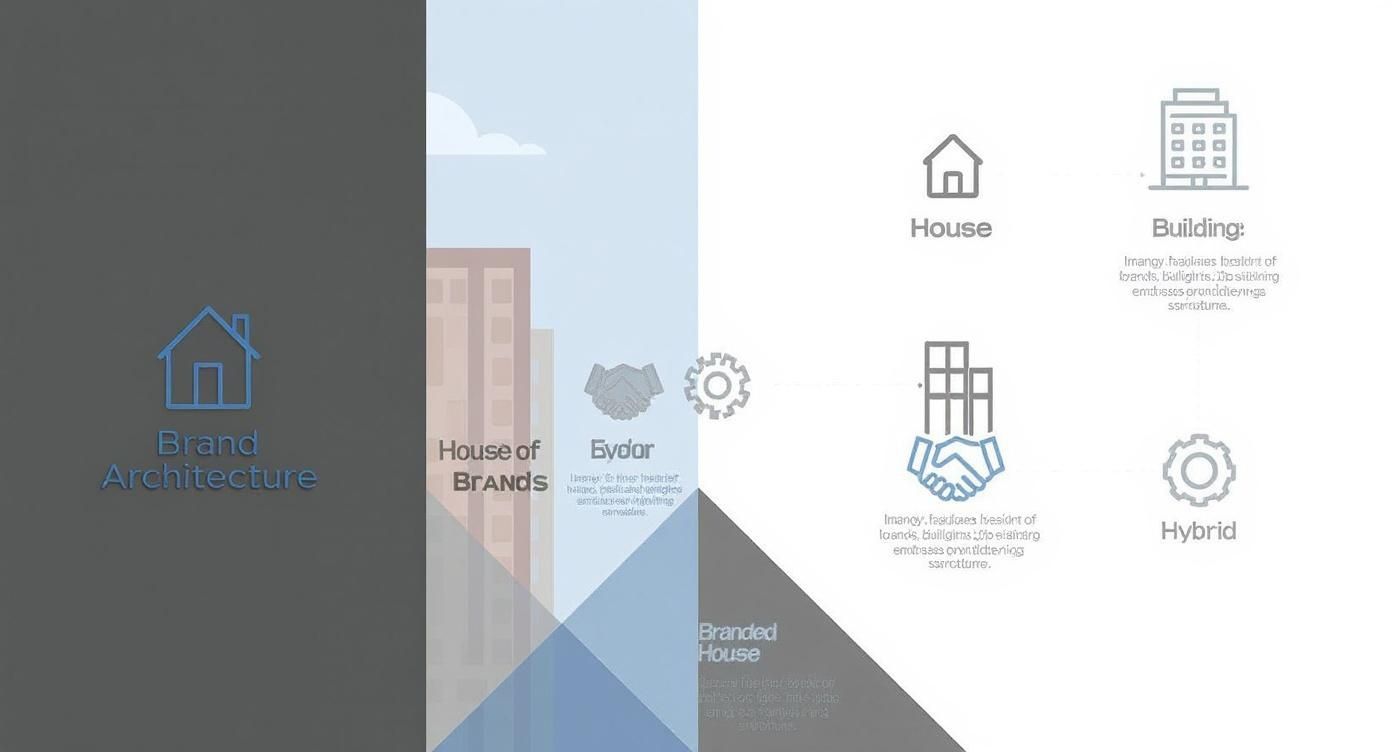
You can immediately grasp the difference between a monolithic approach like the Branded House and a more fragmented one like the House of Brands, with the other models sitting somewhere in between.
Weighing the Strategic Benefits
The Endorsed model strikes a nice balance. It gives sub-brands their own personality while borrowing credibility from the parent. That "stamp of approval" can be a massive shortcut to earning customer trust for new products. The challenge here is making sure every endorsed brand lives up to the parent's promise—one slip-up can damage the name that backs it.
Then there's the Hybrid model, which is the most flexible of the bunch. It’s perfect for companies that have grown by acquiring other businesses, letting them mix and match strategies. But this freedom can get messy fast, creating a confusing experience for customers if there isn't a clear logic holding it all together.
When it comes down to it, you have to square these options with your company’s long-term vision.
The goal isn’t to find a "perfect" brand architecture. It's to choose the one that best supports your specific business strategy, aligns with your tolerance for risk, and fits what you're able to invest. This is a choice that defines how your brand shows up in the world.
Brand Architecture Models: A Comparative Analysis
No single model is the "best" one. The right choice depends entirely on your industry, your competition, and where you want to take your business in the future. To help you see which path might be the smartest for your organization, I've put together a table comparing the pros and cons of each.
| Model | Key Advantages | Key Disadvantages | Ideal Business Scenario |
|---|---|---|---|
| Branded House | Builds powerful master brand equity. Highly efficient marketing spend. Streamlines new product launches under a trusted name. | A single crisis can damage the entire brand portfolio. Can dilute the master brand if it's stretched across unrelated categories. | Companies with a strong, focused value proposition that applies across all their offerings (e.g., Google, FedEx). |
| House of Brands | Allows for total market domination by targeting distinct segments. Insulates brands from each other's failures. Creates a diverse portfolio that can even include competing products. | Extremely expensive to build and maintain separate brands. Doesn't build equity for the parent company. | CPG giants that serve a wide variety of consumer needs and price points (e.g., P&G, Unilever). |
| Endorsed | Lends instant credibility and trust to sub-brands. Balances individual identity with the security of a parent brand. Creates a clear promise of quality. | The parent brand's reputation is on the line with every sub-brand. Requires tight quality control and consistent messaging. | Businesses with distinct product lines that benefit from a corporate stamp of approval (e.g., Courtyard by Marriott). |
| Hybrid | Offers maximum flexibility to adapt to market changes or acquisitions. Allows for a mix of strategies tailored to different business units. | High risk of becoming complex and confusing for customers. Can lead to internal inefficiencies without strong oversight. | Large, diversified corporations that have grown through mergers and acquisitions (e.g., The Coca-Cola Company). |
Ultimately, choosing your brand architecture means looking at these trade-offs honestly. It's about selecting the structure that will give you the most strategic clarity and competitive muscle for the road ahead.
Learning from Real World Brand Architecture Examples
https://www.youtube.com/embed/v871jBHH4WU
Theory is one thing, but seeing brand architecture out in the wild is where it all starts to make sense. The world's most recognizable companies are masters of this game. They use their brand structure to organize everything they sell, conquer markets, and build staggering value. Looking at their playbooks gives us real, tangible lessons we can apply to any business.
These stories aren't just academic case studies; they show how the right architectural moves can create incredible influence and brand loyalty. By seeing how giants in different industries set up their portfolios, the impact of a well-played strategy becomes crystal clear.
The House of Brands: P&G's Quiet Domination
Procter & Gamble (P&G) is the textbook definition of a House of Brands. You might not think about P&G when you buy your detergent or razor, and that’s entirely by design. Instead of pushing the parent company, P&G lets individual brands like Tide, Gillette, and Pampers stand on their own as market leaders.
Each brand has its own unique identity, marketing budget, and specific customer. This lets P&G launch multiple products in the exact same category without confusing anyone. Think about laundry detergent—they sell a whole shelf of them, each positioned differently for specific needs, from heavy-duty stain removal to formulas for sensitive skin. This setup also insulates the parent company; if one brand stumbles, the P&G mothership remains safe and sound.
This model’s power lies in its diversification. It allows a single corporation to capture a massive slice of the market by creating distinct brands for different consumer tastes, needs, and price points.
When you look at how different companies manage their image, it's also worth checking out how brands like Nike maintain flawless consistency, where sharp product visuals are central to their identity. No matter the architecture, strong visuals are non-negotiable for reinforcing what a brand stands for.
The Branded House: Volkswagen’s Road to Market Mastery
On the flip side, the Volkswagen Group is a masterclass in the Branded House model, although it definitely has some hybrid characteristics. VW itself is the solid, reliable parent brand, and while each car brand under its umbrella has its own distinct personality, they all benefit from shared technology and a clear corporate identity.
This approach gives the Volkswagen Group total market coverage. Volkswagen is the car for the people, Audi occupies the premium space, Porsche is for the sports car purist, and brands like Bentley and Lamborghini serve the ultra-luxury crowd.
This structure allows the group to:
- Target very specific buyers with vehicles built for their lifestyle and wallet.
- Share R&D, parts, and platforms behind the scenes to keep costs down and efficiency up.
- Prevent brand confusion by making sure the promise of an Audi is very different from that of a Lamborghini.
Getting this brand positioning examples right is absolutely critical for this to work. At the end of the day, these examples prove that the best brand architecture is simply the one that perfectly fuels a company’s long-term goals.
How to Choose the Right Brand Architecture for Your Business

Deciding on your brand architecture isn't just a marketing task—it's a massive strategic decision. There’s no secret "best" model that works for everyone. The right choice is always a custom fit, one that reflects your unique vision, the realities of your market, and the resources you actually have.
This process calls for an honest look at where your business stands today and a clear-eyed view of where you're heading. It’s less about a creative exercise and more about a strategic workshop for your leadership team. The goal is to ask the tough questions and build a structure that not only works now but can handle growth down the road.
Start With an Honest Look at Your Current Brand Portfolio
Before you can map out the future, you have to get a firm grip on the present. The first step is a full audit of every brand, product, and service under your company's roof. Lay everything out and see how it all connects—or doesn't.
More importantly, you need to understand how your customers see it all. Ask yourself:
- Does it make sense? From an outsider's perspective, is there a clear logic to your offerings? Or does it look like a jumble of unrelated ideas?
- Where's the value? Which of your brands carry the most weight and recognition? Are there any legacy brands that are just draining resources without pulling their weight?
- Are customers confused? Do your customers get what each brand is for? Or is there confusion that might be costing you sales?
Connect Your Architecture to Your Long-Term Business Goals
Your brand architecture is the skeleton that supports your business strategy. If they aren't perfectly aligned, things will eventually fall apart. Your five-year plan should be the primary blueprint for the structure you choose.
Think about how you plan to grow. If your strategy relies on acquiring other companies, you’ll need a flexible House of Brands or Hybrid model. This allows you to bring new, distinct brands into the fold without messing with your core identity.
On the other hand, if your main goal is to build one globally recognized name, a disciplined Branded House approach is your best bet. It creates powerful synergy and makes every marketing dollar work harder.
The right brand architecture doesn't just organize what you have today; it carves a path for where you want to go. It should make achieving your strategic goals easier, not harder.
Get Real About the Financial and Operational Costs
Finally, you have to be realistic about your budget and bandwidth. Each architecture model has its own price tag and operational headaches.
A House of Brands strategy requires separate marketing budgets, dedicated teams, and unique campaigns for every single brand. That’s a serious financial commitment. A Branded House, while often more efficient, demands intense quality control and brand management to protect the parent brand from any missteps.
This isn't a minor detail—it's a critical investment. The global Brand Architecture Service market is expected to hit USD 7,800 million by 2025, growing at a 12.5% CAGR through 2033. This shows just how seriously businesses are taking this.
A clear, well-supported structure is the bedrock of any solid growth plan. For a deeper look at how to build yours, take a look at our complete brand strategy framework.
Common Questions About Brand Architecture
When companies start getting serious about their brand structure, the same practical questions always seem to pop up. Getting clear on these common sticking points is the key to making your architecture a real tool for growth, not just another layer of complexity.
Let's break down some of the most frequent questions we hear from clients.
How Often Should a Company Review Its Brand Architecture?
Think of your brand architecture as a strategic plan, not a one-and-done project. It’s a living thing that has to evolve with your business. A solid rule of thumb is to give it a formal, top-to-bottom review every three to five years.
That said, some events should trigger an immediate rethink, no matter how long it's been. These are the big ones:
- A major merger or acquisition: You can't just staple a new company onto your old structure. You have to decide how it all fits together.
- Significant product line expansion: Launching a completely new category can break your current model if it wasn't built to stretch that far.
- Entering new international markets: What works in one country might not resonate—or even make sense—in another.
- A fundamental shift in business strategy: If your company's core purpose changes, your brand architecture absolutely must follow suit.
Doing these check-ins keeps your brand structure from getting stale, which is a surefire way to confuse your team and dilute your message as you grow.
What Is the Difference Between Brand Architecture and Brand Portfolio?
This is a classic point of confusion, but the distinction is actually pretty simple—and crucial. Imagine an art collection versus the layout of the gallery where it's displayed.
The brand portfolio is the collection itself. It's the complete inventory of every brand, product, and service you own. It's the "what."
Brand architecture is how you arrange that collection. It's the strategic system that defines the relationships between the parent company and all those assets. It's the "how" they all work together to tell a clear story to your customers.
In short, your portfolio is just a list of what you've got. Your architecture is the strategy that turns that list into a powerful, coordinated system where everything makes sense together.
Can a Small Business Have a Brand Architecture?
Absolutely. In fact, small businesses that think about this early on save themselves a world of headaches later. Even if you just have a couple of services or one product, you already have a brand architecture. The only question is whether it's an intentional one or one that just happened by accident.
For example, a small design studio might offer "Studio Ink for Web" and "Studio Ink for Print." That's a simple but effective Branded House approach. On the other hand, they could launch a new service with a totally unique name like "PixelPerfect," which would lean more toward a House of Brands model.
Getting this logic sorted out early on creates a solid foundation for growth. It ensures that as you add new offerings, your brand stays strong, clear, and easy for customers to navigate. It's one of the most important strategic exercises a business of any size can do.
Building a brand architecture that actually drives growth requires strategic clarity and expert execution. At ReachLabs.ai, we specialize in developing the frameworks that help your brand connect with customers and scale effectively. Discover how our collective of marketing specialists can elevate your brand's voice.