So, what does "digital transformation for small business" actually mean?
Forget the corporate buzzwords. At its core, it’s about using modern technology to solve old problems and create new opportunities. It's not about becoming a Silicon Valley startup overnight. Instead, think of it as a series of smart, practical upgrades that make your business run better and keep your customers happy.
It could be as simple as moving from paper invoices to an online payment system, or finally getting a proper customer relationship management (CRM) tool instead of using a spreadsheet.
What Digital Transformation Really Looks Like
Let's ground this in reality. Picture a local bakery that's been using a cash register and a paper notebook for years. They decide to install a simple point-of-sale (POS) system on a tablet.
Suddenly, they can take credit cards, track which pastries are selling best, manage their flour inventory automatically, and even start a simple loyalty program. That’s digital transformation in a nutshell. It's about using accessible tools to work smarter, not harder.
The real goal isn't just to add technology for technology's sake. It's about building a more resilient, efficient, and customer-focused business that's ready for whatever comes next.
It's No Longer a "Nice-to-Have"
Not too long ago, having a great website or an online booking system was a bonus. Today, it’s the bare minimum. Your customers live online, and they expect the businesses they support to be there too.
If a customer can't easily find your hours, book an appointment, or buy a product from their phone, they'll find a competitor who lets them. This shift is happening fast.
By 2025, a staggering 70% of small and medium-sized businesses are projected to be accelerating their use of digital tools. This isn’t a fad; it’s a fundamental change in how business is done.
Digital transformation is less about the technology itself and more about the strategy behind it. It starts with a simple question: "What's our biggest headache right now?" From there, you can find the right tool to solve that specific problem.
The Core Pillars of Digital Transformation
Thinking about where to start can feel overwhelming, but it really boils down to improving a few key areas of your business. To make it clearer, we can organize these efforts into three main pillars.
Here’s a breakdown of what they are and what they mean for a typical small business.
Core Pillars of Digital Transformation for Small Business
| Pillar | Description | Example for an SMB |
|---|---|---|
| Operational Efficiency | Automating the repetitive, time-consuming tasks that bog you down, freeing up your team for more valuable work. | A landscaping company uses scheduling software to automatically plan routes and send appointment reminders to clients. |
| Customer Experience | Making every single interaction a customer has with your business smoother, easier, and more enjoyable. | A local boutique sets up a simple e-commerce site with Shopify, allowing customers to browse and buy online 24/7. |
| Data-Driven Decisions | Moving from gut feelings to using actual data to understand what's working and make smarter strategic choices. | A coffee shop analyzes its sales data to see that oat milk lattes are its most profitable item, then runs a promotion around them. |
Focusing on these three areas provides a clear roadmap. You can start with a small project in one pillar—like automating your invoicing—and build momentum from there.
The third pillar, making decisions with data, is often where businesses see the biggest long-term gains. Instead of guessing what your customers want, you know. To go deeper on this, you can learn more about creating a data-driven marketing strategy and see how information can become your most powerful asset.
The Real-World Benefits of Going Digital

Bringing new technology into your business isn't just about looking modern. It’s about seeing real, tangible results that impact your bottom line. The right digital tools can completely change how you work, saving you precious time and unlocking new ways to grow.
It's the difference between feeling like you're constantly playing catch-up and knowing you're in control. So let's get past the theory and look at the practical perks a smart digital shift can deliver. These aren’t fuzzy concepts; they’re real-world wins that make your business stronger and more profitable.
Often, the first few changes bring the biggest sigh of relief. One of the most powerful benefits is learning how to automate repetitive tasks, which instantly puts hours back into your day. This is more than a small gain—it’s a strategic move that frees you up to focus on what actually grows your business.
Boost Your Operational Efficiency
Think about an HVAC contractor who spends hours every single week manually booking appointments, calling with reminders, and then chasing down payments. It's a grind.
Now, imagine that same contractor starts using a simple field service management tool. Suddenly, appointment reminders are sent automatically, and no-shows plummet. Invoices are generated and sent with a click, and digital payments mean money hits the bank almost immediately. That's not just a minor convenience; that's an extra 10-15 hours a week the owner gets back. Time they can now spend on marketing, training a new hire, or even just getting home a little earlier.
That’s what improved efficiency looks like in the real world. It’s about finding the biggest time-wasters in your daily workflow and using a digital solution to get rid of them for good.
Create an Unforgettable Customer Experience
In today's crowded market, how you make your customers feel is just as important as what you sell. Digital tools are your secret weapon for creating a smooth, professional, and personal experience from start to finish.
Take a small local shop, for example. By using a simple Customer Relationship Management (CRM) system, they can keep track of what people buy and what they like. This lets them stop sending generic email blasts and start sending targeted offers that people actually want to see.
For instance, they can email a special discount on a customer's favorite brand or send a thoughtful birthday coupon. It’s a small touch, but it makes people feel noticed and valued. That's how you build the kind of loyalty that turns a one-time shopper into a lifelong fan.
"Your most unhappy customers are your greatest source of learning." – Bill Gates. Digital tools help you collect feedback and keep tabs on every interaction, turning a potential complaint into a chance to improve.
Make Decisions with Confidence, Not Guesswork
How do you decide which new product to stock or which service to promote? For a lot of small businesses, it comes down to a gut feeling. Going digital replaces that guesswork with hard data, letting you make confident, informed decisions.
A café owner using a modern point-of-sale (POS) system can instantly see which menu items are flying off the shelf and which ones are most profitable. They might discover that while their standard coffee is a steady seller, their high-margin specialty teas are where the real money is made.
Armed with that knowledge, they can act with confidence:
- Run promotions on the items with the best profit margins.
- Adjust their inventory to stop wasting money on unpopular products.
- Test out new menu items and accurately measure whether they're a hit.
This data-driven mindset minimizes risk and boosts your chances of success. It's a massive competitive advantage that used to be reserved for big corporations, but now it's within reach for every small business owner ready to make a change. For 55% of small businesses, the main reason for investing in technology is growth, proving that it's now a core driver of expansion.
The Essential Tools in Your Digital Transformation Kit
Starting a digital transformation doesn't mean you need a Silicon Valley budget or an in-house IT department. It’s about being smart and choosing the right tools for the right problems. Think of it as building a digital toolkit, piece by piece, with accessible technologies that make a real difference.
These tools aren’t just shiny new software; they’re the engines that will drive your efficiency, strengthen customer relationships, and unlock new growth. Let's break down the foundational categories every small business should consider.
H3: Cloud Computing: Work from Anywhere, Anytime
Cloud computing might sound intimidating, but you're probably already using it. If you use Gmail or stream movies on Netflix, you're in the cloud. It’s simply about accessing software and files over the internet instead of hosting them on a single, vulnerable computer in your office.
For a small business, this is a game-changer. It gives you and your team the freedom to collaborate on projects from different locations, pull up crucial data on a smartphone, and sleep better at night knowing your information is securely backed up off-site.
- Real-World Application: Imagine a small accounting firm using Google Workspace. Accountants can work from home or a client’s office, all while securely accessing the same client files and software. This flexibility means they can hire the best talent, regardless of location.
H3: Data Analytics: Swap Guesswork for Smart Decisions
Running a business on gut feelings alone is like trying to navigate a new city without a map. Data analytics tools are your GPS, turning raw numbers about your customers, sales, and website traffic into clear, actionable insights.
You don't need a Ph.D. in statistics to make this work. Modern tools are designed for business owners, not data scientists, and can quickly show you who your best customers are and what they really want.
The goal is to turn data into information, and information into insight. When you track the right things, you stop guessing what your customers want and start knowing for sure.
This knowledge allows you to make confident decisions, from optimizing your marketing budget to focusing on your most profitable services.
H3: Automation: Get Your Time Back
How many hours a week do you lose to repetitive tasks? Chasing invoices, sending follow-up emails, or posting to social media—these little jobs pile up, stealing focus from the big-picture work that actually moves the needle.
Automation software acts as a tireless digital assistant. You set the rules once, and it handles the repetitive work for you, 24/7. It's one of the most impactful parts of a digital shift for any small business.
- Example in Action: A local yoga studio uses an email tool like ConvertKit. When someone signs up for a free trial class on their website, the system automatically sends a welcome email, a reminder the day before, and a follow-up with a special membership offer. The owner doesn't have to lift a finger.
Getting the most from automation requires a plan. Our guide to building a https://www.reachlabs.ai/marketing-automation-strategy-2/ can show you how to systematically save time and nurture leads.
H3: Customer Relationship Management (CRM): Build Stronger Connections
Your list of customers is one of your most valuable business assets. A Customer Relationship Management (CRM) system is the tool you need to protect and grow it. It acts as a central command center for all your customer information—contact details, purchase history, notes from conversations, and more.
This organized approach helps you move beyond scattered spreadsheets to a unified view of every customer. You can provide personalized service, track sales leads from first contact to close, and create marketing campaigns that truly resonate. Many platforms like HubSpot or Zoho even offer free plans that are perfect for getting started.
For those looking to integrate multiple business functions, exploring the top ERP solutions for small businesses can be a fantastic next step, combining CRM with other operational tools.
Artificial intelligence is also making these platforms smarter. In fact, AI adoption is on the rise, with 75% of small business owners seeing it as crucial for launching new ventures. Nearly 44% are already reporting cost savings thanks to AI-powered technologies.
A Quick Guide to Your Digital Toolkit
Choosing the right software can feel overwhelming, but many great options are designed specifically for small businesses. Here’s a quick comparison of popular, accessible tools to help you find the right fit for your needs and budget.
Essential Digital Tools for Small Businesses
| Category | Tool Example 1 (Budget-Friendly) | Tool Example 2 (Growth-Focused) | Primary Use Case |
|---|---|---|---|
| Cloud Computing | Google Workspace | Microsoft 365 | Secure file storage, remote collaboration, and shared software access. |
| Data Analytics | Google Analytics | Hotjar | Understanding website traffic, user behavior, and conversion rates. |
| Automation | Zapier | ActiveCampaign | Connecting apps to automate workflows and marketing sequences. |
| CRM | Zoho CRM | HubSpot | Organizing customer data, managing sales pipelines, and tracking interactions. |
Ultimately, the "best" tool is the one that solves a real problem for your business and is simple enough for your team to use consistently. Start small, focus on one key area, and build your digital toolkit from there.
Your Step-by-Step Digital Transformation Roadmap
Getting started with digital transformation doesn't mean you have to flip your entire business upside down overnight. The best way to approach it is as a series of small, smart, manageable steps. Having a clear roadmap turns what feels like a massive undertaking into a project you can actually tackle, ensuring every move you make is deliberate and serves your bigger goals.
The trick is to start small, build momentum, and let your early wins pay for the bigger projects later on. This step-by-step approach keeps you from getting overwhelmed and keeps your team on board. By following a clear plan, you can systematically improve how you operate, connect better with customers, and build a stronger, more resilient business.
This simple flowchart shows the basic journey: figure out where you are now, pick the right tools, and then get your team up to speed while you track the results.
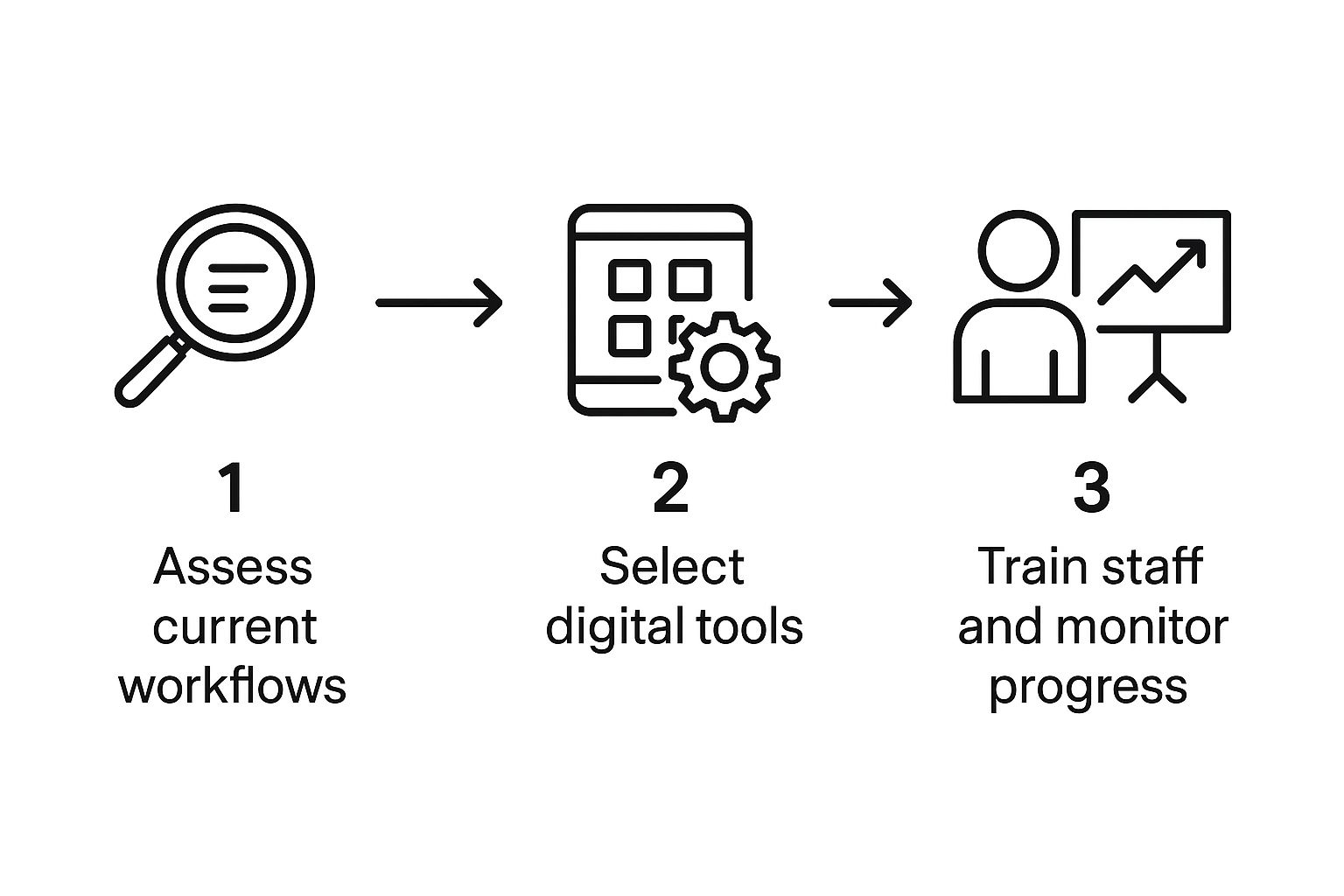
The key takeaway here is that real change starts with assessment, not with buying new software. This ensures that any money you spend is going toward solving actual problems.
Let's break this down into five straightforward, actionable steps.
Step 1: Figure Out Your Starting Point
Before you can map out a route to your destination, you have to know exactly where you're standing. The first step is to take an honest look at your current processes, tools, and all the little things that cause headaches. Don't even think about solutions yet—just observe.
Get your team together and ask some simple questions:
- What manual tasks eat up the most time every week?
- Where are we losing customers or making them frustrated?
- Which processes would completely fall apart if one specific person was out sick?
- What information do we always wish we had at our fingertips but can't get to easily?
The goal here is to create a list of bottlenecks and opportunities. You might find that your invoicing process is a black hole for time, or that customer questions from your website are getting lost in the shuffle. This audit gives you a clear, prioritized list of problems that need fixing.
Step 2: Set Crystal-Clear Goals
Okay, you've got your list of problems. Now you can set some specific, measurable goals. Vague ideas like "be more efficient" are useless. Instead, tie your goals directly to the pain points you just uncovered.
Good, solid goals sound like this:
- Cut down the time we spend on invoicing by 50% in the next three months.
- Increase online appointment bookings by 20% in six months.
- Get our customer response time for all web inquiries under one hour.
These kinds of goals give you a clear definition of what success looks like. They give your team a finish line to run toward and make it obvious whether your efforts are actually paying off.
A goal without a number attached to it is just a wish. By defining specific outcomes, you turn a vague idea about "going digital" into a concrete business plan.
Step 3: Pick Your Battles (and Your Projects)
You now have a list of problems and a set of clear goals. Next up is prioritizing. Not all projects are created equal. You're looking for the "quick wins"—the things that will make a big difference without a ton of effort or cash.
Try using an Impact/Effort Matrix to sort through your ideas. A project that saves ten hours a week (high impact) but only needs you to sign up for a free or cheap software trial (low effort) should go straight to the top of your list. Nailing these first builds momentum and shows everyone on your team that this is worth doing.
Step 4: Roll It Out and Train Your Team
Once you've picked your first project, it's go-time. This part is just as much about people as it is about technology. Just dropping a new tool on your team without proper training is a surefire way to watch it fail.
For a smooth rollout, make sure you do these things:
- Explain the "Why": Let your team know how this new tool will make their jobs easier, not just give them one more thing to do.
- Provide Real Training: Don't just email a link to a help page. Set aside time for everyone to learn the new system together.
- Name a Champion: Pick one person to be the go-to expert for the new tool. This gives the rest of the team a single person to turn to for help.
Your team’s buy-in is the single most important factor. If they see the benefits and feel confident using the new tools, the changes you make will actually stick.
Step 5: Measure, Analyze, and Adjust
This whole process isn't a one-and-done project; it’s a continuous cycle of getting better. After you've launched a new tool or process, the final step is to look back at the goals you set in Step 2.
Are you hitting your numbers? Use the analytics inside your new tools to see what's happening. If you wanted to slash invoicing time, measure it. If you wanted more online bookings, check the stats. The data doesn't lie—it will tell you what’s working and what isn’t.
This is definitely a long-term play, but the payoff is worth it. In fact, three-quarters of CEOs expect to see significant business results from their digital initiatives within three to five years, which shows how critical it is for staying competitive. You can read more about how leaders are approaching this and what small businesses need to know about keeping up with digital advances.
Use what you learn to make adjustments. Maybe a tool isn't the right fit, or maybe your team just needs a bit more training. The ability to measure, analyze, and pivot based on real data is what ensures your digital transformation creates lasting value.
Navigating Common Roadblocks on Your Digital Journey
While the upsides of going digital are huge, let's be honest—the path isn't always smooth. Every big project has its challenges, and knowing what they are ahead of time can be the difference between getting stuck and breaking through.
For most small business owners, the roadblocks aren’t some complex technical glitch. They're the practical, everyday hurdles we all face: tight budgets, not enough tech expertise on the team, and that good old-fashioned resistance to change. The good news? None of these have to stop you in your tracks.
Overcoming Budget Constraints
One of the biggest myths I hear is that digital transformation costs a fortune. That's just not true. You don't need a massive, Silicon Valley-style budget to make real, impactful changes. It’s all about being smart and focusing on what gives you the most bang for your buck.
Instead of dreaming about expensive custom software, start with the amazing tools that are already out there, many of which are free.
- Embrace "Freemium" Tools: A lot of fantastic software companies offer free starter plans that are more than enough for a small team. Think about using HubSpot for customer management, Mailchimp for email newsletters, or Trello for organizing projects. You can get so much done without spending a dime.
- Chase High-Impact Wins: Where should you put your first few dollars? Focus on the one thing that will either save you the most time or make you the most money, fast. Automating your invoicing, for example, directly impacts your cash flow and frees up hours of administrative work.
- Think Small Steps, Not Giant Leaps: A successful digital transformation for small business rarely happens overnight. It's usually a series of small, smart, affordable upgrades that build on each other over time.
Bridging the In-House Skills Gap
"But I don't have a tech genius on my team!" I hear this all the time. Here's the secret: you don't need one. Modern business software is built for regular people, not programmers. The explosion of "no-code" and "low-code" platforms means you can create powerful systems and automate workflows without writing a single line of code.
When you're looking for tools, prioritize ones with a reputation for being user-friendly and having great customer support. Most software-as-a-service (SaaS) companies know their success is tied to yours, so they pack their services with tutorials, live chat help, and onboarding guides.
The goal isn't to become a tech expert yourself. It's to become an expert at choosing intuitive tools that empower your existing team to work smarter.
Managing Employee Resistance to Change
This might just be the trickiest part of all—the people. Change is uncomfortable. Your team has a way of doing things, and even if it's inefficient, it's familiar. Just dropping a new piece of software on them and saying "use this now" is a guaranteed recipe for failure.
The key is to frame the change around how it benefits them, not just the company's bottom line.
- "No More Tedious Work": Explain how a new tool will get rid of that mind-numbing data entry they dread every week.
- "Fewer Annoying Meetings": Show them how a project management tool means less time spent chasing down files and updates.
- "Helping You Hit Your Goals": Connect a new sales CRM directly to their ability to close more deals and earn a bigger commission.
It all comes down to trust. Get your team involved in picking the tools. Ask for their opinions. When you roll something out, celebrate the small wins together. When people see new technology as something that helps them succeed, they'll become its biggest advocates. In the end, navigating these and other small business marketing challenges is always about clear communication and putting your people first.
Real-World Wins: How Small Businesses Are Nailing Digital Transformation
It’s one thing to talk about digital transformation, but it’s another thing to see it in action. These stories aren't about Silicon Valley giants; they're about regular small businesses that used smart, accessible tech to get incredible results. Each one faced a common roadblock, found a digital path forward, and saw a real impact on their bottom line.
This isn't just a trend—it's a massive global movement. In fact, spending on digital transformation is projected to reach an eye-watering $3.9 trillion by 2027, with much of that growth powered by new AI tools. It’s a clear sign that businesses of all sizes are getting on board, and you can learn more about how they are keeping up with these digital advances to stay in the game.
Let’s dive into a few examples of what this looks like on the ground.
The Neighborhood Bakery That Doubled Its Revenue
-
The Problem: A fantastic local bakery was completely dependent on walk-in customers. If people were too busy to swing by, sales took a nosedive. They had no system for pre-orders and no way to connect with anyone who wasn't physically standing outside their shop.
-
The Digital Fix: They set up a simple e-commerce site using a platform like Shopify. Suddenly, customers could see the daily specials online, pre-order custom cakes, and even get their favorite pastries delivered locally.
-
The Bottom Line: It was a game-changer. Within just six months, online orders made up nearly 40% of their total sales. The bakery didn't just get through a slow period—it doubled its annual revenue simply by opening a digital front door.
The HVAC Contractor Who Got 10 Hours Back Every Week
-
The Problem: A one-man HVAC operation was getting buried in paperwork. Every evening was spent juggling schedules, making reminder calls, and trying to track down payments. There was absolutely no time left to think about growing the business.
-
The Digital Fix: He signed up for an affordable field service management app. The software put his scheduling on autopilot, automatically sent text reminders to clients, and let him take credit card payments right on the spot as soon as a job was done.
-
The Bottom Line: The automation immediately saved him over 10 hours of admin work every single week. On top of that, missed appointments fell by a staggering 90%, and his cash flow went through the roof because he was getting paid instantly.
The Boutique Agency That Broke Through Local Barriers
-
The Problem: A small but talented creative agency felt stuck working only with local clients. Trying to manage projects with a patchwork of emails and spreadsheets was a chaotic mess, making it impossible to take on bigger jobs from clients further afield.
-
The Digital Fix: They moved their entire workflow into a cloud-based project management tool like Asana or Trello. This gave everyone—the team, freelancers, and clients—a single, organized hub for every project, no matter where they were located.
-
The Bottom Line: With their new system, the agency went from local to nationwide, landing three major out-of-state contracts in the first year alone. Their internal efficiency shot up, allowing them to take on 50% more projects without hiring a single new person.
Got Questions About Digital Transformation? We've Got Answers.
Stepping into something new always brings up questions. It's only natural. Here are some clear, straightforward answers to the things we hear most often from small business owners, designed to help you feel confident about moving forward.
How Can I Start Digital Transformation on a Tight Budget?
You don't need deep pockets to get started. Honestly, the smartest way to begin is by focusing on small, high-impact changes that solve a real problem you're facing right now.
-
Look for free tools first: There's a surprising number of powerful platforms with "freemium" plans that are perfect for getting started. Think about using Google Analytics for website insights, Mailchimp for email campaigns, or a free version of a CRM like Zoho to organize customer info. They give you a ton of value without costing a dime.
-
Solve one big headache: Instead of trying to overhaul everything at once, pick your biggest pain point. Are you spending hours every week on invoicing? Find a simple, affordable tool to automate that. The time you get back is an immediate return on your investment.
Do I Need to Be a Tech Expert to Succeed?
Not at all. This is a common myth. Your success with digital transformation for small business isn't about being a coder; it's about having a clear strategy. You already have the most important asset: a deep understanding of your business and your customers.
The good news is that most modern software is built for business owners, not IT wizards. These tools are designed to be user-friendly, often with drag-and-drop features and helpful support teams. Your job is to know what problem you need to solve, not how the software that solves it was built.
Your strategy matters more than your technical ability. Knowing why you're adopting a new tool is infinitely more important than knowing how that tool was built.
How Long Until I See Real Results From These Changes?
This is a great question, and the answer depends on what you're trying to achieve. It helps to think about results in two buckets: quick wins and long-term gains.
You can see some results almost immediately. For example, setting up an online appointment scheduler can cut down on phone tag and reduce no-shows within the first week. Automating your billing process can improve your cash flow from day one. These are the quick wins that build momentum.
Other goals, like establishing a strong brand online or collecting enough data to make accurate business forecasts, are more of a slow burn. These strategic efforts pay off over months, not days, but they are what ultimately create a stronger, more profitable business. The trick is to be consistent and patient.
Ready to turn these questions into a solid plan? At ReachLabs.ai, our team specializes in creating data-driven digital strategies that actually work. We'll handle the technical side so you can stay focused on what you do best—running your business. Explore our services and start your journey today.