
Before you even think about searching for a digital marketing agency, you need to do some homework first. It’s tempting to just start Googling, but that’s a recipe for getting overwhelmed by flashy sales pitches. The real first step is to get crystal clear on two things: what you actually want to achieve, and how much you’re prepared to invest to get there.
Getting this internal clarity right from the start is your secret weapon. It acts as a filter, helping you instantly spot the agencies that are a good fit and ignore the ones that aren’t.
First Things First: Define What Success Looks Like

You can’t hire the right partner if you don’t know where you’re going. I’ve seen it time and time again: businesses start their search with vague wishes like “we need more traffic” or “we should do more on social media.” Those aren’t goals; they’re daydreams. They’re impossible to measure and, frankly, set both you and your future agency up for a frustrating partnership.
The process of finding a great agency starts with looking inward. You need to translate those broad business ambitions into a specific, actionable brief that a potential partner can actually sink their teeth into.
Turn Vague Ideas into Concrete Objectives
Your job is to transform those fuzzy wishes into SMART goals—that classic framework of Specific, Measurable, Achievable, Relevant, and Time-bound. It’s a simple but powerful way to force the detail needed to turn a hope into a real business objective.
Let’s look at a couple of real-world examples of this transformation:
- Vague: “We want to improve our SEO.”
- Concrete: “We need to increase qualified B2B leads from organic search by 25% within the next six months.”
- Vague: “We need some help with social media.”
- Concrete: “Our goal is to grow our Instagram engagement rate by 3% and generate 50 direct sales from the platform each quarter.”
See the difference? This level of clarity is a non-negotiable. It immediately tells you which agencies to talk to (and which to ignore) and gives everyone a clear benchmark for what success will look like.
A well-defined brief is your most powerful negotiation tool. When you know exactly what you need, you can have direct, no-fluff conversations about capabilities and ROI. It helps you sidestep the agencies that just want to sell you a pre-packaged, one-size-fits-all solution.
Set a Marketing Budget You Can Stand Behind
The second part of your internal audit is all about the money. The question “how much does a digital marketing agency cost?” has no single answer because it’s entirely tied to your goals. You can’t expect to dominate a competitive national market on a budget that’s better suited for a local pizza shop.
Think of your budget as a true investment, not just another line-item expense. To land on a realistic number, you need to factor in a few things:
- Your Growth Goals: Are you aiming for the moon? Aggressive targets, like doubling your lead flow in a year, are going to require a much bigger investment than slow, steady growth.
- Customer Lifetime Value (CLV): You have to know what a new customer is actually worth to your business. This number is critical for figuring out a reasonable cost per acquisition (CPA) and justifying your marketing spend.
- Industry Reality Check: Do a little digging. Find out what similar companies in your space are typically investing in their marketing. This will give you a sanity check on your own numbers.
Having a clear budget range in mind—say, $3,000 to $5,000 per month—does more than just prepare you for sales calls. It empowers you. You can quickly disqualify agencies that are way out of your league or, just as importantly, those whose prices seem too good to be true.
When you walk into a conversation with clear goals and a defined budget, the dynamic shifts completely. You’re no longer just a potential client; you’re a prepared partner, ready to have a strategic discussion about getting real results.
Vet an Agency’s Real-World Expertise and Results
Every agency website is a highlight reel. They’ll all tell you they’re innovative, data-driven experts. Your job is to cut through the marketing fluff and find the hard proof. This means getting past their sales pitch and digging into their actual track record.
The best way to predict future success is to look at past performance, especially when it looks a lot like your own business challenges. When you’re figuring out how to choose a digital marketing agency, this is where you separate the real specialists from the generalists who just hired a good copywriter.
Look for Relevant Case Studies, Not Just Impressive Ones
It’s easy to be impressed by a flashy campaign for a global sneaker brand, but if you’re a B2B SaaS company, that success story means next to nothing for you. Don’t get star-struck by big names; instead, hunt through their portfolio for clients that look like you.
Look for proof of success in these key areas:
- Similar Industry: Have they actually worked in your market? An agency that’s brilliant at e-commerce might be totally lost with the long sales cycles common in industrial manufacturing.
- Similar Business Size: A strategy that works for a Fortune 500 company with an eye-watering budget is often useless for a startup. You need an agency that has a history of getting results for businesses at your scale.
- Similar Goals: If you need leads, a case study bragging about brand awareness metrics like impressions and social media followers is a big red flag. Find proof they can move the specific needle you care about.
Once you find a relevant case study, don’t just skim it. What was the original problem? What, specifically, did they do to fix it? And most importantly, what were the quantifiable results? You want to see things like a 35% increase in qualified leads or a 50% reduction in cost-per-acquisition.
Pro Tip: If an agency’s case studies feel vague or are filled with vanity metrics, ask them for more detailed examples that apply to your industry. A confident agency with real results won’t hesitate to share specifics (while respecting client confidentiality, of course).
Verify Certifications and Partnerships
Official badges from major platforms aren’t just for show—they’re a strong signal of an agency’s skill and commitment. They prove the agency has met tough standards and has a direct line to the platforms you’ll be using.
Think of these as a verified level of expertise. Here are some of the most important ones to look for:
- Google Premier Partner: This is a big deal. It’s an exclusive status given to the top 3% of participating companies each year, signaling serious expertise in managing Google Ads.
- HubSpot Solutions Partner: Essential if you use or plan to use HubSpot. This certification proves they know their way around inbound marketing, sales, and service on the platform.
- Meta Business Partner: This program from the parent company of Facebook and Instagram gives agencies access to better support, tools, and training. It’s a huge advantage for running effective campaigns.
These partnerships often mean the agency gets early access to beta features, dedicated support teams, and continuous training. That translates directly into better campaign performance and smarter strategies for your business. For a more detailed breakdown of what to look for, our guide on how to choose a marketing agency offers additional insights into evaluating these credentials.
Prioritize Specialization Over a Jack-of-All-Trades
It might seem counterintuitive, but be wary of the agency that claims to do everything for everyone. More often than not, they’re a master of none. A massive, diverse portfolio can sometimes be a sign that they lack deep, focused expertise.
Think about it. A full-service agency might offer SEO, PPC, social media, and web design. A niche specialist, on the other hand, might only do SEO for dental practices. If you’re a dentist, which one would you choose?
A specialized agency already knows your industry, understands your audience’s unique problems, and knows which strategies work in your specific market. They’ve already made the mistakes and learned the lessons on someone else’s dime, meaning they can get you results faster and more efficiently. Don’t shy away from an agency with a narrow focus—it’s often their greatest strength.
Decoding Agency Pricing And Measuring True ROI
Sooner or later, every conversation about hiring a digital marketing agency lands on the big question: what’s it going to cost? But here’s the thing—getting fixated on the price tag is a classic mistake. The real mission is to understand the value behind that number and figure out how the investment will actually fuel your business growth.
Trying to make sense of agency pricing models can feel like you’re learning a new language. Each one has its own logic, its own pros and cons, and the best fit for you depends entirely on your specific goals, your budget, and how you like to work. The key is to shift your mindset from “cost” to “investment.”
This is a great breakdown of the most common pricing models you’ll run into.
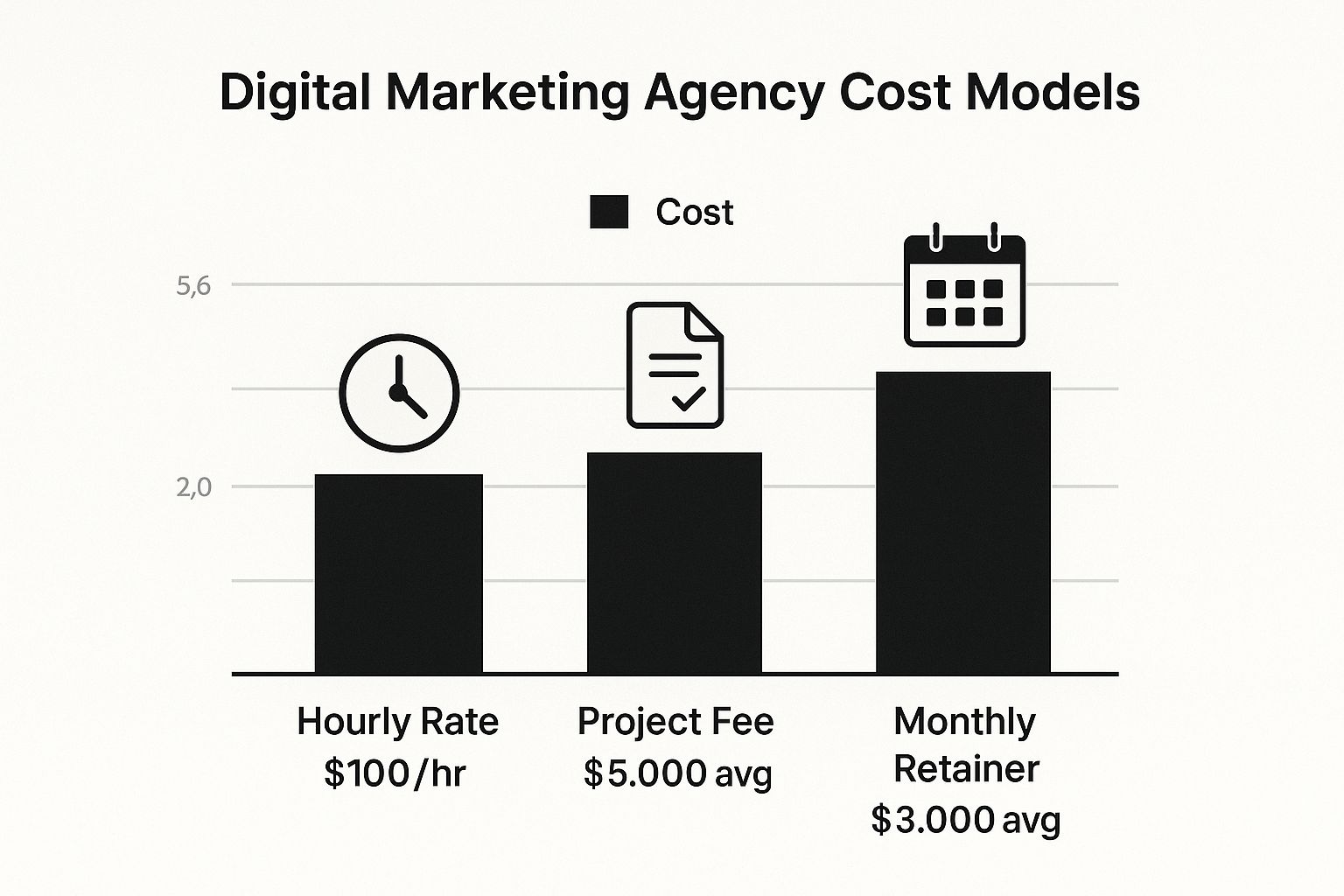
As you can see, there’s a model for pretty much every need, whether it’s the flexibility of hourly rates for quick tasks or the stability of a monthly retainer for your long-term strategy.
Common Digital Marketing Agency Pricing Models
Most agencies stick to a few standard pricing structures. Getting a handle on how they work will help you quickly spot the one that lines up with your company’s financial planning and operational rhythm.
I’ve put together a table that breaks down the three big ones you’re most likely to encounter.
| Pricing Model | How It Works | Best For | Key Consideration |
|---|---|---|---|
| Monthly Retainer | You pay a fixed fee each month for an agreed-upon scope of work, like SEO, content, or social media management. | Long-term, ongoing partnerships where consistency is key. Think of it as having an outsourced marketing team. | Scope creep. Be crystal clear on what’s included to avoid surprise costs or over-servicing that burns out the agency. |
| Project-Based Fee | A one-time, flat fee for a specific, well-defined project. Examples include a website redesign or a new product launch campaign. | Businesses with clear, finite objectives. It’s also a fantastic way to “test drive” an agency before committing to a longer-term relationship. | The project scope must be incredibly detailed upfront. Any changes or additions will likely mean a new quote and more costs. |
| Performance-Based | The agency’s pay is directly tied to hitting specific KPIs, like leads generated, sales closed, or revenue targets. | Companies with a high-stakes campaign and a crystal-clear understanding of their sales funnel and customer value. | It’s a high-risk, high-reward model. The agency needs deep access to your data, and you both have to agree on attribution. |
Each of these has its place. The retainer gives you predictability, the project fee offers control for one-off needs, and the performance model ties agency success directly to your bottom line.
How To Evaluate Value Beyond The Price Tag
Let me be clear: a lower price is rarely a better deal. A cheap agency that delivers zero results is infinitely more expensive than a pricier partner that generates a massive return. The trick is to ask smart questions that connect their fees to real business outcomes.
When an agency hands you a proposal, don’t just skip to the total at the end. You need to get under the hood.
Here’s what I’d be asking:
- “Can you walk me through how this retainer is allocated? I want to see the breakdown across activities and team members.”
- “What specific metrics will we be looking at to track progress toward the goals we discussed?”
- “Based on your work with clients like us, what’s a realistic ROAS (return on ad spend) we can expect in the first six months?”
A great agency doesn’t just sell you a list of services; they sell you outcomes. Their pricing should be a direct reflection of the value and results they plan to deliver, not just a timesheet for the tasks they’ll complete.
It also helps to have a little outside context. Industry benchmarks can give you a reality check on whether a quote is fair. For instance, data from the 2025 Digital Agency Industry Report reveals that 28% of agencies bumped up their hourly rates from 2024 to 2025. Today, about 36% are charging between $175 and $199 per hour. You can find more of these agency pricing trends from Promethean Research.
At the end of the day, this is all about building a partnership focused on growth. A transparent, honest conversation about money is the very first step. By understanding the models and focusing on the link between what you pay and what you get, you’ll be in a great position to choose a partner who truly delivers.
For a deeper dive, check out our guide on how to calculate marketing ROI and measure the real impact of your investment.
Peek Behind the Curtain: What’s in Their Tech Stack?

Let’s be honest, brilliant ideas only get you so far. These days, top-tier marketing is built on a solid foundation of technology. The agency you hire shouldn’t just be aware of the latest tools; they need to be actively using them to find deep insights, work smarter, and give you a genuine edge over the competition.
Think of it this way: an agency wrestling with outdated, clunky software is spending more time fighting their tools than focusing on your campaigns. You need a partner whose tech stack is a launchpad for great results, not a roadblock.
The Essential Tools You Need to Ask About
When you’re vetting agencies, don’t hesitate to ask them to pop the hood on their tech stack. Their answers will tell you a lot about how sophisticated they are and whether they invest in the right resources to get the job done.
A modern, well-equipped agency will be proud to walk you through the platforms they rely on. Here’s what you should be digging into:
- Analytics & Reporting: How are they pulling all your data together? Are they using advanced dashboards to create a single, clear picture of performance, or are you just getting screenshots from Google Analytics?
- SEO Software: What are they using for keyword research, rank tracking, and deep technical audits? You want to hear names like Semrush, Ahrefs, or Moz Pro.
- Project Management: How will you stay in the loop and track progress? A dedicated system like Asana, Trello, or Monday.com signals that they take organization and transparent communication seriously.
- Automation Platforms: If lead nurturing is on your radar, what tools are they masters of? Deep expertise in platforms like HubSpot, Marketo, or Pardot is a must for executing complex campaigns.
The specific brand of tool is less important than their philosophy. A great agency uses technology to automate the repetitive, time-consuming tasks, which frees up their human experts to focus on the high-level strategy that actually moves the needle for your business.
Don’t Forget to Talk About AI
Beyond the standard martech stack, the conversation absolutely must include Artificial Intelligence. AI isn’t some far-off concept anymore; it’s a core component of high-performance marketing. From personalizing customer experiences at scale to predicting what they’ll do next, AI-powered tools are now essential for staying competitive.
The impact of AI, especially in search, is massive. Some experts predict AI-driven activities will account for 75% of all marketing work by 2025. With Google’s AI-powered search results now in front of over 1 billion users, the game has changed. We’re seeing organic click-through rates drop from around 50% down to the 28-30% range.
Any agency that isn’t already weaving AI into its daily workflow is operating in the past. They need to be able to show you exactly how they use AI to make your campaigns better, not just talk about it in vague terms.
This means you need to ask pointed questions. How are they using generative AI for content ideas or ad copy variations? Are they using machine learning to build smarter audience segments? An agency that can give you clear, real-world examples is one that truly gets it.
Naturally, this level of investment in technology is a factor in cost. Our breakdown of digital marketing agency price ranges can give you a better sense of what to expect from proposals.
Dig Into Their Reputation and Client Relationships

Any agency can put together a slick sales deck. It’s designed to impress. But that’s only one side of the story.
To really get a feel for who you’re about to partner with, you need to step outside their polished presentation and see what people are saying in the real world. This is where you’ll uncover the truth about how they treat their clients, how well they communicate, and whether they actually deliver on their promises.
Think of it as essential due diligence. It’s how you find a reliable partner, not just a vendor who’s good at selling themselves. You’re looking for unbiased proof that they can walk the walk.
Go Beyond Website Testimonials
The testimonials on an agency’s website? They’re always going to be glowing. No one posts a bad review of themselves. For a more balanced, honest perspective, you need to head to independent review platforms where clients can share the good, the bad, and the ugly.
These sites give you a much clearer picture of an agency’s strengths and—just as importantly—their weaknesses.
- Clutch and G2: These are my go-to platforms for B2B vetting. They often conduct verified interviews with clients, so you get detailed, unfiltered feedback on project management, actual results, and what it’s like to work with the team day-to-day.
- Google Reviews: A quick Google search for the agency is surprisingly revealing. Don’t just glance at the star rating. Pay close attention to how the agency responds to feedback, especially the negative comments. A defensive or dismissive reply is a huge red flag, while a professional, constructive response is a great sign.
While you’re reading, look for patterns. If five different clients mention stellar communication and proactive ideas, you can probably trust it. On the other hand, if you see repeated complaints about missed deadlines or vague reporting, you know what you need to know.
Ask Their Client References the Right Questions
When an agency gives you a list of references, don’t waste the opportunity with generic questions. This is your chance to get a behind-the-scenes look at what it’s really like to be their client. You want to understand their process, not just their final results.
Skip “Are you happy with them?” and dig deeper with questions that get to the heart of the partnership:
- On Communication: “How responsive is your day-to-day contact? Can you walk me through their reporting process and how they share both wins and setbacks?”
- On Strategy: “Can you tell me about a time they brought a new, proactive idea to the table? Or a time they had to pivot strategy? How did they handle it?”
- On Problem-Solving: “Have you ever had a disagreement or faced a major challenge during a campaign? How did the agency manage that situation?”
- On the Big Picture: “What’s the single best thing about working with them? And what’s one area you think they could improve?”
An agency’s true character isn’t revealed when everything is going perfectly. It’s shown when challenges pop up. How they navigate friction is one of the most reliable indicators of a healthy, long-term partnership.
Gauge Their Industry Authority and Influence
A truly great agency doesn’t just run campaigns; they’re part of the industry conversation. Their public presence tells you a lot about their expertise and whether they’re genuinely passionate about their craft. A team that’s actively engaged in its field is far more likely to be on top of the latest trends.
Look for signs that they’re respected thought leaders. Do they publish insightful articles on their blog? Do their team members speak at industry conferences or host webinars? Often, an agency’s own marketing is the best portfolio they have.
Consider this: 76% of social media users say content from other users influences their purchasing decisions. That number jumps to a staggering 90% for Gen Z, a group where 41% now turn to social media first for information. You can dig into more of these Gen Z consumer trends on Marketing Dive. An agency that not only knows these stats but actively demonstrates this understanding in its own content is proving its capability in real-time.
Frequently Asked Questions About Choosing an Agency
You’ve done the research, sat through the presentations, and reviewed the proposals. But even after all that, a few nagging questions probably remain. That’s completely normal. Hiring a marketing agency is a big commitment, and you want to be absolutely sure before you sign anything.
Think of this as your final gut check. We’ve pulled together the most common questions we hear from businesses right before they make their final decision. Our goal is to give you the clear, straightforward answers you need to move forward with confidence.
What’s a Typical Digital Marketing Agency Contract Length?
Most reputable agencies will propose an initial contract of 6 or 12 months. I know that can feel like a long time to commit, but there’s a solid reason for it. Real, impactful marketing—especially anything involving SEO or content marketing—doesn’t happen overnight. It takes time to build momentum and deliver the results you’re paying for.
Some agencies might offer a 3-month trial, but honestly, that’s barely enough time to get everything set up and running. The first couple of months are always about discovery, planning, and campaign launches. You usually start seeing the needle truly move around the 4- to 6-month mark.
A word of caution: be wary of agencies that require no contract at all. The “month-to-month” flexibility sounds great on the surface, but it can signal a lack of confidence in their ability to deliver results that make you want to stay. A contract is there to protect both parties and set clear expectations.
What Should I Expect During the Onboarding Process?
A seamless onboarding process is one of the best signs you’ve picked a well-oiled machine. If the first few weeks are chaotic, you can probably expect the rest of the relationship to be disorganized, too.
While the exact steps vary, any solid onboarding experience will include these key milestones:
- A Kickoff Meeting: This is ground zero. It’s where you’ll meet the team, get aligned on the big-picture goals, and walk through the roadmap for the first 90 days. Everyone should leave this meeting on the same page.
- Sharing Access & Credentials: They’ll need to get into your core systems—think Google Analytics, your website’s backend, and social media profiles. A professional agency will have a secure, documented process for handling this sensitive information.
- Deep-Dive Questionnaires: Prepare to answer a lot of questions. They’ll want to know everything about your brand, your ideal customer, your competitors, and what you’ve tried in the past. This deep dive is what allows them to build a strategy that’s actually tailored to you.
- Setting the Communication Rhythm: You’ll figure out the schedule for regular check-ins, when to expect reports, and who your main point of contact is. Clear and consistent communication is the bedrock of a good agency partnership.
This whole process usually takes anywhere from one to three weeks. A great agency makes it feel like a collaborative workshop, not homework.
What Are the Biggest Red Flags to Watch Out For?
Knowing what to look for is only half the battle when you’re figuring out how to choose a digital marketing agency; knowing what to run from is just as critical. Some warning signs are subtle, but others are giant, flashing alarms.
Here are the top red flags that should give you serious pause:
- “We Guarantee a #1 Ranking on Google!”
This is the oldest, most tired line in the book—and it’s an impossible promise. No one can guarantee a specific ranking on Google. A legitimate expert will talk about improving your overall visibility and driving the right kind of traffic, not making empty promises. - Vague or Fluffy Reporting
If their sample reports are filled with vanity metrics (like impressions or clicks) but don’t tie back to business goals (like leads, sales, or revenue), that’s a problem. You need a partner who is obsessed with outcomes, not just activity. - High-Pressure Sales Tactics
An agency rushing you with a “special offer that expires today” is more focused on hitting their sales numbers than on helping you hit yours. A true partner gives you the space you need to make a smart decision. - A Lack of Transparency
Are they cagey about who is on their team? Do they deflect when you ask about their process or pricing structure? A great relationship is built on trust, and that starts with being open and honest from day one.
At the end of the day, trust your gut. If a conversation feels off or their answers seem evasive, there’s usually a reason. The right agency will feel less like a vendor and more like an extension of your own team.
At ReachLabs.ai, we build partnerships on a foundation of transparency and a relentless focus on measurable results. Our specialists are here to design and execute a marketing strategy that directly impacts your bottom line.
Ready to see what a dedicated, data-driven team can do for your brand? Explore our services and get in touch today.