

Data-driven content marketing is really just the practice of using hard data—not your gut feelings—to figure out every piece of your content strategy. It’s all about understanding what your audience truly wants, how they want to get it, and when they’re most receptive. This turns your content from a creative shot in the dark into a reliable growth machine.
Why Your Content Needs a Data-Driven Strategy

Let’s be real for a second. The old “publish and pray” approach just doesn’t cut it anymore. We’re living in a world completely saturated with information, so just throwing content out there and hoping something sticks is a surefire way to waste time and money. This is exactly where a data-driven mindset changes everything.
Think of it like a master chef in the kitchen. They don’t just randomly toss ingredients into a pan and hope for the best. They follow a meticulously tested recipe, measuring every component to get a perfect result, time and time again. Data is that recipe for your content. It gives you the structure, the insights, and the direction to cook up something your audience will actually love.
This kind of systematic approach pulls you out of the world of intuition and hunches. Instead of guessing which topics might resonate, you’re using real-world information to make solid decisions. It’s the difference between creating content you think your audience wants and creating content you know they need.
The Shift From Guesswork to Certainty
Making this transition isn’t just some new trend; it’s a fundamental business necessity. The pressure to prove ROI and connect what we do in marketing to real business outcomes has never been higher. A data-driven content marketing strategy gives you the framework to do exactly that.
This shift is picking up speed across the entire industry. By 2025, 64% of marketing executives strongly agree that data-driven marketing is crucial to their success. This highlights just how central it’s become. A big part of this change is also driven by new privacy rules that make it harder to rely on third-party data, forcing us all to get smarter with the information we can ethically collect. You can dig deeper into these marketing trends to see how the whole environment is evolving.
At its core, data-driven content marketing is about making smarter, evidence-based choices. It empowers you to build a content engine that consistently delivers value to both your audience and your bottom line.
By fully embracing this way of thinking, you can:
- Increase Relevance: Deliver content that speaks directly to the pain points, questions, and interests of the people you’re trying to reach.
- Improve Performance: Tweak and optimize your content based on what’s actually working—from the headlines you write to the channels you use to share it.
- Demonstrate Value: Clearly measure the impact of your content and tie your efforts directly back to business goals like generating leads and closing sales.
In the end, this isn’t just another buzzword. It’s a strategic must-do for any business that’s serious about getting real, repeatable results from their content.
The Four Pillars of Actionable Content Data

When marketers hear the word “data,” it’s easy to picture a labyrinth of spreadsheets and charts. But it doesn’t have to be that complicated. Truly effective, data-driven content marketing is about focusing on the right information to answer a few critical questions.
Think of it like building a sturdy table—you need four solid legs for it to be balanced and useful. These four “legs” are the pillars of your content data. Each one gives you a different piece of the puzzle, and together, they create a complete picture to guide every piece of content you create.
Let’s break them down.
Pillar 1: Audience Data
This first pillar tackles the most important question of all: Who are you actually talking to? If you don’t have a crystal-clear answer, even the most amazing content will just be noise. Audience data helps you move beyond generic buyer personas and into a real, nuanced understanding of your customers.
What are their biggest headaches? Do they prefer watching a quick video or reading a deep-dive article? What emotional triggers actually get them to act? This is the kind of gold you can mine from audience data.
You can learn things like:
- Demographics: The basics like age, location, and job title help frame your message.
- Behavioral Insights: How do people actually use your website? Which pages do they love, and where do they get stuck and leave?
- Psychographics: This gets to the “why” behind their actions—their values, interests, and pain points.
By pulling this information from tools like Google Analytics, customer surveys, or your CRM, you can create content that feels like it was written just for them.
Pillar 2: Performance Data
Okay, so you know your audience. The next question is: Is our content actually working? Performance data is your direct feedback loop. It tells you what’s hitting the mark and what’s falling flat, so you stop wasting time and money on ideas that go nowhere.
This is where you have to look past “vanity metrics” that feel good but don’t tell you anything useful. Sure, getting a lot of likes is nice, but it doesn’t pay the bills.
“Vanity metrics may make you feel good, but they don’t offer clear guidance for what to do next.” — Eric Ries, author of The Lean Startup
Instead, you need to focus on data that shows real engagement and progress toward your goals. Performance data will show you which blog posts are bringing in qualified leads, which social media campaigns are driving traffic, and which videos keep people glued to their screens.
Pillar 3: SEO Data
The third pillar helps you look into the future by answering: What is my audience searching for right now? While performance data is a look in the rearview mirror, SEO data uncovers new opportunities by revealing the exact words and phrases your audience is typing into Google.
This is the absolute cornerstone of a great data-driven content marketing plan because it connects your content directly to what people need. When you understand search trends, keyword popularity, and the specific questions people are asking, you can create content that search engines are eager to rank.
Tools like Semrush or Ahrefs are fantastic for this. They help you pinpoint topics with high demand, letting you step in and become the go-to resource. To see how this fits into the larger puzzle, it’s worth exploring a complete data-driven marketing strategy to understand the full context.
Pillar 4: Competitive Data
And finally, our fourth pillar answers the question: What can we learn from everyone else? Believe it or not, your competitors are one of your best sources of data. Analyzing their content can show you where the gaps are in the market, shine a light on topics you’ve missed, and reveal what’s already working with your shared audience.
This isn’t about copying them. It’s about smart reconnaissance to find your own unique advantage.
- Find Content Gaps: What keywords are they ranking for that you’re completely missing?
- Identify Their Winners: Which of their articles get the most traffic and backlinks?
- Analyze Distribution: Where are they promoting their content and getting traction?
By keeping an eye on the competitive landscape, you can make smarter decisions, set your brand apart, and create content that’s not just good—it’s better than the other options out there.
These four pillars give you a 360-degree view, turning content creation from a guessing game into a predictable, results-driven engine for growth.
To bring it all together, here’s a quick summary of how these four pillars work.
The Four Pillars of Content Data
This table breaks down each pillar, the core question it helps you answer, and where you can find the data.
| Data Pillar | Key Question It Answers | Example Metrics or Tools |
|---|---|---|
| Audience | Who are you actually talking to? | Google Analytics, CRM data, Customer Surveys, User Personas |
| Performance | What content is actually working? | Conversion rates, Bounce Rate, Time on Page, Social Shares |
| SEO | What is my audience searching for? | Keyword Rankings, Search Volume (from Semrush, Ahrefs) |
| Competitive | What can I learn from others? | Backlink Analysis, Competitor Top Pages, Content Gap Tools |
Each pillar provides a unique and essential perspective. When you use them all together, you have a powerful framework for making consistently smart content decisions.
Turning Raw Data into a Winning Content Plan
Collecting data is like gathering ingredients. You can have the best, freshest produce in the world, but if you don’t know how to cook, you’re just left with a pile of vegetables. The real skill is knowing how to turn that raw information into a strategic content plan that actually drives results. That’s where data-driven content marketing really shines.
Without a solid process, it’s easy to get buried in spreadsheets and dashboards. You end up with “analysis paralysis”—so stuck on the numbers that you never actually do anything with them. The goal is to build a reliable bridge from insight to execution. It doesn’t need to be overly complicated, just consistent.
Here’s a simple look at how the workflow breaks down, moving from raw data to a finished plan.
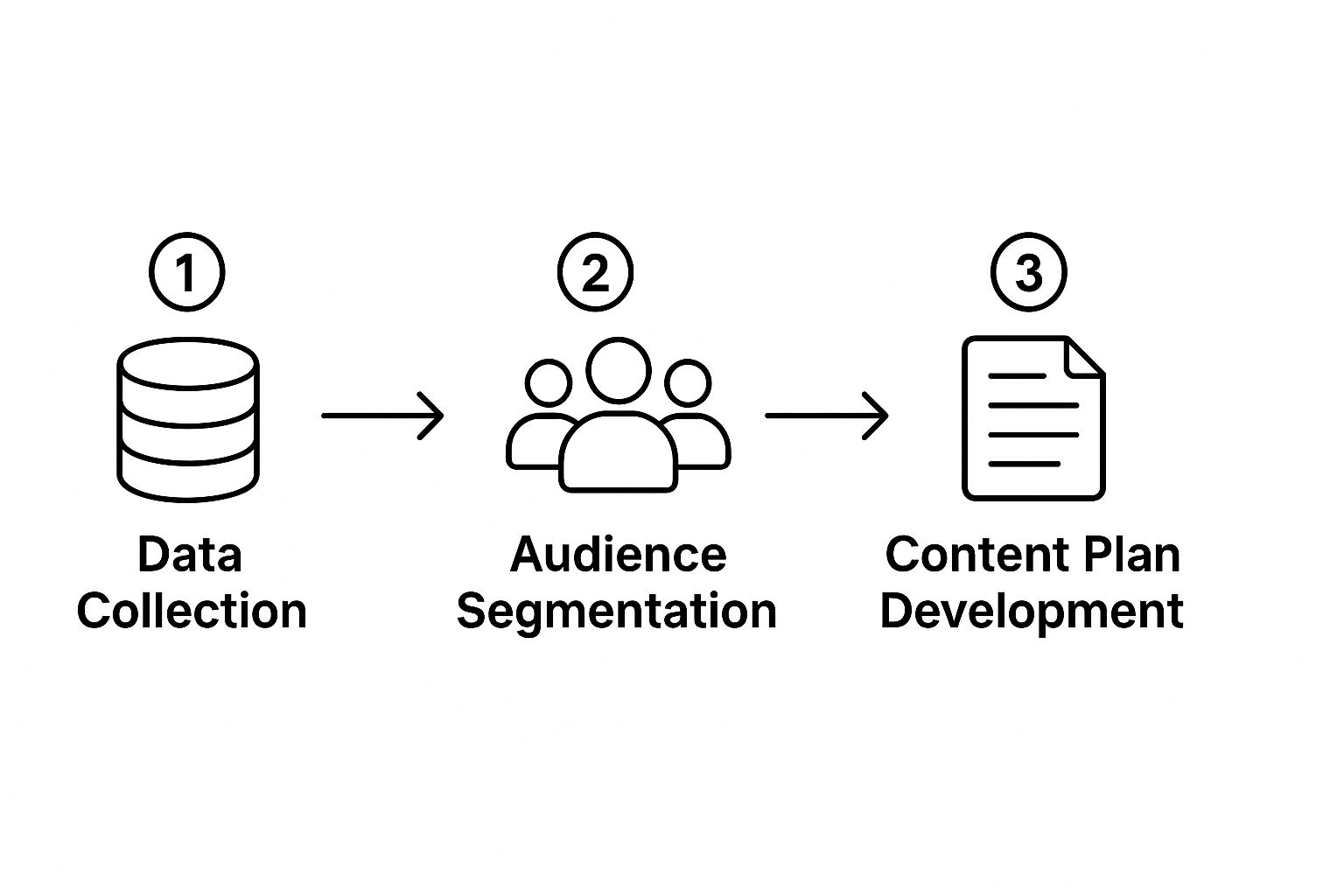
As you can see, everything starts with data and a clear understanding of your audience. Those foundational elements directly shape the strategic plan, creating a logical path from what you know to what you do.
Stage 1: Start with Data-Informed Goals
Before you even glance at a metric, you have to know what you’re trying to achieve. Vague goals like “get more traffic” just don’t cut it. A data-driven approach is all about specifics.
For example, let’s say you review your analytics and notice your “commercial plumbing services” page gets decent traffic, but almost everyone leaves immediately. That’s a clear data point.
Instead of a generic goal, you can now set a data-informed one: “Reduce the bounce rate on the commercial plumbing page by 15% in the next quarter by adding more in-depth, problem-solving content.” Now you have a target that’s specific, measurable, and tied directly to a real problem.
Stage 2: Gather and Synthesize the Right Information
With a clear goal locked in, you can gather data with a purpose. Don’t boil the ocean by looking at every metric available. Focus only on the information that relates directly to your objective.
For our plumbing company example, you’d pull together:
- Performance Data: What’s the current bounce rate? How long are people actually staying on the page?
- Audience Data: Who is visiting this page? Dig into Google Analytics to see if they’re from a specific industry or location.
- SEO Data: What search terms are bringing people here? Are we missing obvious keywords related to “how-to” guides or “cost” breakdowns?
- Competitive Data: How do the top-ranking competitors structure their commercial plumbing pages? What topics are they covering that we aren’t?
This focused approach keeps you from getting overwhelmed. You aren’t just collecting numbers for the sake of it; you’re gathering evidence to solve a specific business problem.
A winning content plan is built on a foundation of questions. The data doesn’t provide the answers directly; it helps you ask smarter questions that lead to effective content.
Stage 3: Brainstorm Content Ideas with Confidence
This is where the magic happens. Your synthesized data becomes the fuel for real content ideas. Instead of guessing what your audience wants, you’re brainstorming from a position of strength, grounded in hard evidence.
Based on the data we gathered for our plumbing business, some clear ideas start to take shape:
- A detailed guide: “The Complete Checklist for Commercial Plumbing Maintenance.” This hits on potential long-tail keywords and offers immediate value.
- A case study: “How We Saved XYZ Restaurant $10,000 in Emergency Repair Costs.” This leverages customer success to build trust and prove your expertise.
- An infographic: “5 Common Signs of Impending Commercial Pipe Failure.” This is a perfect, shareable asset for attracting backlinks and social media attention.
See how each idea is a direct answer to the insights you uncovered? You’re no longer just throwing things at the wall to see what sticks.
Stage 4: Create and Optimize Based on Evidence
With your data-backed ideas ready to go, the actual creation process is so much smoother. You already know which keywords to target, what questions your audience is asking, and which formats are most likely to work.
As you build out the “Complete Checklist” guide, you would:
- Incorporate SEO Data: Weave the primary and secondary keywords you found during your research into the text naturally.
- Use Competitive Insights: Make sure your guide is more comprehensive and easier to read than the ones currently ranking at the top.
- Leverage Audience Data: Write in a tone that speaks directly to a facility manager or restaurant owner—whoever your analytics showed was your core visitor.
Stage 5: Distribute and Measure Intelligently
A data-driven plan doesn’t stop once you hit “publish.” Use your audience data to figure out the best places to promote your content. If you know your target audience hangs out on LinkedIn, put your energy there, not on Instagram.
After the launch, the cycle begins again. You have to measure the performance of your new content against the specific goal you set in Stage 1. Did the bounce rate on the commercial plumbing page actually go down? Did the new guide bring in any qualified leads?
This new data becomes the starting point for your next initiative, creating a powerful, continuous loop of improvement.
Your Data-Driven Content Marketing Toolkit

Any great strategy is only as good as the tools you use to bring it to life. But building a tech stack for data-driven content marketing doesn’t mean you need a dozen expensive, complicated platforms. The real key is choosing a select few that work together to give you a complete picture of your audience and performance.
Think of it like a builder’s tool belt. You don’t need every tool ever made, just the right ones for the job—a hammer for framing, a saw for cutting, and a level to make sure everything lines up. Your content toolkit works the same way, with each tool playing a distinct but essential role in building a solid content program.
This is your guide to assembling a powerful, manageable toolkit. We’ll break down the essentials into categories so you can see how they all fit together, helping you make smarter decisions at every stage.
Analytics Platforms That Reveal User Behavior
First things first: you have to know what people are actually doing on your website. Analytics platforms are the bedrock of any data-driven effort, acting as your source of truth for user behavior.
Google Analytics 4 (GA4) is the undisputed industry standard here, and it’s a non-negotiable part of your setup. It’s free yet incredibly powerful, helping you answer the most critical questions:
- Which blog posts are drawing the most attention?
- Where is your most engaged traffic coming from?
- Which pages are causing visitors to bounce?
Getting answers to these questions is fundamental. The insights you pull from GA4 tell you what’s truly connecting with your audience and where you can focus your efforts for the biggest wins.
SEO Tools for Search and Competitive Insights
While analytics tools show you what’s happening on your own turf, SEO platforms pull back the curtain on the entire search landscape. They are your eyes and ears, helping you spot new opportunities and size up the competition.
Heavy-hitters like Semrush and Ahrefs lead the pack in this space. They empower you to perform the essential research that fuels a winning content plan.
With a solid SEO tool, you’re no longer guessing what your audience wants. You can see the exact questions they’re typing into search engines, allowing you to create content that meets their needs in that perfect moment of discovery.
Specifically, these platforms help you:
- Conduct Keyword Research: Find the actual phrases and terms your audience uses to search for solutions.
- Analyze Competitors: See what’s working for others by identifying the keywords and content driving their traffic.
- Identify Content Gaps: Discover valuable topics your competitors are ranking for that you haven’t even touched yet.
Audience Insight and Content Optimization Tools
The final piece of your toolkit involves platforms that bring you closer to your audience and help polish your content for maximum impact. This is where you can get really specific with your strategy.
SparkToro, for instance, is a fantastic audience research tool. It helps you uncover what your audience reads, watches, and follows online, giving you rich qualitative data to inform your content’s tone, style, and distribution channels.
Then there are the AI-powered content optimization platforms, which have become a game-changer. It’s predicted that by 2025, over 80% of marketers globally will incorporate AI into their strategies. We’re already seeing this shift, with 85% of B2B marketers now using generative AI and 42% of them using it for content creation. You can find more on these AI-driven content marketing statistics.
These tools help you turn a good idea into a great, high-performing piece of content. For a deeper dive into crafting exceptional articles, be sure to check out our guide on content marketing best practices.
By combining these different types of tools, you create a system that constantly feeds you insights, helping you refine and improve with every single piece you publish.
Proving Your Content’s Value to the Business
Creating great content is only half the battle. If you can’t show how your work actually helps the business grow, it will always be seen as a cost center, not a revenue driver. A data-driven content marketing approach is your best friend here, helping you draw a straight line from a blog post to a signed contract.
Many marketers fall into the trap of tracking vanity metrics—numbers that look good in a report but don’t mean much for the bottom line. Sure, high page views or a bunch of social media likes feel great, but they don’t answer the one question your stakeholders really care about: “Did this make us any money?”
To get to that answer, you have to start tracking metrics that truly matter.
From Vanity Metrics to Impact Metrics
The secret is to build a measurement framework that tells the whole story, from the very first click to the final sale. It’s about following the user’s entire journey, not just celebrating the fact that they showed up. This changes the conversation from “how many people saw our content?” to “how many qualified leads did it bring in?”
Here’s a simple way to think about what you should be prioritizing:
- Instead of Page Views: Look at the Conversion Rate on your content pages. Are visitors actually taking the next step you want them to, like downloading an ebook or signing up for a webinar?
- Instead of Social Likes: Measure the Click-Through Rate (CTR) on your calls-to-action. Are people moving from your content to a high-value product or service page?
- Instead of Time on Page: Zero in on Lead Generation. How many Marketing Qualified Leads (MQLs) did that specific article produce this month?
This simple shift is critical. It reframes the entire narrative around your work and gives you concrete evidence of its value. For a deeper dive, our guide on the ROI of content marketing walks you through exactly how to calculate these figures.
The ultimate goal is to prove that your content isn’t just attracting an audience—it’s attracting the right audience and guiding them toward a purchase.
Building a Simple Performance Dashboard
You don’t need some wildly complicated system to prove your content’s worth. A straightforward dashboard, even one built in a simple spreadsheet, can tell a powerful story about your impact. The whole point is to create a clear, visual narrative that connects what your content is doing directly to what the business wants to achieve.
Your dashboard should answer three fundamental questions:
- Attraction: Which articles, guides, or videos are bringing in the most relevant traffic?
- Conversion: Which pieces are best at turning those visitors into actual leads?
- Revenue: Which content has had a hand in closing the most deals?
When you track these key data points over time, you build an undeniable case for your strategy. And this data-first mindset is paying off for others, too. In 2025, a whopping 58% of B2B marketers reported that their content marketing directly led to increased sales and revenue. On top of that, nearly half (41%) now measure their content’s success primarily through sales metrics. You can read more on how data-informed content fuels financial success and see where the industry is heading.
Ultimately, proving your value is about speaking the language of business. When you can walk into a meeting and confidently say, “Our content strategy last quarter generated 75 qualified leads and influenced $150,000 in new business,” you’re no longer just a creative—you’re an essential driver of growth.
Common Questions About Data-Driven Content
Shifting to a new strategy always stirs up a few questions. Moving from gut feelings to data-backed insights is a big step, but it doesn’t have to be overwhelming. Let’s walk through some of the most common concerns and misconceptions marketers have, so you can move forward with confidence.
This isn’t about flipping a switch overnight. It’s about making smarter, more deliberate decisions, no matter the size of your team or budget.
How Can a Small Business Get Started with a Limited Budget?
You don’t need a huge software budget to start making smarter content decisions. The trick is to get scrappy with the powerful, free tools you already have access to and focus on what will make the biggest difference.
Start with the basics: Google Analytics and Google Search Console. These two platforms cost nothing and give you a goldmine of information. You can see who’s visiting your site, how they’re finding you, and which content they actually care about. This is your foundation.
Once you have that, you can get direct feedback without spending a dime.
- Whip up simple surveys with Google Forms to ask your customers what their biggest headaches are.
- Dig through customer service emails and support tickets. What questions pop up again and again?
- Read reviews—not just for your products, but for your competitors’ too. What do people genuinely love or hate?
The best way to start is to think small. Pick one clear goal—say, getting more traffic to your most important service page—and use the data you have to make that one thing better. Smart decisions don’t need expensive tools, just a clear focus.
Does Using Data in Content Creation Kill Creativity?
This is probably the biggest myth out there. There’s a fear that if you lean too heavily on data, you’ll suck the soul out of your work and end up with robotic, paint-by-numbers content. But the opposite is true.
Think of data as the canvas and frame for your art. Data tells you the size of the canvas (how many people care about this topic), the shape of the frame (the format they like), and the colors that will resonate most (their specific pain points). Creativity is the masterpiece you paint within those guardrails.
Data gives you the strategic direction so your creative energy isn’t wasted on a brilliant idea that nobody is looking for. It confirms an audience is waiting for what you have to say. Your creativity is what makes the final piece memorable and uniquely yours. Data just makes sure your brilliant ideas actually find the right people.
What Are the Most Common Mistakes to Avoid?
When you start working with data, it’s easy to fall into a few common traps. Knowing what they are ahead of time will help you turn data into an advantage instead of a source of frustration.
Keep these four missteps in mind:
- Analysis Paralysis: This is the big one. You get so caught up in collecting and organizing data that you never actually do anything with it. The goal isn’t a perfect report; it’s an actionable insight.
- Ignoring Qualitative Data: If you only look at numbers like traffic and bounce rate, you miss the “why” behind what people are doing. The real story is often in the qualitative stuff—the survey responses, reviews, and customer feedback that give numbers their human context.
- Falling for Confirmation Bias: We all do it. We naturally look for data that proves what we already think is true. A real data-driven approach means being willing to challenge your own assumptions, even if the data points you in a totally new direction.
- Inconsistent Measurement: If you’re tracking different metrics every month or constantly changing what “success” looks like, you’ll never see the big picture. Define your key performance indicators (KPIs) from the start and stick with them. Only then can you track real progress over time.
How Long Does It Take to See Real Results?
Patience is key in content marketing, especially when you’re building a strategy on data. While you can see some encouraging signs pretty quickly, the kind of results that really impact the business take time to build. Think of it as a long-term investment, not a quick fix.
You can expect to see leading indicators within the first 2-3 months. This could be things like better keyword rankings, higher engagement on your new articles, or more organic traffic to key pages. These are the green shoots that tell you you’re on the right path.
However, the bottom-line results that prove your ROI—like a real lift in qualified leads or new customers from your content—typically take 6-12 months to become clear and consistent. The effort compounds, so sticking with it is far more important than getting everything perfect right away.
Ready to stop guessing and start growing with a content strategy built on real insights? At ReachLabs.ai, we combine world-class talent with a data-first approach to create marketing that moves the needle. Discover how our tailored digital strategies can elevate your brand and drive measurable results. Learn more at ReachLabs.ai.