
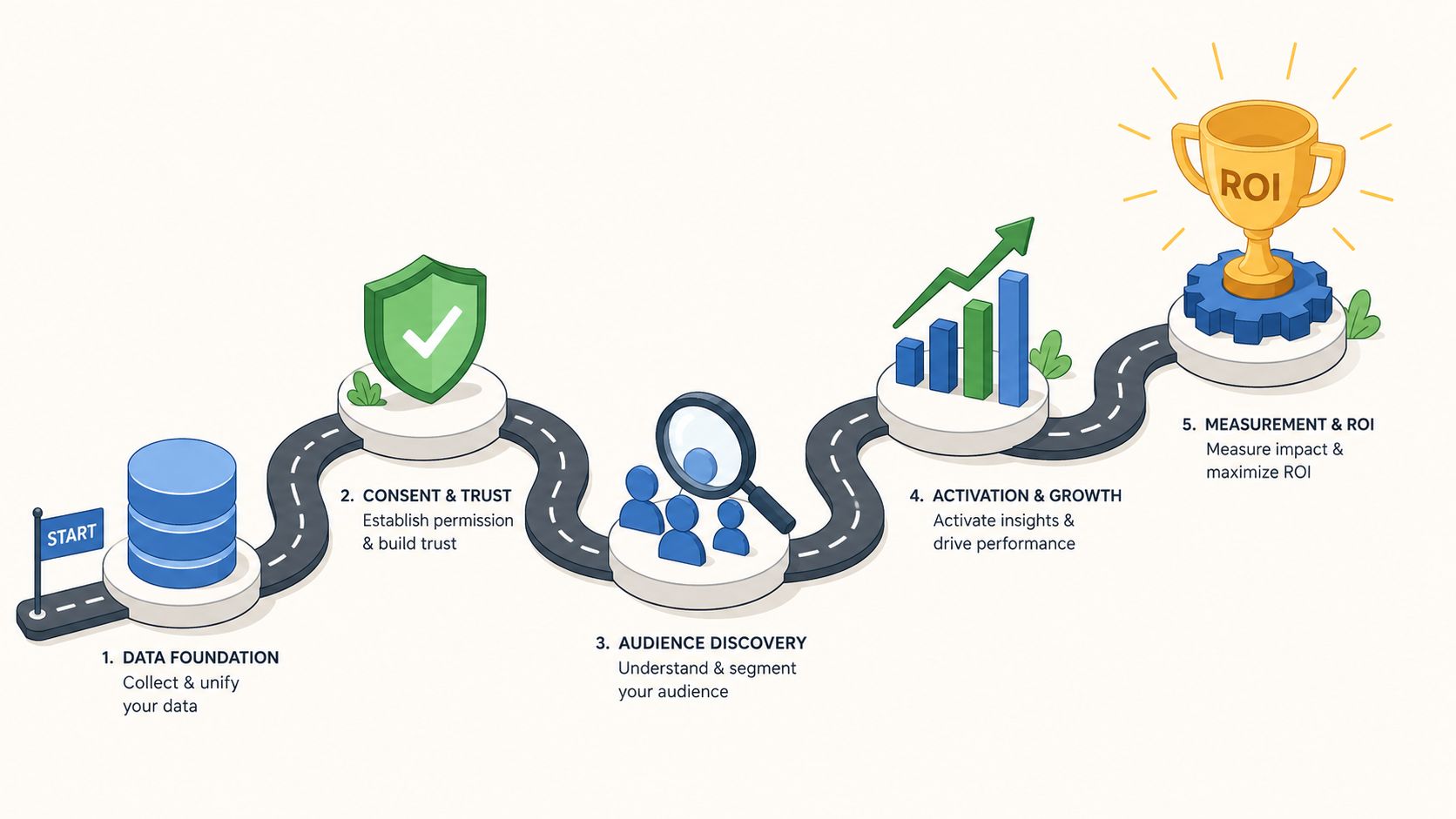
A first party data strategy stopped being optional when 71% of brands, agencies, and publishers were already growing or planning to grow their first-party datasets in 2024, up from 41% two years earlier, according to the IAB data cited in OmniBound's first-party data statistics roundup. That shift matters because the problem isn't collecting more signals, it's turning those signals into usable audiences, cleaner measurement, and campaigns that still work when third-party cookies get unreliable.

Still get stuck in the same place. They build forms, add tracking, centralize records, and then wonder why paid media, CRM, and analytics still disagree about what happened. The gap isn't data collection, it's activation. If the audience can't be matched, segmented, or measured consistently, the program becomes a storage project with a privacy label on it.
A useful way to think about the shift is operational, not philosophical. A mature first party data strategy starts with owned signal, but it ends with how teams use that signal across ad platforms, lifecycle marketing, and reporting. If you want a practical lens for turning data into revenue motion, the RevOps perspective in activate first party data in RevOps is a good complement to the marketing view, because the ownership problem usually cuts across both functions.
Why First Party Data Strategy Became a Business Imperative
The strategic pressure is real, but the real story is operational. Marketing teams, paid media teams, and analysts now need the same customer signal to do different jobs, and if that signal is not structured well, every handoff breaks somewhere. A first party data strategy matters because it creates a shared system for targeting, measurement, and lifecycle work, not because it adds another storage layer.
What changed was the operating environment. Third-party cookie reliability dropped, privacy expectations hardened, and platform-level signals became harder to trust at face value. Teams that kept relying on borrowed audiences and modeled attribution ran into the same problem in every channel, they could not consistently prove who the customer was, what action mattered, or which system owned the next step. The brands that adapted fastest rebuilt the flow from collection to activation, and they did it with tighter definitions, clearer ownership, and fewer guesses.
The strategic break point
The mistake is treating first-party data like a form-filling exercise. Teams add more fields, collect more opt-ins, and assume the value will show up later. It usually doesn't, because no one defines what the data should do downstream.
Practical rule: if a field doesn't map to a campaign, a lifecycle trigger, or a measurement use case, it's probably clutter.
The stronger programs look like operating systems because the work is shared. Marketing owns the use cases, analytics owns the definitions, engineering owns the pipes, and compliance owns the permissions. Each group works from the same source map, not its own version of the truth, which is why teams that invest in marketing data integration usually get cleaner handoffs than teams that only add more collection points.
That is where the business case gets concrete. Owned data gives you a stable signal layer when platforms shift, reporting gets noisy, or paid media needs a cleaner matchback. The companies that win here are rarely the ones with the biggest database. They are the ones with the clearest path from customer interaction to decision, and with RevOps aligned early enough to keep activation from turning into a pile of disconnected exports. If you want the operational side of that alignment, the framework for activate first party data in RevOps is the right companion to the marketing plan.
Auditing Your Collection Touchpoints and Data Schema
Before you activate anything, you need a plain-language inventory of what's being collected, where it lives, and whether it's usable. Teams often discover too late that they have plenty of records, but no consistent schema. That's how you end up with a CRM that knows a contact exists, a web stack that knows they visited, and a paid media team that can't match them back to anything useful.

Start with sources, not platforms
A one-page data-source map is enough to begin. List each touchpoint, the event or field it produces, who owns it, and what it supports. For ecommerce, that might include product view, add-to-cart, checkout start, order completed, and email capture. For B2B, the useful touchpoints are usually demo request, pricing page visit, webinar registration, content download, and sales inquiry.
The most common mistake is overcollecting at the top of the funnel and undercollecting at the point of intent. Teams add optional fields to top-of-funnel forms because they're easy to request, then wonder why downstream segments are weak. Better to collect fewer fields at a moment of real value exchange, then preserve them cleanly across systems.
A simple filter helps. Ask whether each field improves one of three things, audience creation, campaign routing, or measurement fidelity. If it doesn't, it's probably not part of the minimum viable schema yet.
Use a schema that can survive activation
The schema has to work for both marketing and analytics, which means it should be boring on purpose. Standardize identifiers, event names, timestamps, consent flags, and source tags. If a record can't be joined, deduplicated, or filtered by consent status, it's not ready for activation.
The article at Marketing data integration at ReachLabs is relevant here because the hardest part is rarely the existence of data. It's the mismatch between systems. Marketing wants segments, analytics wants precision, and engineering wants a stable event model. A good schema reduces all three forms of friction at once.
The B2B side usually needs less breadth than teams expect. A smaller schema with reliable identity, role, company, stage, and engagement depth often outperforms a sprawling one with weak field hygiene. In ecommerce, deterministic order and product events carry more weight than a long trail of soft signals.
If data is going to be shared across teams, it also has to be clean enough for contact-level use. That's where a validation layer becomes useful, especially around email quality and consent-ready records. Tools like Email Validation API are worth considering when deliverability and record hygiene are affecting segment quality, because bad addresses create noise that looks like poor audience strategy.
Audit for duplicates and dead fields
Once the map is in place, identify where the same attribute is captured multiple times with different names, formats, or owners. That's where schema bloat starts. Also flag fields that were added for a campaign long ago and never removed, because dead fields create false confidence and slow everyone down.
A clean audit does two things. It shows you what to keep, and it shows you what to stop pretending is strategic. If marketing, product, and analytics can't agree on the minimum schema, the downstream activation work will keep failing in the same places.
Building Consent Architecture and Server-Side Tracking
Consent has to be built into the data path, not bolted on at the banner. If the consent layer is vague, inconsistent, or easy to bypass, the whole system becomes risky fast. The practical goal is simple, capture only what users have agreed to share, and preserve that decision through every downstream destination.
A strong consent model starts with clear purpose text, a persistent consent state, and downstream enforcement. When someone opts in or out, that state needs to travel with the event, the profile, and the audience export. If the consent flag gets lost between the website, the CDP, and the ad platform, you've created compliance debt and measurement gaps at the same time.
For a lightweight starting point, the Static Forms consent templates are useful because they make the legal language easier to structure before you customize it for your stack and jurisdiction.
Move critical signals server-side
Client-side pixels are still useful, but they're no longer reliable enough as the only source of truth. Browsers, ad blockers, and consent restrictions can all suppress events before marketing ever sees them. Server-side tracking helps preserve higher-confidence events by sending them from your infrastructure instead of depending entirely on the browser.
That doesn't mean every event should move server-side on day one. Start with the signals that matter most for identity, conversion, and audience creation, then expand outward. The best candidates are usually form submits, purchases, account events, and lifecycle milestones.
Server-side collection is less about more tracking and more about durable tracking.
Fix the failure points that quietly drop data
The common implementation errors are painfully ordinary. Consent gets stored in one place and ignored elsewhere. Event names differ by platform. Identity keys get dropped during handoff. Timestamp formats drift. One team uses raw email, another uses hashed email, and a third uses a customer ID nobody else can read.
That's why governance matters as much as configuration. Put a weekly or biweekly review on the calendar with marketing ops, analytics, and engineering. Review consent coverage, event loss, and destination routing. If a change goes live without that review loop, the pipeline usually starts leaking in places nobody notices until campaign performance dips.
Event-stream collection helps here because it forces teams to think in terms of durable signals rather than page tags alone. The win isn't theoretical privacy compliance, it's better signal continuity when the browser layer gets messy.
Modeling Audiences and Activating Campaigns
First party data strategy either proves itself or gets ignored. The fastest way to waste good data is to build segments that sound smart internally but don't map to how buyers move. A useful segment should point to a specific audience, a specific channel, and a specific action.
The internal guide on audience segmentation is useful context because the best first-party segments aren't demographic containers. They're operational units. A segment should tell paid media who to reach, tell lifecycle marketing who to nurture, and tell analytics what outcome to watch.
Build segments around buyer behavior
Start with buyer type and intent level. For ecommerce, that often means category viewers, cart abandoners, repeat purchasers, and high-value customers. For B2B, it may mean evaluators, decision-makers, event attendees, trial users, and sales-qualified leads. The point is to create groups that platforms can activate against.
Then define the action each segment is meant to support. Retargeting is obvious, but so are suppression, upsell, win-back, and cross-sell. If the use case isn't written down, the segment tends to drift into generic reporting instead of campaign use.
Use the right KPIs
Three activation KPIs matter most, ad-platform match rate, activated-audience share of paid spend, and first-party retargeting ROAS versus third-party retargeting ROAS. The operational benchmarks from Audiencescience's first-party data strategy guidance say 50%+ match rate is healthy for ecommerce and 30%+ for B2B, 40%+ of paid spend on first-party audiences within six months is a strong activation target, and first-party retargeting ROAS should be 1.5 to 2.5x higher than third-party retargeting if the segments and identity graph are working.
| First-Party Data Activation KPI Benchmarks | Ecommerce Target | B2B Target | Diagnostic Signal |
|---|---|---|---|
| Ad-platform match rate | 50%+ | 30%+ | Low identity quality or poor normalization |
| Activated-audience share of paid spend | 40%+ within six months | 40%+ within six months | Weak adoption or slow campaign migration |
| First-party retargeting ROAS versus third-party retargeting ROAS | 1.5 to 2.5x higher | 1.5 to 2.5x higher | Segments too broad or identity graph too weak |
If match rate is low, look first at identifiers and normalization. If spend isn't shifting, the problem is usually process, not data. If ROAS isn't improving, the segment may be too broad, too early, or too disconnected from intent.
A reverse-ETL pipeline helps when the audience needs to move from warehouse to ad platforms without manual exports. Pre-built segment templates also matter because teams rarely adopt a new activation workflow if every campaign starts from scratch. The best programs reduce friction enough that using first-party segments becomes the default, not a side project.
Why First Party Data Alone Will Not Solve Your Targeting Problems
First-party data is powerful, but it isn't magic. If the identity graph is thin, the audience is too narrow, or the data only captures one part of the journey, performance still stalls. That's why the strongest teams combine deterministic first-party signals with trusted enrichment and identity resolution, instead of expecting raw collection volume to do all the work.

Enrichment should add clarity, not noise
The question isn't whether to enrich. It's what enrichment improves. Good enrichment fills gaps in contactability, firmographics, or preference context. Bad enrichment adds speculative traits, weak provenance, or consent risk.
Recent guidance from Martech.org on why first-party data alone won't solve marketers' challenges makes the same point in practical terms, first-party data is strongest when it's combined with identity resolution, preference data, or other trusted inputs, not treated as the whole answer. That nuance matters because a clean but incomplete profile is still incomplete.
Evaluate enrichment partners on provenance, consent chain integrity, and refresh logic. If a provider can't explain where the data came from, how often it updates, or how consent travels with it, the risk is too high for serious activation.
Signal quality beats raw volume
The shift toward server-side and event-stream collection is part of the same story. Durable measurement now depends less on the number of events you capture and more on whether those events are stable, attributable, and compliant. A thousand messy events won't help if none of them can be trusted downstream.
The right mix usually looks like this. First-party data defines the core relationship, identity resolution helps connect fragments, and enrichment fills specific gaps that matter for activation. That gives marketing reach, gives analytics context, and keeps compliance from becoming an afterthought.
The wrong mix is simpler. Collect everything, enrich indiscriminately, and hope the platforms sort it out. They won't.
Avoiding the Data Graveyard and Measuring What Matters
Under-activation is the failure mode that kills most first-party programs. Data gets collected, stored, and governed, then almost never used in live campaigns. Industry research cited in Visionary Marketing's 2026 first-party data statistics summary reported a median first-party data activation rate of 34%, which means roughly two-thirds of collected data never gets used. That's not a data problem. It's an execution problem.

Build for use cases, not archives
Collection should start with a use case list. Every new field, event, or audience should answer a business question before it gets added to the pipeline. If the answer is vague, the data tends to sit idle.
Pre-built segment templates help here because they move teams from theory to action quickly. Instead of asking every marketer to define a segment from scratch, give them approved templates tied to specific outcomes, retargeting, nurture, suppression, expansion, or win-back. That reduces debate and speeds adoption.
Assign ownership to every dataset
Each dataset needs a named owner, not just a system of record. Marketing ops should own activation readiness, analytics should own definitions and measurement logic, and engineering should own pipeline reliability. Compliance should be involved in review, not stuck cleaning up after launch.
The monthly audit is the simplest governance rhythm that works. Review what was collected, what was activated, where match rates changed, and which segments got used in live spend. If a dataset stays untouched for months, it either needs a new use case or it should be retired.
Measure lift, not activity
Leadership doesn't need a report about how many fields are stored. It needs to know whether the program is changing revenue, efficiency, or competitive position. That's where attribution and incrementality matter, and the internal guide on attribution modeling is useful because activation should always connect back to business impact.
A good report tells a simple story, what was activated, what changed, and what should happen next. If first-party audiences are used but don't move spend, improve the process. If spend shifts but performance doesn't, refine the segment. If neither happens, the data is probably still trapped in the graveyard.
Your 90-Day Implementation Roadmap
The first 30 days are for foundation. Audit collection points, write the minimum viable schema, and review consent flows for gaps. Marketing, analytics, and engineering should each own a piece of the map, with one person accountable for keeping the inventory current.
Days 31 to 60 are for activation. Build the first two or three segments, push them through reverse-ETL or your activation pipeline, and launch campaigns against a defined outcome. Don't try to operationalize every use case at once, because the team needs proof that the process works before it expands.
Days 61 to 90 are for optimization. Review match rate, spend share, and retargeting performance, then decide whether to tighten the schema, improve identity resolution, or expand enrichment. That cadence turns first-party data from a project into a system.
If you can't assign an owner, define a KPI, and name the campaign that will use the data, it isn't ready to build yet.
The cleanest path is to prove value early, then scale with discipline. That's what keeps the work from turning into another overengineered stack that nobody trusts.
ReachLabs.ai helps teams turn first-party data strategy into a working operating model, not just a tracking plan. If you need marketing, analytics, and paid media aligned around schema, activation, and measurement, visit ReachLabs.ai to see how a practical execution partner can help you move from collected data to usable campaigns.