You launch a campaign with a clear goal. The targeting is solid, the offer makes sense, and the budget is approved. Then the creative arrives. It looks polished, but conversions stall. Or the opposite happens. The media team pushes campaigns live fast, but the visuals feel inconsistent, the landing page doesn't match the ad, and the sales team says the message coming through leads is all over the place.
That problem usually isn't about talent. It's a design problem inside the agency model itself.
Design is still often treated as a downstream service. Strategy happens first, media happens next, and design is told to “make it look good” at the end. Modern marketing agency design works differently. It turns design into an operating system for how strategy becomes assets, how assets become tests, and how tests become better business results.
Why Your Marketing and Design Feel Disconnected
The disconnect usually starts with how work gets briefed.
A business owner asks for a campaign. The account team writes a scope. The strategist defines audience and channel. The designer gets a few notes about tone, brand colors, and due dates. Everyone is working, but they're not working from the same decision framework. That's how you get attractive ads with weak offers, strong copy on weak landing pages, or a sales deck that doesn't resemble the campaign bringing leads in.
Where the breakdown actually happens
In practice, disconnected marketing and design often show up in a few familiar ways:
- Creative gets judged by taste: Internal feedback sounds like “make it pop” or “this needs more energy,” but nobody ties revisions to a business goal.
- Campaigns fragment across channels: Paid social, email, website, and sales collateral all say slightly different things.
- Design arrives too late: The creative team gets involved after key decisions are already locked, so they can only decorate the strategy instead of shaping it.
- Performance data never returns to creative: Designers don't see which hooks, layouts, or message structures moved pipeline.
The result is expensive confusion. Teams stay busy, but the system doesn't learn.
A better model is to treat marketing agency design as the structure that connects brand decisions, campaign execution, and commercial outcomes. That matters in a market of significant scale. The global marketing agencies market was estimated at USD 473.57 billion in 2026, with digital services accounting for 61.58% of the market, and full-service agencies projected to grow at an 11.32% CAGR according to Mordor Intelligence's marketing agencies market analysis. That points in one direction. Buyers increasingly want integrated delivery, not isolated creative services.
Practical rule: If design only starts after channel strategy is finalized, the agency has already reduced design to production.
What connected teams do differently
Connected teams brief design with business context, not just visual requirements. They tell designers what the audience needs to believe, what action matters, what objections need to be handled, and what success looks like once the campaign is live.
That shift changes everything. Design stops being a cost center that produces assets. It becomes a decision-making function that helps shape demand, clarify positioning, and improve how campaigns convert.
Defining Modern Marketing Agency Design
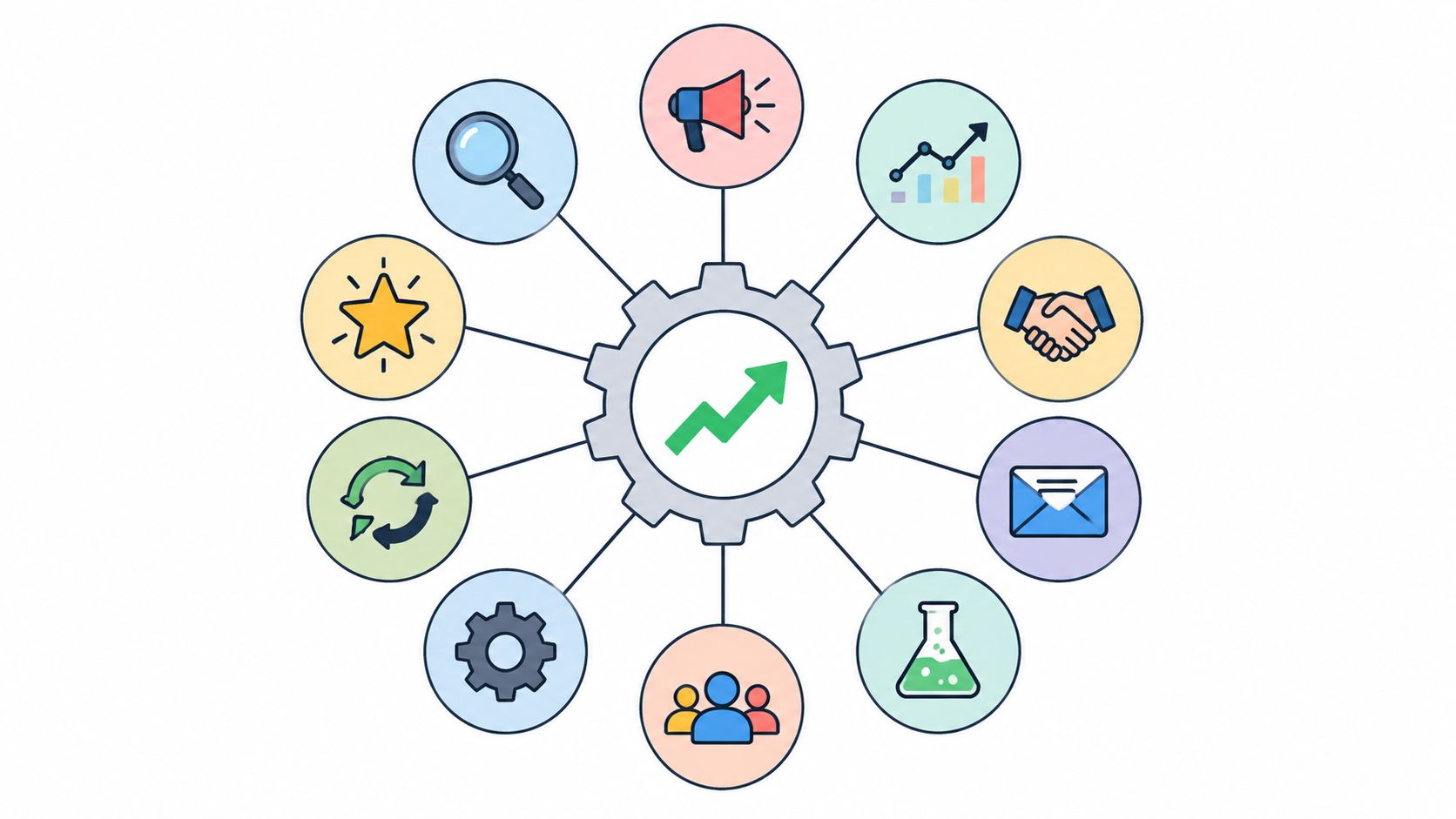
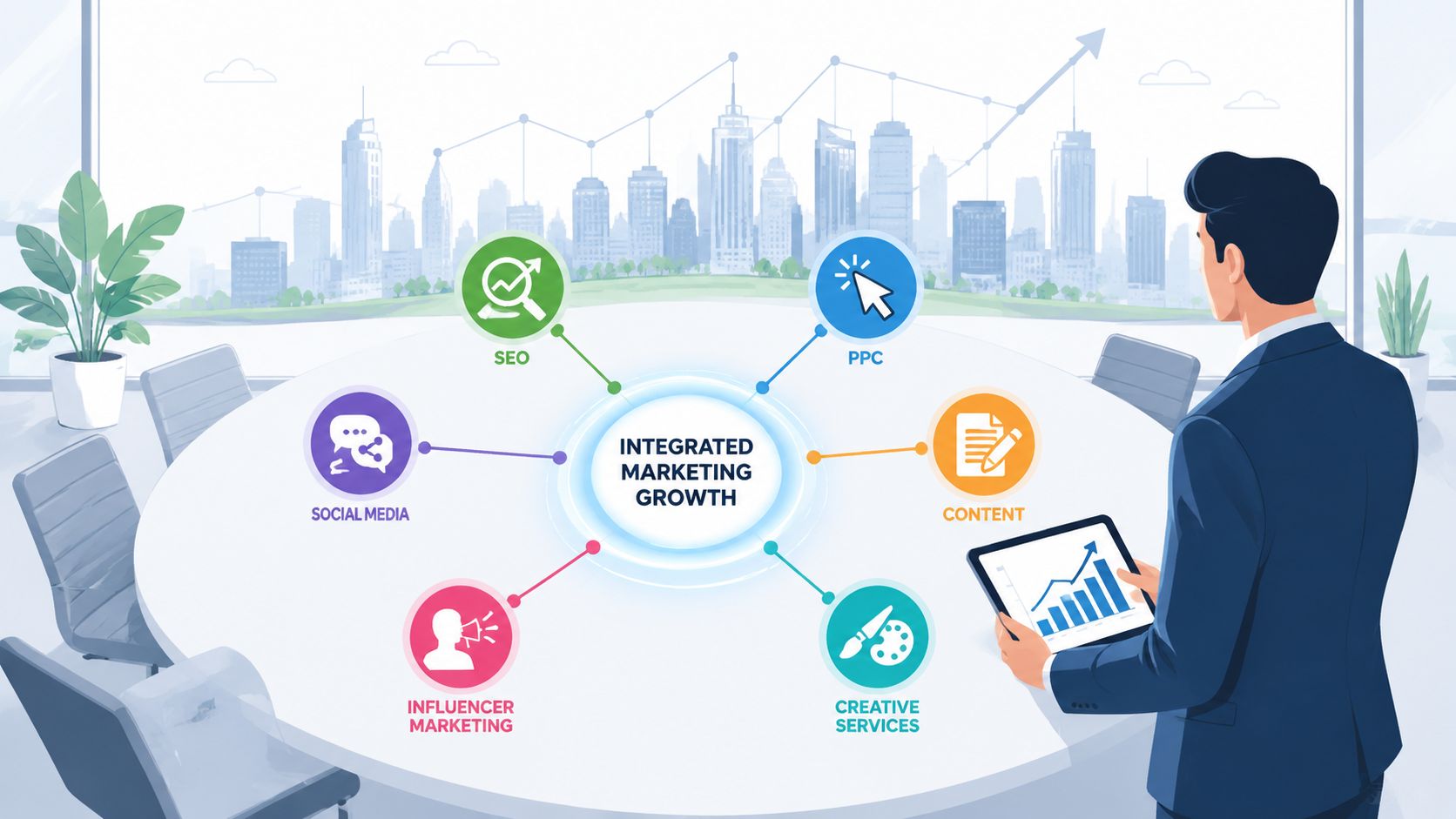
Modern marketing agency design isn't a menu of creative services. It's the blueprint an agency uses to make strategy, creative, and execution work as one system.
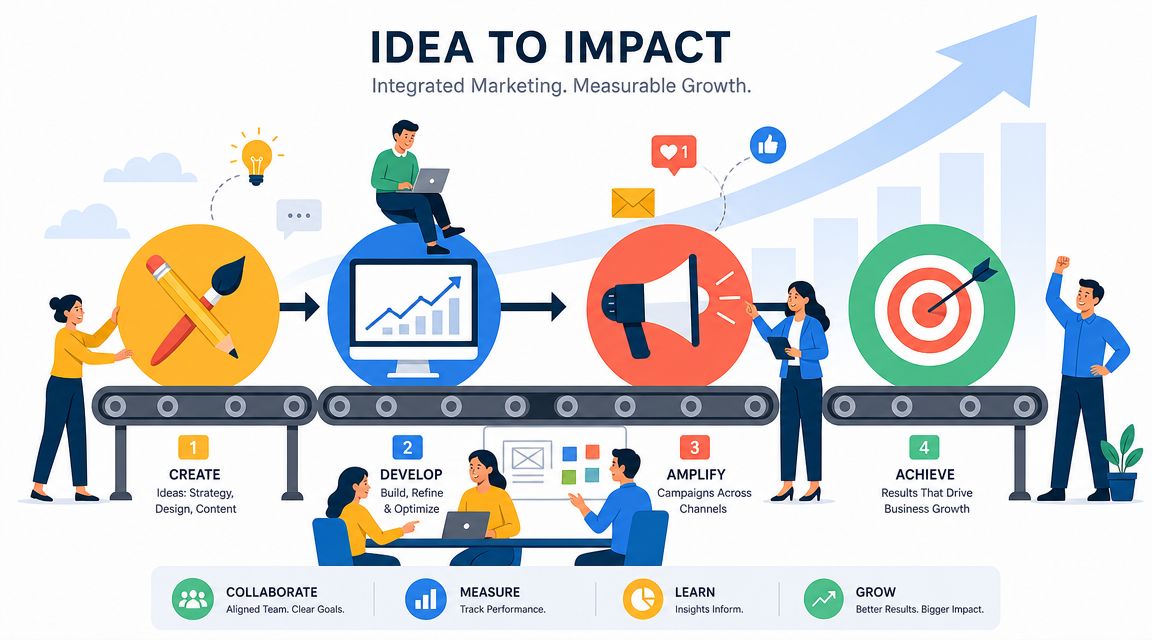
The easiest way to think about it is this. Weak agencies run design like a separate paint shop. Strategy builds the car, media drives it, and design adds color at the end. Strong agencies build an assembly line where design influences the shape of the product from the first step.
The economic logic supports that shift. The design agencies market was valued at over USD 3.1 billion in 2025 and is projected to reach USD 5.1 billion by 2035, according to Research Nester's design agencies market report. Design has its own market weight. It isn't just support work.

The three pillars that matter
A workable model usually rests on three pillars.
Strategic core
At this stage, the agency decides what the brand stands for, who it needs to persuade, and what problem the campaign is solving. Without this layer, design defaults to mood boards and trend chasing.
Typical inputs include:
- Audience clarity: pains, motivations, buying triggers, and objections
- Positioning choices: what the brand wants to be known for and what it will ignore
- Commercial priorities: pipeline quality, deal velocity, retention, or expansion
Creative execution
This is the production engine. It covers visual identity systems, ad creative, landing pages, decks, social assets, motion, and content design. But execution only works when it's governed by rules, not improvisation.
That usually means templates, modular design systems, reusable components, approval workflows, and clear file structures. Teams looking to formalize this side of the function often study how agencies structure branding and design systems so assets stay consistent across campaigns.
Performance creative
This is the part many agencies still underbuild. Performance creative asks a different question from brand design. Not “does this look on-brand?” but “does this asset increase the chance of action without breaking brand trust?”
Good design protects brand memory. Performance design also earns the click, the form fill, the demo request, or the reply.
What this definition excludes
Modern marketing agency design is not:
- A standalone design department waiting for requests
- A style guide without measurement
- A production queue disconnected from audience insight
- A collection of deliverables sold without a clear operating model
When agencies define design this way, clients stop buying “assets” and start buying a system that can produce better assets repeatedly.
Integrating Design with Marketing Strategy
The operational center of a strong agency isn't the design file. It's the brief.
Most weak briefs contain channel, deadline, dimensions, and maybe a vague objective. Strong briefs do more. They connect business goals to creative decisions before anyone opens Figma, Adobe Creative Cloud, or a landing page builder. That means the design team isn't reacting to opinions. They're responding to strategy.
Build one source of truth
A useful creative brief should answer a short set of hard questions:
| Brief element | Why it matters |
|---|---|
| Business objective | Keeps the work tied to revenue, pipeline, retention, or another concrete outcome |
| Audience and segment | Prevents generic creative that speaks to everyone and persuades no one |
| Offer and message | Forces clarity on what the user is being asked to do and why now |
| Channel context | A LinkedIn ad, Google landing page, and sales one-pager don't need the same format or emphasis |
| Success metric | Gives the team a shared way to evaluate whether the creative worked |
When that document is clear, design becomes a strategic response. Layout choices reflect hierarchy. Copy length reflects buyer intent. Visual treatment reflects the level of trust the market needs before taking the next step.
Close the loop with data
Integrated agencies don't stop at launch. They feed performance signals back into the creative team.
That requires data architecture, not just dashboards. Effective agencies build a system that unifies campaign, CRM, and analytics data so attribution and optimization are based on integrated reporting rather than siloed views, as outlined in Seven Figure Agency's guidance on performance metrics and analytics.
Here's what that changes inside the design function:
- Designers see downstream outcomes: not just click data, but lead quality and sales movement where available
- Strategists stop guessing: they can compare creative themes against actual conversion behavior
- Media buyers and creatives work from the same facts: instead of arguing over platform metrics in isolation
- Landing page decisions get sharper: teams can spot whether the issue is message mismatch, weak structure, or friction in the form flow
Design decisions should be testable
A modern agency treats creative choices as hypotheses.
If a short headline outperforms a longer one, that's not just copy feedback. It may signal audience sophistication, urgency level, or the need to simplify the promise. If a visually minimal layout performs better, it may reveal that the audience needs speed and clarity more than brand theater.
Working standard: Every important design choice should connect to a reason the team can explain and a signal the team can measure.
That's what makes design strategic. Not because it sits in the same meeting as marketing, but because it participates in the same feedback loop.
Exploring the Agency Creative Workflow
A strong workflow doesn't make the work less creative. It makes good creative more repeatable.
Without structure, agencies burn time in preventable places. Stakeholders give feedback too late. Designers rebuild the same assets from scratch. Copy and visuals drift apart. Nobody knows what “approved” means. A clear workflow fixes that by defining what gets decided, when it gets decided, and who owns the next move.
A common five-stage workflow looks like this.

The five stages
Discovery and strategy
During this phase, the agency gathers audience insight, positioning context, existing brand materials, campaign goals, and competitive inputs. Deliverables often include messaging notes, creative brief, channel plan, and reference examples.Concept development
The team translates the brief into directions. This can include mood boards, hook territories, sample headlines, wireframes, and rough visual routes. The goal isn't polished work. The goal is alignment before production gets expensive.Design and production
Designers, copywriters, and channel specialists build the assets. Depending on the engagement, that may include ad sets, landing pages, email modules, organic social templates, sales enablement materials, or brand kits.
For teams trying to reduce friction at this stage, creative operations management practices matter as much as design taste. File naming, handoff standards, review rounds, and asset libraries all affect margin.
A short walkthrough can help make the sequence tangible:
Review and refinement
This stage is where many agencies lose control. Feedback needs to be consolidated, ranked, and tied back to the brief. If every stakeholder gets an equal vote with no criteria, revision cycles expand and asset quality drops.Launch and optimization
Final delivery is not the end. Once assets are live, the team checks message match, user behavior, and campaign signals. Some assets stay stable. Others get revised based on performance.
What businesses should expect to receive
Deliverables vary by agency model, but a serious design-led workflow usually produces combinations of the following:
- Brand tools: identity kit, typography system, color guidance, usage rules
- Campaign assets: ad creative, motion variants, static sizes, channel-specific formats
- Conversion assets: wireframes, landing pages, thank-you pages, form logic suggestions
- Sales support: decks, one-pagers, case study layouts, outreach graphics
- Operational files: source files, templates, approval notes, version control structure
What usually breaks the workflow
The failures are predictable.
- Vague approvals: “looks good” is not an approval standard
- Late copy changes: design gets rebuilt because the message changed after layout was finished
- Channel blindness: one asset gets stretched across every platform instead of being adapted
- Unlimited revision culture: teams never establish decision rights
The best workflows protect creative quality and agency profitability at the same time.
Measuring the ROI of Marketing Design
If the only feedback your design team gets is “the client liked it,” you don't have a measurement system. You have taste-based approval.
Design ROI has to connect creative work to business movement. Sometimes that movement is immediate, like stronger conversion behavior on a landing page. Sometimes it's cumulative, like more coherent messaging across a sales cycle. Both matter, but they need different scorecards.

Match metrics to business stage
High-performing agencies don't use one flat KPI dashboard for every client. They adapt metrics to business maturity. Early-stage agencies prioritize lead velocity, burn rate, pipeline conversion, and win/loss ratio, while growth-stage agencies shift toward client churn, Net Revenue Retention, team utilization, and project profit margin, according to DesignRush's agency KPI framework.
That matters because design should support the bottleneck the business has.
If a client struggles to generate qualified demand, design should be judged partly on its contribution to response and conversion. If the business already has demand but loses trust in the funnel, design should be judged more heavily on clarity, consistency, and sales enablement.
Use two lenses instead of one
A practical way to evaluate marketing design is to split metrics into two groups.
| Metric lens | What it helps you judge |
|---|---|
| Brand metrics | Whether the market understands, remembers, and trusts the message |
| Performance metrics | Whether specific assets move users toward action efficiently |
Brand metrics can include things like message consistency, audience resonance, and sales-team feedback on whether leads understand the offer. Performance metrics can include conversion rate, cost efficiency, form completion behavior, and asset-level contribution to campaign goals.
If you're building reporting around that logic, a useful companion resource is this review of SEO reporting tools for agencies, especially for teams that need cleaner client-facing visibility into search and content performance alongside creative reporting.
Don't isolate the creative from the funnel
Design ROI gets distorted when teams look only at the top of the funnel. A strong ad can fail because the landing page breaks trust. A polished page can underperform because the audience was mis-targeted. A well-designed deck can do little if sales calls ignore the narrative it was built to support.
That's why ROI conversations need joined-up measurement across media, web, CRM, and sales context. Teams that want a more rigorous baseline for that process often start with a clear framework for calculating marketing ROI before they start debating individual assets.
The right question isn't “did design work?” It's “where in the customer journey did design increase or reduce momentum?”
Best Practices for Exceptional Results
Most agencies can produce attractive deliverables. Far fewer can build a design function that improves output month after month without creating chaos.
The difference usually comes down to operating habits, not artistic talent.

Build tighter feedback loops
The media buyer, strategist, copywriter, and designer should not work as separate islands. When those roles share observations regularly, creative gets sharper faster.
A few practices consistently help:
- Review performance by asset theme: Don't just compare campaigns. Compare hooks, formats, offers, and visual structures.
- Consolidate feedback before it reaches design: One decision-maker should collect comments, remove contradictions, and tie revisions to goals.
- Document what changed and why: Revision history becomes useful when the team can see which choices were strategic and which were personal preference.
Protect consistency without becoming rigid
Brand consistency matters, but many agencies apply it badly. They confuse consistency with repetition.
Useful consistency means a buyer can recognize the brand, understand the message architecture, and move through different touchpoints without friction. That still leaves room for channel-specific adaptation. A paid social creative system should not look identical to a webinar deck or sales leave-behind. It should feel related.
For teams refining UX inside that broader system, these Kogifi DXP design insights are a practical reference for how usability choices affect the experience users have once they engage with the creative.
Treat inclusivity as a design constraint
Inclusive design is often handled as a late-stage review item. That's a mistake.
Authentic, inclusive marketing cannot be reduced to a checklist. It has to be integrated from the start of the creative process so research, messaging, and asset design build belonging-centered systems rather than isolated gestures, as discussed in Matthew Tsang's conversation on inclusive marketing.
That changes how agencies work in a few concrete ways:
- Research broadens: Teams look beyond default audience assumptions
- Creative review improves: Representation, tone, and framing are examined before approval
- Messaging gets more precise: The agency avoids flattening different audiences into one generic voice
A useful test: If inclusivity only appears in final QA, it isn't part of the design system.
Keep the function commercially disciplined
Exceptional design teams also understand margin.
They reuse components where it makes sense. They standardize common asset types. They set revision boundaries. They know when custom work will create strategic value and when it will just consume hours. Design maturity is not only visible in the work. It's visible in how efficiently the agency can produce high-quality work repeatedly.
Choosing and Collaborating with a Design-Led Agency
A design-led agency doesn't just have designers on staff. It builds strategy, workflow, measurement, and collaboration around the idea that creative decisions affect business outcomes.
That's what you should test when evaluating a partner.
Questions worth asking before you sign
Use questions that expose how the agency operates:
- How does your team brief design work? You want to hear about business goals, audience insight, and measurable outcomes, not just style references.
- What happens after launch? If the answer ends at delivery, the agency is probably production-led rather than performance-led.
- How do media, strategy, copy, and design collaborate? This reveals whether functions are integrated or handed off in sequence.
- Show me an example of data changing creative direction. Good agencies can describe the decision logic, even if they don't share confidential numbers.
- How do you control revisions and approvals? This tells you whether the workflow is mature enough to protect timelines and margins.
- How do you approach inclusive creative from the start? If they answer with a compliance checklist, the system is likely shallow.
What good collaboration looks like on your side
Clients shape outcomes too. The strongest partnerships usually have:
| Client behavior | Why it helps |
|---|---|
| One clear decision-maker | Prevents contradictory feedback |
| Honest access to performance data | Gives the agency a real basis for optimization |
| Fast, prioritized feedback | Keeps momentum without creating confusion |
| Agreement on success criteria | Reduces subjective disputes later |
A modern agency should be able to explain how design influences pipeline, campaign efficiency, and customer experience. If it can't, you're probably buying deliverables instead of a system.
That's the difference that matters. Marketing agency design works when design is treated as part of commercial strategy, not as decoration added after the decisions are already made.
If you want a partner that approaches creative as part of a measurable growth system, ReachLabs.ai offers a model built around integrated strategy, creative execution, and data-informed marketing operations. It's a practical fit for teams that need design to support real campaign performance, not just output volume.