
In a crowded content landscape, simply creating a video is no longer enough. The real challenge, and the greatest opportunity, lies in crafting videos that capture attention, drive engagement, and deliver tangible business results. The gap between a video that disappears into the digital void and one that becomes a cornerstone of a successful campaign is defined by strategy, not just production quality. This guide is built to bridge that gap.
We’ve compiled a comprehensive roundup of the most critical video marketing best practices that transform content from a simple creative exercise into a powerful marketing asset. Forget generic tips; this is a tactical playbook designed for immediate implementation. You will learn how to hook viewers in the crucial first three seconds, optimize every frame for mobile-first consumption, and use data to refine your approach for maximum impact.
This article moves beyond the basics to provide a clear, actionable framework covering everything from narrative structure and platform-specific optimization to distribution strategies and performance measurement. Each point is designed to be a concrete step you can take to elevate your content. Whether you're aiming to boost brand awareness, generate leads, or drive sales, mastering these principles will provide the roadmap you need. Prepare to move beyond simply pressing 'record' and start unlocking the true potential of your video marketing efforts. We will explore how to create custom thumbnails, write compelling calls-to-action, and balance high production value with the authenticity modern audiences crave.
1. Start with a Strong Hook in the First 3 Seconds
In the fast-paced digital world, you have mere moments to capture a viewer's attention before they scroll away. The first three seconds of your video are the most critical real estate you have. This initial window determines whether a user commits to watching or moves on, making a powerful hook a non-negotiable element of modern video marketing best practices. A strong start directly impacts key metrics like viewer retention and average watch time, which algorithms on platforms like YouTube and Instagram use to rank and distribute content.

This principle is mastered by creators like MrBeast, who often opens his YouTube videos by immediately revealing the most dramatic or high-stakes moment of the challenge. This approach, known as an "in medias res" opening, bypasses slow introductions and gives viewers a compelling reason to stick around to see how the situation unfolds. To immediately captivate your audience, focus on creating viral short videos with irresistible hooks that grab attention within the first few seconds. Research from video hosting platform Wistia validates this, showing that videos with strong hooks can retain up to 80% of viewers past the initial drop-off point, compared to just 45% for those without.
How to Implement a Powerful Hook
To make your video openings irresistible, focus on disrupting expectations and creating an immediate information gap.
- Use a Pattern Interrupt: Start with a quick camera movement, an unexpected sound effect, or a sudden change in music. This jolt is enough to break the viewer's scrolling hypnosis.
- Ask a Provocative Question: Pose a question that taps into your audience's pain points or curiosity. For example, a financial advisor might start with, "Are you making this one critical mistake with your savings?"
- Show, Don't Just Tell: Instead of describing the video's value, show it. A cooking video could start with a shot of the delicious final dish, not the raw ingredients.
- Leverage Text Overlays: Use bold, concise text on screen to state the video's core promise, such as "3 Marketing Hacks That Doubled Our Leads."
By front-loading your video with its most valuable or intriguing content, you align with audience behavior and algorithmic priorities, setting the foundation for a successful video campaign.
2. Optimize for Mobile-First Viewing
With the vast majority of online video consumption now happening on smartphones, a mobile-first approach is no longer a recommendation but a fundamental requirement. Designing videos for vertical screens, silent viewing, and on-the-go consumption is one of the most critical video marketing best practices you can adopt. Failing to optimize for mobile means alienating a huge segment of your audience, resulting in poor engagement, lower reach, and wasted ad spend as viewers quickly swipe past content not formatted for their device.
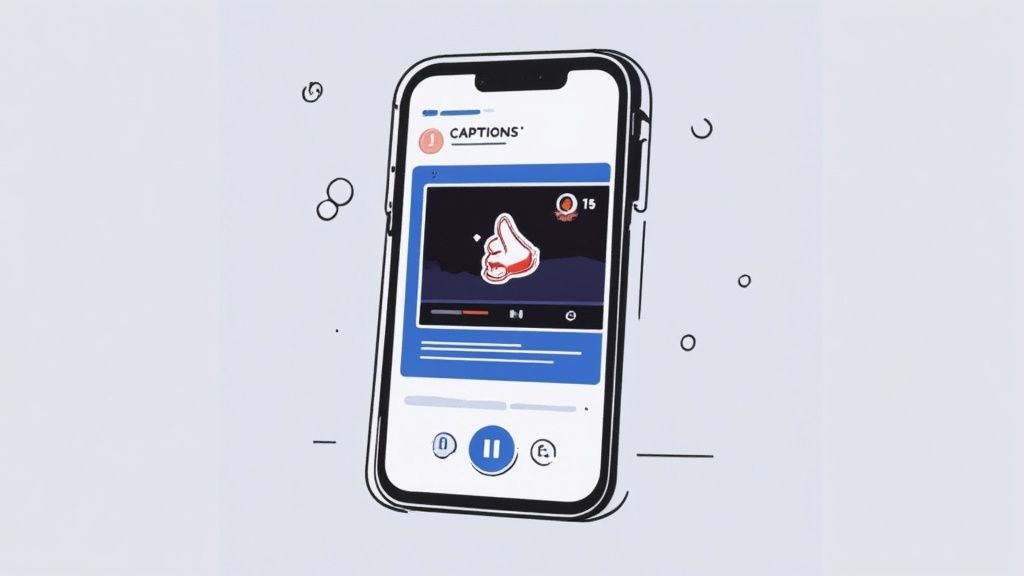
The explosive growth of platforms like TikTok and Instagram Reels, which exclusively prioritize vertical video, provides definitive proof of this shift. Even YouTube, once the bastion of horizontal 16:9 content, has seen massive engagement with its vertical YouTube Shorts format. These platforms have trained users to expect content that fills their entire screen without needing to turn their phone sideways. According to Statista, mobile devices accounted for over 60% of all website traffic globally in 2023, and that figure is even higher for social media video consumption.
How to Implement Mobile-First Optimization
To ensure your videos resonate on the small screen, build your production and editing workflow around mobile constraints from the start.
- Shoot Natively in Vertical: Whenever possible, record your content in a 9:16 aspect ratio. This avoids awkward cropping or black bars that make your video look unprofessional and out of place in vertical feeds.
- Add Captions by Default: A significant portion of mobile video is watched with the sound off. Burned-in captions or subtitles ensure your message is understood even in silent environments, dramatically improving accessibility and comprehension.
- Use Large, Legible Text: Any on-screen text or graphics must be large and clear enough to be read easily on a small screen. Test your video on an actual mobile device during the editing process to check for readability.
- Keep Key Elements Centered: Avoid placing important visuals or text near the edges of the frame, as platform interfaces (like usernames, captions, and like buttons) can often cover these areas.
By adopting a mobile-first mindset, you create a more seamless and engaging viewing experience that aligns directly with modern user behavior, leading to better performance across all key metrics.
3. Use Captions and Text Overlays
A significant portion of social media video is consumed without sound, making captions and text overlays an essential component of modern video marketing best practices. Incorporating on-screen text isn't just an accessibility feature; it's a strategic tool to ensure your message lands regardless of the viewing environment. By providing visual context, you accommodate sound-off viewers, reinforce key points for those with audio on, and significantly improve comprehension and retention.
This practice is standard across all major platforms, from Netflix's robust subtitle options to the dynamic, animated text popularized by TikTok creators. Research confirms its impact: a study by Verizon Media found that 80% of consumers are more likely to watch an entire video when captions are available. To help readers grasp the foundational importance of this feature, you can explore a complete guide to understanding closed captions and their benefits. News outlets like CNN also master this by using continuous on-screen text to deliver key information, ensuring viewers can grasp the story's essence at a glance.
How to Implement Captions and Text Effectively
To maximize engagement and clarity, your on-screen text should be designed for a seamless viewing experience, especially on mobile devices.
- Prioritize Readability: Use a high-contrast, bold font that is easy to read on small screens. Place captions over a solid or semi-transparent background to prevent them from getting lost in the video.
- Synchronize Perfectly: Ensure your captions appear exactly as the words are spoken. Poorly timed text can be distracting and appear unprofessional, undermining your message.
- Guide the Viewer's Eye: Use text overlays strategically to highlight critical data, pose questions, or introduce new topics. This acts as a visual signpost, keeping the viewer engaged.
- Leverage Efficient Tools: Utilize software like Rev for professional human transcription, or use the built-in auto-captioning tools in platforms like YouTube, Instagram, and CapCut to streamline your workflow.
4. Include Clear Call-to-Actions (CTAs)
A great video without a clear next step is a missed opportunity. A Call-to-Action (CTA) is an explicit instruction designed to prompt an immediate response from the viewer, guiding them on what to do next. Including a direct CTA is a fundamental video marketing best practice that transforms passive viewers into active participants, subscribers, leads, or customers. Without it, your audience is left wondering what to do with the value you just provided, significantly diminishing your campaign's ROI.
The power of a well-placed CTA is proven by data. According to research, videos that include a clear CTA achieve significantly higher click-through and conversion rates than those that don't. Marketing automation giant HubSpot, a pioneer in this space, often reports engagement rates over 75% on their video CTAs by seamlessly integrating them into their educational content. This strategy is also a hallmark of successful YouTube creators, who consistently end videos with verbal and visual prompts like "Smash that subscribe button" or "Check the link in the description," directly contributing to channel growth and community building.
How to Implement Effective CTAs
To maximize conversions, your CTAs must be clear, timely, and compelling. The goal is to make the desired action as easy and logical as possible for the viewer.
- Combine Verbal and Visual Cues: Don't just say what you want them to do; show them. Pair a verbal instruction like "Visit our website" with an on-screen text overlay or an animated button showing the URL.
- Time It Strategically: Place your primary CTA when viewer engagement is highest, typically around the 70-80% mark of the video, after you've delivered the core value. Avoid placing it too early before trust is built or too late after viewers have dropped off.
- Be Specific and Benefit-Driven: Instead of a generic "Click Here," use action-oriented language that highlights the value. "Download Your Free Ebook" is far more compelling than a vague request.
- Utilize Platform-Specific Features: Leverage built-in tools like YouTube's end screens and cards to create clickable, non-intrusive CTAs. On social platforms, direct users to the "link in bio" or use interactive stickers in Stories.
By making your call-to-action a natural and valuable conclusion to your video, you create a seamless pathway for viewers to deepen their relationship with your brand.
5. Create Custom Thumbnails That Stand Out
Your video’s thumbnail is its digital billboard. In a sea of content on platforms like YouTube, it's often the single most important factor determining whether a potential viewer clicks on your video or scrolls past it. A well-designed custom thumbnail acts as a powerful teaser, conveying the video's topic, tone, and value proposition in a single glance. This element is a cornerstone of effective video marketing best practices, as data consistently shows that custom thumbnails can boost click-through rates (CTR) by over 30% compared to auto-generated ones.

The impact of a great thumbnail is perfectly illustrated by creators like MrBeast, whose thumbnails are a masterclass in visual psychology. He uses bright, high-contrast colors, expressive human faces with exaggerated emotions, and minimal, large-font text to create an irresistible visual hook. Similarly, tech reviewer Marques Brownlee (MKBHD) uses clean, high-quality product shots against minimalist backgrounds to signal professionalism and quality. A/B testing has proven the value of this approach, with some brands seeing a 40% lift in clicks simply by adding a human face to their thumbnails.
How to Implement Stand-Out Thumbnails
To design thumbnails that stop the scroll and drive clicks, focus on clarity, emotion, and visual hierarchy.
- Prioritize High-Contrast Visuals: Use a bright, vibrant color palette that stands out. Place your main subject against a contrasting background to make it pop, ensuring it is clearly visible even at a small size.
- Feature Expressive Human Faces: The human brain is hardwired to notice faces. Use a close-up shot of a person showing a strong, relevant emotion (surprise, excitement, curiosity) to create an instant connection.
- Use Bold, Legible Text: If you add text, keep it to three or four powerful words. Use a thick, easy-to-read font that contrasts with the background and is large enough to be legible on a mobile screen.
- Incorporate Branding Elements: Use consistent fonts, color schemes, or a small logo to build brand recognition across your video content, as seen with channels like WIRED.
- Test and Optimize: Don't assume your first design is the best. Use YouTube's "Test & Compare" feature to A/B test different thumbnail variations and identify which one generates the highest CTR for your audience.
6. Tell Compelling Stories with Narrative Structure
Humans are wired for stories, not for sales pitches. Structuring your videos with a clear narrative arc (setup, conflict, resolution) is a powerful way to create an emotional connection and make your message stick. Research has shown that stories are up to 22 times more memorable than facts alone, a critical advantage in a saturated content landscape. This principle transforms a simple informational video into an engaging experience that drives deeper brand loyalty and increases shareability.
This approach is exemplified by Dollar Shave Club’s viral launch video. It didn't just list product features; it told the relatable story of a frustrated consumer (the hero) fighting a common enemy (overpriced razors). This simple narrative resonated with millions, turning a startup into a billion-dollar brand. Similarly, brands like Patagonia use documentary-style videos to tell powerful stories about environmental activism, connecting their products to a larger purpose. Crafting these narratives is a cornerstone of professional brand storytelling with video production, as it shifts the focus from selling a product to sharing a belief.
How to Implement Narrative Structure
To weave compelling stories into your video marketing, focus on classic narrative elements that build an emotional journey for the viewer.
- Establish a Relatable Character: Start with a protagonist (your customer, an employee, or a brand persona) who faces a clear problem or goal that your audience understands.
- Introduce Conflict and Stakes: What obstacle stands in the character's way? What is at risk? This conflict creates tension and gives the audience a reason to care about the outcome.
- Show, Don't Tell: Use visuals, sound design, and character actions to convey the story rather than relying on a narrator to explain everything.
- Build to a Climax and Resolution: Guide the viewer through the character's journey as they overcome the conflict, leading to a satisfying resolution where your product or service plays a key role.
- End with a Transformation: Conclude by showing the "after" state. How has the character's world improved? This transformation reinforces the value you provide and leaves a lasting impression.
7. Optimize Video Length for Platform and Content Type
The idea of a single "optimal video length" is a myth in modern marketing. The most effective duration is dictated not by a universal rule, but by the specific platform you're on and the audience's expectations there. Failing to adapt your video's runtime to each channel's culture is a common mistake that severely limits reach and engagement. This is a critical component of video marketing best practices because platform algorithms and user behavior are intrinsically linked to content length, directly impacting your video’s visibility and performance.
Tailoring video length is a strategy perfected by brands like National Geographic, which might release a gripping 90-second clip on Instagram Reels but expand the same story into an in-depth 8-minute documentary on YouTube. This approach recognizes that a user scrolling through TikTok has a vastly different attention span and intent than someone browsing YouTube for educational content. Data consistently shows that aligning with platform norms works; LinkedIn's own research indicates videos under 90 seconds see the best completion rates, while YouTube often rewards creators like MrBeast, whose 12-15 minute videos maximize watch time and ad revenue potential.
How to Implement Platform-Specific Video Lengths
To effectively match your video's duration to its environment, you must think like a multi-format publisher, not a single-video producer.
- Analyze Platform Norms: Start by mapping out the ideal length ranges for your key platforms. Aim for 15-60 seconds on TikTok and Reels, 30-90 seconds on LinkedIn, and 2-5 minutes for Facebook feed videos. YouTube can support longer content, often in the 10-20 minute range for deep dives.
- Repurpose Strategically: Film one comprehensive, long-form "pillar" video. Then, edit and extract shorter, punchier clips from it, each tailored for a different platform. A 10-minute YouTube tutorial can become five 60-second TikTok tips.
- Monitor Audience Retention: Use platform analytics, especially YouTube Studio's audience retention graphs, to identify where viewers drop off. If you see a consistent drop at the 2-minute mark, your next video should deliver its core value before that point.
- Test and Track Completion Rates: Don't just guess. Post videos of varying lengths (e.g., 30s, 60s, 90s) on the same platform and compare the completion rates and engagement metrics to find what resonates best with your specific audience.
By treating video length as a variable to be optimized for each channel, you respect the user's context and align with algorithmic preferences, ensuring your message has the best possible chance to land.
8. Focus on High Production Value and Authenticity Balance
In the world of video marketing, audiences crave a delicate balance. While low-quality production can damage your brand's credibility, content that is overly polished can feel sterile and unrelatable. Striking the right equilibrium between high production value and genuine authenticity is a crucial video marketing best practice that builds trust and fosters connection. This balance signals professionalism without sacrificing the human element that resonates with viewers, especially on platforms where relatability drives engagement.
This principle is perfectly demonstrated by tech reviewer MKBHD, whose videos feature crisp 8K footage and flawless editing (high production value) while delivering his honest, unscripted opinions (authenticity). Similarly, Dwayne 'The Rock' Johnson pairs professionally shot movie promotions with raw, off-the-cuff workout videos on Instagram. The optimal mix depends heavily on your audience and platform. For instance, a B2B LinkedIn video demands a higher level of polish than a behind-the-scenes TikTok, where Gen Z audiences often prefer unfiltered, point-of-view content. Research from Stackla shows that 86% of consumers say authenticity is a key factor when deciding what brands they like and support.
How to Balance Polish and Authenticity
Achieving this balance doesn’t require a Hollywood budget. Instead, it’s about making smart investments in key areas while letting genuine moments shine through.
- Invest in Good Audio: Poor sound is often more distracting than poor video. A simple USB microphone or lavalier mic (around $50-$200) can dramatically improve your perceived production value.
- Prioritize Stable Shots and Good Lighting: Use an affordable tripod or gimbal to eliminate shaky footage. Natural light from a window is free, and a basic ring light can provide consistent, flattering illumination.
- Embrace Imperfection: Don't edit out every stumble or laugh. Leaving in unscripted, genuine moments makes the content feel more real and relatable.
- Show the Process: Instead of only showing the final, perfect product, create behind-the-scenes content. This builds a deeper connection with your audience by revealing the people and effort behind your brand.
9. Leverage Data Analytics to Optimize and Iterate
Creating great video content is only half the battle; understanding its performance is what unlocks sustainable growth. Simply publishing a video and hoping for the best is a recipe for wasted resources. Instead, a core tenet of modern video marketing best practices involves leveraging data analytics to continuously measure, test, and improve your content strategy. This data-driven approach transforms marketing from a guessing game into a science, allowing you to systematically refine your efforts for maximum impact. Key metrics like watch time, click-through rate (CTR), and audience retention are the signals that tell you precisely what resonates with your audience and what needs to be fixed.
YouTube creators are masters of this principle, constantly scrutinizing audience retention graphs in YouTube Studio to pinpoint exact moments where viewers lose interest. A sharp drop-off at the 15-second mark might indicate a weak introduction, while a gradual decline could suggest pacing issues. Similarly, A/B testing different thumbnail designs is a standard practice that can boost CTR by 30-50%, dramatically increasing a video's initial reach. By treating each video as an experiment, you gather valuable insights that inform every subsequent piece of content you produce. To build a robust framework for this process, you can explore detailed methods to analyze content performance and turn data into action.
How to Implement Data-Driven Optimization
To turn your video analytics into a powerful feedback loop, adopt a systematic and consistent approach to measurement and testing.
- Focus on Key Metrics: Don't get lost in vanity metrics. Identify 2-3 primary KPIs tied to your goals, such as average view duration for engagement or conversion rate for lead generation.
- Analyze Audience Retention Graphs: Regularly check for drop-off points. Did viewers leave during your intro, your call-to-action, or a specific segment? Use these insights to restructure future videos.
- A/B Test One Variable at a Time: To get clean data, test a single element, such as the thumbnail, title, hook, or call-to-action. Testing multiple variables at once makes it impossible to know what caused the change.
- Use UTM Parameters: When directing traffic from a video to your website, use unique UTM parameters to accurately track which videos are driving visits, sign-ups, or sales in Google Analytics.
By consistently reviewing your performance data, you can make informed decisions that compound over time, ensuring your video marketing strategy becomes increasingly effective with each new video you publish.
10. Repurpose and Distribute Content Across Multiple Platforms
Creating high-quality video content is a significant investment of time and resources. One of the most effective video marketing best practices is to maximize that investment by creating once and distributing everywhere. This strategy involves taking a single, long-form "pillar" piece of content and strategically adapting it into numerous smaller assets tailored for different platforms like YouTube, TikTok, Instagram, and LinkedIn. This approach multiplies your content's value, extends its reach, and significantly reduces the cost per published piece.
This model is famously championed by entrepreneurs like Gary Vaynerchuk, whose team creates dozens of content pieces from a single keynote or podcast episode. Similarly, a HubSpot webinar can be transformed into a full-length YouTube video, several short educational clips for LinkedIn, a series of Instagram Reels, and even a text-based blog post. This isn't just cross-posting; it's a strategic adaptation that respects each platform's unique format and audience culture, ensuring the content feels native and performs optimally. Implementing effective content repurposing strategies allows a single production effort to fuel your entire marketing calendar for weeks.
How to Implement a Content Repurposing Strategy
To efficiently adapt your content, start with a comprehensive piece and work your way down to smaller, platform-specific clips.
- Start with a Pillar Asset: Begin with a long-form video like a webinar, podcast interview, in-depth tutorial, or customer testimonial. This serves as your source material.
- Extract Key Moments: Identify the most valuable, interesting, or shareable moments within your pillar content. These could be key tips, surprising statistics, or powerful quotes that can stand alone.
- Adapt for Each Platform: Reformat the extracted clips for each channel. Create a 9:16 vertical video for TikTok and Instagram Reels, a 1:1 square video for LinkedIn feeds, and a 16:9 horizontal clip for YouTube Shorts.
- Tailor Captions and Text: Don't use the same caption everywhere. Write unique copy that aligns with the tone of each platform, using relevant hashtags and calls-to-action. For example, a LinkedIn post should be more professional, while an Instagram caption can be more casual.
By building a repurposing workflow, you ensure a consistent stream of high-value content across all your channels without constantly starting from scratch, dramatically improving your marketing efficiency and ROI.
Top 10 Video Marketing Best Practices Comparison
| Item | 🔄 Implementation Complexity | ⚡ Resource / Speed | 📊 Expected Outcomes | Ideal Use Cases | ⭐ Key Advantages | 💡 Quick Tips |
|---|---|---|---|---|---|---|
| Start with a Strong Hook in the First 3 Seconds | Low–Medium — quick creative/editing changes | Low resources; fast to deploy but needs editing time | Higher early retention and CTR; reduced bounce | Short-form, ads, social feeds | Grabs attention immediately; boosts algorithm signals | Test multiple hooks; use pattern interrupts |
| Optimize for Mobile-First Viewing | Medium — requires reframing & planning for mobile | Moderate resources; shoot/format for vertical/square | Higher mobile engagement, watch time, conversions | TikTok, Reels, Shorts, mobile-first audiences | Better reach on dominant mobile platforms | Shoot natively vertical; keep key info away from edges |
| Use Captions and Text Overlays | Medium–High — added captioning and timing work | Moderate time investment; tools speed process | Higher completion, accessibility, discoverability | Social feeds, noisy contexts, accessibility needs | Enables sound-off viewing; improves comprehension | Use high-contrast fonts; test on actual phones |
| Include Clear Call-to-Actions (CTAs) | Low–Medium — strategic placement & tracking | Low resources; requires testing for best timing | Strong increases in conversions and measurable ROI | Promo videos, e‑commerce, demos, lead gen | Guides behavior; easy to measure and optimize | Use 1–3 CTAs; place primary CTA ~70–80% through video |
| Create Custom Thumbnails That Stand Out | Low–Medium — design skills and iteration | Low cost; quick to A/B test and update | Significant CTR lift and higher impressions | YouTube and discovery-driven platforms | Boosts clicks and channel visibility | Use faces, bold text, test at mobile thumbnail size |
| Tell Compelling Stories with Narrative Structure | High — scripting, planning and refined editing | Higher time/resources; slower production cycle | Deeper engagement, memorability, shareability | Brand campaigns, long-form, emotional content | Highly memorable; drives behavior and shares | Start with relatable character; show, don’t tell |
| Optimize Video Length for Platform and Content Type | Medium — analytics + multi-edit workflow | Moderate resources; multiple edits per platform | Improved retention and platform performance | Multiplatform strategies, repurposing workflows | Matches audience expectations per platform | Use retention data to choose ideal lengths; repurpose clips |
| Focus on High Production Value + Authenticity Balance | Medium–High — equipment + creative direction | Varies by budget; basics give strong ROI | Better trust, brand perception, sustained engagement | Brand channels, corporate, Gen Z-targeted content | Credibility without losing relatability | Invest in audio; allow slight imperfections |
| Leverage Data Analytics to Optimize and Iterate | High — ongoing tracking, A/B testing, analysis | Time-intensive; needs tools and expertise | Continuous performance gains; higher ROI | Channels seeking scale and evidence-based growth | Removes guesswork; identifies what truly works | Track 2–3 core metrics; test one variable at a time |
| Repurpose and Distribute Content Across Platforms | Medium–High — editing for multiple formats & scheduling | Efficient long-term ROI; upfront work multiplies content | Increased reach, reduced cost per asset, cross-platform growth | Teams producing long-form source content | Maximizes content value across channels | Start with one long-form source; extract tailored clips |
From Best Practices to Best Performance
Navigating the dynamic landscape of video marketing can feel like trying to hit a moving target. Yet, as we've explored, a strategic framework built on proven principles can transform uncertainty into predictable success. The journey from a simple video concept to a high-performing marketing asset is not about a single magic bullet; it's about the deliberate and consistent application of the video marketing best practices we've outlined. From capturing attention in the first three seconds to meticulously analyzing performance data, each step is a crucial component of a powerful, cohesive strategy.
Think of these practices not as a rigid set of rules but as a flexible toolkit. The true mastery lies in knowing which tool to use for which job. A short, punchy video with bold text overlays might dominate on TikTok, while a longer, narrative-driven piece with a compelling story arc could be the key to engaging your audience on YouTube. The principles remain the same-a strong hook, a clear call-to-action, mobile optimization-but their application must be tailored to the platform, the audience, and the specific goals of your campaign.
The Continuous Loop of Optimization
The most significant takeaway is that exceptional video marketing is not a "set it and forget it" endeavor. It is a continuous, iterative cycle of creation, distribution, measurement, and refinement.
- Create with Intent: Every video should be built on a foundation of storytelling, optimized for mobile viewing, and designed with a clear purpose, whether that's to educate, entertain, or convert.
- Measure with Precision: Don't rely on vanity metrics. Dive deep into analytics to understand what truly resonates. Track watch time, click-through rates, and conversion data to see the tangible impact of your efforts.
- Iterate with Confidence: Use the data you gather to inform your next move. Did a particular thumbnail style lead to a higher click-through rate? Did videos under 60 seconds have a significantly better completion rate? Let these insights guide your future creative decisions, turning each campaign into a learning opportunity that fuels the next.
This data-driven approach removes the guesswork and empowers you to make smarter, more effective choices. It’s the bridge between simply following video marketing best practices and achieving best-in-class performance that moves the needle for your business.
Turning Knowledge into Action
The path forward is clear: start small, but start now. Don't wait for the perfect, high-budget production to begin implementing these strategies. Pick one or two key areas to focus on for your next video project.
Perhaps you'll double down on creating five different custom thumbnails and A/B testing them to see what your audience responds to. Or maybe you'll make a commitment to add accurate, branded captions to every single video you post, expanding your accessibility and reach. By integrating these habits into your workflow, you build momentum. Each small win provides data and confidence, paving the way for more ambitious and successful video campaigns down the line.
Ultimately, mastering video marketing is about building a system that connects with your audience on a human level while delivering on strategic business objectives. It's the art of storytelling combined with the science of data analysis. By embracing this dual-focused mindset and consistently applying these foundational best practices, you can ensure your video content doesn't just get seen-it gets results.
Ready to implement these video marketing best practices without the operational headache? The team at ReachLabs.ai is a collective of world-class talent dedicated to integrating data-driven insights with creative excellence to elevate your brand's video strategy. Let us handle the complexities of production, distribution, and optimization so you can focus on the results. Visit ReachLabs.ai to discover how we can help you turn best practices into your best performance yet.