When people talk about growing a business with search engines, they're almost always talking about SEO and SEM services. Think of them as two different tools in the same toolbox, both designed to get you in front of customers. SEO is all about earning free, organic traffic over the long haul, while SEM uses paid ads for instant visibility. The best digital strategies don't pick one—they master both.
What Are SEO and SEM, Really?
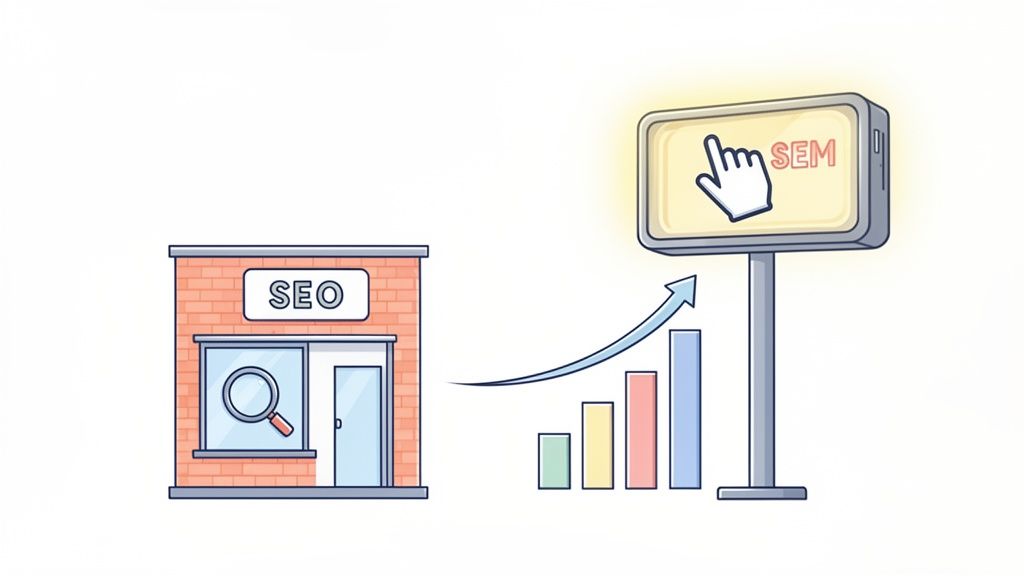
Let's break down search marketing without all the technical jargon. Picture your website as a new shop in a gigantic, sprawling city. That city is the internet, and the millions of people wandering around are all looking for something. They're your potential customers.
So, how do you get those people to walk into your store? You've got two main options, and they perfectly explain the difference between SEO and SEM.

The Two Ways to Get Found in Search
Search Engine Optimization (SEO) is like setting up your shop in the best possible location—right in the center of a busy town square where people naturally gather. You put in the work to build a beautiful storefront, create clear signs, and earn a great reputation. It takes time, but eventually, people find you, trust you, and keep coming back.
You aren't paying a fee for every single person who walks through the door. Instead, you're making a long-term investment in building and maintaining that prime real estate. Top-tier SEO services are laser-focused on creating this foundational strength.
Search Engine Marketing (SEM), on the other hand, is like launching a massive advertising campaign across the city. You pay to put up flashy billboards at the main intersections, guiding people who are looking for exactly what you sell straight to your doorstep. As soon as you pay, the traffic starts coming.
This approach gets you customers right now. It's perfect for a grand opening, a special sale, or just catching buyers the moment they decide they're ready to make a purchase.
To put it simply: SEO is earned. You build an asset that brings you traffic for years. SEM is paid. You buy traffic for immediate results. A truly dominant search presence needs both.
Why You Can't Just Pick One
A smart strategy never forces you to choose between the two. Instead, it makes them work together. The instant data you get from a paid SEM campaign can tell you exactly which keywords are making you money. You can then take that information and apply it to your long-term SEO strategy. It’s like a cheat sheet for organic growth.
At the same time, having a strong organic presence from SEO builds a level of trust and credibility that money can't buy. This authority can actually make your paid ads perform better and sometimes even cost you less per click.
When a business shows up in both the paid and organic search results, it takes up significantly more screen real estate and projects massive authority. You're not just visible; you're everywhere your customers are looking. This is the first step to building a truly powerful presence online.
Building Your Organic Foundation with SEO
While paid ads give you an immediate traffic boost, Search Engine Optimization (SEO) is all about playing the long game. It's the craft of building a powerful, lasting digital asset. Think of it like buying and developing prime real estate—it takes a solid plan, a strong foundation, and a great reputation to attract a steady stream of visitors. SEO works by focusing on three core pillars that are separate but have to work together.

Get these three pillars right, and you'll build incredible trust with search engines like Google, proving that your website is a go-to resource for your audience.
On-Page SEO: The Art of Clear Communication
On-page SEO is everything you do on your actual website pages to make it crystal clear to both people and search engines what your content is about. It's like organizing a library with clear signs, logical sections, and well-labeled book spines. You’re making it easy for everyone to find exactly what they’re looking for.
Good on-page SEO makes your content a breeze to discover and understand. This includes things like:
- Keyword Research: Finding the specific words and phrases your customers are actually typing into Google and using them naturally on your pages.
- High-Quality Content: Creating genuinely helpful articles, guides, and service pages that solve your audience's problems.
- Title Tags & Meta Descriptions: Writing the punchy headlines and short summaries that show up in search results and make people want to click.
- Internal Linking: Guiding visitors and search engines to other relevant pages on your site, which helps them explore and spreads your site's authority around.
This pillar is absolutely essential. In fact, on-page SEO is expected to account for 41.80% of all global SEO/SEM services revenue—a whopping USD 31.29 billion by 2025. It’s also a secret weapon for your paid ads, as a well-optimized page improves your Quality Score and can actually lower your ad costs.
Off-Page SEO: Building Your Street Cred
If on-page SEO is what you say about yourself, off-page SEO is what the rest of the internet says about you. This is all about building your website's authority and reputation online. Think of it as earning glowing reviews and word-of-mouth referrals. The biggest piece of this puzzle is link building.
A backlink is simply a link from someone else's website pointing to yours. Search engines see these as votes of confidence. The more "votes" you get from credible, respected sites, the more trustworthy your own site becomes.
A huge part of building your organic presence is implementing effective SEO link building strategies that prioritize quality over sheer numbers. One link from a major industry publication is worth more than a hundred links from tiny, unknown blogs. Other off-page factors include things like brand mentions, social media buzz, and online reviews.
Technical SEO: Making Sure the Engine Runs Smoothly
Finally, we have technical SEO. This is the nuts and bolts of your website's infrastructure. It’s the foundation of your digital storefront. If the foundation has cracks, the wiring is faulty, and the doors don't open properly, it doesn't matter how amazing your products are—people won't stick around.
Technical SEO tackles all the behind-the-scenes stuff that affects how search engines access your site and how users experience it. The big three are:
- Site Speed: Pages need to load fast. Slow websites frustrate visitors and send them running to your competitors.
- Mobile-Friendliness: Your site has to look and work flawlessly on a phone. No exceptions.
- Crawlability: You have to make it easy for search engine "bots" to find, read, and understand all your pages so they can be added to search results.
These optimizations aren't optional anymore; they're table stakes. That's why a thorough technical audit is almost always the first thing an SEO agency does. If you're curious about what goes into that kind of deep dive, check out our guide on professional SEO audit services. By mastering all three pillars—on-page, off-page, and technical—you create a reliable, long-term source of organic traffic that will fuel your business for years.
Accelerating Growth with Paid Search and SEM
While SEO is the long game—methodically building your digital presence over time—Search Engine Marketing (SEM) is your express lane to the top. Think of it this way: if SEO is like cultivating a beautiful organic garden that matures over seasons, SEM is like flipping a switch to instantly light up your storefront with bright, eye-catching neon signs.
It’s the engine for immediate traffic. This makes it perfect for businesses that need to generate leads, test new offers, and capture sales right now. SEM, which is most often centered on Pay-Per-Click (PPC) advertising, lets you place your business directly in front of people at the exact moment they’re searching for your solution.
The Anatomy of a Winning SEM Campaign
A successful paid search campaign isn't just about throwing money at ads and hoping for the best. It’s a precise science, a delicate balance of strategic bidding, compelling creative, and a deep understanding of customer psychology. It’s all about maximizing your return on every dollar spent.
The core activities in professional seo sem services work together to drive qualified traffic that actually converts:
- Keyword Bidding: This is the auction house of search. You bid on specific keywords and phrases your ideal customers are using, competing with others for those prime ad spots at the top of the page. An expert knows how to find high-intent keywords that don't break the bank.
- Ad Copywriting: Your ad is your digital billboard. Crafting concise, persuasive text that speaks directly to the searcher's pain point is what earns the click and makes you stand out.
- Landing Page Optimization: Getting someone to click your ad is only half the battle. The page they land on must be crystal clear, relevant to their search, and designed to guide them toward a single action. A seamless landing page experience is non-negotiable.
The real goal of SEM isn't just to get clicks—it's to get the right clicks. Every click should come from a potential customer who is highly likely to take that next step, whether that's making a purchase, filling out a form, or picking up the phone.
Understanding Different Ad Types
SEM provides a versatile toolkit of ad formats, and choosing the right one depends entirely on your business goals. You can reach customers through various touchpoints, depending on what you’re selling and who you’re trying to reach.
- Text Ads: These are the classic ads you see at the top of Google. They are simple, text-based, and incredibly effective for targeting users who know what they want and are ready to buy.
- Shopping Ads: A must-have for e-commerce, these are the visually rich ads that show product images, prices, and your store name right in the search results.
- Display Ads: These are the image-based banner ads that follow you around the internet, appearing on various websites within Google's network. They are fantastic for building brand awareness and retargeting people who have visited your site before.
The Quality Score Advantage
It's a common myth that the highest bidder always wins the top ad spot. In reality, Google uses a powerful mechanism called Quality Score to reward advertisers for creating a great user experience. It’s a rating from 1 to 10 based on your ad’s relevance, expected click-through rate, and landing page quality.
Here's the kicker: a high Quality Score can actually lower your advertising costs and improve your ad position. This is where your SEO efforts pay direct dividends for your SEM campaigns. A well-optimized, fast, and relevant landing page—a cornerstone of good SEO—can significantly boost your Quality Score, making your paid ads far more efficient and effective. You can learn more about how these disciplines work together in our guide on search engine marketing strategies.
The demand for these services is massive. North America alone commands a dominant 33.90% of the global SEO services market. In the US, SEM investments delivered an average ROI of 200% in 2024, as businesses tapped into paid search to grab a piece of the 5.9 million queries happening every minute on Google. Check out more stats about the growing SEO market on xamsor.com. That incredible volume and potential for return make SEM an indispensable tool for rapid growth.
Why You Need Both SEO and SEM Working Together
It’s easy to think of SEO and SEM as two separate things, often competing for the same marketing dollars. But that’s a rookie mistake. The real breakthrough comes when you stop seeing them as rivals and start treating them as partners. When you integrate your SEO and SEM services, you're not just improving each channel on its own—you're creating a powerful, unified search presence that's far stronger than the sum of its parts.
Think of it this way: SEM is your fast, agile scout, getting immediate intel from the front lines about what your customers are searching for right now. SEO is your long-term strategist, meticulously building a fortress of authority and trust that will stand the test of time. To dominate the search results, you absolutely need both.
This is especially true when you look at how a paid ad campaign is structured. It's a system with several moving parts that all have to work together.

Notice how the landing page is a core pillar of a successful paid campaign? That landing page experience is a direct product of good SEO.
How SEM Data Gives Your SEO a "Cheat Sheet"
Paid search campaigns are an incredible source of real-world data. Since you’re paying for every click, you get instant feedback on which keywords don’t just bring in traffic, but actually lead to sales and sign-ups. This information is pure gold for your long-term organic strategy.
Your SEM campaigns can quickly tell you:
- Which Keywords Actually Convert: You can pinpoint the exact phrases people use when they’re ready to pull out their wallets. This allows you to target these same high-value terms in your SEO content and attract organic visitors who are ready to buy.
- What Ad Copy Grabs Attention: By testing different headlines and descriptions in your ads, you can see what messaging truly connects with your audience. The winners can be repurposed for your SEO title tags and meta descriptions, leading to a much higher organic click-through rate.
- Who Your Best Customers Are: Paid platforms like Google Ads provide detailed demographic and behavioral data on the people who convert. This helps you sharpen your buyer personas and create content that speaks directly to them.
Essentially, using SEM for rapid testing takes the guesswork out of your SEO. You can focus your energy and resources on the strategies you already know will work.
An integrated strategy means your marketing budget works smarter, not just harder. The dollars you spend on SEM today are directly investing in the intelligence that will build your free, organic traffic for tomorrow.
How a Strong SEO Foundation Boosts Your SEM
This partnership is a two-way street. A solid organic presence built through smart SEO work makes your paid campaigns more efficient and effective. When search engines already view your site as a credible and authoritative resource, it gives your ads a powerful advantage.
Here’s how great SEO gives your SEM campaigns a leg up:
- Improves Your Quality Score: Google’s Quality Score is a key metric that is heavily influenced by the quality and relevance of your landing pages. A fast, mobile-friendly page with great content—all things that are central to SEO—will earn you a much higher score.
- Lowers Your Ad Costs: A higher Quality Score is rewarded with a lower cost-per-click (CPC). This means your ad budget stretches further, getting you more clicks and conversions for the exact same spend.
- Helps You Rank Higher: A strong Quality Score can actually help your ads secure a better position in the search results, even if your bid isn’t the highest one in the auction.
- Builds Trust and Credibility: When a user sees your brand listed in both the paid and the organic results, it sends a strong signal of authority. This "double-dip" effect makes them much more likely to click on one of your links.
Investing in SEO doesn't just build a foundation for free, sustainable traffic; it makes every dollar you spend on paid ads a better, more profitable investment.
SEO vs SEM: A Strategic Comparison
To really understand how these two channels work together, it helps to break down their individual strengths and how they complement each other. This table puts their key differences and synergies side-by-side.
| Attribute | SEO (Search Engine Optimization) | SEM (Search Engine Marketing / PPC) | Synergy Point |
|---|---|---|---|
| Time to Results | Long-term (3–6+ months). Building organic authority is a marathon, not a sprint. | Immediate (within hours). Ads can go live and start generating traffic almost instantly. | Use SEM for quick wins and data gathering while your long-term SEO strategy gains momentum. |
| Cost | No direct media cost, but requires significant investment in content, technical expertise, and time. | Pay-per-click (PPC) model. You pay every time someone clicks on your ad. | Strong SEO improves Quality Score, which lowers your SEM ad costs (CPC) over time. |
| Targeting | Broad targeting based on keywords and user intent. Less granular control over demographics. | Hyper-specific targeting based on keywords, demographics, location, time of day, and audience behavior. | Use SEM's detailed audience data to refine your SEO content and better understand your target customer. |
| Sustainability | Once you achieve a high ranking, you can receive "free" traffic 24/7. Results are durable. | Traffic stops the moment you turn off your ad spend. Results are temporary. | SEO provides a stable baseline of traffic, reducing your complete dependence on paid advertising. |
| Testing Ability | Slower. A/B testing titles or content can take weeks or months to yield clear data. | Fast and effective. You can A/B test ad copy, landing pages, and offers in real-time to find winners quickly. | Test messaging and offers with SEM, then apply the winning formulas to your SEO meta descriptions and content. |
By looking at this breakdown, it becomes clear that the question isn't "Should I do SEO or SEM?" The right question is, "How can I make my SEO and SEM work together to achieve our goals faster and more efficiently?" Combining them allows you to cover all your bases—capturing immediate demand with SEM while building a long-lasting, cost-effective asset with SEO.
How to Choose the Right SEO SEM Agency
Picking the right partner for your SEO and SEM services is one of the most critical decisions you'll make for your company's future. A great agency becomes a seamless extension of your team, driving real results that actually move the needle. The wrong one? They can burn through your budget in a hurry and set you back months, if not years.
The sheer number of agencies out there can feel overwhelming, but a structured vetting process helps you cut through the noise. It’s all about asking the right questions and knowing which red flags to look for. You're not just hiring someone to "do SEO"—you're looking for a strategic partner who gets your business goals.

Go Beyond Surface-Level Questions
Generic questions get you generic, canned answers. If you really want to understand what an agency is capable of, you have to dig deeper. Ask questions that force them to reveal their strategic thinking and prove their hands-on experience. Forget asking "What do you do?" and start asking "How do you do it, and why?"
Here are a few insightful questions to add to your list:
- "How do you measure success beyond just traffic and rankings?" A top-tier agency will immediately pivot the conversation to business metrics—things like lead quality, conversion rates, and cost per acquisition (CPA). Their focus should be firmly on your bottom line, not on vanity metrics that don't pay the bills.
- "Walk me through a case study where you combined SEO and SEM to hit a specific business goal." This is a great way to see if they can truly build a unified strategy. Listen for examples where paid search data helped inform the SEO content strategy or how strong organic rankings helped lower ad costs.
- "What does your communication and reporting process look like in practice?" You need total transparency and a predictable rhythm of communication. Don't be afraid to ask for a sample report to make sure it's clear, insightful, and directly tied to the goals you’ve discussed.
- "Who, specifically, will be working on my account?" Get to know the actual team. Understanding their experience level and roles helps you avoid the classic bait-and-switch where you get sold by the A-team and then handed off to a junior account manager.
Spotting the Red Flags
Knowing what to look for is only half the battle; you also need to know what to look out for. Certain warning signs should give you serious pause before you sign any contract.
Be extremely wary of any agency that offers guaranteed results, like a #1 ranking on Google. The search algorithms are far too complex and dynamic for anyone to make that promise. It's a classic sign of inexperience or, worse, a "black-hat" approach that could get your site penalized.
Keep an eye out for these other major red flags:
- The "Secret Sauce" Mentality: A legitimate agency will be open and honest about its strategies. If they're cagey about their process, it’s often because they’re using outdated, ineffective, or risky tactics.
- A Cookie-Cutter Approach: If their pitch feels like a one-size-fits-all template, they haven't bothered to understand your specific business, your market, or your competition. Run.
- No Access to Your Accounts: You should always own your ad accounts (Google Ads) and analytics profiles (Google Analytics). An agency that insists on keeping these assets under their own name is a massive red flag and creates a hostage situation down the line.
Understanding Common Pricing Models
Finally, you need to get a handle on how an agency structures its fees. Finding a model that aligns with your budget and goals is key. Most agencies offering integrated SEO and SEM services work with one of these common models:
- Monthly Retainer: This is the most popular model by far. You pay a fixed fee each month for an agreed-upon scope of ongoing work. It’s perfect for long-term strategies and continuous optimization.
- Project-Based: This involves a one-time fee for a specific, well-defined project. Think of things like a technical SEO audit, a website migration plan, or an initial campaign setup.
- Performance-Based: While it sounds appealing, be cautious. This model ties the agency's fee to specific outcomes, like a percentage of ad spend or a flat fee per lead. The fine print here is everything, so read it carefully.
Choosing the right partner comes down to finding that perfect mix of expertise, transparency, and strategic alignment. By asking tough questions and looking for a partner who is obsessed with your business outcomes, you can confidently find an agency that will become a powerful engine for your growth.
Measuring What Matters in Your SEO & SEM Campaigns
Kicking off an SEO or SEM strategy is really just the starting line. The real win comes from knowing what to measure and how to measure it. After all, simply getting more eyeballs on your website isn't the goal. You need to attract the right kind of traffic—people who are actually likely to become customers—and see a clear line from your investment to real business growth.
This means we have to look past the "vanity metrics" that feel good but don't mean much for the bottom line. Solid seo sem services are built on data. Every decision, every tweak, should be weighed against tangible results like leads generated and dollars earned.
Core SEO Metrics That Drive Business Value
When you're playing the long game with SEO, success isn't about a one-day spike in traffic. It's about sustainable growth and genuine user engagement. Keyword rankings are a piece of the puzzle, but they don't show the whole picture.
Here’s what truly matters:
- Organic Conversion Rate: This is the big one. It’s the percentage of your organic search visitors who take a meaningful action, like filling out a contact form or buying a product. It tells you if you're attracting high-quality traffic.
- Keyword Visibility: Think of this as your market share in the search results. It tracks how often you show up for a whole group of important keywords, giving you a sense of your overall presence for topics that drive your business.
- Backlink Profile Growth: Watching the number and quality of new websites linking to you is a great way to gauge your site's growing authority. Good backlinks are like votes of confidence from around the web.
Essential SEM Metrics for Profitability
With paid search, the feedback loop is much faster, and the focus is squarely on efficiency and return. Every single dollar has to pull its weight.
These are the non-negotiables:
- Return on Ad Spend (ROAS): This is the ultimate gut-check for any paid campaign. It answers a simple question: for every dollar I put in, how many am I getting back? It’s a direct line to profitability.
- Cost Per Acquisition (CPA): This metric tells you exactly what you’re paying to get a new customer through your ads. A lower CPA means your targeting and messaging are on point, leading to a more efficient strategy.
- Click-Through Rate (CTR): Your CTR shows how well your ads are connecting with people. A high CTR is a strong signal that your ad copy is relevant and compelling enough to make someone stop scrolling and click.
The Tools That Power Performance Tracking
To get this kind of data, professional agencies don't just guess. We rely on a powerful toolkit to gather, analyze, and report on these vital KPIs. Platforms like Google Analytics, Ahrefs, and Semrush are the command centers for modern search marketing, giving us the deep insights needed to make smart, data-backed decisions.
For example, here's a look at a typical dashboard from Semrush, one of the go-to tools for tracking a website's authority and search visibility.
This kind of high-level view lets you see a site's health at a glance, tracking everything from organic traffic trends to the number of new backlinks—all key indicators of SEO performance.
The tools themselves are a massive industry. The global SEO software market, which is the engine behind all these insights, was valued at USD 76.8 billion in 2024 and is expected to rocket to USD 299.6 billion by 2035. This incredible growth shows just how much the industry depends on sophisticated tools to track what's working. You can find more details about the SEO software market on sphericalinsights.com.
By focusing on these core metrics and using the right tools, you move from simply doing SEO and SEM to doing them effectively. For a deeper look into this, check out our guide on how to measure marketing campaign success.
Answering Your Top SEO & SEM Questions
Diving into the world of search marketing often brings up more questions than answers. It's totally normal. As you start looking at different strategies and talking to potential agencies, getting straight answers is the only way to feel confident about your next move. Let's clear up a few of the most common questions we hear from business owners.
How Long Until I See Results From SEO?
Let’s set the right expectation from the start: SEO is a marathon, not a sprint.
You might see small wins from technical fixes in just a few weeks, but the real, meaningful gains in organic traffic and keyword rankings usually take about four to six months to kick in. Why? Because you're building real authority and creating content that's genuinely valuable, and it takes time for search engines like Google to recognize and reward that effort.
The beauty of SEO is its consistency. Paid ads vanish the moment you stop paying for them. The momentum you build with a solid SEO strategy, however, becomes a lasting asset that keeps paying you back for months and even years to come.
For a New Business, Should I Choose SEO or SEM?
This is a classic question, but the answer isn't "one or the other." For a new business, you almost always need both working together. You shouldn't have to choose.
Think of it this way: SEM gives you that immediate hit of traffic and leads you need to start making money and validating your offer. The data you get from those paid campaigns—what keywords convert, which ad copy works—is pure gold. It tells you exactly where to focus your long-term SEO efforts.
So, SEM is your tool for instant market research and cash flow, while SEO is your long-term investment in building a powerful, cost-effective growth engine.
Can I Just Do SEO and SEM Myself?
Technically, yes, you can handle some of the basics yourself. But the digital marketing world is a constantly shifting, incredibly complex arena. A professional agency isn't just a pair of extra hands; they bring years of specialized experience, access to expensive, sophisticated tools, and the dedicated time it takes to actually win.
Their expertise helps you sidestep the common pitfalls that can cost you time and money, ultimately getting you to your goals much faster.
The whole point of investing in SEO and SEM services is to drive real, sustainable growth. To truly scale your business, you need to connect these efforts to bigger-picture initiatives, like these proven small business growth strategies. Bringing in an expert is often the most direct path to seeing the significant, measurable results you're after.
At ReachLabs.ai, we transform your search presence by integrating data-driven SEO with high-impact SEM. Let's build a strategy that delivers real business growth.