Influencer marketing is the most direct—and frankly, most cost-effective—way I've seen startups build real brand trust and land those critical first customers. By working with genuine creators, you can sidestep the overwhelming noise of traditional ads and speak directly to engaged, niche communities. It’s a strategy that runs on credibility, not just clicks.
Why Influencer Marketing Is Your Startup’s Secret Weapon
Let's be honest, when you're running a startup, every single marketing dollar feels precious. You can pour money into traditional ad platforms, but you're often just shouting into a void, trying to get skeptical consumers to pay attention. This is where influencer marketing completely changes the playbook. It offers a powerful, ROI-focused approach to growth that builds the one thing ads can’t buy: authentic trust.
Think about it. As a new company, you have no brand history to lean on. So instead, you can "borrow" the trust that creators have spent years building with their followers. When an influencer your ideal customer already respects shares your product, it’s not an advertisement. It’s a warm recommendation from a trusted source.
A Cost-Effective Engine for Growth
This isn't just a feel-good strategy; the numbers back it up. The global influencer marketing space is exploding, on track to become a $40 billion industry by the end of 2026. That growth is massively outpacing what we see in traditional digital advertising.
But what does that really mean for your startup’s budget? The data is compelling. On average, businesses are seeing a return of about $5.78 for every dollar spent on influencer marketing. The best-performing campaigns can even hit returns of $6.50. When your funds are tight, that kind of efficiency is impossible to ignore.
To see how this stacks up against more conventional methods, here’s a quick breakdown:
Influencer Marketing ROI vs. Traditional Ads for Startups
| Metric | Influencer Marketing | Traditional Digital Ads (PPC/Social) |
|---|---|---|
| Trust & Credibility | High (relies on earned trust of the creator) | Low (viewed as paid, corporate messaging) |
| Cost Per Acquisition (CPA) | Often lower, especially with micro-influencers | Can be high and volatile, subject to bidding wars |
| Audience Targeting | Hyper-specific (based on community interests) | Broad (based on demographic/behavioral data) |
| Content Generation | High-quality, authentic UGC is a core byproduct | Requires separate budget for creative production |
This comparison makes it clear why influencer marketing is such a smart move for new brands. The efficiency is especially pronounced when you work with nano and micro-influencers. These creators have smaller, tight-knit communities that deliver incredible engagement rates, often for a fraction of what you'd pay a huge star. It means you can run dozens of small-scale experiments, test your messaging, and get real feedback without draining your bank account.
Building Authentic Connections and Brand Credibility
Authenticity is the currency of marketing today. People are exhausted by polished, corporate ads and are actively looking for recommendations they can believe in. Influencer marketing is your direct line to that.
Unlike a scripted commercial, an influencer’s content feels personal and real. It puts your product into a real-world setting, being used by someone the audience already looks to for advice. This single action helps you knock out several key startup goals at once:
- Rapid Brand Awareness: Get your name in front of exactly the right people, and fast.
- Targeted Audience Reach: Tap directly into niche communities that match your ideal customer profile perfectly.
- Social Proof and Credibility: Build instant legitimacy when a respected voice vouches for your product.
- High-Quality User-Generated Content (UGC): You’ll walk away with a library of authentic photos and videos to use across all your marketing channels.
Ultimately, influencer marketing isn't just about a quick spike in sales. It's about planting the seeds of long-term loyalty and building a foundation of trust that will fuel your growth for years. To dig deeper, explore the core benefits of influencer marketing in our guide.
Building the Foundation for Your First Campaign
I get it. You're eager to get your product into the hands of influencers and see your brand pop up on social feeds. The temptation is to just start firing off DMs, but hitting the brakes for a moment to lay a proper foundation is the single best thing you can do for your campaign's success.
Before you even think about who to contact, you need to be crystal clear on your goals, your budget, and what you’re actually asking for. Getting this right from the start is what separates the campaigns that drive real growth from the ones that just burn cash and time.
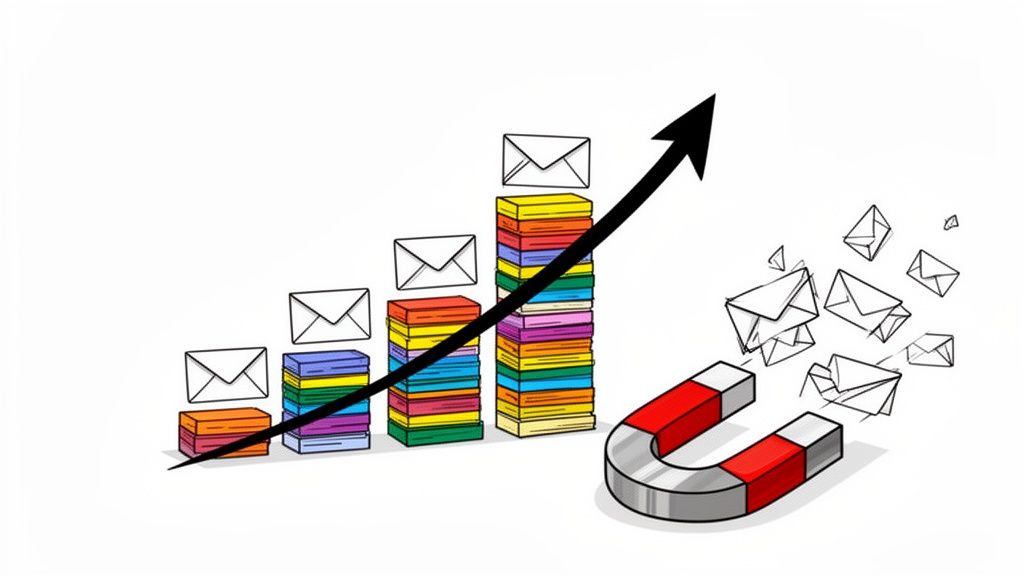
This simple loop is the engine behind every successful influencer program: you invest in the right partnerships, and those partnerships create a cycle of measurable growth.

Let’s break down how to get this foundation right.
What Does "Success" Look Like?
First things first: you have to define the win. Are you trying to get your name out there, or are you trying to drive immediate sales? Your answer changes everything—from the influencers you choose to the metrics you’ll obsess over.
Most startups will be aiming for one of these outcomes:
- Brand Awareness: The goal is pure exposure. You want to introduce your brand to new, highly relevant audiences. We measure this with things like reach, impressions, and new follower counts.
- Lead Generation: This is all about capturing contact info. You're driving traffic to a landing page to get email sign-ups for a beta launch, a free download, or a waitlist.
- Direct Sales: The most bottom-of-funnel goal. Success here is measured in dollars and cents through promo code usage, affiliate link clicks, and tracked conversions.
My two cents: Don't try to do everything at once. Pick one primary goal for your first campaign. If you try to build awareness, generate leads, and drive sales simultaneously, your message gets muddled, and you’ll have no idea what actually worked.
Nailing Down a Realistic Startup Budget
Let's talk money. You don't need a massive war chest to get started. You can launch a campaign with a great product and zero cash, or with just a few hundred bucks. The key is being smart with what you have.
And make no mistake, this is a channel worth investing in. The average influencer marketing budget saw a staggering 171% year-over-year jump between 2024 and 2025, and 84% of brands confirm it’s an effective strategy. While some companies now spend over $5 million a year, that just proves the model works. As a startup, your small, strategic investment is tapping into a proven growth lever. You can dig into more of the numbers by checking out these comprehensive influencer marketing statistics.
For an early-stage brand, your budget will likely fall into one of these buckets:
- Product-Only (Gifting): This is the go-to for bootstrapping. You send your product to nano-influencers for free in hopes of an authentic post. It’s a numbers game, but it can work wonders.
- Small Cash Budget ($500 – $1,500): This range opens the door to collaborating with a few fantastic micro-influencers for dedicated content, like a Reel or a set of Stories.
- Hybrid Model: This is often the sweet spot. You offer both free product and a small cash payment or an affiliate commission. It gives the creator some guaranteed income while tying a portion of their earnings to the results they drive.
Crafting a Simple, Effective Creative Brief
A creative brief isn’t about micromanaging a creator—it’s about providing clear guardrails so their creativity aligns with your business goals. Think of it as a one-page "cheat sheet" for your campaign. It prevents confusion and ensures everyone is on the same page.
Keep it short and to the point. Here's what to include:
- About Us: One quick paragraph on who you are and the problem you're solving.
- Our Goal: State your one primary objective. For example, "drive sign-ups for our new app beta."
- Key Messages: List 2-3 core ideas you need them to hit. These are talking points, not a script. Let them say it in their own voice.
- The Ask (Deliverables): Be specific. "We're looking for one Instagram Reel and three Stories."
- The Nitty-Gritty: Include your timeline, any required tags or hashtags, and the specific call-to-action you want them to use.
This simple document is your best friend. It builds trust and sets the stage for a partnership that feels professional and produces results.
Finding and Vetting Influencers Who Actually Fit Your Brand

Let’s be honest: your entire campaign hinges on picking the right people. This is where the real work of influencer marketing for startups begins. It’s less about chasing vanity metrics and more about finding creators whose audience and personal values genuinely click with what your brand is all about.
My advice? Forget the big names with millions of followers. For a startup, the real gold is often found with smaller, more niche creators. Time and again, data shows that micro- and nano-influencers drive significantly higher engagement and come across as far more authentic—usually for a much smaller investment.
The reason is simple. Their followers aren't just a faceless crowd; they're a tight-knit community built on trust. A product shout-out from a micro-influencer feels more like a recommendation from a friend you trust, and that’s the kind of social proof a new brand desperately needs.
Where to Start Your Search
You don't need a fancy, expensive platform to find your first wave of influencers. Honestly, some of the best partners can be found with a little bit of clever, manual digging.
The key is to think exactly like your ideal customer. Where do they hang out online? What hashtags are they already following? Who do they already listen to? Your search starts there.
- Hashtag Deep Dives: Get specific. Instead of a broad tag like
#fitness, you'll find better-fit creators using long-tail hashtags like#postpartumworkoutor#veganmealprepsunday. These niche tags are a direct line to creators who are already speaking to your target audience. - Audience Overlap: Check out the followers of brands that are similar—but not direct competitors—to yours. Who are your dream customers already following and interacting with? An influencer’s “Following” list can be a treasure trove.
- Go Local: If your startup has a geographic component, use Instagram’s location tags. Searching for influencers in specific cities is a game-changer for local service apps or brands with a physical presence.
At this stage, just focus on building a list. Pop potential names into a spreadsheet without overanalyzing just yet. A solid starting list of 20-30 candidates is a great goal.
Vetting: Looking Beyond the Follower Count
Once you have your list, the real work begins. Vetting is the one step you absolutely cannot skip. It’s how you’ll filter out creators with fake followers, an unengaged audience, or a simple lack of brand fit. You're hunting for genuine influence, not just a big number at the top of their profile.
Here’s the personal checklist I run through to confirm if a creator is the real deal:
- Audience First, Always: My first question is always: Does their audience match my customer persona? If you're selling a premium tech gadget, an influencer who primarily posts budget-friendly life hacks is a poor match, even if their engagement rate is stellar. The alignment has to be there.
- Engagement Rate vs. Follower Count: A massive follower count paired with low engagement is a huge red flag. Do the quick math: (Likes + Comments) / Followers x 100. For micro-influencers (10k-100k followers), you want to see rates above 3%. For nano-influencers (under 10k), great ones often hit 5-8%, which indicates a super-healthy community.
Key Takeaway: I'd take an influencer with 8,000 followers and a 7% engagement rate over one with 100,000 followers and a 1% rate any day. As a startup, you're paying for engaged eyeballs, not just vanity metrics.
Spotting Red Flags and Confirming Authenticity
Not all engagement is good engagement. You need to look closer to make sure you aren't about to invest in a profile propped up by bots or low-quality interactions. This is a crucial skill in effective influencer marketing for startups.
Here’s how to tell the real creators from the fakes:
- Read the Comments: Are they all generic one-liners like "Great post!" or "Love this!"? Or are people asking thoughtful questions and sharing personal stories? Real conversation is the clearest sign of genuine influence.
- Check the Follower-to-Following Ratio: I get skeptical when an account follows thousands and thousands of other people. It’s often a sign of aggressive "follow-for-follow" tactics they used to inflate their numbers. A healthy profile usually follows way fewer accounts than follow them.
- Review Past Partnerships: Look at their previous sponsored posts. Do they partner with brands you respect? A feed that's cluttered with frequent, random, or low-quality ads suggests their audience might have ad fatigue.
- Assess Content Quality: Is there a consistent theme, voice, and aesthetic? A well-managed feed shows they’re professional and treat their own profile like a brand, which makes them a much more reliable partner for you.
Finding the right nano- and micro-influencers is one of the most powerful, budget-friendly ways to get your startup in front of a targeted audience. To dive deeper into this process, check out our complete guide on how to find micro-influencers who can drive real results. By prioritizing authenticity and true audience alignment, you can build partnerships that create real trust and deliver returns you can actually measure.
Crafting Outreach That Actually Gets a Reply
Alright, you've put in the work and built your dream list of creators. Now for the tricky part: actually making contact. Let's be real, an influencer’s inbox is a warzone, flooded with lazy, copy-pasted templates. If you want to stand out, your approach needs to be about building a genuine partnership, not just making a one-sided ask.
Your goal isn't just to get a "yes." It's to kick off a real conversation that could lead to a long-term relationship. Your first message sets the entire tone.
Personalizing Your Pitch Beyond "Hey [Name]"
Simply dropping their first name into a template isn't personalization. It's the bare minimum. Creators can spot a generic email blast from a mile away, and they’ve learned to ignore them. True personalization shows you've actually done your homework.
Here’s how to craft an intro that proves you’re not just another brand spamming their inbox:
- Reference their actual work. Mention a specific post, Reel, or even a line from a Story that caught your eye. Something like, "I loved your Reel on finding vintage denim last week—that find from the flea market was incredible!" shows you're a real fan.
- Connect the dots to their audience. Don't just talk about your product; explain why you believe their specific community would genuinely connect with it. This shows you're thinking about providing value to them, not just extracting it.
- Lead with the partnership, not the ask. Before you dive into deliverables, frame the collaboration. Explain what's in it for them and how it aligns with the content they're already creating.
A great pitch isn't about what you want from them; it's about what you can build together. Start with authentic appreciation and a clear vision for how your brand can benefit their audience. A little bit of genuine effort here goes a very long way.
Negotiating on a Startup Budget
You're a startup. You probably don't have a massive cash budget for influencer marketing, and that’s okay. Some of the most successful partnerships are built on creative compensation models that go way beyond a simple flat fee. Honesty is your best asset here.
Be upfront about being an early-stage brand, but frame it as an exciting opportunity to grow together. Here are a few compensation structures that work wonders for startups:
- Product Seeding (Gifting): This is your foot in the door. You send your product for free to a curated list of nano- and micro-influencers with no strings attached. It's a bit of a numbers game, but the authentic mentions and user-generated content (UGC) you can get are pure gold.
- Affiliate Partnerships: This is a classic win-win. You give the creator a unique discount code for their followers and a custom link to track sales. They earn a commission on every purchase they drive. It's incredibly low-risk for you and gives them unlimited earning potential.
- Hybrid Models: This is often the sweet spot. You can offer a smaller flat fee to cover their time and creative energy, paired with a strong affiliate commission. This model shows you respect their work while tying compensation directly to campaign performance.
Protecting Both Parties with a Simple Agreement
Once you’ve settled on the terms, get it in writing. This doesn’t have to be a scary, 20-page legal document. A simple, one-page agreement is all you need to protect your startup and the creator by making sure everyone is on the same page from day one.
Think of it as a professional handshake that outlines the key details.
Key Elements for a Basic Influencer Agreement:
| Clause | What It Covers | Why It Matters |
|---|---|---|
| Deliverables | The exact content to be created (e.g., 1 Instagram Reel, 3 Stories). | No guesswork. Everyone knows the scope of work. |
| Timeline | Dates for draft submission and final posting. | Keeps your campaign on schedule and avoids delays. |
| Compensation | The agreed-upon payment structure (fee, product, affiliate details). | Prevents any awkward conversations about money later. |
| Content Usage Rights | Where and for how long you can use their content. | Gives you the legal right to repurpose their awesome UGC. |
| Exclusivity | Whether they can work with direct competitors during the campaign. | Protects your brand from getting lost in the noise. |
| Disclosure Rules | A reminder to use appropriate hashtags like #ad or #sponsored. |
Ensures you both comply with FTC guidelines and build trust. |
This simple step professionalizes the relationship and prevents misunderstandings down the line. It’s the foundation for a successful partnership you can hopefully repeat again and again.
Measuring Success and Proving Your ROI

The campaign is live. The content looks great. Now for the hard part: proving the investment actually paid off. For a startup, tracking performance and calculating ROI isn't just a "nice-to-have" marketing task; it’s fundamental to your survival and ability to scale.
If you aren't tracking your results, you're just throwing money at the wall and hoping something sticks. We need to move past the vanity metrics. Likes and follower counts feel good, but they don’t pay the bills or tell you if a campaign actually moved the needle for your business. Solid tracking is what separates a one-off experiment from a predictable growth channel.
Building Your Tracking Foundation
Before any content goes out the door, you absolutely must have a system in place to measure its impact. This is non-negotiable, and thankfully, the tools you need are mostly straightforward and often free.
Your best friend here is the UTM parameter. A UTM (Urchin Tracking Module) is just a small piece of code you add to the end of a URL. It acts like a digital breadcrumb, telling your analytics tool—like Google Analytics—precisely where a visitor came from.
This is how you attribute website traffic, sign-ups, and sales directly to a specific influencer, or even a specific piece of their content. It’s the difference between seeing "we got some traffic from Instagram" and knowing "Jane Doe's Reel drove 150 new users and 12 sales." That level of detail is gold.
My advice: Create a unique UTM link for every single influencer and every post they make. Yes, it's a bit of upfront work, but this is how you spot your top performers, kill what isn't working, and understand what kind of creative actually drives action.
The KPIs That Actually Matter for Startups
The KPIs you track should be a direct reflection of your campaign goals. An awareness campaign is going to have completely different success metrics than a sales-focused one. Let's look at the essential KPIs for each stage of the marketing funnel.
The table below breaks down the key performance indicators you should be monitoring. Think of it as your dashboard for campaign health, organized by how close a potential customer is to making a purchase.
Essential KPIs for Startup Influencer Campaigns
| Funnel Stage | KPI | What It Measures |
|---|---|---|
| Top of Funnel (Awareness) | Reach & Impressions | How many unique people saw your content and the total number of times it was viewed. This is your brand exposure. |
| Top of Funnel (Awareness) | Engagement Rate | The percentage of the influencer's audience that interacted with the content (likes, comments, shares). Shows content quality. |
| Mid-Funnel (Consideration) | Link Clicks | The number of people who clicked your unique UTM link. This signals clear intent to learn more about your brand. |
| Mid-Funnel (Consideration) | Cost Per Click (CPC) | Your total campaign cost divided by the total number of clicks. A core metric for measuring the efficiency of your spend. |
| Bottom of Funnel (Conversion) | Conversions | The number of desired actions taken (e.g., sales, sign-ups, downloads). This is the direct business impact. |
| Bottom of Funnel (Conversion) | Conversion Rate | The percentage of link-clickers who ended up converting. This tells you how effective the influencer's content was at persuading their audience. |
| Bottom of Funnel (Conversion) | Customer Acquisition Cost (CAC) | Your total campaign cost divided by the number of new customers acquired. The ultimate measure of profitability. |
By focusing on this mix of metrics, you get a complete picture of performance, from initial visibility to the final sale. To dig even deeper into this, check out this excellent guide on Modern Influencer Marketing Measurement.
Getting Attribution Right
Attribution is one of the trickiest parts of marketing. A customer might see an influencer's post, forget about it, Google your brand a week later, and then finally buy after seeing a retargeting ad. Who gets the credit?
This is where attribution models come into play.
- First-Touch Attribution: Gives 100% of the credit to the first marketing touchpoint—in this case, the influencer’s post. It's useful for understanding what initially brings people into your world.
- Last-Touch Attribution: Gives 100% of the credit to the very last touchpoint before the sale. It’s the easiest to track but often undervalues the awareness-building work that came before.
- Multi-Touch Attribution: This model is more sophisticated, distributing credit across all the touchpoints that led to a conversion. It gives you the most realistic view of how different channels work together.
As a startup, you can’t go wrong by starting with a simple last-click model using your UTMs and unique discount codes. As you grow, you can layer in more advanced models to get a clearer picture of the entire customer journey.
The more you dig into your data, the better you'll get at calculating your true influencer marketing ROI and turning this channel into a repeatable engine for growth.
A Few Common Questions About Startup Influencer Marketing
Jumping into influencer marketing always brings up a few nagging questions. Even with a solid plan, you're bound to hit some confusion points—it's a new world with its own language and unwritten rules.
I've been there. Let's walk through the most common hurdles I see founders face and get you some clear, straightforward answers.
How Much Should I Actually Pay an Influencer?
This is the big one, the question I hear every single time. And the honest-to-goodness answer is: it completely depends on the creator and the campaign. There’s no magic rate card, unfortunately.
Several things will move the price tag up or down:
- Audience Size & Niche: A creator with 20,000 followers in a super-specific niche like B2B SaaS can easily charge more than a general lifestyle creator with 100,000 followers. Niche expertise is valuable.
- Engagement Rate: This is huge. A high engagement rate (think 5% or more) proves their audience actually listens. Creators with these active, trusting communities deliver real action, and they can charge for it.
- The "Ask": What are you actually asking for? A single, 15-second Instagram Story is a world away from a dedicated, professionally shot YouTube review. The more effort required, the higher the cost.
- Usage Rights: If you want to take their content and run it as a paid ad on your own channels, that's a separate line item. Expect to pay a premium for those rights.
For a startup, I almost always recommend starting with a hybrid deal. Offer a fair base fee that respects their time and creative work, but add an affiliate commission so they have a real stake in driving sales. It's the perfect way to balance your budget while motivating the creator.
Is Gifting Products Still a Thing?
Absolutely, product gifting is still one of the most effective tools in the startup playbook—but only when it's done thoughtfully.
The biggest mistake I see is the "spray and pray" approach: mass-mailing products to a long list of influencers with a generic "Hope you like it!" note. That isn't a strategy; it's just burning through inventory and postage.
To make gifting work, you have to be personal and targeted. Zero in on nano-influencers (those with 1k-10k followers) who are a dead-on match for your brand and have a genuinely connected audience.
Here's a pro tip: Don't make your first message a request. Warm them up. Follow them, and for a week or two, leave genuine comments on their posts. When you finally slide into their DMs, your pitch will feel less like a cold email and more like a conversation. Explain why you thought of them specifically. It makes all the difference.
What's the Real Difference Between Influencer and Affiliate Marketing?
It's easy to get these two confused, especially since they often work together. The key is understanding their primary purpose. Influencer marketing is mostly about building brand awareness and credibility. Affiliate marketing is a pure performance-based sales channel.
When you're mapping out your early growth plans, it’s crucial to understand the nuances between affiliate marketing vs influencer marketing so you can pick the right tool for the job.
Here's how I break it down for founders:
| Aspect | Influencer Marketing | Affiliate Marketing |
|---|---|---|
| Primary Goal | Brand awareness, trust, social proof | Driving direct sales |
| Compensation | Often flat fees, product, or hybrid | Purely commission-based (pay-per-sale) |
| Partners | Content creators, storytellers | Anyone with an audience (can include influencers) |
| Focus | Creative content and authentic storytelling | Driving clicks and conversions |
The best startup campaigns find a way to blend both. For example, you might pay an influencer a flat fee for a creative Instagram Reel (that's influencer marketing) but also give them a unique affiliate link to share with their followers to earn a cut of the sales (that's affiliate marketing). It's a win-win.
Ready to stop guessing and start growing? ReachLabs.ai offers full-service influencer marketing strategies designed to connect your startup with authentic creators who drive real results. Let our team of specialists build and manage your campaigns, turning influencer partnerships into a predictable engine for customer acquisition.