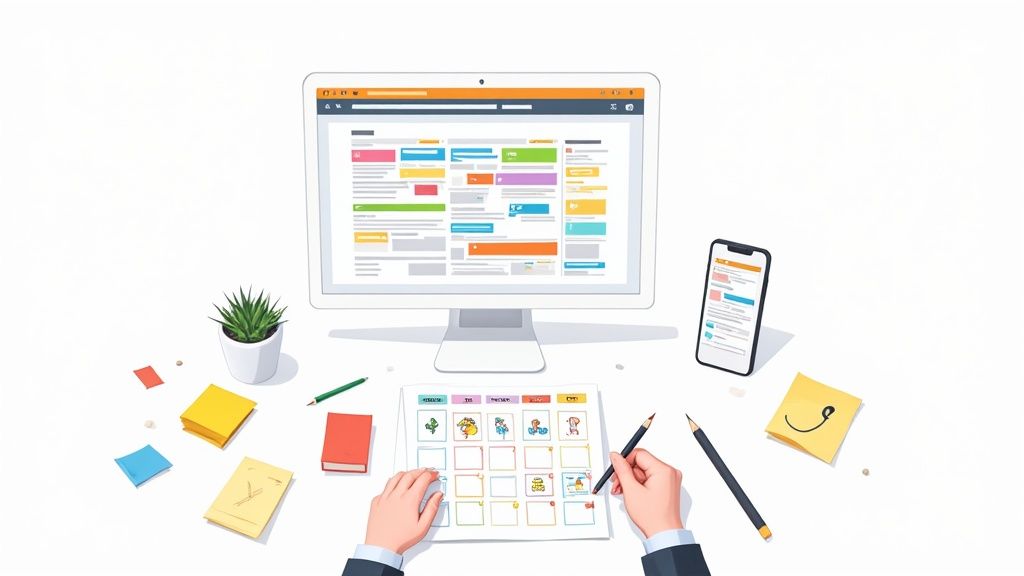
A solid content calendar comes down to a few key moves: setting clear goals, truly understanding your audience, defining your core content pillars, and picking the right tools for the job. Think of it less as a simple schedule and more as the strategic roadmap that transforms content chaos into a smooth, effective marketing machine.
Why Your Content Calendar Is a Strategic Game Changer
Let's get one thing straight: a content calendar is so much more than a glorified to-do list. It’s the strategic backbone of your entire marketing effort. When you don't have one, you're always playing catch-up, scrambling for last-minute ideas and publishing content that just feels… random.
A well-built calendar completely flips that script. It turns content from a daily chore into a proactive tool for growth.
Get Your Team on the Same Page and End the Chaos
One of the most immediate wins is team alignment. Suddenly, your writers, designers, and social media managers are all working from a single source of truth. The constant back-and-forth disappears because everyone knows what’s coming, what they’re responsible for, and when it’s due.
This kind of clarity is a lifesaver. It prevents bottlenecks and eliminates that last-minute panic that absolutely crushes creativity. Instead of a morning scramble asking, "What are we posting today?" your team can actually focus on doing their best work. For a really practical walkthrough, this guide on how to create a content calendar for social media is a great resource.
Shift from Reactive Posting to a Proactive Strategy
A calendar gives you the power to think weeks, and even months, ahead. This is where the real strategy kicks in. You can start planning with purpose.
- Big Moments & Events: Got a trade show, a holiday campaign, or a major product launch coming up? You can build your content around it, creating momentum instead of a last-minute rush.
- Filling Content Gaps: A long-term view helps you spot the topics your audience is asking for that you haven't covered yet.
- Getting More from Your Winners: You can strategically schedule time to turn that one high-performing blog post into a video, an infographic, or a whole series of social media snippets.
The data doesn't lie. Research shows that 96% of the most successful content marketers rely on a documented content calendar, directly linking organized planning to better results. Yet, here's the disconnect: while over 60% of marketers publish content daily, only 53% have a structured workflow to manage it. That gap is where opportunity is lost.
A content calendar doesn't box in your creativity—it builds the framework for it to flourish. It ensures every single thing you publish has a purpose and pushes you closer to your big-picture goals.
When you plan ahead, you create consistency. And consistency is what builds trust with your audience and establishes your brand as an authority. If you want to see how this works specifically for social channels, check out our guide here: https://www.reachlabs.ai/social-media-content-calendar/
Set Your Foundation with Clear Goals and Audience Insights
Before you even think about brainstorming a single topic or picking a fancy new tool, we need to get back to basics. It all boils down to two simple questions: Why are we creating this content in the first place, and who is it actually for?
Skipping this foundational step is a classic mistake. I’ve seen it happen countless times. You end up with a calendar full of random acts of content that don't connect, don't perform, and don't move your business forward. A great content calendar isn't just a schedule; it’s a strategic roadmap where every single piece has a job to do.
Define Your Content Marketing Goals
Let's be honest, "increase brand awareness" isn't a goal; it's a wish. To get real results, your objectives need to be specific, measurable, and tied to a deadline. Think of them as SMART goals—Specific, Measurable, Achievable, Relevant, and Time-bound. This simple framework turns vague ideas into clear, actionable targets.
So, what does success actually look like for your business three months from now? Six months from now?
Here are a few examples of what strong, goal-oriented content objectives look like in the real world:
- Increase organic search traffic to our blog by 20% in Q3.
- Generate 50 marketing-qualified leads (MQLs) from our new e-book within its first 60 days.
- Boost video engagement rates on LinkedIn by 15% over the next three months.
- Grow our email subscriber list by 500 new contacts this quarter using gated content.
Connecting these goals directly to your bigger business objectives is where the real power lies.
Here’s a simple table to help you map everything out:
Mapping Your Content Goals to Business Results
| Business Objective | Content Goal | Primary KPI | Example Content |
|---|---|---|---|
| Increase revenue from new customers | Generate high-quality leads | Marketing Qualified Leads (MQLs) | Gated e-book, webinar registration |
| Improve customer retention | Increase product adoption & engagement | Feature usage rate, support tickets | "How-to" video tutorials, user case studies |
| Establish authority in the industry | Grow organic traffic and visibility | Organic keyword rankings, backlinks | In-depth pillar pages, original research reports |
| Build a loyal community | Boost social media engagement | Likes, comments, shares, saves | Interactive polls, user-generated content campaigns |
By linking every action to a tangible outcome, you ensure no piece of content is created just to fill an empty slot on the calendar.
When you set these clear benchmarks, you give every blog post, video, and social update a distinct purpose. You stop creating content for the sake of it and start creating content that actively moves the needle.
Get to Know Your Audience Deeply
Once you’ve figured out your "why," it's time to lock in your "who." Publishing content without a crystal-clear picture of your audience is like shouting into the void. You might be saying all the right things, but if no one's listening—or the wrong people are—it's a massive waste of effort.
This is where you need to go beyond surface-level demographics. Age and job title are a start, but what really matters are the psychographics—their motivations, their biggest headaches, and what they're trying to achieve.
Creating detailed audience personas is the best way to do this. A persona is essentially a character sketch of your ideal customer, pieced together from real data and research. It makes your target audience feel like a real person you know. If you're new to this, our guide on how to create buyer personas walks you through the entire process.
To build a persona that’s actually useful, you need to answer questions like:
- What are their biggest professional pain points and daily frustrations?
- What does a "win" look like for them in their role?
- Where do they hang out online to get advice? (Think specific LinkedIn groups, forums, or blogs).
- What kind of content do they actually prefer? Short-form video? In-depth articles? Case studies?
This insight is everything. When you know exactly who you're talking to and what keeps them up at night, every piece of content you plan will hit home, building the trust you need to turn them from a reader into a customer.
Brainstorm and Organize Your Core Content Pillars
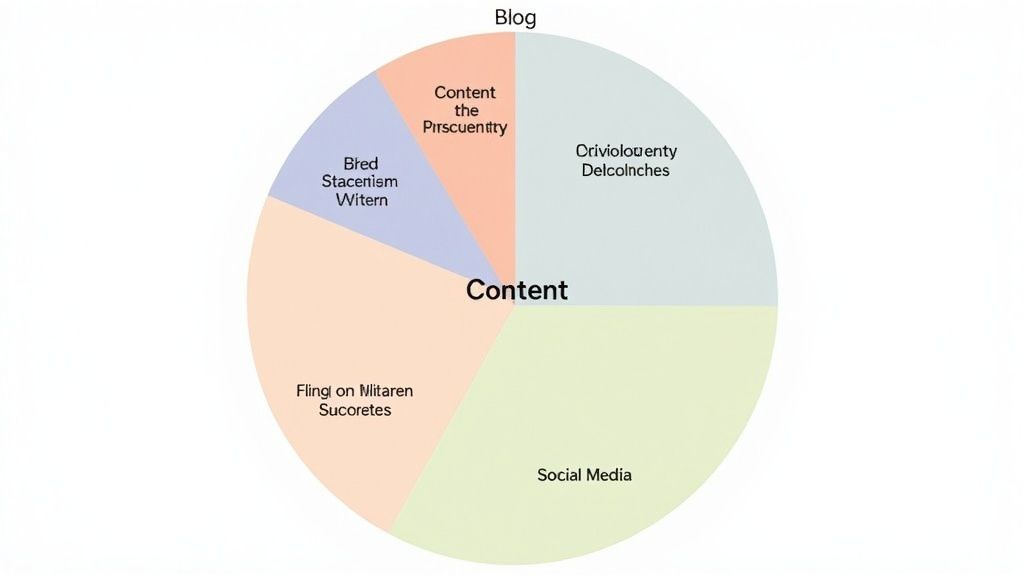
Now that you know your goals and who you're talking to, it’s time to decide what you’ll actually talk about. This is where the magic of content pillars comes into play. Instead of chasing a never-ending stream of disconnected ideas, you’re going to establish 3-5 core themes that your brand will completely own.
Think of these pillars as the foundational topics at the very heart of your expertise. They're the subjects your audience is hungry for and that directly connect back to the problems your business solves. They become the main categories on your blog or the central playlists on your YouTube channel.
Getting this right is what stops your content from feeling random and disjointed. Every single piece you create will tie back to one of these pillars, reinforcing your authority and making your message stick.
Uncovering Your Core Topics
So, where do these pillars come from? It's a blend of looking inward at your own expertise and outward at what your audience actually needs. Your best ideas almost always live at the intersection of what you know best and what your audience is actively searching for.
Start by just getting ideas down on paper. Don't filter yourself yet—the goal is volume. To really get the creative juices flowing and build a library of great topics, it’s worth exploring some top ideation techniques.
Here are a few practical ways I like to kick off a brainstorming session:
- Analyze Your Competitors: See what topics your most successful competitors keep coming back to. Use their success as a clue, but more importantly, look for the gaps they’ve missed. That’s your opening.
- Dive into Keyword Research: Fire up your favorite SEO tool and find out what your audience is actually typing into Google. Look for recurring questions and themes related to your industry.
- Talk to Your Team: This one is gold. Your sales and customer service folks are on the front lines every single day. They know the real questions, objections, and pain points that come up in actual conversations.
Once you have a massive list of potential ideas, start grouping them into logical categories. You'll quickly see clusters forming, and those clusters will become your content pillars.
Your content calendar isn't just a schedule; it's a strategic asset that turns your hard work into measurable growth. A pillar-based approach is the foundation for this, and it’s a key reason why 74% of marketers report that content marketing helps them generate more demand.
From Pillars to Specific Ideas
Let's walk through a quick example. Imagine you’re a B2B SaaS company with a great project management tool. After brainstorming, you might land on these core pillars:
- Project Management Methodologies
- Team Productivity & Collaboration
- Leadership & Management Skills
These are broad enough to give you plenty of room to play but specific enough to keep you focused. From here, you can start breaking each pillar down into dozens of potential content pieces—blog posts, videos, social media updates, you name it.
For instance, under the "Team Productivity & Collaboration" pillar, you could create:
- A blog post: "5 Asynchronous Communication Strategies for Remote Teams"
- A short video: A demo of a feature that improves team workflow
- A LinkedIn post: A quick tip on running more effective meetings
This pillar system is the secret to building a content calendar that actually works. It makes planning manageable, guarantees consistency, and cements your reputation as the go-to expert in your space.
Choose the Right Tools for Your Content Calendar
Even the most brilliant content strategy will sputter out without the right tools to bring it to life. Your content calendar is the command center where ideas get turned into action, so picking a platform that actually fits your team’s workflow is non-negotiable.
The goal isn’t to find the flashiest software with a million features. It’s to find the one that makes your job easier. Many of the most successful content operations I’ve seen run on surprisingly simple setups, so don't feel pressured into a complex, expensive system from the start.
Start Simple: Spreadsheets and Kanban Boards
If you’re a solo creator or part of a small, nimble team, don’t underestimate the power of free tools. A well-organized Google Sheet or a simple Trello board can often do everything you need without the unnecessary fluff.
- Google Sheets: This is the ultimate blank slate. You can build a system from the ground up with custom columns for anything you can think of—publish dates, authors, target keywords, status updates, distribution channels, you name it. It's free, collaborative, and completely flexible.
- Trello or Asana (Free Tiers): For those who think visually, Kanban-style boards are a game-changer. Create a card for each piece of content and physically drag it through your workflow stages, from "Idea" to "Drafting," "In Review," and finally to "Published."
Starting with these basic tools is smart. It forces you to figure out what your process really is before you get locked into a paid platform's way of doing things.
When It's Time to Upgrade to a Dedicated Platform
Sooner or later, you'll feel the growing pains. Spreadsheets get clunky, notifications get missed, and you find yourself spending more time managing the tool than creating content. That’s the signal that it's time to look at dedicated software.
A great platform does more than just hold your schedule. It should streamline your entire content process, from the first spark of an idea to the final review of its performance.
This is where tools like CoSchedule, Airtable, or the paid versions of Asana come in. They offer features that simple tools can't, like integrated social media scheduling, automated approval workflows, and performance dashboards that tie content directly back to your business goals.
The global calendar market itself was valued at $36.4 billion in 2021 and is on track to hit $43.4 billion by 2025. This tells you just how critical sophisticated planning tools have become for businesses of all sizes. You can dive deeper into these trends in the full calendar market report.
Ultimately, choosing a tool is a balancing act. Start with what you need right now, but always keep an eye on the future. As your strategy gets more sophisticated and your team grows, don't hesitate to invest in a platform that can grow with you.
Build Your Calendar and Establish a Sustainable Workflow
Alright, you've done the strategic heavy lifting. Now it’s time to get tactical and build the actual calendar. This is where your goals, audience insights, and brilliant ideas transform into a living, breathing plan. The first practical step is to start populating your chosen tool, whether that’s a straightforward spreadsheet or a more robust platform like Asana or Trello.
Think of your calendar as the command center for your entire content operation. For it to work, every single entry needs to contain the essential details. This way, anyone on your team can quickly understand the status of any piece of content without having to ask.
Here's the key information I always make sure to track for each content item:
- Topic: The working title or a clear description of the subject.
- Content Type: Is it a blog post, video, case study, or social media campaign?
- Owner: Who is the single point of contact responsible for this piece from start to finish?
- Due Date: The deadline for the final draft to be ready.
- Publish Date: The day it goes live for the world to see.
- Status: A simple progress marker, like Idea, In Progress, In Review, or Published.
Define Your Publishing Cadence and Workflow
A calendar filled with ideas is great, but without a process, it's just a wish list. You need to build a workflow that defines exactly how a raw idea becomes a polished, published piece of content.
The aim here is consistency, not intensity. A frantic, all-hands-on-deck approach might work for a week, but it leads to burnout fast. It's far better to establish a realistic publishing cadence that your team can stick to month after month.
This is where a well-defined workflow becomes your best friend. It outlines every step, from initial brief to final promotion.
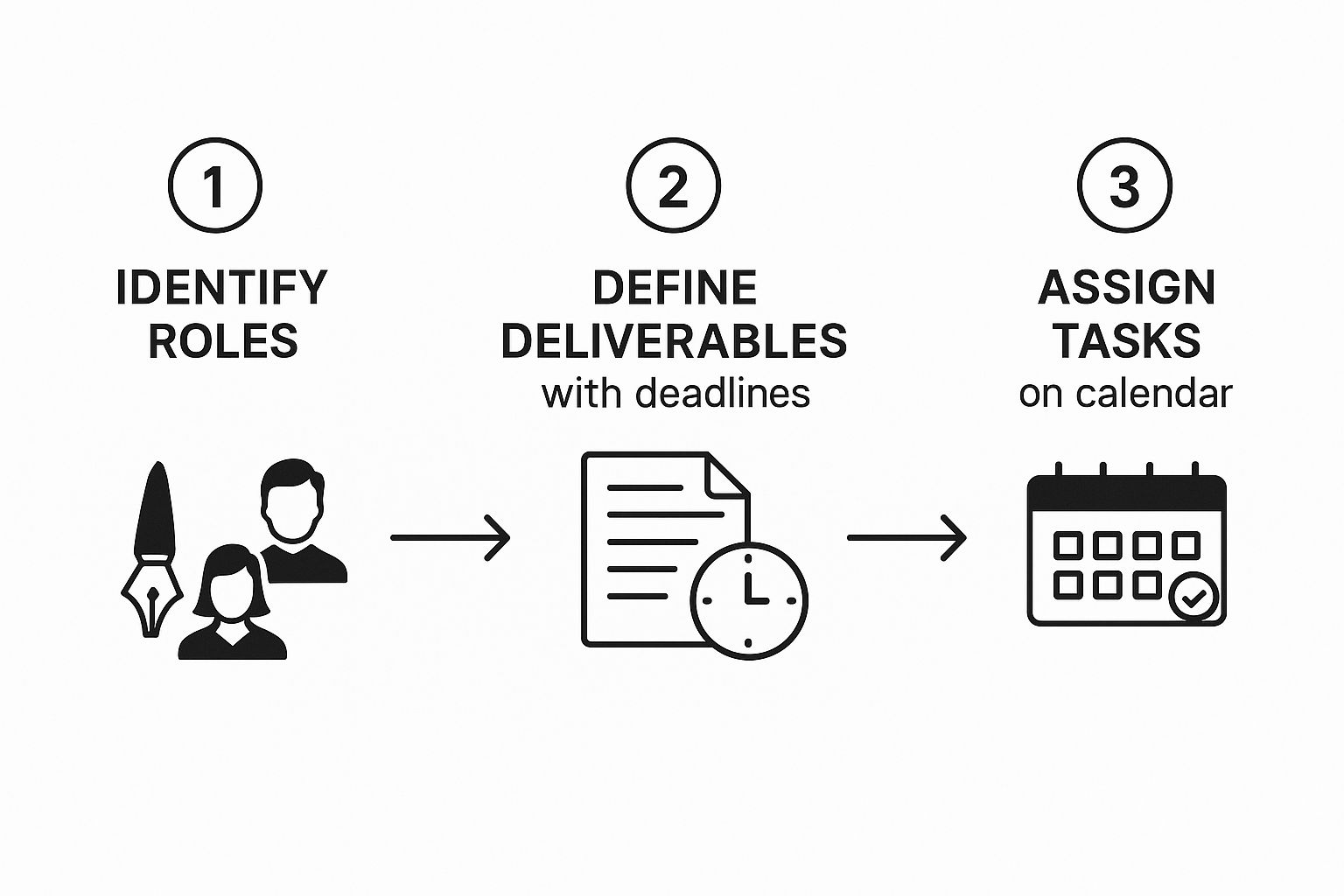
As you can see, a solid workflow relies on clear roles and a central place to track everything.
When everyone knows their part—the writer handling the draft, the editor polishing the copy, the designer creating the visuals—the whole operation runs smoothly. Documenting this process is the secret to true accountability. If you want to really nail this down, our guide on building an effective content marketing workflow is the perfect next read.
Don't Forget Distribution and Promotion
Hitting "publish" isn't the finish line. In fact, creating the content is only half the job. Your calendar needs to be the central hub for planning how you’ll get that content in front of the right eyeballs.
Think about it: with 65.7% of the world's population on social media, using an average of 6.84 different platforms each month, you can't just publish and pray. The promotional landscape is just too complex. You can find more social media usage stats over at Sprout Social.
Your content calendar should do more than just plan creation—it must also orchestrate distribution. By scheduling promotional activities alongside content publication, you ensure your hard work actually gets seen.
This means adding distribution tasks directly into your calendar. For every blog post, for example, you should have corresponding entries to:
- Schedule social media posts for all your key platforms.
- Draft and schedule an email newsletter announcing the new piece.
- Identify and plan outreach for backlinks or potential partnerships.
By building these promotional steps right into your calendar, you create a complete system. It takes your content from a simple idea to a fully promoted asset, making sure nothing ever slips through the cracks.
Have Questions About Your Content Calendar? We've Got Answers
Even the most meticulously crafted content calendar will run into a few bumps in the road. That's just part of the process. The goal isn't to create a rigid, unbreakable plan but to build a living, breathing framework that can adapt to reality.
Let’s tackle some of the most common questions that pop up once you start putting your calendar into action. Think of this as your cheat sheet for keeping things running smoothly.
How Far in Advance Should I Actually Plan My Content?
This is a classic question, and honestly, there's no single magic number. But from what I've seen work best, planning on a quarterly basis is the sweet spot. This gives you a 90-day strategic runway to map out major campaigns, align with product launches, and build momentum around key themes.
But you don't just plan for 90 days and walk away. It's a layered approach:
- Quarterly View: This is your high-level strategy. What are the big rocks you need to move in the next three months? What are your core themes?
- Monthly Sprints: Before each month begins, you zoom in. This is where you get specific, fleshing out exact topics, assigning articles to writers, and locking in deadlines.
- Weekly Check-ins: This is your pulse check. You’ll review what's happening, see if you need to adjust to any breaking news, and confirm the final publishing schedule for the next 7 days.
This rhythm gives you the best of both worlds: a clear long-term vision and the agility to adapt week-to-week.
We're Falling Behind Schedule… Now What?
First off, take a breath. It happens to everyone. The most important thing is how you react. Before you do anything, figure out why you're behind. Did you underestimate the research time for a blog post? Did a key team member get pulled into an urgent project? Was the scope just too ambitious? Pinpointing the root cause is the only way to prevent the same problem from derailing you next month.
Your content calendar isn't meant to be a rigid rulebook. It's a guide. Its real power comes from helping you make smart decisions when things inevitably go off-script.
If you have a content gap looming, look at what you can do right now. Can you pull an evergreen piece forward from next month? A fantastic quick win is to repurpose an old winner—turn that popular blog post into a quick infographic or a series of social media tips. It fills the slot with something valuable without a massive effort. Never rush a piece just to hit a date; it's always better to publish something great a little late than to push out sloppy work on time.
How Can I Keep My Calendar Flexible for Trending Topics?
This is a huge one. Nobody wants a content plan so locked down that you can't jump on a viral trend or a piece of breaking industry news. The trick is to plan for spontaneity.
It sounds counterintuitive, but it works. When you're building out your calendar, don't fill every single slot. I always recommend leaving one or two "flex slots" open each month, or even each week if your industry moves that fast.
These are your designated spots for reactive content. When something big happens, you're not scrambling and throwing your entire schedule into chaos. You just grab one of your open slots and go. This way, you get to be timely and relevant without sacrificing your core strategic content.
At ReachLabs.ai, we specialize in turning simple content schedules into high-performance growth strategies. If you’re ready to build a content plan that truly moves the needle, see how our data-driven approach can help.