
Your brand's voice is the distinct personality that comes through in your words. It’s not just about what you say, but how you say it—in every email, every social media post, and every single page on your website.
Think of it as the soul of your communication. It’s what makes your company sound like a person you can relate to, not a faceless corporation.
Your Brand Already Has a Voice—Is Anyone Listening?

Before you even think about writing down brand voice guidelines, you have to accept one simple truth: your brand is already speaking. Every interaction—from a casual customer service chat to a detailed product description—is shaping how people perceive its personality.
The real task isn't inventing a voice out of thin air. It’s about discovering the voice that’s already there and then learning how to refine and amplify it.
It's a lot like meeting someone for the first time. Their word choice, their energy, the way they phrase things—it all paints an instant picture of who they are. Your brand does the same thing. When that voice is consistent, customers feel like they're connecting with something real, something they can actually get to know and trust.
Why Your Voice Matters More Than Ever
Let's be honest, the market is crowded. A memorable personality is one of your biggest competitive advantages. People are flooded with generic marketing messages every day, and a unique voice is what finally cuts through all that noise.
When your voice is clear and consistent, it accomplishes a few crucial things for your business:
- It Builds Genuine Trust: Consistency creates a sense of familiarity and reliability. When you sound the same everywhere, customers know what to expect from you, which is the foundation of trust.
- It Creates an Emotional Connection: People don’t form relationships with faceless companies; they connect with personalities. A strong voice gives your brand a human quality that people can actually resonate with.
- It Fosters Unbreakable Loyalty: A voice that mirrors your audience's values and speaks their language can turn casual buyers into passionate fans who will go to bat for your brand.
A scattered brand messaging strategy just confuses customers and sends them straight to competitors who communicate clearly. A strong voice gives your team clear guidelines to keep content consistent and continually reinforces what your company does and why it matters.
At the end of the day, defining and using your brand voice isn't just a fun creative exercise. It's a strategic move that separates the brands people remember from the ones they easily forget.
What Are the 4 Pillars of Brand Voice?
So, what is a brand voice, really? It's easy to think of it as just a "vibe," but to make it work for you, you need to get more specific. Let's break it down into four core parts. Think of them as the four pillars holding up your brand's entire personality.
Get these right, and you'll have a complete, authentic, and recognizable voice. Nail down your Character, Tone, Language, and Purpose, and you'll move from vague ideas to a solid framework your whole team can actually use.
Pillar 1: Character
Your Character is the very soul of your brand's personality—it's who you are, consistently, no matter what. This is your foundation. A good starting point is to ask: if my brand was a person, who would they be?
Would they be the wise, experienced mentor you can always count on? A witty and playful friend who's always up for a laugh? Or maybe a bold innovator, shaking things up and challenging the old ways? This character is your brand's true north.
For instance, a financial planning firm will probably lean into a wise and trustworthy character. On the flip side, a new energy drink is more likely to be bold and adventurous. This core identity sets the stage for everything you say and do.
Pillar 2: Tone
If Character is your unchanging personality, then Tone is how you express that personality in different situations. It’s your emotional dial. After all, you wouldn't talk to a friend at a birthday party the same way you'd speak at a serious business meeting, right? Your brand shouldn't either.
Your tone needs to flex depending on where you are and what's happening:
- Social Media: Your tone might be upbeat and celebratory when you're launching something new.
- Customer Support: When a customer is frustrated, your tone shifts to be patient, calm, and reassuring.
- Website Copy: Here, your tone could be more informative and confident, establishing your expertise.
Tone is the chameleon of your brand voice. It makes sure you're always appropriate and empathetic, allowing your core character to connect with people on a human level, no matter the scenario.
Pillar 3: Language
Language is all about the actual words you use—the nuts and bolts of your communication. This is where your character and tone become real through your vocabulary, sentence style, and even the grammar you choose. Do you use technical jargon, or do you keep it simple and direct?
This isn't a random choice; it has to be deliberate and based on who you're talking to. The best brands don't just guess. They invest time in understanding their audience to figure out which words will actually land. In fact, research shows that 70% of audiences respond positively to brands whose CEOs are active on social media, which just goes to show how much a personal, authentic voice matters. You can see how top companies use research to shape their identity in this deep dive on brand voice.
Pillar 4: Purpose
Finally, every single thing you communicate needs a Purpose. What’s the "why" behind the message? Are you trying to teach your audience something? Make them laugh? Inspire them? Or get them to click "buy now"?
Your purpose is the anchor for the other three pillars. It makes sure your character, tone, and language are all pulling in the same direction to hit a specific goal. Without a clear purpose, even the most polished voice just ends up making noise.
To bring this all together, think of these four components as a system. Each one informs the others, creating a complete and cohesive voice.
The Four Pillars of Brand Voice
| Component | What It Is | Example Question to Ask |
|---|---|---|
| Character | The core personality of your brand. It’s consistent and doesn’t change. | If my brand were a person, what are their top 3 traits? |
| Tone | The emotional inflection of your voice. It adapts to different situations. | How should we sound when a customer is upset vs. excited? |
| Language | The specific words, phrases, and sentence structures you use. | Do we use slang and emojis, or keep it formal? |
| Purpose | The goal behind every piece of communication. The "why" behind the words. | What do we want our audience to do after reading this? |
By defining each of these pillars, you create a powerful tool that guides every blog post, email, and social media update, ensuring your brand always sounds like itself.
Why a Consistent Voice Is Your Greatest Asset
Defining your brand voice is one thing, but applying it consistently is where the real magic happens. Think of it like this: if a friend of yours was energetic and hilarious one day, then quiet and formal the next, you'd feel confused. You might even start to question how well you really know them. It's the exact same for your brand.
Consistency is what turns your business from a faceless logo into a familiar, reliable presence. When your Instagram stories, email newsletters, and customer support chats all sound like they’re coming from the same source, you build a powerful sense of trust. Customers know what to expect from you, which makes them feel secure.
Fostering Unbreakable Trust and Loyalty
That feeling of reliability is the bedrock of customer loyalty. In a world crowded with brands all shouting for attention, people naturally lean toward the ones they feel a genuine connection with. A consistent voice that mirrors their values can transform a casual buyer into a passionate advocate for your business.
This isn't just a warm and fuzzy idea; it has a real, measurable impact. While 85% of businesses go to the trouble of creating brand voice guidelines, a surprisingly low number actually enforce them. That's a huge missed opportunity, especially when you consider that 90% of consumers expect a consistent experience everywhere they interact with you.
When you deliver on that expectation, the results speak for themselves. A whopping 76% of people prefer buying from brands they feel a connection with over impersonal competitors. And what drives that connection? Shared values, which are the primary reason 64% of consumers stay loyal. If you want to dive deeper into the numbers, check out this detailed brand voice analysis.
This diagram breaks down how all the core components of brand voice work together.
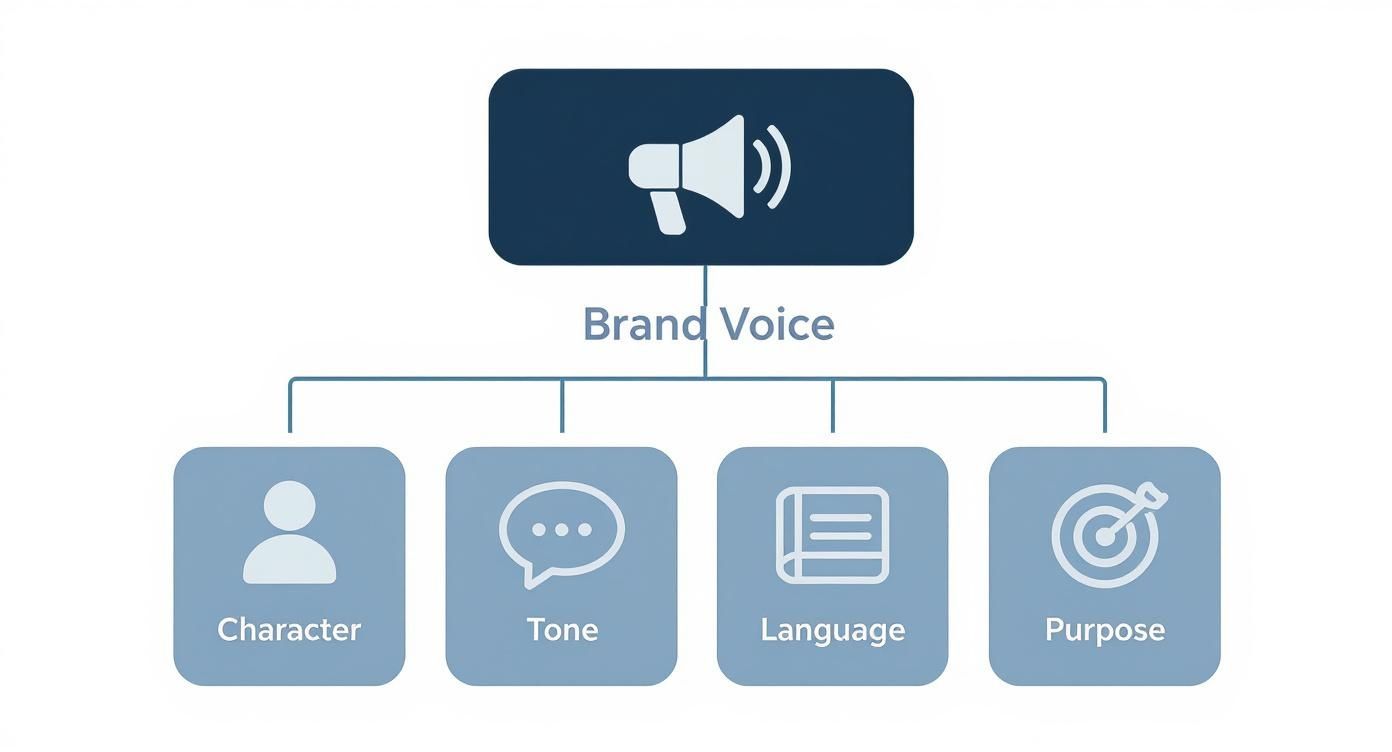
As you can see, every piece—from the high-level character down to the specific words you choose—plays a part in building a unified and effective brand personality.
Creating an Unbeatable Competitive Edge
Finally, a unique and consistent voice is your ultimate secret weapon. Let’s be honest, so many companies in the same industry end up sounding exactly alike. They all use the same tired jargon and safe, corporate-speak. A distinctive personality ensures you are instantly memorable.
When competitors blend into the background, a brand that speaks with a clear, consistent, and authentic voice doesn't just get heard—it gets remembered and chosen.
Think about it from the customer's perspective. When they need a solution you offer, whose name will pop into their head first? Will it be one of the dozen generic companies they vaguely recall, or will it be the one with the memorable personality they've come to know and trust? That's the power of a consistent brand voice. It's not just about sounding good; it’s about building a real asset that drives growth and sets you leagues apart from the crowd.
Your Step-by-Step Guide to Crafting a Brand Voice
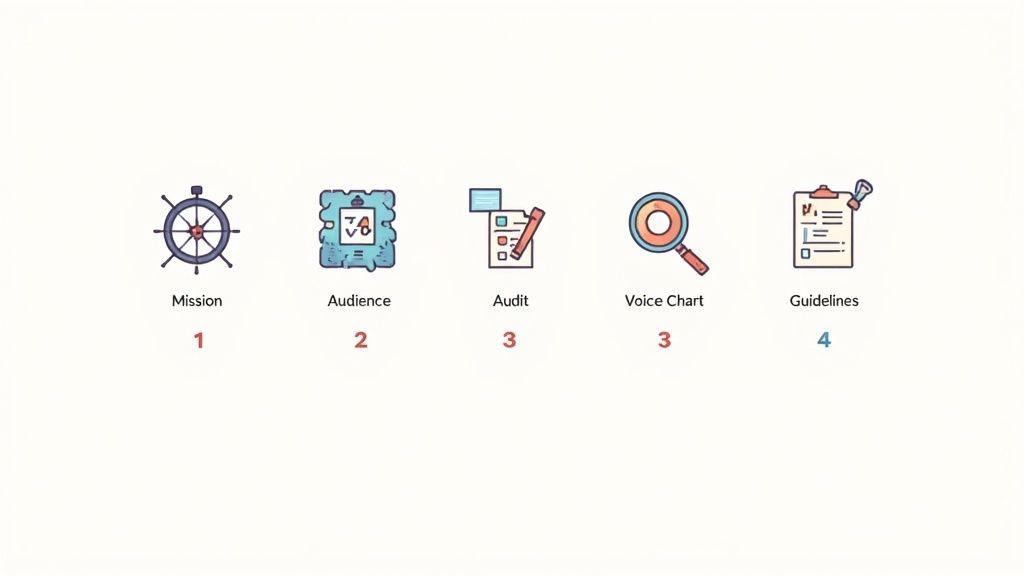
Now that we've covered the what and the why, it's time to get our hands dirty. Defining your brand voice isn't some abstract creative exercise—it's a series of deliberate actions that turn your brand’s personality into a tangible, powerful asset.
This practical, five-step framework will walk you through the entire process of discovering, defining, and documenting your brand's unique voice. Let's build a voice that’s both authentic and incredibly effective.
1. Anchor in Your Mission and Values
Before you figure out how to speak, you have to know what you stand for. Your mission, vision, and core values are the bedrock of your brand voice. They provide the "why" that fuels every email, blog post, and social media update.
Start by asking the big questions:
- Why does our company exist? Look past the balance sheet and pinpoint the core problem you solve for people.
- What values guide our decisions? List the principles that are completely non-negotiable for your business.
- What impact do we want to make? Define the change you hope to create in your industry or community.
Your answers here are the foundation of your brand’s personality. A brand built on sustainability will naturally sound very different from one focused on bleeding-edge innovation.
2. Profile Your Ideal Audience
You can’t have a real conversation without knowing who you’re talking to. Your brand voice should connect with your target audience on a personal level, speaking their language and reflecting what matters to them.
Go deeper than basic demographics. Build a detailed persona and think about their hopes, their biggest challenges, and their communication styles. What kind of content do they love? What tone do they use when talking with their friends or colleagues? Speaking their language shows you get them on a much deeper level.
To see how this fits into a bigger picture, you can explore how a complete brand messaging framework connects your voice directly to your audience's needs.
3. Audit Your Current Content
Let's be honest—you’re already communicating, so it's time for an honest assessment. Gather a wide range of your existing content, from blog posts and social media updates to email campaigns and website copy.
As you comb through it all, ask yourself:
- Does this sound like it all came from the same company?
- What personality traits are coming through the strongest?
- Is there a gap between how we want to sound and how we actually sound?
This audit is incredibly revealing. It will expose inconsistencies and highlight what’s already working, giving you a clear starting point for refinement.
4. Create a Brand Voice Chart
This is where your voice transforms from an idea into a practical tool. A brand voice chart translates abstract personality traits into clear, actionable writing guidelines. It's a simple concept, but it's incredibly powerful.
Start by picking three to five adjectives that capture your brand's character (e.g., "Passionate," "Helpful," "Witty"). Then, for each one, define what it looks like in practice with clear "Do" and "Don't" examples.
Voice Chart Example: Witty
We Are: Clever, humorous, and engaging.
We Are Not: Sarcastic, silly, or unprofessional.
Do: Use clever wordplay to make a point memorable.
Don't: Make jokes at the expense of our customers or competitors.
This chart removes the guesswork and gives your team a simple reference to keep everyone on the same page.
5. Document and Distribute Your Guidelines
Finally, pull all your hard work together into a simple, accessible guide. This doesn't need to be a 50-page document that gathers digital dust. A concise resource that includes your mission, audience profile, and brand voice chart is far more effective.
Make this guide a living document, easy for everyone on your team to find and use—from marketers to customer service agents. The goal is to empower every single employee to become a confident ambassador for your brand. As your team dives in, a few tips on finding your authentic writing voice can be a huge help in bringing the guidelines to life.
Great Examples of Brand Voice in the Wild

Theory is one thing, but seeing a powerful brand voice in action is where the lightbulb really goes on. To get a better feel for how these ideas work in the real world, let's look at three companies that have absolutely nailed their unique personalities.
We're going to break down the specific choices these brands make everywhere from their social media posts to their website copy. The goal here isn't just to admire their work, but to understand the strategy behind the words so you can start brainstorming your own.
Innocent Drinks: The Witty Friend
Innocent Drinks has built a massive following on a simple, playful voice. They sound like that slightly quirky, charming friend who always makes you laugh and also happens to make fantastic smoothies. Their magic lies in making the ordinary feel extraordinary.
You won't find boring product descriptions on their labels. Instead, you get witty observations and silly jokes. Their social media feels less like a corporate megaphone and more like a casual, ongoing chat. This approach instantly disarms you, turning a routine purchase into a genuinely fun moment.
This witty voice isn't just for fun; it's a strategic choice that perfectly matches their mission to make healthy, natural food feel accessible and enjoyable. They're living proof that you don't have to be stuffy to be successful.
By sticking to a consistently playful voice, Innocent makes its audience feel like they're in on an inside joke. This forges a strong emotional connection that’s about much more than just the product.
Patagonia: The Purpose-Driven Activist
Patagonia is on the complete other end of the spectrum, but their voice is every bit as effective. They speak with conviction, purpose, and an activist's unwavering passion. Every single word reinforces their core mission: "We're in business to save our home planet."
You can see it in their direct, no-fluff website copy and their hard-hitting marketing, like the legendary "Don't Buy This Jacket" ad. They aren't afraid to be bold or take a firm stand on environmental issues, even when it seems to go against the grain for a clothing company.
This unwavering consistency has earned them incredible trust. Their customers don't just buy jackets; they buy into a movement. Patagonia’s voice is a masterclass in how aligning what you say with what you believe can build a fiercely loyal community. For more inspiration, you can explore other powerful brand voice examples that showcase how different personalities win.
Mailchimp: The Friendly Expert
Mailchimp plays in the complicated sandbox of marketing automation, but you wouldn't guess it from their tone. They have perfected the "friendly expert" persona—a knowledgeable guide who is professional, yet incredibly approachable and encouraging.
Their language is deliberately simple and clear, steering well clear of the confusing jargon that plagues so many tech companies. Instructions feel empowering, and their famous mascot, Freddie the chimp, adds just the right touch of personality. It all works together to make a potentially intimidating topic feel manageable, and maybe even a little fun.
Mailchimp’s voice is a constant reassurance to its users, making them feel like they have a helpful partner right there with them.
How to Maintain Your Voice Across Every Channel
Defining your brand voice is a huge accomplishment, but the real work starts now. The true test is keeping that voice consistent everywhere you show up.
A witty, brilliant voice on your blog doesn't mean much if your social media feels like it was written by a completely different person. This consistency is the secret ingredient for building the kind of trust that turns casual followers into loyal customers.
This isn’t just about sounding good; it’s a smart business move. Companies that nail brand consistency see revenue jump by 23% to 33%. That number proves that a unified voice isn’t just a nice-to-have—it’s a powerful engine for growth. You can dig into the numbers behind the power of brand voice to see just how big an impact it makes.
When everyone is on the same page, your team feels empowered. They gain the confidence to get creative, knowing they have clear boundaries that ensure your brand's personality always shines through.
Create a Living Style Guide
The most powerful tool you have for keeping your voice consistent is a brand voice style guide. Forget dusty, 50-page rulebooks nobody ever reads. Think of it as a practical, easy-to-use cheat sheet for anyone in your company.
This guide should be a living document that’s simple to find and even simpler to understand. The key is to outline the core elements of your voice with practical, real-world examples.
- Key Voice Attributes: List the 3-5 adjectives that capture your personality (e.g., Witty, Confident, Empathetic).
- Do's and Don'ts: This is where the magic happens. For each attribute, provide clear examples of what to say and what to avoid. It takes all the guesswork out of the equation.
- Channel-Specific Nuances: Briefly explain how the voice flexes. Your LinkedIn tone, for instance, might be a bit more buttoned-up, while your Instagram can be more casual and conversational.
A great style guide doesn't stifle creativity; it channels it. It gives your team the guardrails they need to stay on-brand while still producing unique and engaging content.
For a complete walkthrough on building one, check out our guide on how to create brand guidelines that your team will actually use.
Train Your Team and Audit Regularly
Your style guide is only as good as the people using it. Make it a core part of your onboarding process for new hires, especially for anyone in marketing, sales, or customer service. This gets everyone dialed into the "why" behind your communication from day one.
Finally, get into the habit of doing regular content audits. Once a quarter, grab a sample of content from your different channels and see how it all stacks up. The goal isn't to point fingers; it's a chance to recalibrate as a team and make sure your brand's personality stays strong and unified everywhere your audience finds you.
A Few Lingering Questions About Brand Voice
As you get ready to nail down your own brand voice, a few questions almost always come up. Let's walk through them so you can move forward with total confidence.
What Is the Real Difference Between Voice and Tone?
This is easily the most common point of confusion, but the distinction is actually pretty simple once you see it.
Think of it like this: your brand voice is your unchanging personality, while your tone is the emotional inflection you use in the moment. Your voice is who you are—maybe you're consistently witty, deeply authoritative, or warm and friendly. That core identity doesn't change from day to day.
Your tone, on the other hand, absolutely should change depending on the context. You wouldn't use a hyped-up, celebratory tone to respond to a customer's support ticket, right? You’d shift to a reassuring, helpful tone. The personality behind it (your voice) is the same, but the emotional delivery (your tone) adapts to the situation.
How Often Should We Update Our Brand Voice?
Your brand voice isn't like a wardrobe you change with the seasons. It's a foundational piece of your brand's identity, so it needs to have some real staying power.
That said, it's not set in stone forever. A great practice is to revisit your voice guidelines once a year or whenever your business hits a major milestone. This could be anything from a refined company mission to a big shift in who your target audience is.
Your voice should evolve slowly with your brand, not chase fleeting trends. Minor tweaks to keep it fresh are smart; a complete personality overhaul every year will only confuse your audience.
Can a Small Business Truly Compete on Brand Voice?
Not only can you compete—you can win. A unique voice is one of the most powerful and affordable advantages a small business has in its corner. Huge corporations often sound robotic and impersonal by default, which creates a golden opportunity for you to connect with people on a genuine human level.
A distinct, authentic voice cuts through the noise of a crowded market. It helps you build a loyal community that bigger, more generic brands simply can't. For a deeper dive, you can explore additional resources on brand voice.
Ready to build a voice that captivates your audience and drives real growth? ReachLabs.ai integrates world-class talent with data-driven insights to elevate your brand’s voice. Learn how we can deliver tailored digital strategies that meet your unique goals at https://www.reachlabs.ai.