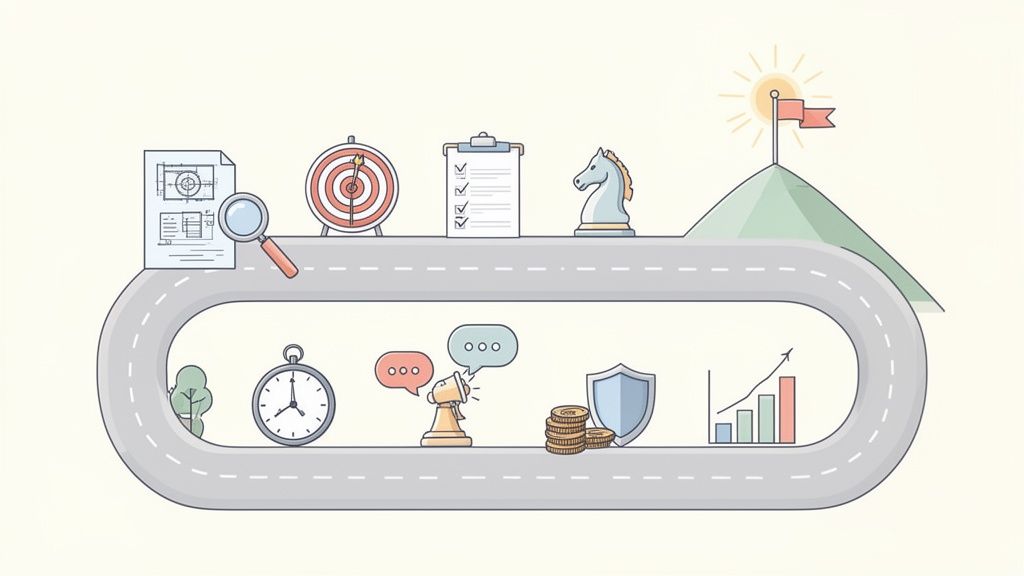
So, what exactly goes into a marketing plan? At its heart, it's the roadmap that directs every single one of your marketing efforts. The core pieces usually cover a deep dive into your market, a crystal-clear picture of your target audience, solid objectives, the big-picture strategies you'll use, and the specific tactics to make it all happen. Of course, you also need a budget and a way to measure what’s working.
Your Marketing Blueprint: Unpacking Each Key Component
Think of your marketing plan as the architectural blueprint for growing your business. If you start building without one, you're just guessing, hoping the walls line up and the roof doesn't leak. We're going to break down each critical component, turning what can feel like a daunting document into a clear, actionable guide. The goal is to build a strategy that’s both ambitious and firmly planted in reality.
A truly effective plan does more than just list a bunch of marketing activities. It creates a seamless connection between your high-level vision and the day-to-day work. This ensures every email, social media post, and ad campaign has a purpose and pushes you closer to your main business goals. The biggest win here is clarity—for you, your team, and any stakeholders. When all the pieces connect, your marketing transforms from a collection of random shots in the dark into a powerful, cohesive growth engine.
This flowchart shows that hierarchy perfectly, illustrating how your big goals trickle down into concrete tactics and, ultimately, measurable results.

What this really drives home is that a solid plan isn't just about what you're doing. It’s about how each part supports the next, creating a clear and logical path to success. We’ll dig into every component of a marketing plan one by one, giving you the tools to build a strategy that doesn’t just gather dust—it delivers real, tangible outcomes.
The Interconnected Nature of a Marketing Plan
None of these components exist in a vacuum. Your deep dive into the market (your market analysis) will tell you exactly who your target audience should be. Knowing that audience inside and out will then shape your messaging and dictate which channels you use to reach them. From there, these strategic choices naturally inform your budget and the key performance indicators (KPIs) you need to track.
A great marketing plan is a living document. It's not a 'set it and forget it' exercise. It's a dynamic guide that evolves with your market, your customers, and your business.
This interconnectedness is what makes a marketing plan so powerful. When you understand how each piece of the puzzle affects the others, you can build a strategy that's not just effective, but also resilient and ready to adapt.
2. Laying the Groundwork with Market Analysis
Before you can chart a course for the future, you have to get a firm grasp of where you stand right now. This is where market analysis comes in. Think of it as the surveyor's report for your business—it maps the terrain so you don't build your strategy on shaky ground. It’s all about swapping out risky assumptions for hard facts.
The process is a two-way street. First, you look inward to get an honest assessment of your own company's unique strengths and internal weaknesses. Then, you turn your gaze outward to scan the horizon for market opportunities you can jump on and potential threats you need to defend against.

Getting the Full Picture with a SWOT Analysis
One of the most straightforward yet effective tools for this job is the SWOT analysis. It’s a simple framework that helps you organize your thoughts into four key areas, giving you a complete snapshot of your situation.
- Strengths (Internal): What are you genuinely great at? This could be anything from a patent-protected technology and a rockstar team to incredible brand loyalty.
- Weaknesses (Internal): Where are the cracks? Be brutally honest. Maybe it's a tight budget, a small market share, or a missing feature in your product.
- Opportunities (External): What trends or market gaps can you take advantage of? Look for shifting customer needs, new technologies you can adopt, or an area your competitors are ignoring.
- Threats (External): What’s out there that could trip you up? This might be a new competitor, looming regulations, or a downturn in the market.
Running through this exercise gives you a clear lay of the land. You'll immediately see where you can double down on your advantages and where you need to build up your defenses.
Sizing Up the Competition
Beyond a general SWOT, you absolutely have to dig deep into your competitive landscape. Who are you up against? What do they sell, and how do they talk about it? This goes way beyond just looking at their products; you need to deconstruct their marketing playbooks. To build a solid plan, you need to learn how to conduct market analysis that properly sizes the market and benchmarks your position.
By putting your competitors under the microscope, you can spot the gaps they've missed. This is where you find underserved customers and unique angles to make your brand stand out.
For example, if everyone in your space is fighting a race to the bottom on price, you might see a huge opportunity to win by offering world-class customer service or a premium-quality product. Check out our guide on using a https://www.reachlabs.ai/competitor-analysis-framework/ for a more detailed, step-by-step approach. This kind of analysis is what keeps your marketing from becoming just more noise in an already crowded room.
3. Who Are You Talking To? Pinpointing Your Ideal Customer
If you try to market to everyone, you end up connecting with no one. It's the marketing equivalent of shouting into a packed stadium and hoping the right person happens to hear you. Great marketing, on the other hand, feels like a one-on-one conversation.
This is where you get crystal clear on exactly who you’re talking to. The first step is audience segmentation—a fancy term for a simple, powerful idea: breaking down your broad market into smaller, more manageable groups of people. Instead of a faceless crowd, you get well-defined clusters of people who share similar needs, habits, or characteristics.
This clarity changes everything.
From Vague Groups to Real People: Building Your Buyer Personas
Once you have your segments defined, it's time to bring them to life by creating buyer personas. A persona is a detailed, semi-fictional profile of your ideal customer, built from real data and solid market research. Think of it as creating a character sketch for the star of your brand's story.
This exercise forces you to step out of the spreadsheet and into your customer's shoes. You start to understand the why behind their decisions. You're no longer marketing to a generic "Female, 30-45"; you're speaking directly to "Startup Sarah," a tech-savvy founder who's short on time and desperately needs tools to simplify her team's workflow.
Getting this specific is what allows your messaging to actually resonate. In fact, a HubSpot study found that 51% of top marketers say refining their audience segmentation is their number-one priority for getting better results. For a deeper dive into this, check out our guide on what is audience segmentation.
To help you get started, let's look at the common ways to slice up a market.
Key Audience Segmentation Methods
Each method gives you a different lens through which to view your customers, and the most effective strategies often combine two or more.
| Segmentation Type | Description | Example |
|---|---|---|
| Demographic | Groups based on objective, statistical data. | "Men, aged 25-34, living in urban areas with an income over $75,000." |
| Psychographic | Groups based on personality, values, and lifestyle. | "Eco-conscious consumers who value sustainability and are willing to pay more for ethically sourced products." |
| Geographic | Groups based on physical location. | "Small businesses located in the Midwest that experience harsh winters." |
| Behavioral | Groups based on actions, habits, or product usage. | "Frequent online shoppers who have abandoned their cart in the last 7 days." |
Using these methods helps you move beyond assumptions and build your marketing on a foundation of real human insight.
How to Build a Buyer Persona That Actually Works
A useful persona is more than just a name and a stock photo. It’s a tool that helps you make smarter decisions across your entire marketing plan.
Your buyer persona is your north star. When you're stuck on a decision—from the channels you use to the subject line you write—just ask, "What would Sarah think of this?"
To build your own, you'll need to do some digging. Gather information from customer surveys, interviews, and your website analytics to fill in these crucial details:
- Demographics: Start with the basics—age, location, job title, and income. This gives you a foundational sketch.
- Goals & Motivations: What are they trying to achieve? What gets them out of bed in the morning? Is it a promotion, more family time, or mastering a new skill?
- Pain Points & Challenges: What's standing in their way? What problems keep them up at night? This is where your product or service becomes the solution.
- Communication Channels: Where do they hang out online? Are they glued to LinkedIn, listening to specific podcasts, or active in niche Facebook groups?
When you put in this work upfront, your marketing transforms. It stops being a guessing game and becomes a focused, strategic effort built on a genuine understanding of the people you’re trying to help.
4. Objectives and SMART Goals

If your market analysis is the map and your customer personas are your travel companions, then your goals are the destination. Without a clear destination, you’re just driving aimlessly. This is the part of your marketing plan where vague ambitions become concrete, actionable objectives that guide every single decision you make.
Too many marketing strategies fall apart because they’re built on fuzzy goals. Things like "get more leads" or "improve our social media presence" sound good in a meeting, but they don't provide the focus needed to get real results. To give your plan some teeth, you have to set goals that are specific, measurable, and tied to a deadline.
From Vague Ideas to Actionable Targets
The best way I’ve found to sharpen your objectives is by using the SMART framework. Think of it as a simple checklist that ensures every goal you set is clear, trackable, and actually helps your business move forward. Each letter gives your ideas a critical filter.
- Specific: What, exactly, do you want to accomplish? Who needs to be involved? Get rid of ambiguity.
- Measurable: How will you know you’ve won? You need numbers—how much, how many—to track your progress.
- Achievable: Be honest. Is this goal realistic with your current resources, time, and budget? It should be a stretch, but not a fantasy.
- Relevant: Why are you doing this? The goal must align with your bigger company objectives and what’s happening in your market.
- Time-bound: Every goal needs a finish line. A deadline creates urgency and keeps everyone focused.
Running your goals through this framework is what separates wishful thinking from strategic execution.
A goal without a plan is just a wish. The SMART framework is the tool that turns that wish into a detailed, step-by-step plan for success.
Putting SMART Goals Into Practice
Let's see how this works in the real world. We’ll take a common marketing ambition and transform it into a powerful, clear objective.
Vague Goal: We want to increase brand awareness.
SMART Goal: Increase organic brand name mentions on Twitter by 30% (from 50 to 65 mentions per month) by the end of Q3 by launching a targeted influencer collaboration campaign.
See the difference? Now let’s try one for lead generation.
Vague Goal: Get more webinar sign-ups.
SMART Goal: Generate 250 qualified marketing leads (MQLs) from our new "Advanced SEO Tactics" webinar series within the next six months.
Each of these refined goals gives your team a crystal-clear target. Everyone knows exactly what success looks like, how you’re going to measure it, and when it needs to happen. This clarity isn't just a nice-to-have; it's a fundamental piece of any marketing plan that actually drives growth.
Crafting Your Strategy and Tactical Plan
Alright, you've done the homework. You know your market, you’ve defined your ideal customer, and you've set clear goals. Now comes the fun part: building the machine that will actually get you there. This is where all that foundational research—your market analysis, those detailed personas, and your SMART objectives—comes together into a real plan of attack. We're moving from the "why" to the "how" and "what."
First, let's get one thing straight: strategy and tactics are not the same thing. I see them used interchangeably all the time, but they're fundamentally different.
Think of your strategy as the grand philosophy, your north star. It’s the big-picture answer to the question, "How are we going to win?" Are you going to be the go-to thought leader in your space? Or maybe you'll focus on building an unbeatable community around your brand. Perhaps you'll simply outspend everyone on paid ads. That's your strategy.
Your strategy is the game plan. Your tactics are the individual plays.
From High-Level Strategy to Ground-Level Tactics
Once you've settled on your overarching strategy, it’s time to break it down into a concrete tactical plan. This is where the rubber meets the road. If your strategy is to become a thought leader, your tactics are the specific things you’ll do to earn that title.
Here’s how you translate that big idea into action:
- Nail Your Core Messaging: What’s the one big idea you need to get across? It has to speak directly to your customer's biggest problem and show them exactly why you’re the solution.
- Pick Your Channels: Where does your audience actually hang out? Your research should tell you this. Don’t just jump on the newest shiny platform; be where your customers are, whether that's LinkedIn, niche forums, or their email inbox.
- Outline Your Campaigns: Bundle your tactics into focused campaigns. A single campaign isn't just one blog post; it might be a series of articles, a supporting webinar, and an email sequence designed to nurture leads from that content.
If a big part of your plan involves social media, it's worth digging into a solid social media marketing strategy playbook. It’s a beast of its own and deserves a dedicated approach.
A marketing strategy without a tactical plan is like a map without a route. You know your destination, but you have no idea which roads to take to get there.
An Example in Action
Let's make this real. Imagine a B2B software company with a SMART goal to generate 100 new qualified leads in Q4.
Strategy: They decide to use a content marketing strategy. Their big idea is to educate project managers on improving team productivity.
Tactics:
- Content Creation: Publish four deep-dive blog posts on advanced project management techniques.
- Lead Magnet: Create a downloadable ebook, "The Ultimate Productivity Checklist for Remote Teams," that people get in exchange for their email.
- Email Marketing: Set up a five-part automated email series for everyone who downloads the ebook. It will offer more tips and end with an invitation to a product demo.
- Social Promotion: Share snippets and key takeaways from the blog posts on LinkedIn to drive traffic and promote the ebook to their target audience.
See how that works? Every single tactic directly supports the strategy, which in turn is designed to hit that 100-lead goal. Nothing is random. This clear connection between goals, strategy, and daily tasks is the absolute core of an effective marketing plan.
8. Nail Down Your Budget and Measure What Matters

A brilliant strategy is just a nice-looking document without the fuel to make it go. This is where we get down to brass tacks and answer two make-or-break questions: how much will this all cost, and how will we know if any of it is actually working?
Getting your budget right gives your plan the resources it needs to succeed. Nailing your measurement, on the other hand, is how you prove your value and justify every dollar spent.
Setting a Realistic Marketing Budget
Your marketing budget isn't just a random number you pull out of a hat. It's a strategic allocation of capital that’s directly tied to hitting those SMART goals you just set. Let's look at a few common ways to figure out your number.
- Percentage of Revenue: This is the most straightforward method. You simply allocate a fixed percentage of the company’s revenue to marketing. For many businesses, this falls somewhere between 5% and 12%. It’s easy to calculate and scales up or down as the business grows.
- Objective-Based Costing: This is my personal favorite because it’s so strategic. You start with your goals and work backward. Want to generate 100 new leads a month? Figure out the cost of the ads, content, and tools needed to do that, and voilà—there's your budget.
- Competitor-Based Budgeting: This approach is all about keeping pace. You essentially try to spend in line with your direct competitors to hold onto your market share. It’s a decent benchmark, but it makes the dangerous assumption that your competitors know what they're doing.
For most small and mid-sized businesses, the best approach is a hybrid. Start with a percentage of revenue as a baseline, then refine that number based on your specific objectives.
Your budget is a direct reflection of your strategic priorities. Where you invest your money shows what you truly value and expect to achieve.
Once you’ve locked in your budget, the conversation immediately shifts to accountability. You have to prove that every dollar is pulling its weight and delivering a real return.
Measuring What Matters with KPIs
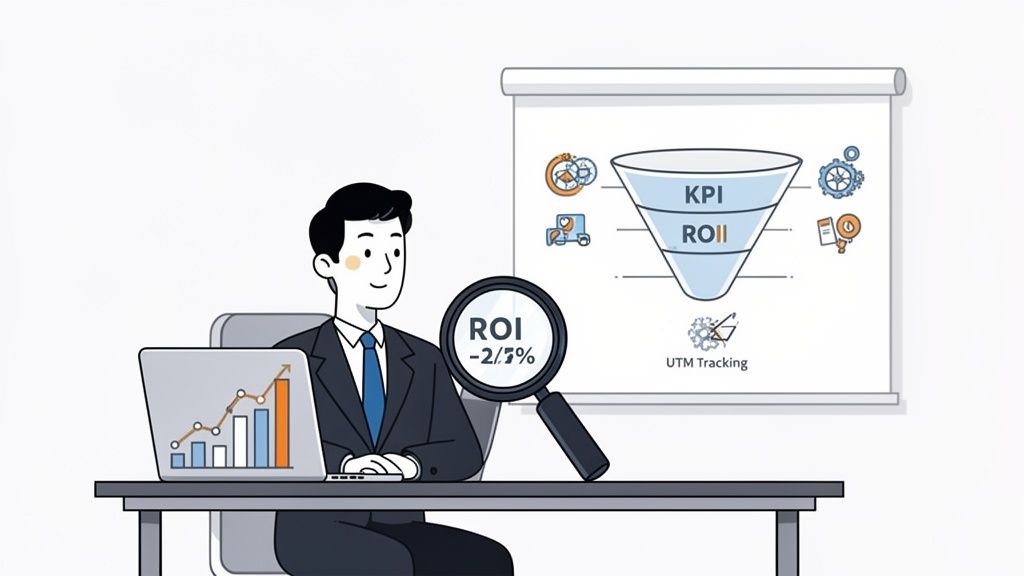
This is where your SMART goals get real. Key Performance Indicators (KPIs) are the specific, trackable numbers you’ll watch to see if you’re getting closer to your objectives. Think of them as the vital signs for your marketing health.
It's absolutely critical to pick the right KPIs. It’s easy to get distracted by vanity metrics—like social media likes—that feel good but don’t actually move the needle. You need to focus on data that ties directly to business outcomes, like leads, sales, and revenue.
If you really want to get granular, you should learn how to calculate marketing ROI to show the precise financial impact of your work.
To get you started, here’s a quick look at how you can tie common goals to the right metrics.
Matching KPIs to Marketing Goals
| Marketing Objective | Primary KPI | Secondary KPI |
|---|---|---|
| Increase Brand Awareness | Website Traffic & Direct Visits | Social Media Reach & Engagement |
| Generate New Leads | Cost Per Lead (CPL) | Conversion Rate (e.g., from form fills) |
| Boost Sales & Revenue | Customer Acquisition Cost (CAC) | Customer Lifetime Value (CLV) |
| Improve Customer Loyalty | Customer Churn Rate | Net Promoter Score (NPS) |
Consistently tracking these numbers creates a powerful feedback loop. You can see what’s working, what’s a waste of money, and where you need to pivot. This data-driven mindset turns your marketing plan from a static document into a living, breathing tool for growth.
Frequently Asked Questions About Marketing Plans
Even with the best roadmap, you’re bound to hit a few bumps or question a turn along the way. Let’s tackle some of the most common questions that come up when putting a marketing plan into practice.
How Often Should I Update My Marketing Plan?
Think of your marketing plan as a living, breathing guide, not a stone tablet. You’ll want to give it a major overhaul at least annually. This is your time to step back, look at the big picture, and set fresh, ambitious goals for the year ahead.
But don't just set it and forget it. I recommend quarterly check-ins to keep things on track. These shorter reviews are perfect for seeing what’s working, what isn't, and shifting your budget to chase new opportunities. The annual plan sets your destination; the quarterly check-ins are you adjusting the GPS to avoid traffic.
What Is The Most Important Component Of a Marketing Plan?
This is a tough one, as every piece is connected. But if I had to pick one foundational element, it would be your target audience and buyer personas. Hands down.
Why? Because everything else you do flows directly from understanding who your customer is.
- Your messaging: The language you use and the stories you tell.
- Your channels: The places you need to be to meet them.
- Your offers: The products or services you craft to solve their specific problems.
If your picture of the customer is fuzzy, the rest of your plan is just a shot in the dark. Nailing your audience is the pillar that supports the entire strategy.
How Can a Small Business Create a Plan on a Tight Budget?
A smaller budget doesn't sideline you; it just forces you to be more creative and disciplined. The secret is to ruthlessly prioritize activities that deliver the most bang for your buck.
Start by focusing on organic strategies like SEO and content marketing. These tactics take time, but they build valuable assets that pay dividends for years. Take advantage of the countless free tools out there for market research, social media management, and performance analytics. Get one or two things working really well before you even think about expanding.
A small budget forces ruthless prioritization. It makes you identify the single most effective action you can take and execute it flawlessly, which is a powerful discipline for any business.
At ReachLabs.ai, we specialize in building and executing data-driven marketing plans that deliver measurable growth without breaking the bank. Learn how our experts can build a strategy that moves the needle for your business.